Prioritize event venue amenities that keep guests comfortable and vendors working: dependable audiovisual equipment, power, climate control, accessible routes, and clearly assigned staffing. With audiovisual needs identified as a major expense by 66% of planners, technical inclusions deserve scrutiny before decorative extras.
You're comparing beautiful properties, trying to understand what the rental price covers, and wondering whether a longer inclusion list means an easier event. The useful question isn't how many amenities a venue advertises. It's which problems those amenities solve, who operates them, and what happens when the original plan changes.
Table of Contents
- Why Amenities Decide How the Day Actually Feels
- Defining Event Venue Amenities in Functional Terms
- How Amenities Differ Across Venue Types
- The Production Stack Audio Visual Power and Climate
- Service and Staffing Amenities Behind the Scenes
- Accessibility as an End-to-End Guest Experience
- The Buyer's Amenity Checklist Before You Tour
- Putting It All Together Before You Book
Why Amenities Decide How the Day Actually Feels
On the morning of an event, vendors arrive while a coordinator searches for an extension cord. The catering van stops across the parking lot because nobody identified a service entrance, and the wedding party asks where they're supposed to get dressed.
That's an illustrative scenario, not an inevitable disaster. But it exposes the difference between a property that photographs well and a property your team can operate without improvising.
Event venue amenities are working infrastructure. A dressing suite protects preparation time. A service entrance keeps equipment carts out of guest traffic. A usable indoor alternative gives the coordinator somewhere to move the ceremony when outdoor conditions become unsuitable.
Translate the brochure into tasks
Start with the language venues use, then ask what your team can do.
- Complimentary parking: Where do guests park, where do vendors unload, and who directs arrivals?
- Climate-controlled hall: Can staff adjust conditions during setup, dinner, and dancing?
- Full bar: Does that mean a built-in counter, beverage service, staffing, glassware, or some combination?
- On-site support: Who is present, what decisions can they make, and when does their responsibility end?
Don't accept an adjective where you need an operating answer. Spacious, flexible, and convenient aren't specifications.
Practical rule: If an amenity matters to your timeline, ask someone to demonstrate how it works.
The economic context reinforces why these details deserve serious attention. U.S. meetings generated approximately $325 billion in direct spending in 2016, according to the meetings industry economic-impact analysis published by ICCA. That historical figure isn't a forecast for your event, but it puts venue infrastructure in perspective: these spaces support substantial work across hospitality, transportation, catering, and production.
Put amenity questions into your initial shortlist, not your post-deposit planning session. If an essential capability is missing, you need time to price the workaround, find the right vendor, or choose another property. Discovering the gap after committing limits your options.
Defining Event Venue Amenities in Functional Terms
A useful definition is simple: event venue amenities are the spaces, equipment, permissions, and services that let people deliver the event. Treat them as a toolbelt, not a collection of perks.
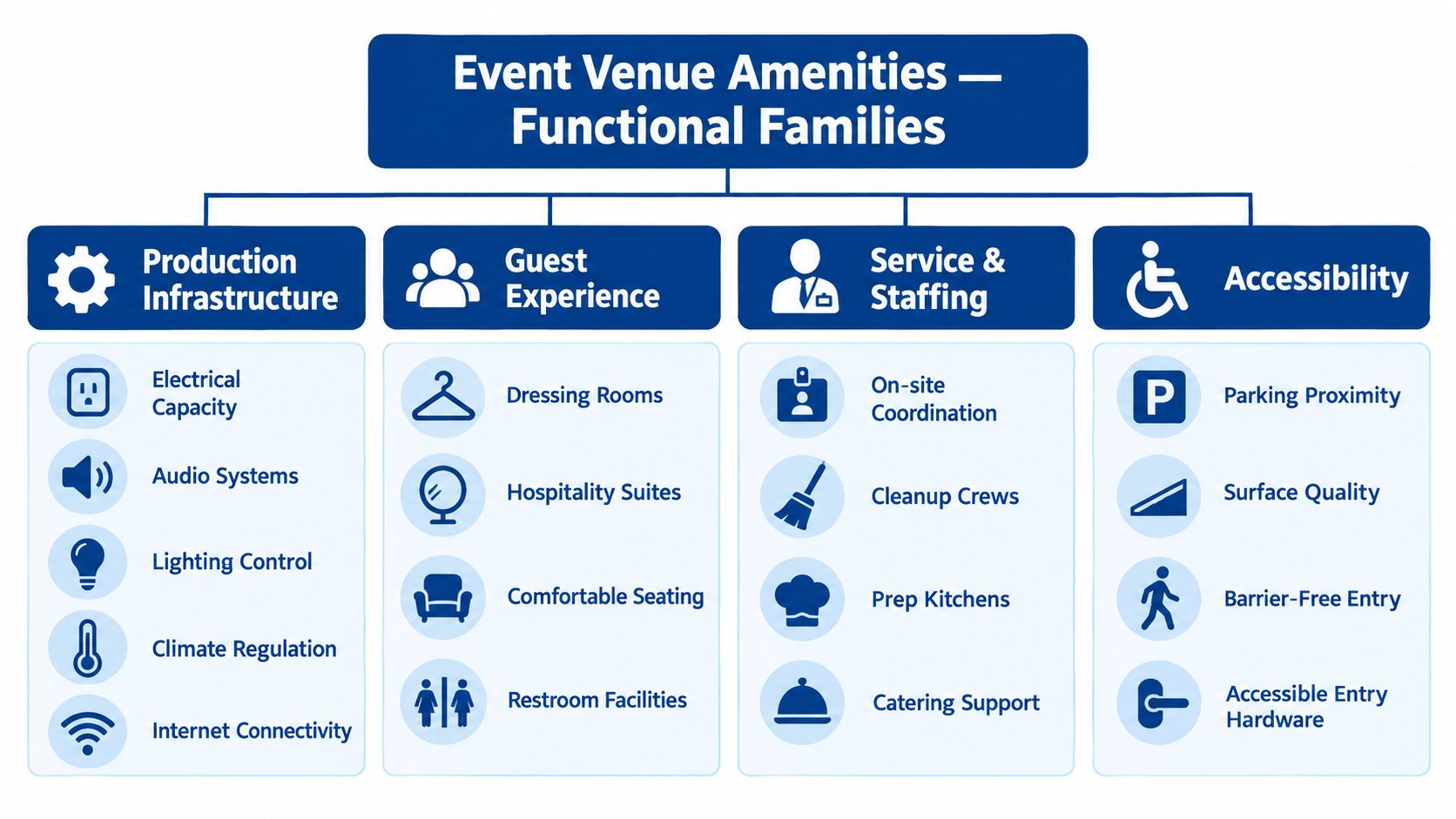
I organize that toolbelt into production infrastructure, guest experience, logistics, and service. Accessibility belongs across every family, because a feature isn't useful if a guest or vendor can't reach or use it.
Give each amenity a job
Production infrastructure includes electricity, sound, lighting, climate systems, and connectivity. Its job is to support what people need to hear, see, operate, and communicate. A microphone belongs here, but so does the power supply serving the presentation equipment.
Guest experience covers dressing areas, restrooms, comfortable seating, arrival spaces, and movement between activities. Evaluate these features from a guest's position rather than from the doorway during an empty-room tour.
Logistics includes delivery access, preparation areas, furniture inventory, storage, and usable layouts. A beautiful room can still be awkward to operate if caterers have nowhere to stage trays or rental crews can't store empty cases.
Service determines who turns those physical resources into a functioning event. Management, cleanup, vendor permissions, operating hours, and escalation procedures belong in this family.
Distinguish availability from usability
Use a simple test when reviewing an inclusion:
- Present: Does the feature exist in the specific space you're renting?
- Usable: Does it suit your event format, equipment, and guest needs?
- Supported: Who prepares it, operates it, and resolves problems?
- Included: Is its use covered by the quoted agreement?
A prep kitchen illustrates the distinction. The room may exist, yet your caterer still needs to confirm appliances, refrigeration, permitted activities, and access arrangements. Don't translate “kitchen” into “full cooking capability” without checking.
The same applies to furniture. Included tables are useful only when their dimensions, condition, quantities, and layout suit your meal service. Name the job first, then judge whether the amenity performs it.
How Amenities Differ Across Venue Types
Choose the venue model before getting attached to a particular package. A hotel, standalone ballroom, multi-hall property, and rural estate can all accommodate a celebration, but you shouldn't evaluate them with identical assumptions.
The comparison below is a touring framework, not a promise about every property. Each cell identifies what to investigate rather than declaring that a venue category automatically includes it.
Amenity Coverage by Venue Type
| Amenity Category | Ballroom | Hotel Venue | Multi-Hall Property | Outdoor / Estate |
|---|---|---|---|---|
| Parking | Check dedicated allocation | Clarify guest and overnight use | Separate hall-specific and shared areas | Inspect surfaces and arrival routes |
| Dressing suites | Confirm private preparation space | Separate guestrooms from event inclusions | Verify suites assigned to your hall | Confirm indoor preparation facilities |
| A/V inventory | Request room-specific equipment | Clarify equipment and technician charges | Identify systems assigned to each hall | Verify outdoor coverage and protection |
| Outside vendors | Review approvals and restrictions | Confirm catering and production rules | Establish delivery and shared-access rules | Check vendor infrastructure requirements |
| Cleanup | Define room reset responsibilities | Separate banquet service from teardown | Confirm responsibility within your rental | Include grounds and temporary equipment |
A ballroom deserves close attention when your event depends on a contained indoor layout. A hotel deserves consideration when lodging and event activities need to connect. Neither choice removes the need to inspect the actual room, service route, or contract.
For a multi-hall Hill Country property, focus on boundaries. Which parking areas, entrances, outdoor spaces, and preparation rooms belong to your booking? Ask how staff prevent deliveries, signage, and arriving guests from drifting toward another event.
Match the property to your compromises
An outdoor estate may suit your desired atmosphere while requiring more coordination around terrain, temporary infrastructure, and weather decisions. Don't treat those requirements as flaws. Treat them as work that needs an owner and a budget.
Hotels and other hospitality-led spaces also warrant a conversation about guest connectivity and network administration. For your technical team's review, Purple Shield for hospitality venues is a relevant vendor resource, not evidence that a particular venue has deployed it.
Your choice should reflect the kind of work you're prepared to manage. Don't pay for a heavily serviced package you won't use, but don't choose a lightly equipped property and assume your vendors will absorb the missing infrastructure.
The Production Stack Audio Visual Power and Climate
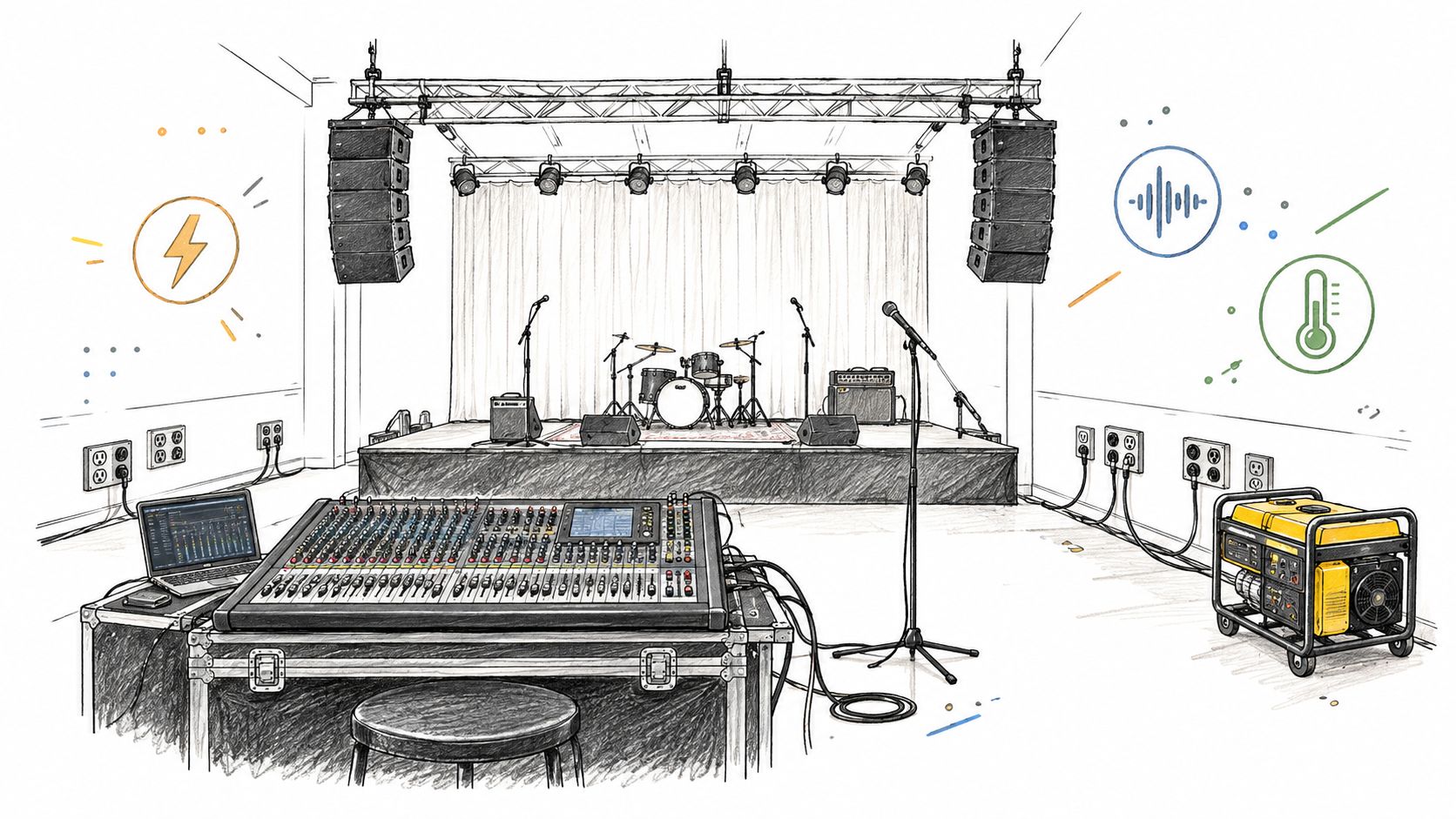
Test the production stack before signing. A list containing speakers, Wi-Fi, and air conditioning tells you very little about whether your ceremony, presentation, or entertainment will work as planned.
The PCMA reporting on event investment and planning costs identifies audiovisual needs as a major expense for 66% of planners, while 73% of organizations were investing in event technology. The buying lesson is straightforward: clarify what's included before your production vendor quotes additional equipment.
Follow the signal and the electricity
Ask staff to demonstrate the microphone from the actual speaking position while someone listens at the farthest guest location. For outdoor use, check speaker placement, intelligibility, and the plan for protecting equipment.
Bluetooth can be convenient for background music. Don't let that convenience substitute for your DJ's or production technician's confirmation of compatible connections.
- Power: Ask for outlet locations and circuit information your vendors can review. Identify what shares a supply with catering or entertainment.
- Backup: Establish which failures the venue can address and which require rented equipment or an outside technician.
- Lighting: Test presentation visibility, room dimming, and the transition from dinner to dancing.
- Internet: Test where the livestream or presentation will happen, not merely beside the office router.
If temporary connectivity might be needed, ask your production team to evaluate options such as Splash Access's Meraki-powered temporary internet. Confirm site suitability, power, support, and backup arrangements before relying on any proposed solution.
Check comfort under event conditions
For a Texas summer event, don't judge cooling from a briefly opened, lightly occupied hall. Ask how the venue prepares the room, who controls the thermostat, and what happens when service doors remain active during setup.
Review the property's indoor climate-control information alongside your expected room layout and schedule. Separate dressing rooms, kitchens, and reception areas may require different operating decisions.
Don't buy technical capability by adjective. Buy it by demonstration, specification, and assigned responsibility.
Photograph connections and equipment labels with permission. Have the relevant vendors approve the setup, then attach the agreed inventory, support arrangements, and limitations to your booking documentation.
Service and Staffing Amenities Behind the Scenes
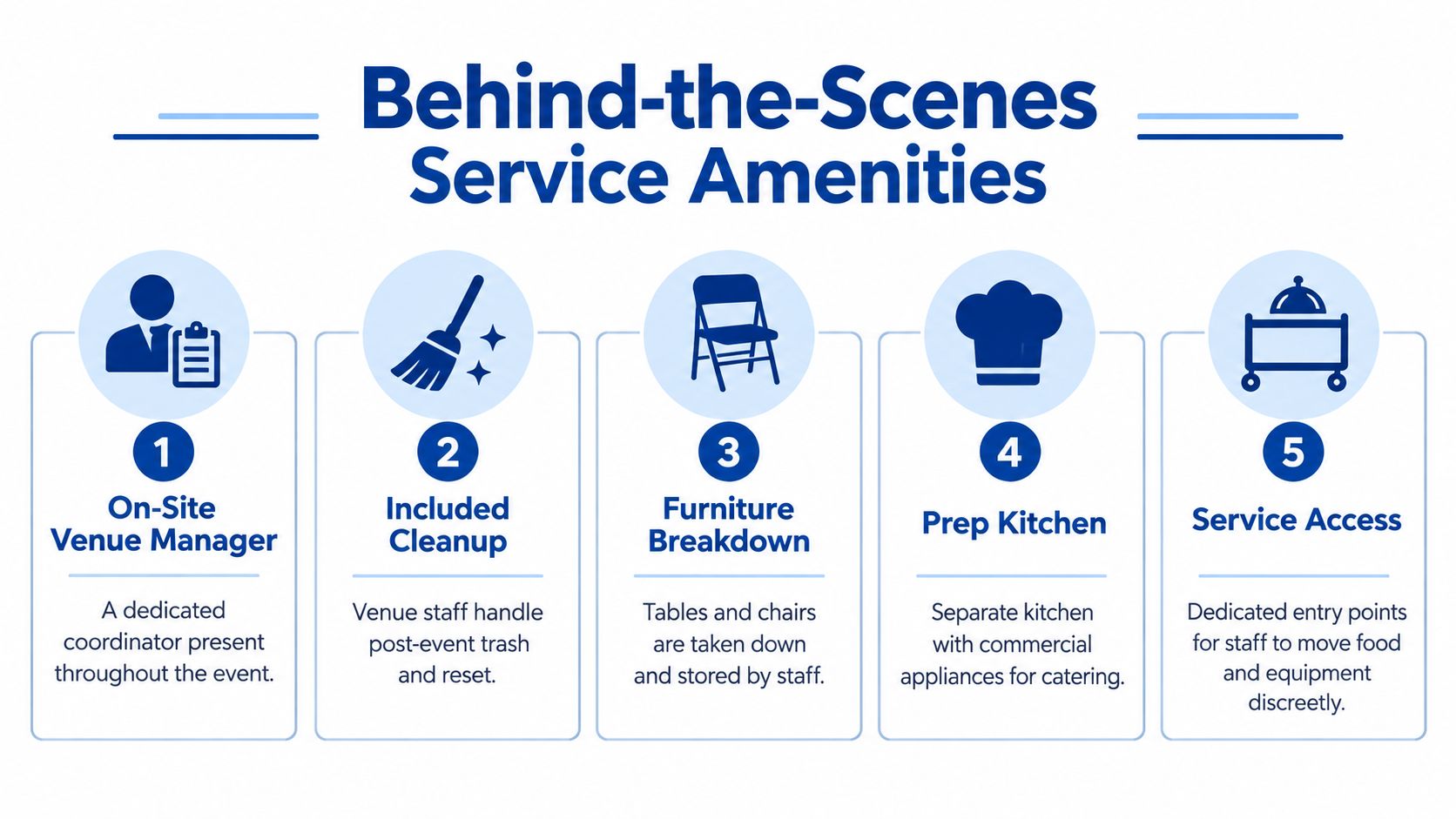
A venue manager, wedding coordinator, catering captain, and production technician perform different jobs. Don't assume an on-site manager will cue your ceremony, supervise catering staff, or troubleshoot a livestream unless the agreement assigns those duties.
Ask who unlocks the building, authorizes layout changes, handles facility issues, and answers vendor questions. Then establish who takes over if that person becomes unavailable.
Price the work, not just the room
The attractive base price isn't the full comparison. Build a responsibility sheet that identifies the person performing each task and any separate charge.
| Task | Question to resolve |
|---|---|
| Furniture setup | Who places tables and chairs before vendors arrive? |
| Ceremony reset | Who moves furniture, and when can they start? |
| Cleanup | Does coverage include trash, spills, kitchen areas, and grounds? |
| Breakdown | Who stores venue furniture and handles outside rentals? |
| Final departure | What must vendors complete before access ends? |
A longer exclusive rental window can give vendors more room to sequence their work than a compressed booking. But extra access isn't automatically useful staffing time. Confirm when management, security, bartending, and other services begin and end.
Don't assume cleanup includes removing decorations or packing personal belongings. Those jobs need named owners too.
Examine the rules that affect your suppliers
An outside-caterer policy offers choice, but the caterer still needs to approve the prep kitchen and service route. Request appliance details and clarify whether food preparation, cooking, warming, or plating is permitted.
A bring-your-own-beverages arrangement also needs an operating plan. Ask about approved bartenders, delivery, refrigeration, ice, glassware, service restrictions, and removal of leftovers.
For any quoted package, request the following in writing:
- Furniture inventory: Itemized quantities and dimensions, not just “tables and chairs.”
- Total pricing: A clear statement of taxes, gratuities, required services, and possible additional charges.
- Vendor permissions: Approval procedures, delivery conditions, and responsibilities for damage.
- Access terms: Setup, celebration, breakdown, and final collection requirements.
These details let you compare a venue with included management and teardown against a cheaper room that requires additional labor. Compare the completed operating plan, not isolated rental prices.
Accessibility as an End-to-End Guest Experience
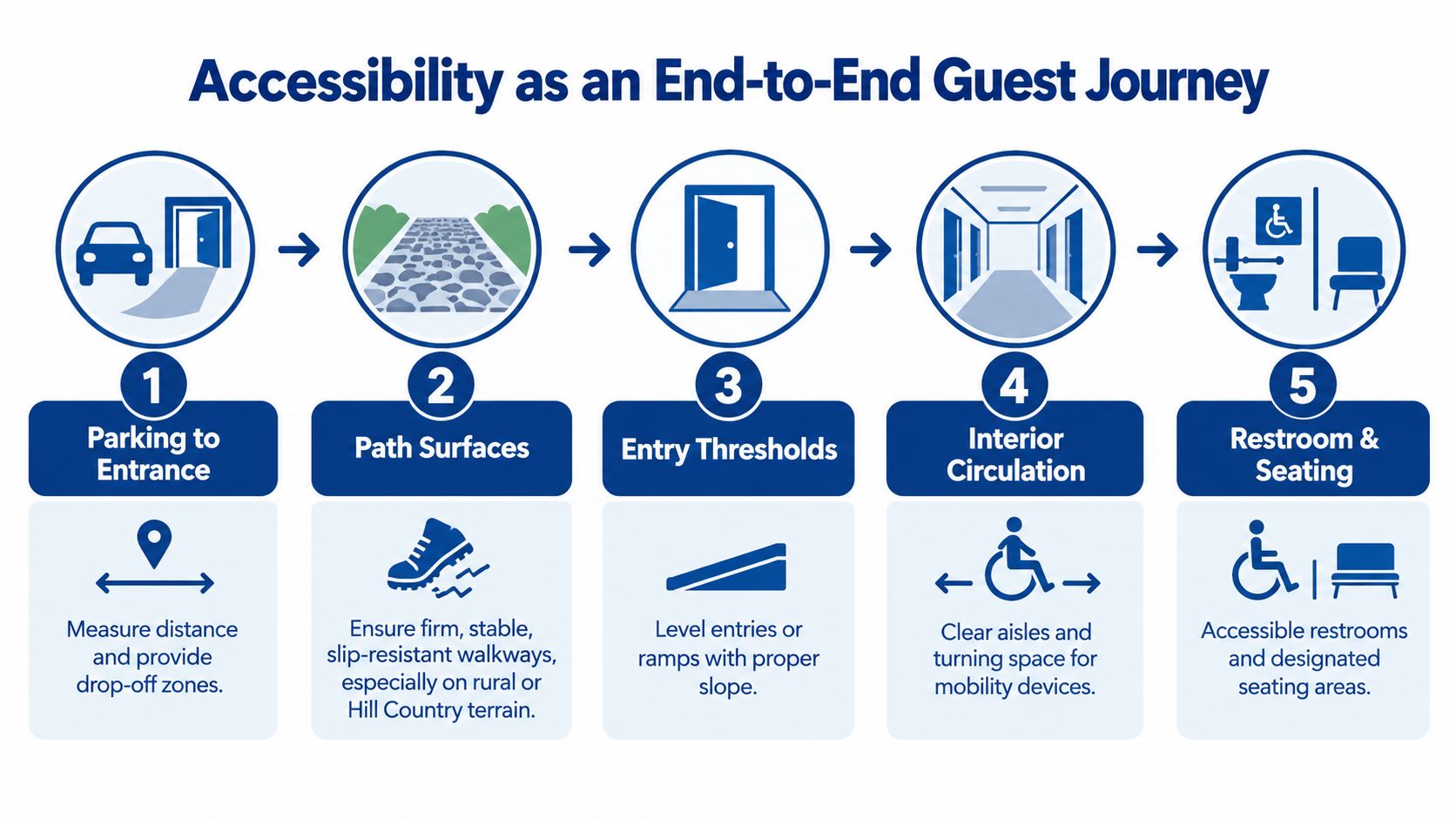
An accessible entrance doesn't prove that guests can participate throughout the event. They still need to reach the ceremony, use the restroom, approach the bar, find a seat, and leave comfortably.
Industry reporting states that 52% of disabled people struggle to attend live events because of accessibility issues, while accessible venues and public-transport access remain selection priorities, according to Conference News's discussion of event-industry accessibility challenges. Treat accessibility as a guest journey, not a parking designation.
Walk the route guests will actually use
Begin at the arrival point and follow the full itinerary. On rural and Hill Country grounds, inspect grass, gravel, slopes, bridges, thresholds, and the distance between activities.
An outdoor setting can introduce barriers that aren't apparent in ceremony photographs. A route that looks manageable during a dry daytime visit still needs assessment for wet conditions, evening lighting, and guests with limited stamina.
- Mobility: Ask staff to document step-free routes, surface conditions, doorway access, and restroom arrangements.
- Stamina: Identify drop-off options, resting places, and seating during standing receptions.
- Hearing: Plan for interpreters, captions, sightlines, and intelligible announcements.
- Vision: Review route lighting, readable signage, and assistance arrangements.
- Sensory needs: Identify a quieter area and explain how guests can reach it.
Use published accessibility features as a starting point for questions, not as a substitute for the walkthrough.
Ask for documentation without making assumptions
Request a route map, relevant measurements, and photographs of potential obstacles. Ask how the route changes if the ceremony moves indoors or vehicles can't use the preferred drop-off location.
Guest-first standard: Nobody should have to discover an avoidable barrier after arriving dressed for your celebration.
Invite guests to share accommodation needs privately, without requiring them to explain a diagnosis. Then confirm arrangements with the people who will use them rather than guessing what assistance they want.
Don't promise an accommodation just because the venue says it should be possible. Assign responsibility, verify equipment or staffing, and communicate the practical details before guests arrive.
The Buyer's Amenity Checklist Before You Tour
Bring a checklist that records evidence, not impressions. Use the property's venue inspection checklist alongside the questions below, and leave space for an owner, document, or follow-up beside every unresolved item.
Initial research and site visit
- Define nonnegotiables: Which missing capability would force a different venue or substantial outside support? Remove unsuitable properties before spending time on decorative comparisons.
- Schedule access: Request a tour appointment rather than assuming you can drop in. Ask to see the spaces and routes your event will use.
- Request a working layout: Can staff show dining, entertainment, service, and guest circulation together? A room-capacity statement alone won't answer that.
- Inspect the fallback: Where does each outdoor activity move, and who approves the change? Resolve the decision process before weather becomes urgent.
For a corporate event with specific guest-network requirements, have your network administrator review Purple's OpenRoaming standard for network admins. Use it to inform technical questions, not to assume the venue supports that approach.
Contract review and final preparations
- Attach the evidence: Does the agreement identify the rented spaces, equipment, inventory, access, and service responsibilities? Resolve verbal promises before paying.
- Review exclusions: Which charges or tasks remain outside the quote? Look especially for unassigned resets, collections, and labor.
- Coordinate before the final month: Have vendors confirmed delivery instructions and their own requirements? Escalate conflicts while changes are still practical.
- Reconfirm during event week: Who holds the final layout, contact sheet, and contingency decisions? Make sure everyone works from the same version.
Treat vague A/V descriptions, undocumented manager coverage, and unexplained small-print charges as unresolved risks. A shared thermostat also deserves investigation if your activities require different conditions across the building.
Walk away when the venue won't document an essential promise. You're buying permission and support to run an event, not merely access to an attractive room.
Putting It All Together Before You Book
Choose the property your team can operate confidently. A striking view or elaborate entrance can support the atmosphere, but neither compensates for an unresolved dependency that affects guests or vendors.
Before you commit, take these actions:
- Audit your risk profile: Identify the weather exposure, vendor mix, accommodation requirements, and technical dependencies that matter to your event.
- Prioritize by function: Rank production, guest experience, logistics, and service against those needs. Don't give every brochure feature equal weight.
- Complete the guest walkthrough: Assess the actual itinerary and fallback arrangements, not just the main entrance.
- Document the operating agreement: Resolve access, management, cleanup, and supplier responsibilities while you still have negotiating room.
- Compare total operational value: Include outside equipment, additional labor, and the coordination required to fill gaps.
Clear documentation won't eliminate every unexpected moment. It gives your coordinator and suppliers a shared basis for responding without asking you to make avoidable decisions during the celebration.
Put your next tour on the calendar and send your priority questions ahead of it. Arrive ready to test, photograph, and confirm. Amenities aren't extras when your event depends on them.
Texas Old Town offers indoor halls and outdoor ceremony settings, with on-site management, prep kitchens, dressing suites, and included cleanup and furniture breakdown. Visit Texas Old Town to arrange a tour, bring your amenity checklist, and review how the selected space would support your vendors, guests, and contingency plan.