Texas Old Town's four halls run from $1,500 to $7,500 before extras, and the national average reception venue spend for couples married in 2025 was about $12,900. That spread is the whole story of wedding hall rental cost in Central Texas: the sticker on the hall is a starting position, not a total.
The most popular advice in every planning group is to budget the national venue average and pick the hall that comes in under it. That advice breaks the moment you use it. A hall quoted at $1,500 with no furniture and a four-hour window and a hall quoted at $3,500 with tables, cleanup and a full day of access are not the same purchase at two prices, and ranking them by rental fee ranks them wrong. Rank them by total contracted cost per expected guest and the order changes.
Table of Contents
- What a Wedding Hall Costs in Central Texas
- What the Quoted Price Actually Includes
- How Guest Count Changes Cost per Guest
- How Day, Hours and Season Change the Price
- Why Published Venue Averages Disagree
- How to Build a Realistic Hall Budget
- Compare Three Quotes Before You Sign
What a Wedding Hall Costs in Central Texas
Texas Old Town's halls fall into four price tiers, and the spread is tighter than many couples expect. Redbud Hall ranges from $1,500 to $5,000 and holds up to 150 guests in an 81'4" x 39'10" space. Tejas Hall ranges from $2,000 to $5,750 for up to 320 guests. Sage Hall ranges from $2,250 to $6,500 for up to 300 guests. Stone Hall ranges from $2,750 to $7,500 for up to 300 guests.
Those ranges need context before they can rank anything. A hall's quoted fee reflects its capacity tier, the day of the week, and what the rental already covers. Each of the four private venues is priced differently depending on the day of the week, so a Saturday quote and a Tuesday quote for the same room are different data points. A guest list of 220 removes Redbud from consideration before price enters the decision.
The national reference point is much higher. The Knot reported an average U.S. wedding venue cost of $12,900 for couples married in 2025, based on its 2026 Real Weddings Study (Aisle's guide to wedding venue costs). All four Texas Old Town ranges sit below that figure at their high end. That gap matters, but it does not make the local halls interchangeable.
| Hall | Max guests | Price range | Included in base price |
|---|---|---|---|
| Redbud Hall | 150 | $1,500–$5,000 | Furniture and cleanup/tear down |
| Tejas Hall | 320 | $2,000–$5,750 | Reception tables and chairs per published furniture counts |
| Sage Hall | 300 | $2,250–$6,500 | 300 white padded ceremony chairs, 300 dark resin reception chairs, outdoor tree swing |
| Stone Hall | 300 | $2,750–$7,500 | Reception tables and chairs, private garden ceremony site, cleanup and breakdown |
The practical conclusion is simple. A lower sticker price can still be the better buy when it carries more of the event, but only after the guest count fits the room. Judge each quote against its own range, capacity and inclusions, then convert it into a total contracted cost per expected guest. That method gives Central Texas couples a fairer ranking than a national average can provide.
What the Quoted Price Actually Includes
A rental quote only becomes useful once the included services are visible. Self's guide to average wedding costs reports that 57% of couples encountered a mandatory service charge, commonly adding 18% to 25% to the bill. It also reports that 74% of couples had rentals included in their venue arrangement, while only 7% paid for space alone. Those figures explain why a higher base quote can produce the lower total. A room with furniture, staffing and cleanup inside it can beat a cheaper-looking quote that leaves each piece to the couple.
Texas Old Town's pricing is structured to make the total easier to read. The price quoted is the price the customer pays, including sales tax and gratuity. Redbud Hall ranges from $1,500 to $5,000, and that rental price includes furniture and cleanup and tear down. Tables and chairs come with the reception hall, while linens are not provided. A non-refundable deposit of 25% of the contract amount is required to hold the reservation.
That difference matters because service charges change the comparison. A large mandatory percentage can turn a mid-range quote into a much larger contract, even before tax appears as a separate line. When tax and gratuity are already included, the quoted figure works as the contract benchmark. When they are added later, the top line stops being comparable.
The access window belongs in the same calculation as furniture and tax. Each venue rental includes a 16-hour rental from 8 a.m. to midnight, covering setup, ceremony, reception and breakdown inside one contracted period. Redbud Hall wedding clients have had venue access from 8 AM until midnight. That structure reduces the chance of paying separately for early decorating or late strike work.
Ask for a written line-item quote covering each of these, then compare the answers side by side:
- Facility rental and ceremony-site access. Each of the four wedding venues has a dedicated, private outdoor ceremony site. The indoor reception hall can also be used for the ceremony if preferred.
- Tables, chairs and linens. Texas Old Town provides chairs and tables for the reception hall but does not provide linens.
- Setup, cleanup, staffing and security. Cleanup and furniture breakdown are included in the Redbud Hall rental price. Confirm how other venues treat each item.
- Overtime, catering requirements, bar service, corkage and cake cutting. These small lines can change the final total even when the base rental looks similar.
| Line item | Typical treatment | What to ask |
|---|---|---|
| Ceremony site access | Dedicated private outdoor ceremony site with each hall | Confirm exclusive use of the ceremony site |
| Tables and chairs | Included per published furniture counts | Confirm counts match your guest list |
| Linens | Not provided | Budget linens as a separate line |
| Setup and breakdown | Cleanup and furniture breakdown included in Redbud Hall | Confirm the access window covers setup |
| Sales tax and gratuity | Included in the quoted price | Ask whether other venues add these on top |
| Mandatory service charge | Not added on top of the quoted price | Ask for the percentage in writing before comparing totals |
| Overtime and security | Setup, ceremony, reception and breakdown fit inside the 16-hour window | Ask for the hourly overtime rate and any security requirement |
| Bar service | Host-provided beverages with an approved bartending company | Ask for the approved vendor list and any corkage or per-bottle fees |
Furniture counts deserve their own check. Redbud Hall includes 150 folding white padded ceremony chairs and 150 folding dark resin padded reception chairs. Sage Hall includes 300 folding white padded ceremony chairs, 300 folding dark resin padded reception chairs, and an outdoor tree swing. Couples and hosts can choose their own vendors and customize their day and décor, so the quote should be read alongside the actual event plan.
The wedding venue amenities page lists the furniture counts and equipment that come with the room. Before any tour, work through this checklist of what to ask before booking so the answers you collect from each venue line up.
How Guest Count Changes Cost per Guest
Venue pricing doesn't scale linearly with headcount. Reported averages run about $6,500 for weddings of 1 to 50 guests, $10,400 for 51 to 100 guests, and $16,000 for more than 100 guests, because larger events carry more seating, restrooms, parking, service circulation, ceremony infrastructure and staff (My Venue HQ on how wedding venues price). The jump from the smallest tier to the largest is roughly two and a half times the spend, not a gentle slope.
Dividing each hall's range by its maximum capacity shows where the value sits.
| Hall | Max guests | Price range | Cost per maximum-capacity guest |
|---|---|---|---|
| Redbud Hall | 150 | $1,500–$5,000 | $10.00–$33.33 |
| Tejas Hall | 320 | $2,000–$5,750 | $6.25–$17.97 |
| Sage Hall | 300 | $2,250–$6,500 | $7.50–$21.67 |
| Stone Hall | 300 | $2,750–$7,500 | $9.17–$25.00 |
The trap is in the denominator. Those figures divide by capacity, and you don't pay for capacity, you pay for attendance. A 100-guest wedding in Tejas at $2,000 costs $20 per guest, not $6.25, because a third of the hall stays empty. The number is still useful, just not the way most couples read it.
The divisor that matters: always divide the room fee by the guests you expect to attend, not the guests the room can hold. The capacity figure tells you whether the hall fits. The attendance figure tells you what it costs.
Run three attendance tiers against the same fee and the shape becomes obvious. At 75 guests, Redbud's $1,500 entry price is $20 per guest. At 150 guests, that same $1,500 is $10 per guest, because the fixed fee is spread across everyone in the room. At 300 guests, Redbud is out of capacity entirely; Tejas at $2,000 divides to $6.67 per guest, and Sage at $2,250 divides to $7.50.
What doesn't fall is the rest of the bill. Catering and bar are priced per head, so every added guest multiplies them while the hall fee stays flat. That's the central trade-off between downsizing and choosing a larger hall: cutting 50 guests cuts per-person costs and leaves the room fee untouched, while moving up a capacity tier adds space without adding a per-head charge. Tejas is the only hall that seats above 300, so a list past 300 has one answer here. If you're closer to the middle of the range, our venues for 150 guests show how the smaller halls lay out at that count.
How Day, Hours and Season Change the Price
A Tuesday quote and a Friday quote for the same hall can sit at different points in the range. Each of the four private venues is priced differently depending on the day of the week, so the calendar changes the starting number before décor, guest count or vendor choices enter the calculation. Treat the day of the week as one of the first cost drivers to test.
The benchmark you compare against also needs a date label. Great Event reported U.S. couples' average reception venue spend at $12,200 for 2024–2025 (Great Event's wedding venue cost guide). That figure helps frame national spending, but it does not replace a venue's own price range for the date you want.
Hours change the value of the quote more than many couples expect. A short window compresses setup, ceremony, photographs, dinner, dancing and breakdown, which creates schedule pressure and can leave little room for delays. Texas Old Town venue rentals include a 16-hour rental from 8 a.m. to midnight, with wedding clients at Redbud Hall having had venue access from 8 AM until midnight. That structure lets couples compare quotes by what the contracted period covers, rather than by the room fee alone.
Early decorating changes the arithmetic. A $750 rehearsal dinner booking allows early decorating when the space is still available 90 days before the event. For a family handling its own décor, that option can reduce the need for a separate morning setup window.
Seasonal pricing varies by venue, so ask each venue for its season-by-season rate list in writing. The same question applies to inflation: Evernote reported that 85% of engaged couples said inflation affected or would affect their planning (Evernote's wedding cost guide). A price that looks manageable on a calendar date can still become the wrong choice if the hours are tight or the setup window creates extra work.
Test any date with four questions: which day of the week it falls on, how many hours the price includes, what overtime costs per hour, and whether a rehearsal or off-peak date prices differently. A cheap date that compresses your schedule isn't cheap.
Why Published Venue Averages Disagree
Published venue averages disagree because they answer different questions. A national figure can describe what couples report spending on a reception venue, while another figure can describe a venue fee alone. That gap matters when a Central Texas hall quote already includes chairs, tables, access hours and cleanup. The useful comparison is the one that matches the lines in front of you.
The Knot's series shows how much the benchmark year changes the result. Reported averages run $9,000 in 2016, $10,500 in 2019, $10,700 in 2021, $11,200 in 2022, $12,800 in 2023, $12,200 in 2024 and $12,900 in 2025, a $3,900 increase, or about 43.3%, across nine years with no 2020 value and visible year-to-year swings (The Knot's average reception venue cost). A benchmark borrowed from 2019 can therefore understate a current quote.
The scope gap is just as important as the year. Nearlywed reports an approximate $7,900 figure for 2025, tied to U.S. wedding venue cost (Nearlywed's venue cost report). The Knot's 2025 figure sits much higher because it tracks reception venue spending. One number can sit closer to a site fee. The other sits closer to the reception space as couples buy it, with rentals and services attached.
| Source | Year | Figure | Scope |
|---|---|---|---|
| The Knot series | 2016 to 2025 | $9,000 rising to $12,900 | Reception venue spending |
| The Knot Real Weddings Study | 2025 | $12,900 | Reception venue |
| Nearlywed Magazine | 2025 | $7,900 | Venue cost, published as one national average |
| Zola | 2025 | About 17% of total spending | Venue fee alone |
| The Knot budget breakdown | 2025 | About 29% of total spending | Venue and rentals |
This table is a scope map, not a price list. Treat the $7,900 figure as a broad venue-cost benchmark, not a target for a private hall with furniture included. Treat the $12,900 figure as a reception-spending benchmark, useful when your quote covers the room and the event setup around it. A percentage share works differently again, because it depends on total wedding spending.
Match the benchmark's scope to your quote before judging the number. A bundled quote that includes furniture, ceremony access, cleanup and tax should be checked against a bundled figure. A bare-space quote should be checked against a venue-only figure. Mixing the two flatters whichever number supports the first conclusion.
A national average can tell you whether a quote is plausible. It can't tell you what a hall in Kyle should cost on a Saturday in October. For that, rank the actual contracted total by expected guest count, using the capacity tier your guest list needs.
How to Build a Realistic Hall Budget
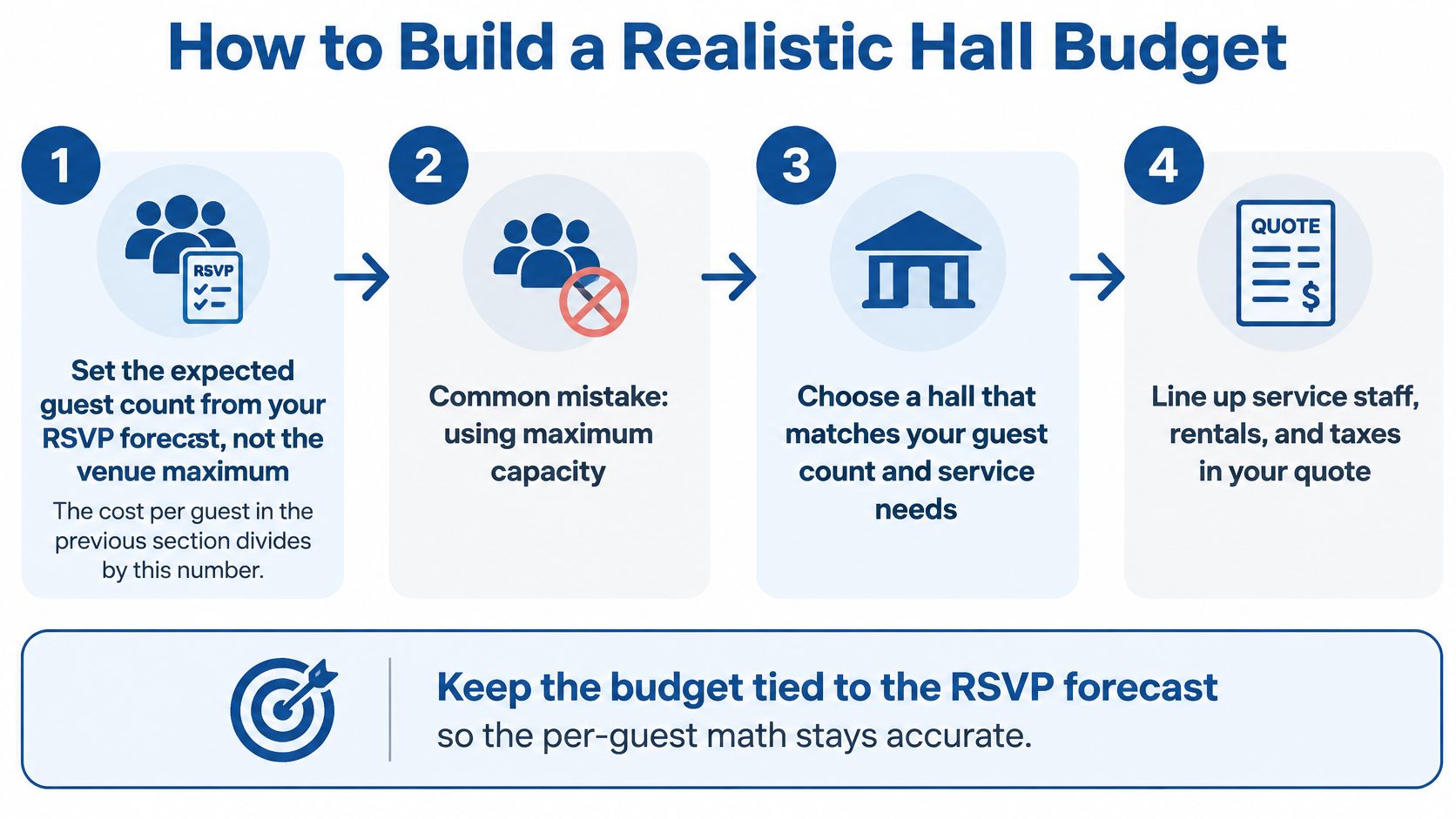
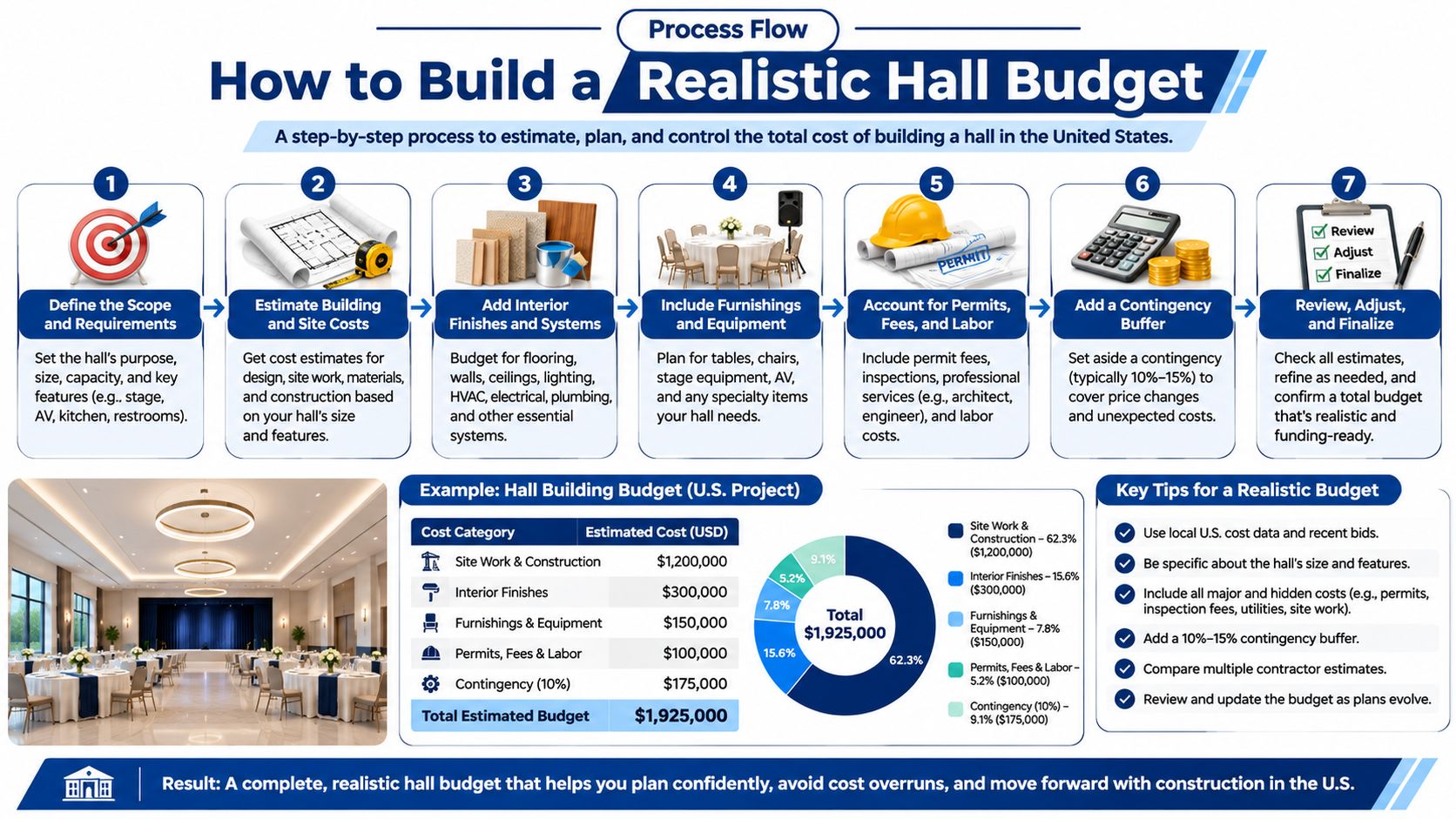
A realistic hall budget starts with the number that will divide the invoice: expected guests, not maximum capacity. Build the figure in order, and the total holds. Skip a step, and the shortfall surfaces close to the date, when choices are narrow and every substitution costs more. Keep the working document simple, with one line for each required item and one line for each optional item.
Set the expected guest count from your RSVP forecast, not the venue maximum. This is the divisor for every later comparison. Using capacity makes an oversized hall look cheaper per head than it is, because the room cost is spread across people who may never attend.
Choose the capacity tier that fits that count. Check the per-guest range in the table above before choosing a building. The lowest base price can still be the wrong buy if it leaves you paying for space you will not fill. At Texas Old Town, Redbud Hall holds up to 150 guests in a space measuring 81'4" x 39'10", while Sage Hall holds up to 300 guests in a space measuring 94' x 60'8".
Request a written line-item quote from each shortlisted venue. Rental, furniture, cleanup, access hours, overtime and any service charge should each have a number. A verbal price blocks comparison because it hides which items are bundled and which are added later.
Add tax and gratuity wherever a quote omits them. Some quotes state a net price and add both at contract. If a quote does not state its service charge percentage, treat that as a missing line and ask for it in writing rather than assuming there is none. At Texas Old Town, the price quoted is the price the customer pays, including sales tax and gratuity.
List what the venue does not provide. Linens are a common gap. Texas Old Town provides chairs and tables for the reception hall but does not provide linens. Couples and hosts can choose their own vendors and customize their day and décor, so catering, bartending and décor may need separate budget lines.
Plan the deposit before you compare. A 25% non-refundable deposit holds the reservation for the desired event date. Confirm the day, the hall and the access window before sending it, because the deposit is tied to that date.
Keep a contingency line of about 10% of the total. Treat that as a planning assumption, not a market rate. A buffer absorbs changes such as an extra guest table or a last-minute rental delivery before they reach the final invoice.
Finish by dividing the completed total by expected guests. That figure is the only venue number that compares halls with different inclusions. If one hall includes 300 ceremony chairs, 300 reception chairs and an outdoor tree swing, as Sage Hall does, those items stay out of the separate rental column. Redbud Hall includes 150 folding white padded ceremony chairs and 150 folding dark resin padded reception chairs, with furniture and cleanup included in the rental price. Each venue rental also includes a 16-hour rental from 8 a.m. to midnight, and wedding clients at Redbud Hall have had venue access from 8 AM until midnight. Keep those inclusions in the same column as the base fee, or the per-guest result will overstate the true cost.
Compare Three Quotes Before You Sign
Put three quotes on one page and add up the full cost of each. Say Hall A quotes $2,000 for the room, then adds $1,400 for furniture and $600 for cleanup, which lands at $4,000 before an 18% service charge of about $720, or $4,720. Hall B quotes $3,500 all-in, including tax, gratuity and cleanup. Hall B has the higher sticker and the lower total by $1,220. A third hall at $2,700 with no service charge but no linens and a six-hour window can still lose once you price the linens and the setup crew.
The test that settles it: total every required service, then divide by the guests you expect. The lowest cost per expected guest wins, not the lowest base rental. The cheapest fee on the page is frequently the most expensive wedding.
Line up the three quotes on five fields: total cost, cost per expected guest, what's included, deposit and cancellation terms, and the access window. The last two decide how much risk you're carrying. A non-refundable deposit on a date you haven't confirmed with family is a bet, and a short access window converts into overtime the first time a caterer runs late.
If catering is a separate contract, read it the same way you read the hall quote, and use this guide to compare caterer pricing and contracts before you sign either one. Our venue rental contracts page explains how the deposit and payment schedule work here.
Then take the practical step: ask each venue for a written line-item quote, confirm the day-of-week price and the access window in writing, and tour before you pay anything. Texas Old Town offers tours by appointment, quotes with sales tax and gratuity already included, and four halls from 150 to 320 guests, which makes us a useful first quote to hold the others against.
Texas Old Town hosts weddings, quinceañeras, corporate retreats and milestone events across four halls on 55 acres in Kyle, between Austin and San Antonio. Every rental includes 16 hours from 8 a.m. to midnight, every quote includes sales tax and gratuity, and every hall comes with published furniture counts so you can run the per-guest math before you commit. Send us your expected guest count and we'll tell you which hall fits it; visit Texas Old Town to book a tour.