You're comparing birthday party venues with one eye on the guest list and the other on the clock. The house suddenly feels too small, the driveway won't hold every car, relatives need comfortable seating, and someone will have to clean up while the birthday child is still enjoying the day. A birthday party venue rental can solve those problems, but only if you compare usable hours, total cost, layout, and guest comfort, not just the advertised room rate.
The right choice isn't automatically the largest hall or the lowest quote. It's the space that gives your family enough time to set up, host the celebration, and leave without rushing, while making the day workable for children, older relatives, and guests with mobility or sensory needs.
Table of Contents
- When Home Stops Working for Birthday Parties
- Understanding Birthday Rental Demand and Budgets
- How to Match Capacity Layout and Amenities
- Uncovering the True All In Rental Cost
- Smart Questions Timeline and Logistics That Prevent Stress
- Designing for Comfort Safety and All Ages
- Planning Your Celebration at Texas Old Town
When Home Stops Working for Birthday Parties
A family birthday often begins. You invite close relatives, put out food, hang a few decorations, and keep the celebration moving between the kitchen and backyard. Then the guest list grows. A grandparent needs a stable path to the restroom, children need a safe place to move around, the weather forecast becomes part of the planning, and the host realizes there's no quiet moment to welcome vendors or arrange the cake.
That's usually the point when a rented venue starts making practical sense. The benefit isn't only extra square footage. A suitable hall creates separate time and space for setup, the celebration itself, and teardown, so the person paying for the party doesn't also spend the entire event carrying chairs, directing deliveries, and collecting trash.
A home party may still be the better fit when the gathering is small, familiar, and easy to manage indoors. Venue rental becomes more useful when several of these signals appear:
- The guest list keeps expanding: More families and age groups make seating, food service, and supervision harder to coordinate at home.
- The celebration has a program: A quinceañera, retirement party, milestone birthday, speeches, dancing, or formal meal needs a layout that supports transitions.
- Parking and weather are uncertain: A private lot, climate-controlled room, and indoor backup reduce pressure on the host.
- You want to enjoy your own event: On-site management, included furniture, and cleanup can remove jobs that would otherwise fall to relatives.
For example, a family planning a science-themed children's party may find useful activity ideas in find science party inspiration, then discover that experiments, food, and active play need more controlled surfaces and cleanup space than the living room provides. A milestone birthday or multigenerational gathering may need even more room because guests aren't all participating in the same activity.
Use a simple self-test: if your home can comfortably handle the guest flow, food preparation, seating, parking, weather changes, and cleanup without turning the host into staff, stay home. If two or more of those areas feel uncertain, tour venues and compare the complete experience rather than the room alone.
Texas Old Town provides a useful Central Texas example because its halls and outdoor settings can be evaluated by guest count, program, indoor comfort, and setup requirements. The same decision method works for a community hall, restaurant room, private entertainment space, or Hill Country venue.
Understanding Birthday Rental Demand and Budgets
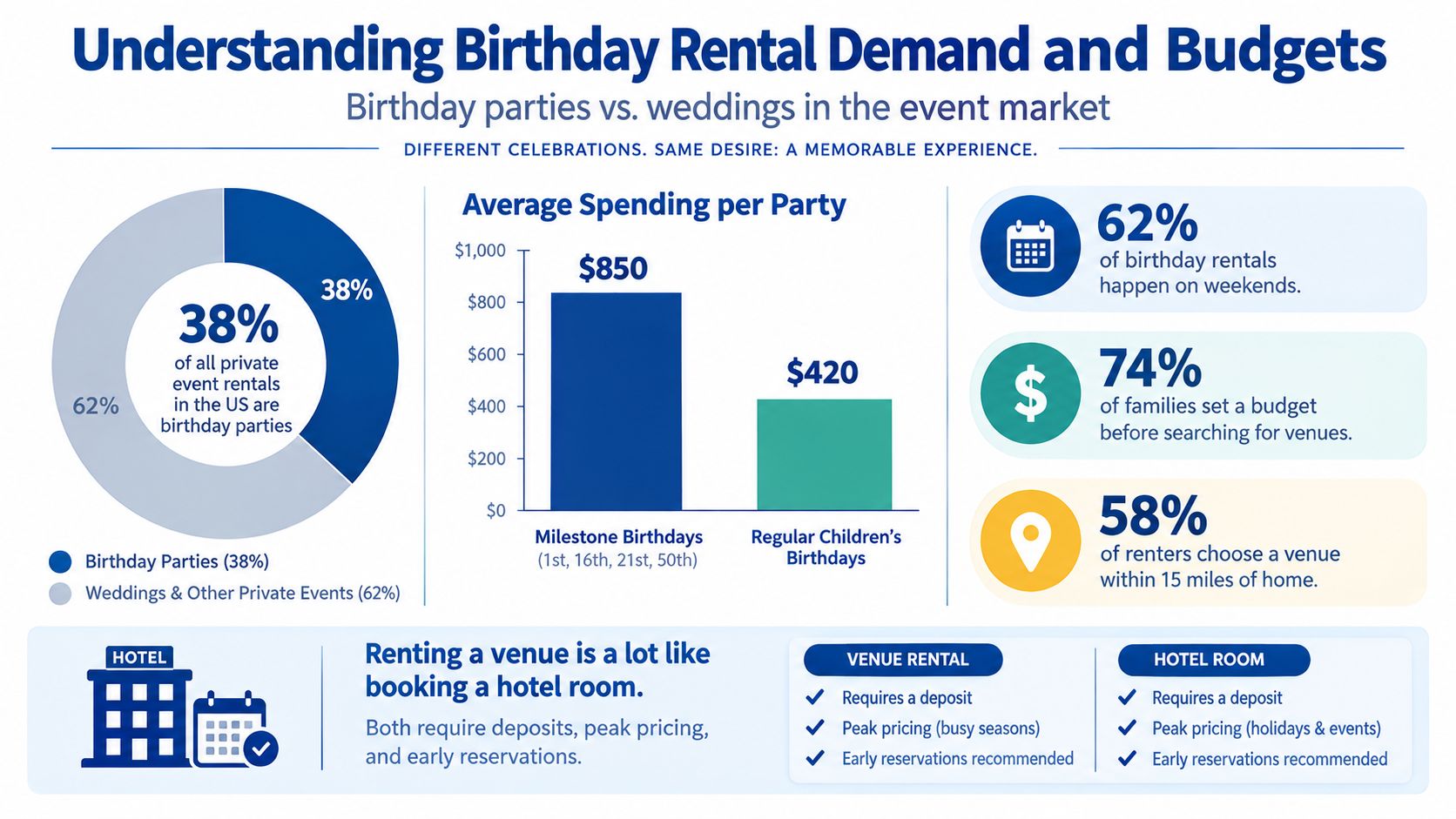
A birthday booking can look simple until the guest list includes toddlers, grandparents, meals, music, and changing weather. The room fee is only one part of the decision. Families also need to account for usable event hours, setup and cleanup time, furniture, climate control, parking, food service, and how easily different age groups can move through the space.
Birthday parties make up a meaningful part of the wider party-rental market. An industry estimate placed U.S. party-rental revenue at $14.5 billion in 2022, with annual growth of 5.1% since 2017. Birthdays represented approximately 15% of that revenue, compared with 35% for weddings and 20% for corporate events, according to Worldmetrics. The same estimate put average birthday-party spending at about $890, while wedding spending was approximately $1,950. These are broad market benchmarks, not a quote for a Central Texas venue.
Two birthday markets need different answers
A children's birthday and an adult milestone celebration may share a cake, but they place different demands on a venue. One industry report estimated average spending at $314 for a children's birthday party and approximately $1,185 for an adult milestone celebration in 2026. It also reported that more than 70% of parents hosted parties at home to control costs, while food, venue, and entertainment together represented more than 80% of total spending. A typical children's guest list was estimated at 15 to 20 children. Treat these figures as private-industry context rather than official national totals. The birthday-party spending report helps explain why a small home gathering and a larger milestone event require different comparisons.
For children, check whether the venue provides a visible activity area, convenient food access, durable surfaces, and restrooms that adults can reach without losing sight of the group. For a retirement party or milestone birthday, prioritize seating, clear acoustics, meal service, presentation space, and comfortable routes for older guests. A mixed-age birthday works best when active and quiet areas can coexist.
Think in priorities, not averages
Use the budget as a checklist rather than a target:
- Guest experience: Can people sit, move, eat, hear announcements, and reach restrooms comfortably?
- Usable hours: Does the rental include enough time for decorating, vendors, the celebration, and cleanup?
- Host workload: Which tasks would you prefer the venue to handle?
- Program complexity: Will the event need a meal, entertainment, speeches, dancing, or several activity zones?
- Weather protection: What happens if outdoor plans change?
A lower-cost home party may suit a small group with simple needs. A venue can make better financial sense when it includes furniture, indoor comfort, setup time, parking, or support that would otherwise require separate rentals and extra labor. Compare the all-in cost and usable hours, not only the advertised room price.
Texas Old Town offers a Central Texas example for this comparison. Families can assess its halls and outdoor settings by guest mix, indoor comfort, access, setup requirements, and the amount of work they want to carry themselves. The same method applies to a community hall, restaurant room, private entertainment space, or Hill Country venue.
How to Match Capacity Layout and Amenities
A venue can accept a large crowd and still feel uncomfortable. Capacity tells you how many people may enter. Layout shows whether they can eat, talk, move, and reach the facilities without crossing through another activity. For a mixed-age birthday, that difference affects both the guest experience and the amount of usable space you are paying for.
Begin with the celebration's main activity. A children's party needs an open area, clear sightlines for adults, and food placed away from active play. A quinceañera or milestone birthday may need dining tables, a presentation area, dancing, sound equipment, and a quieter corner for older relatives. Outdoor space can add room, provided it connects sensibly to restrooms and food service and has a practical indoor backup.
| Party style | Guests | Space needs | Amenity priorities |
|---|---|---|---|
| Children's activity party | Small to medium group | Open play area, visible seating, clear food zone | Climate control, accessible restrooms, durable surfaces, sound reach |
| Family milestone birthday | Mixed-age group | Dining, conversation, cake or presentation area | Comfortable seating, parking, lighting, climate control, on-site support |
| Quinceañera or formal birthday | Larger gathering | Dining, dancing, formal entrance, photo areas | Sound system, dressing suite, catering access, parking, indoor backup |
| Retirement celebration | Mixed-age adult group | Seated meal, speeches, conversation, optional dancing | Acoustic clarity, accessible routes, restrooms, food-service layout |
Children's parties usually prioritize activity flow and supervision. Milestone celebrations often need more structured amenities, such as formal seating, meal service, presentation space, and clear acoustics. Use that distinction to choose facilities, rather than applying the same room checklist to every birthday.
Compare the room as guests will use it
A tour should follow the movement of the event, not just the appearance of an empty room. Walk the route a guest might take:
- Park and enter with a stroller, mobility aid, or arms full of supplies.
- Find the restroom without crossing the main food or dance area.
- Move from dining tables to the cake, presentation, or activity zone.
- Check whether guests at the back can hear music and announcements.
- Identify where children can play without blocking older guests.
- Ask how the room changes if part of the celebration moves outdoors.
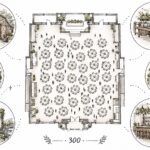
Table count often shapes the layout more than the guest total. A room may hold everyone comfortably until tables, buffet furniture, a cake station, gifts, and activity equipment occupy the floor. Ask for the published furniture counts for each room, then sketch the actual arrangement you need.
For Central Texas options, compare those counts with the event's age mix and activity plan. The capacity verification information provides room details for Tejas, Sage, Stone, and Redbud. Tejas accommodates up to 320 guests, Sage and Stone up to 300 each, and Redbud up to 150, according to Texas Old Town's venue information.
An intimate hall may suit the celebration better than the largest available room. Extra capacity helps only when it provides usable movement, comfortable seating, activity space, or room for production needs. A smaller room with the right furniture plan can offer more practical value than a larger space that leaves guests spread out or forces every feature into a narrow pathway.
Uncovering the True All In Rental Cost
The cheapest advertised venue may not be the cheapest birthday party. A base quote can exclude the hours needed to decorate, the staff required to manage the event, the furniture you assumed was included, or the cleanup that happens after guests leave.
A venue-planning guide lists typical rentals at roughly $75 to $500 or more, while identifying deposits, cleanup, staffing, security, insurance, food, drinks, décor, and entertainment as possible additions. It also recommends booking 8 to 12 weeks ahead, but families still need to ask how much of the rental window is usable for vendor arrival, decorating, guest access, food service, and breakdown. Review the event-hall planning guidance as a starting point, then request a venue-specific quote.
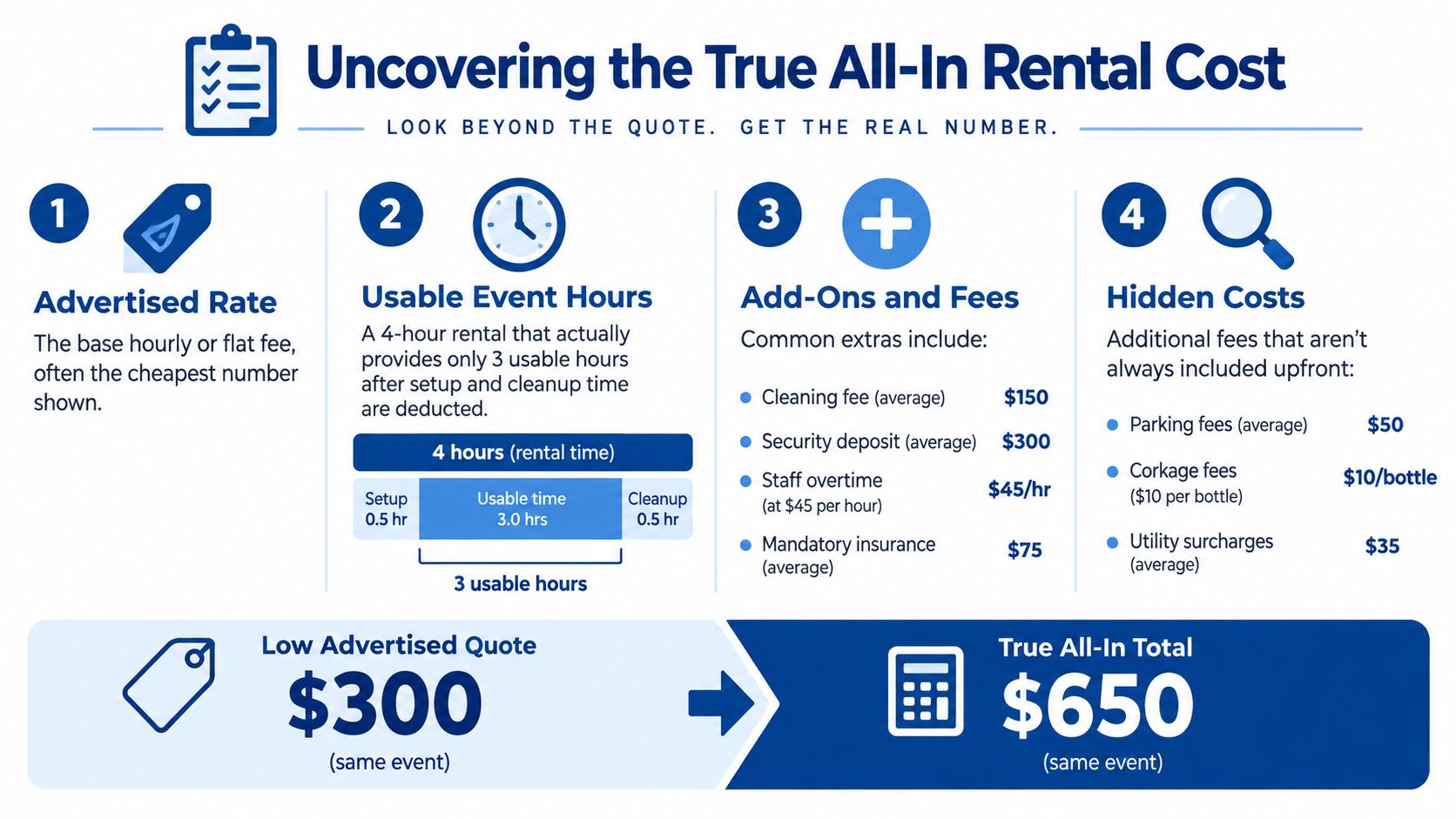
Practical rule: Compare the cost of the complete event, not the price of the empty room.
Build an itemized worksheet
Ask every venue to separate these categories:
- Base rental: Is the fee hourly, flat-rate, or package-based?
- Usable access: When can your caterer, decorator, entertainer, and family enter?
- Furniture and equipment: Are tables, chairs, sound equipment, microphones, and lighting included?
- Labor: Who handles setup, furniture movement, event management, and cleanup?
- Food and beverages: Can you choose a caterer? Are outside beverages allowed? Is an approved bartender required?
- Risk and deposits: Are insurance, security deposits, security staff, or cancellation charges separate?
- Taxes and gratuity: Does the written quote include them?
Then calculate the all-in total and the usable event hours. A four-hour booking may be a poor value if setup and cleanup consume much of that window. A longer exclusive-access period can cost more at first glance but give vendors room to work and hosts time to breathe.
Sanitation also belongs on the worksheet. Clarify who empties bins, cleans food areas, handles spills, and resets restrooms. Families preparing a private property or comparing venue maintenance standards can use this guide to elevate your sanitation standards while asking what the venue includes.
For a Central Texas comparison, review the banquet hall rental cost information and ask the same questions of every venue. Transparent terms, included furniture, management, cleanup, and flexible payment arrangements may outweigh a lower initial quote.
Smart Questions Timeline and Logistics That Prevent Stress
A successful booking begins before the contract. Tour the venue with your actual event in mind, then put every important answer in writing. Verbal assurances about setup access, outside catering, or cleanup can become difficult to verify once several vendors are involved.
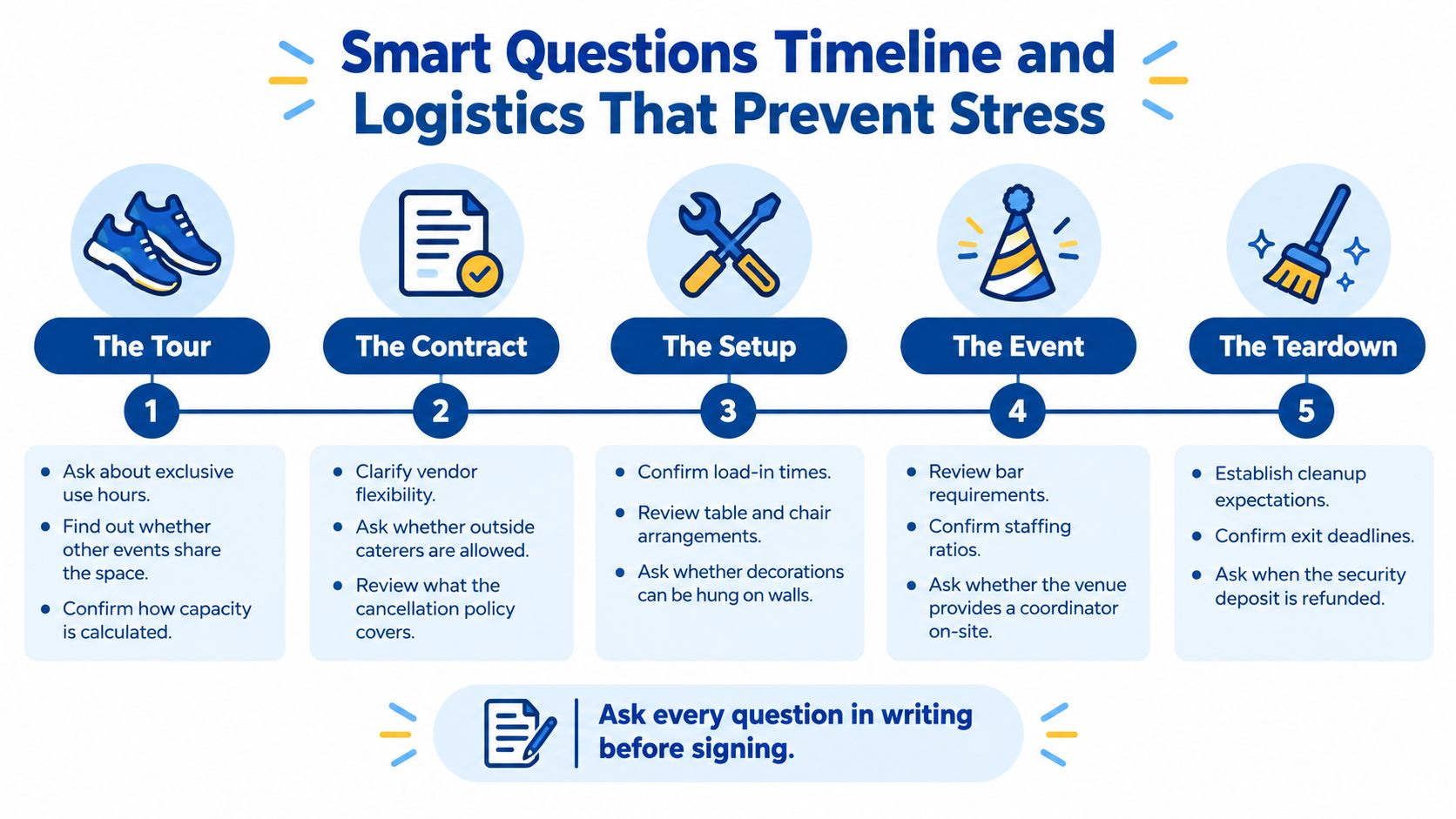
Ask these questions during the tour
Start with access. Ask when your family, caterer, decorator, entertainment provider, and photographer may arrive. Confirm whether another event shares the property, whether your hall is private, and when everyone must leave.
Then examine vendor rules. Can you choose any caterer? Is there a prep kitchen with a separate service entrance? Can you bring beverages, and does the venue require an approved bartender? Ask whether the sound system supports Bluetooth and whether a wireless microphone is available for speeches or announcements.
Clarify the physical setup. Request the furniture count, floor plan, load-in route, decoration rules, power access, restroom location, parking arrangements, and weather backup. A caterer may need a different entrance from guests, while a decorator may need enough time to install items before the first arrival.
For additional perspective on coordinating food vendors, review this resource on event planning logistics for caterers. Use it to create questions about delivery timing, service flow, kitchen access, waste removal, and breakdown.
Use a timeline that protects the day
A practical rhythm looks like this:
- Several weeks before: Tour, compare written quotes, confirm the guest range, and sign only after reading cancellation and vendor terms.
- Before the event week: Finalize the floor plan, menu, entertainment, accessibility requests, and arrival instructions.
- Event morning: Let vendors load in, arrange tables and chairs, test music and microphones, and finish decorations before guests arrive.
- During the party: Assign one venue contact or family representative to handle deliveries, questions, and schedule changes.
- After the final guest leaves: Confirm what the family must remove, what the venue handles, the exit deadline, and how deposits are returned.
The main protection is written clarity. Your contract should state the access period, included services, vendor permissions, beverage rules, cleanup responsibility, cancellation terms, and the person managing the event.
Designing for Comfort Safety and All Ages
A capacity number doesn't tell you whether a birthday party will feel easy for every guest. A mixed-age celebration may include toddlers, children, grandparents, guests using wheelchairs or walkers, people who need quieter seating, and relatives who struggle with heat or long walks from the parking area.
Walk the venue from arrival to exit. Notice the distance from parking, the surface underfoot, ramps, doorway width, handrails, restroom access, lighting, shaded waiting areas, and the transition between indoor and outdoor spaces. Ask whether the climate-controlled room can hold the celebration if rain or heat changes the plan, and whether guests can hear announcements from every important seating area.
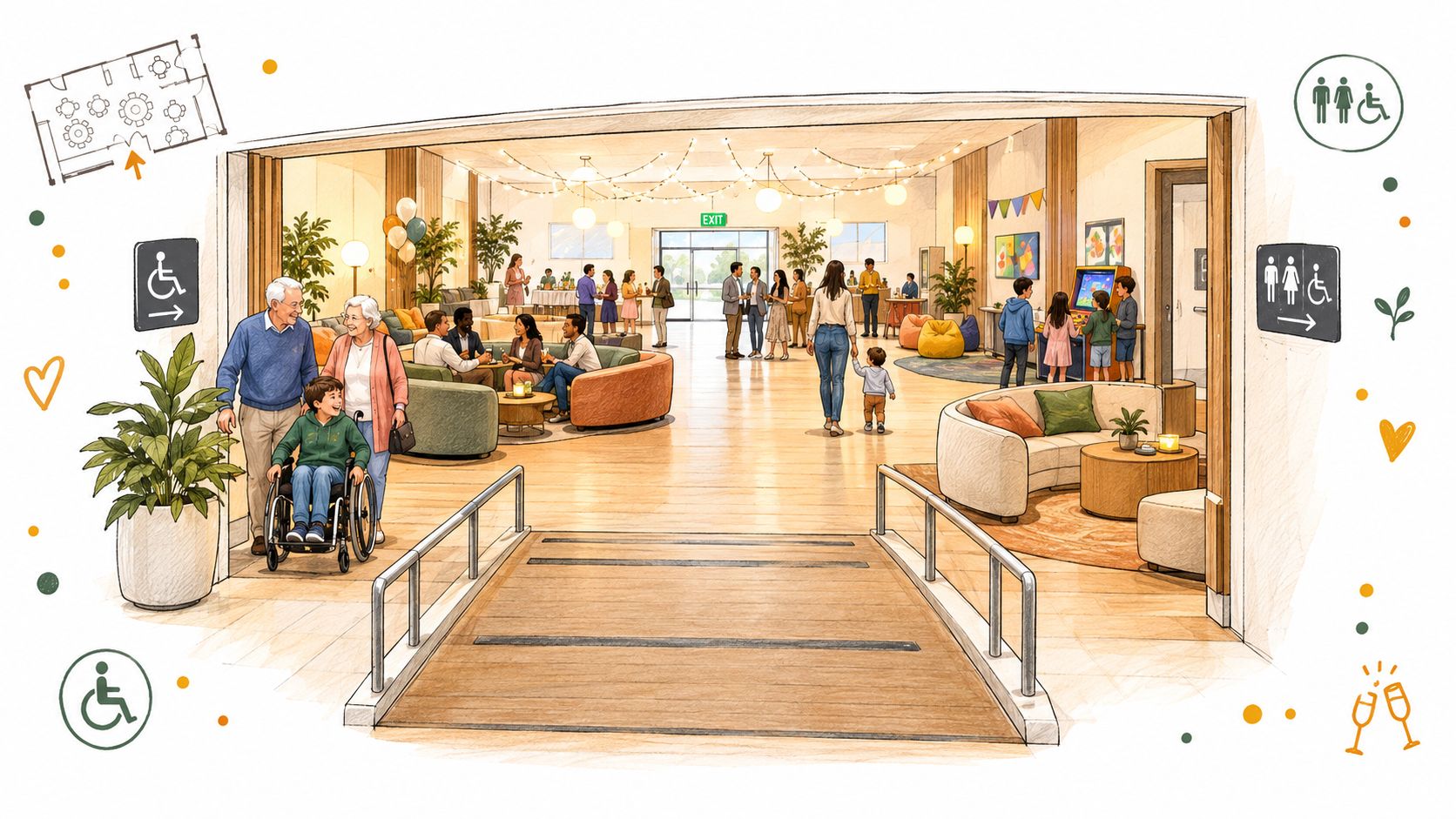
Test the guest journey
During the tour, check each stage rather than treating accessibility as a form:
- Arrival: Is there convenient parking, a stable walking route, and enough room for drop-off?
- Entry: Can guests using mobility aids reach the main room without a difficult detour?
- Restrooms: Are accessible restrooms easy to find and close enough for older guests and children?
- Celebration: Can guests move between seating, food, activities, and restrooms without crossing hazards?
- Sound and light: Can people hear speeches without excessive volume, and are paths well lit?
- Weather: Is there a clear indoor plan for rain, heat, or a sudden change in outdoor conditions?
- Emergency response: Where are first-aid supplies, fire extinguishers, exits, shelter areas, and staff contacts?
Available venue guidance encourages families to ask about ramps, elevators, accessible restrooms, wide doorways, lighting, handrails, first-aid equipment, fire extinguishers, emergency planning, and security cameras, but those features matter because they shape the actual timeline and comfort of the event. The party-venue accessibility and safety guidance can support your tour questions.
Acoustics deserve special attention. Children may need an active zone away from seated relatives, while older guests may prefer a quieter table away from speakers. A venue with indoor and outdoor sound equipment can make transitions smoother, but only if the operator explains how the system works and where sound reaches.
Ask the venue manager to describe the wet-weather procedure in plain language. You should know where guests go, how food service changes, and whether decorations or entertainment need to move. That answer tells you more about practical readiness than a capacity figure alone.
Planning Your Celebration at Texas Old Town
Central Texas families comparing birthday party venues can apply the same checklist to a property with multiple halls and outdoor settings. Texas Old Town offers four private venues on a 55-acre Hill Country property in Kyle, between Austin and San Antonio. The halls range from Redbud, with capacity up to 150 guests, to Tejas, with capacity up to 320, while Sage and Stone accommodate up to 300 each.
The useful comparison isn't which room is largest. Redbud may suit an intimate retirement gathering or family birthday, while Tejas, Sage, or Stone may provide the scale needed for a quinceañera, formal milestone celebration, or large multigenerational party. Outdoor grounds and water features add options, while an indoor climate-controlled hall provides a practical alternative when weather or comfort becomes a concern.
Match the offering to the earlier questions
Several listed services address the problems that commonly inflate stress and cost:
- Extended access: Exclusive use from 8:00 a.m. to midnight gives vendors and family members time for setup, the event, and breakdown.
- Included infrastructure: Published furniture counts, indoor and outdoor PA systems, Bluetooth connectivity, a wireless microphone, dressing suites, and private restrooms support formal and informal programs.
- Food flexibility: A prep kitchen with a separate service entry and the ability to choose a caterer can simplify vendor coordination.
- Beverage planning: A built-in bar supports host-provided beverages, with an approved bartending company required.
- Day-of support: An on-site venue manager, included cleanup, and furniture breakdown reduce the number of jobs assigned to relatives.
- Cost clarity: The provided venue information states that quoted pricing has no hidden fees and includes sales tax and gratuity, with personalized payment plans available.
Review why Texas Old Town can suit Hill Country birthday celebrations and then compare the details against your worksheet. Ask for a tour by appointment, confirm the furniture plan for your guest count, and check vendor and beverage requirements before choosing a date.
A confident booking leaves you with a written total, a realistic access schedule, a comfortable route for every guest, and a clear answer for bad weather. Those four checks matter more than choosing a room because it looks impressive in a photograph.
Texas Old Town offers four private halls, indoor and outdoor settings, extended exclusive access, on-site management, included cleanup, flexible catering, and practical amenities for family and milestone celebrations. Visit Texas Old Town to schedule a tour, compare venue layouts, and start planning a birthday party that gives your guests comfort and gives your family time to enjoy the day.