You've chosen a wedding season, started a guest list, and probably saved more venue photos than you'd like to admit. Then the practical question arrives: how far in advance should you book a wedding venue? The answer isn't one universal deadline. A Saturday in peak season at a sought-after property demands a very different strategy from a weekday celebration with a flexible guest list.
Your venue determines the date, ceremony layout, guest capacity, rental schedule, and much of your vendor search. Book too late, and you may still find a beautiful space, but you'll likely trade away date choice, vendor availability, or planning breathing room. Book with a clear framework, and you can decide whether you need to move quickly or can confidently plan closer to the wedding.
Table of Contents
- Planning Your Venue Booking Timeline
- Determining Your Ideal Booking Window
- Tailoring Timeline to Guest Count and Venue Type
- Coordinating Vendor Availability Within Your Schedule
- Strategies for Near-Term Bookings at Texas Old Town
- Common Mistakes and Practical Tips
- Conclusion and Action Plan
Planning Your Venue Booking Timeline
Maya and Daniel had a date in mind, a rough guest count, and family members traveling from different cities. They also wanted a spring Saturday, which meant their preferred dates were competing with other couples looking for the same limited inventory. Their first instinct was to book a photographer, but that would have been premature. Until the venue confirmed the date, every major vendor conversation remained provisional.
The practical order is simple. Establish your date flexibility, estimate your guest count, tour suitable venues, and secure the venue before finalizing the rest of the wedding team. Couples who want a particular season, Saturday, property, or room capacity need to start earlier than couples willing to consider weekdays, winter dates, or different venue styles.
Practical rule: Treat the venue as the anchor of the wedding plan. Don't build the rest of the schedule around an unconfirmed date.
Your working timeline should account for more than the ceremony itself. Include tours, contract review, deposit decisions, vendor research, guest travel, and any rehearsal or setup needs. A detailed event planning timeline for Texas Old Town can help you place those decisions in the right order, while downloadable event checklist templates can keep conversations, deadlines, and follow-ups visible.
Start by answering four questions:
- How fixed is your date? A single Saturday requires an earlier search than a range of possible dates.
- Which season matters? Spring and fall dates generally face stronger competition than less popular periods.
- How many guests are you inviting? Capacity can eliminate otherwise attractive venues.
- What type of space do you want? A popular barn, estate, hotel, or specialty property may fill faster than a less date-sensitive option.
Determining Your Ideal Booking Window
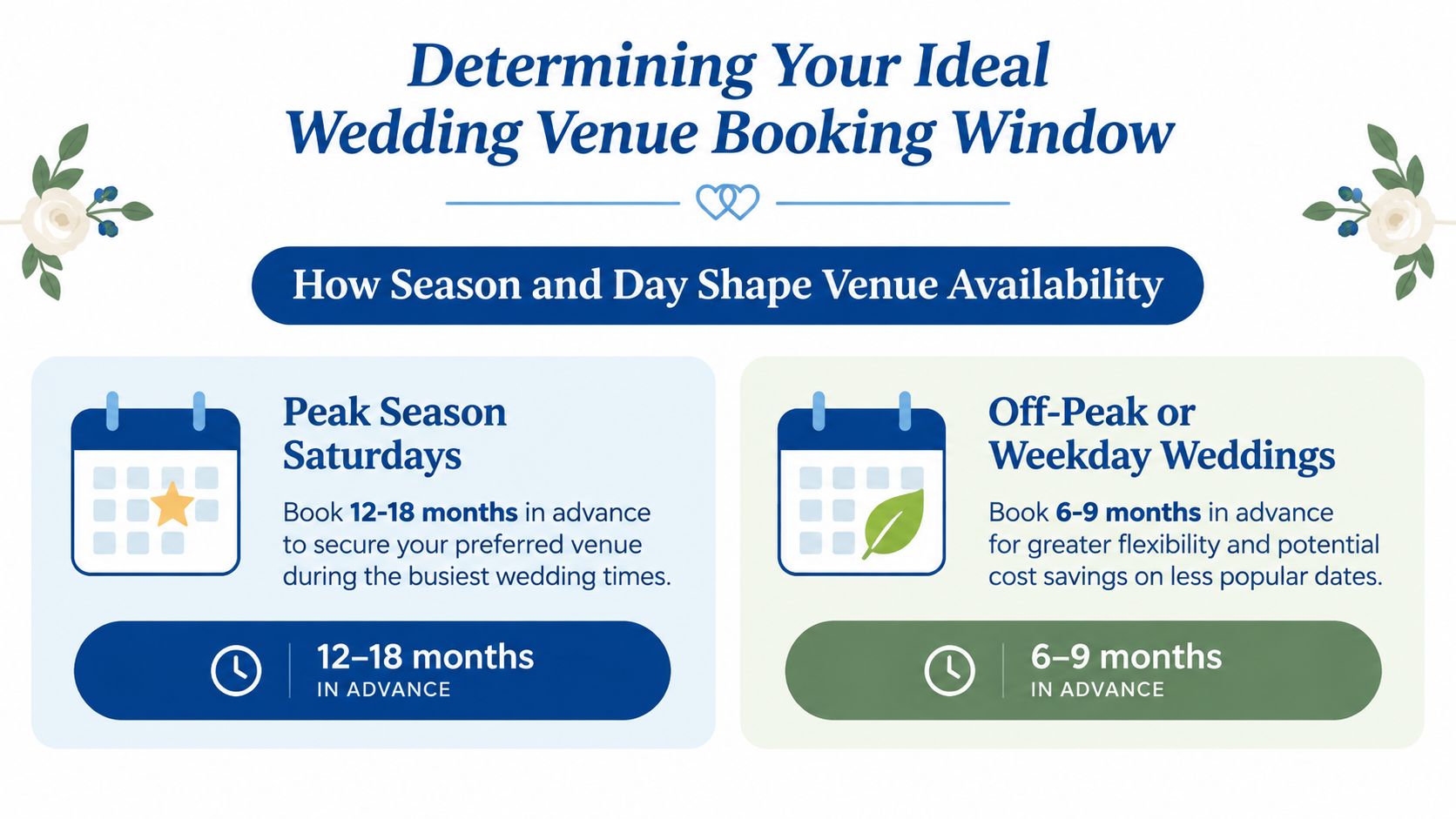
A couple planning a spring Saturday at a popular venue should begin serious research 12 to 18 months before the wedding. That window gives you time to compare spaces, review contracts, and act before preferred dates disappear. For an off-peak date or weekday, 6 to 9 months ahead can be enough, particularly when you can adjust the exact date or venue style, according to a 2026 wedding venue market analysis.
Highly competitive dates require an earlier start. A sought-after property, a specific spring or fall Saturday, and a narrow guest-capacity range can push the search to 18 to 24 months. Contact venues before your preferred date enters the standard planning window, tour promptly, and be ready to decide when the right space becomes available.
Match the timeline to your date
Use the date, season, and guest logistics to set your target:
- Peak-season Saturday: Start venue research 12 to 18 months out. For a highly requested property or unusually competitive date, begin 18 to 24 months ahead.
- Spring or fall Friday or Sunday: Start around 9 to 12 months out. Move sooner if your venue list is short or your guest count fits only one hall.
- Winter or another off-peak date: A 6 to 9 month search can work, especially when the day of week remains flexible.
- Weekday wedding: Aim for 6 to 9 months, while contacting venues earlier if guests must travel or your vendor needs are specialized.
Booking behavior supports a two-stage process. Couples who booked their venue committed a median of 248 days before the wedding, about 8 months, while their first inquiry arrived a median of 359 days ahead, about 12 months in the reported wedding venue data. Start researching and sending inquiries roughly a year out, then allow several months to compare availability, pricing, layouts, and contract terms before signing.
Decide what you're willing to trade
A shorter booking window works when you keep a major choice flexible. If you want a peak Saturday at one specific venue, with a tightly defined capacity and fixed vendors, begin early. If the wedding is closer, adjust the day, exact date, or venue type. Texas Old Town couples should use that same approach, checking which available space fits the guest count before sacrificing the date.
Tailoring Timeline to Guest Count and Venue Type
Your guest count should shape the venue search before you schedule tours. It determines whether the room can accommodate the celebration comfortably and whether the layout leaves space for dining, dancing, bars, buffet lines, and guest movement. A 150-person wedding and a 300-person reception need different rooms, even when both couples want an indoor hall with an outdoor ceremony.
Texas Old Town makes that comparison concrete. Redbud accommodates up to 150 guests, while Tejas accommodates up to 320 guests. Sage and Stone each accommodate up to 300 guests, giving couples several capacity and atmosphere options within the same broader setting.
Venue size affects timing, but capacity is not the only demand factor. A smaller room can book quickly if it suits intimate weddings, while a large hall may have more date availability but fewer spaces that fit a large guest list. Use the table as a planning guide, then ask about actual openings for your preferred season and day.
| Venue Space | Max Guests | Practical booking guidance |
|---|---|---|
| Redbud | 150 | Start 12–18 months ahead for a peak Saturday. A flexible weekday or off-peak date may work 5–9 months out, but intimate spaces can fill quickly when demand is high. |
| Tejas | 320 | Start 12–18 months ahead for a peak Saturday because large guest lists eliminate smaller rooms. A flexible weekday or off-peak date may work 5–9 months out. |
| Sage | 300 | Start 12–18 months ahead for a peak Saturday. For a weekday or off-peak date, 5–9 months can work if the room and layout match your guest count. |
| Stone | 300 | Start 12–18 months ahead for a peak Saturday. A 5–9 month window is more realistic for flexible dates, especially when you can consider another room or setup. |
The wider pattern is clear. Peak Saturdays need the longest lead time, while flexible weekday and off-peak celebrations can often use a shorter window, as described in the 2026 venue insight report. Venue type changes the risk: distinctive halls and rooms that match a narrow guest-count range may have fewer suitable dates than adaptable spaces.
Apply the capacity check
- Set an expected guest range. Include family members, wedding-party guests, and likely plus-ones.
- Check the maximum capacity. Treat it as a ceiling, not an ideal layout. Ask how ceremony seating, dining tables, dancing, bars, buffet lines, and accessibility will fit.
- Match space to the event format. A large room may feel sparse for a small wedding, while a near-capacity reception can restrict movement and seating choices.
- Choose your flexibility lever. If the guest count is fixed, adjust the date. If the date is fixed, consider more venue types or compare spaces through large event venues in Texas.
Book the room that supports how guests will eat, celebrate, and move, not merely the room whose maximum capacity matches your headcount.
Coordinating Vendor Availability Within Your Schedule
A venue date sets the working schedule for every other supplier. After the location and date are confirmed, contact the photographer, planner, caterer, florist, DJ, band, and transportation providers with specific details. Before then, vendors may show interest without holding an unconfirmed date.
Late venue decisions leave less room to assemble a compatible team. Couples may face fewer vendor options and more schedule pressure, with less time to compare services, review contracts, and coordinate logistics, as explained in the discussion of wedding vendor timing. Availability alone is not enough. The provider must also fit your budget, style, event format, and schedule.
Protect the vendors that matter most
Identify priority vendors before touring venues if photography, live music, catering, or planning drives your wedding experience. Do not sign contracts before securing the venue unless the vendor offers a clear date-transfer policy. Instead, ask which dates they can accept and how long they can hold a tentative option.
Entertainment affects the reception timeline, sound setup, dance floor, and guest experience. Decide whether a DJ, band, or another format suits your plan, then use this guide to choosing your wedding entertainment before approving a room layout. A band may require more floor space and power access, while a DJ may need a different setup.
Reply quickly once inquiries begin. The wedding vendor lead response report recorded a median first reply of 11 hours, while top-quartile venues responded in under 8 minutes and top-decile venues in under 60 seconds in the wedding vendor lead response report. Treat every response as time-sensitive. Confirm whether the date is still open, schedule the tour, and send focused questions before another couple claims the slot.
Strategies for Near-Term Bookings at Texas Old Town
A wedding within six months is realistic, but a peak Saturday may not be. Near-term couples need a booking plan built around flexibility, quick decisions, and a complete first inquiry. Give the venue your guest range, preferred dates, ceremony preference, and decision deadline immediately.
Use flexibility as a planning tool
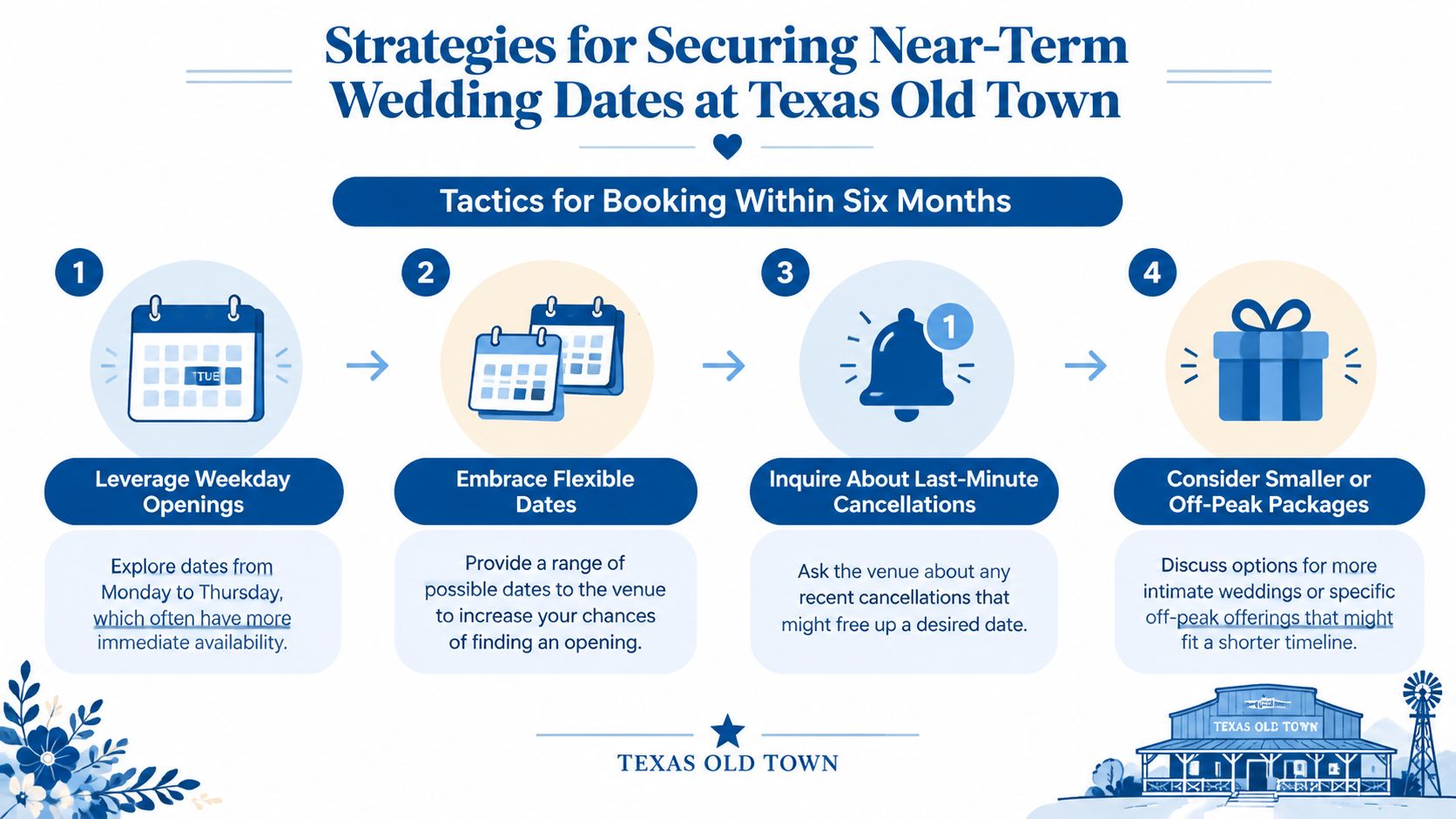
Offer Monday through Thursday first if your guests can attend. Fridays and Sundays create more options, as do winter dates and other off-peak openings. Send a range of acceptable dates instead of requesting one Saturday. The venue team can then search the calendar against your actual priorities.
Ask about cancellations, recently released dates, and packages designed for off-peak celebrations. A date may be available without appearing in a standard availability discussion, particularly if you explain that you are ready to decide quickly. Smaller guest counts can also make a near-term opening workable, but confirm the room layout and package requirements before assuming it fits.
Follow a short, disciplined process
- Send a complete inquiry. Include estimated guests, date range, ceremony and reception needs, and required amenities.
- Schedule the tour immediately. Inspect the ceremony location, reception flow, dressing areas, parking, sound setup, and backup options.
- Request the contract and payment details. Review cancellation terms, included services, approved vendor requirements, and the payment schedule before paying a deposit.
- Confirm the date in writing. A verbal hold is not a booking.
- Contact priority vendors the same day. Check photography, planning, catering, and entertainment before filling the remaining roles.
Texas Old Town has four venue spaces, indoor and outdoor ceremony options, on-site management, included cleanup and furniture breakdown, a prep kitchen, and a caterer-choice policy. Those features can reduce coordination work on a compressed schedule. Confirm the available space, date, and applicable vendor terms directly before signing.
Fast replies matter. The response-time benchmark cited earlier found that top-quartile venues answered in under 8 minutes and converted up to 12% of leads, compared with 3–6% for average venues in the same response-time report. Keep both partners available after the tour so you can approve the contract, or reject the date, without losing time.
Common Mistakes and Practical Tips
A near-term wedding date exposes weak decisions quickly. Couples lose options by waiting for a final guest list, researching every vendor, or settling every design detail before contacting venues. Set a realistic guest range and identify the wedding style first. Then secure the venue before choosing details that depend on its layout, rules, and availability.
Mistakes that reduce your choices
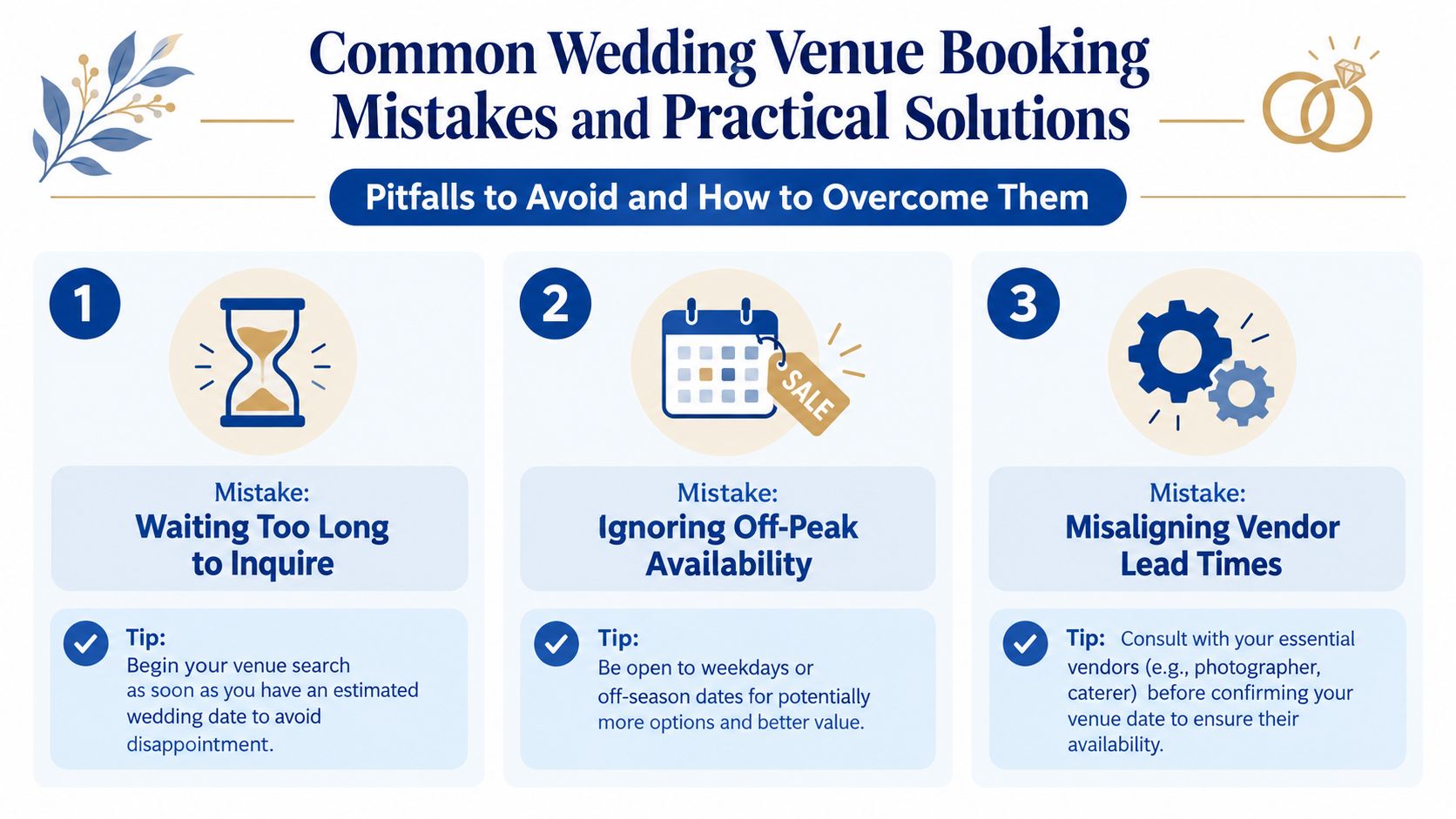
- Waiting to inquire: Contact venues once you have an estimated date or date range. Couples often start inquiries about 12 months before the wedding and commit closer to 8 months out, according to the wedding venue booking dataset. Treat early research as preparation, not a reservation.
- Treating Saturday as mandatory: A short timeline requires flexibility. Ask about Fridays, Sundays, weekdays, and off-peak months. A different day can preserve access to the venue style and guest capacity you want.
- Ignoring capacity details: Match your guest range to the usable floor plan, not only the advertised maximum. Confirm space for the dance floor, bar, buffet, DJ, band, ceremony seating, and guest movement.
- Signing without reading the contract: Check payment deadlines, cancellation terms, included rentals, vendor requirements, access hours, and cleanup duties. Use Texas Old Town's venue rental contract information to build a practical question list for any property.
- Delaying vendor calls after booking: Contact priority vendors as soon as the date is confirmed. Photography, planning, catering, and entertainment may have limited availability, especially for a short booking window.
Keep one page with preferred dates, acceptable alternatives, guest range, venue type, and priority vendors. Bring it to each tour. This keeps an emotional decision tied to the practical limits of your wedding and makes it easier to act when a suitable opening appears.
Conclusion and Action Plan
For a peak-season Saturday, start looking 12 to 18 months ahead, and begin earlier when the venue or date is highly competitive. For a weekday, winter, or flexible off-peak celebration, 6 to 9 months can be workable. Match the room to your guest count, tour promptly, review the contract carefully, and contact priority vendors immediately after booking. If you're planning within six months, offer several dates, ask about cancellations, and move quickly when a suitable opening appears.
Texas Old Town offers four private halls, indoor and outdoor ceremony settings, 16-hour access, on-site management, and a flexible caterer policy across its 55-acre Kyle property. Visit Texas Old Town to request a tour, share your date range and guest count, and find out which near-term wedding options are available.