The proposal just happened, and both families are already texting about a party. One parent wants an elegant dinner, the other is picturing a backyard gathering, and you're trying to find a date before wedding planning takes over your calendar. That's a normal starting point, but it's also where engagement parties begin to drift off course.
A good engagement party doesn't need wedding-level production. It does need a clear host, a firm spending limit, a venue that matches the guest count, and a schedule that accounts for Central Texas logistics. If you're figuring out how to plan an engagement party in a six-to-eight-week window, make the decisions below in order.
Table of Contents
- Starting Your Engagement Party on the Right Foot
- Setting a Realistic Budget You Can Stick To
- Choosing the Right Date and Venue
- Building the Guest List and Sending Invitations
- Sorting Out Catering, Bar, and Décor
- Planning the Timeline From Six Weeks Out to Day Of
- Central Texas Venue Features That Make Planning Easier
Starting Your Engagement Party on the Right Foot
Before anyone tours a venue or orders invitations, decide what this party is supposed to do. An engagement party can be a relaxed stand-alone celebration, an early introduction between two families, or a more formal announcement that begins the wedding conversation. Those are different events. A backyard cocktail gathering may suit the first purpose, while a hosted dinner or venue party may fit the third.
Start with a short conversation between the couple and the people who may contribute money or planning help. Agree on the expected formality, approximate guest group, whether there will be speeches, and what the budget is meant to cover. Don't let one parent assume the party includes every wedding guest while the other assumes it's limited to immediate family.
Practical rule: Nobody gets to expand the guest list, promise a date, or add a major vendor until the host and budget are clear.
Decide who owns the decisions
Choose one primary host, even if several people are contributing. The host doesn't have to pay for everything personally, but one person should maintain the budget, communicate with vendors, collect decisions from both families, and approve changes. Shared ownership without a decision-maker creates delays and duplicated spending.
Write down three answers:
- Who hosts: Identify the person or people responsible for the event.
- Who pays: Separate engagement-party funds from the wedding budget before anyone signs a contract.
- Who speaks: Decide whether the host, a parent, or the couple will welcome guests and give toasts.
The money conversation deserves special attention. A parent who offers to help may have a different idea of what “help” includes. Clarify whether the contribution covers venue rental, food, drinks, décor, rentals, invitations, and unexpected costs. If a relative wants to contribute only to florals or catering, record that limitation rather than treating it as a general fund.
Central Texas couples can also use an experienced planning resource to compare event formats and clarify what kind of celebration fits their wider wedding plans. The Wedding Studio planning resource can be useful when the engagement party needs to feel connected to the wedding without becoming a miniature version of it.
Lock the scope before the date
Don't announce a date because it works for one family. Build a short list of possible weekends, check the most important guests, and confirm venue availability before sending anything public. A date that sounds perfect in a family group chat means nothing if the property, caterer, or approved bartender can't support it.
The rest of the plan becomes much easier once these three decisions are settled: what the party is for, who controls the decisions, and what the budget covers. Without them, every later choice becomes a negotiation.
Setting a Realistic Budget You Can Stick To
A Central Texas engagement party can look affordable until the venue adds bartender requirements, rental delivery, setup time, and weather backup costs. Set the spending ceiling before choosing the guest count. Then select a party format that fits the ceiling, rather than inviting everyone first and cutting important services later.
Published engagement-party guidance places small at-home events for 10 to 25 guests around $200 to $800, restaurant private dining for 20 to 50 guests around $800 to $4,000, catered backyard or venue events for 50 to 100 guests around $2,000 to $8,000, and formal events for 100 or more guests around $5,000 to $15,000 or more. These benchmarks appear in this engagement-party planning guide. Use them to compare formats, not to predict a Central Texas invoice. Date, venue rules, service level, guest count, and bar arrangements can change the total quickly.
A venue-based party needs room for costs that do not appear in a headline rental price. One allocation model assigns 25% to 35% to venue rental, 25% to 30% to food, 15% to 25% to drinks, 8% to 12% to décor and florals, 5% to 10% to entertainment, 2% to 5% to invitations, and 5% to 10% to contingency spending, as detailed in EventCortex's engagement-party budget guide. On a $5,000 budget, that model puts roughly $1,250 to $1,750 toward the venue, $1,250 to $1,500 toward food, and $750 to $1,250 toward drinks.
Use the budget as a guest-count filter
Work backward from the format you want:
- Set the maximum amount the host will spend.
- Reserve contingency money before planning décor.
- Request a venue estimate showing every mandatory fee.
- Price food, drinks, rentals, and staffing against the likely headcount.
- Cut the guest list or simplify the format if the numbers work only with optimistic attendance.
Ask for the full rental math, especially at Central Texas properties. A 16-hour rental window may sound generous, but it can include vendor access, setup, the party itself, teardown, and cleanup. If the venue requires the same window for all activity, late deliveries or a complicated ceremony-site transition can consume time and create labor charges. Budget for the schedule the venue allows, not only for guest-facing hours.
Bar rules deserve their own line. A BYOB venue may let the host purchase alcohol directly, but many properties still require an approved bartender. Add bartender fees, ice, mixers, glassware, coolers, delivery, and restocking before calling the bar affordable. Confirm whether alcohol must remain indoors, whether the bartender handles service throughout the ceremony-site and reception flow, and whether unopened beverages can leave with the host.
Hold 10% to 15% for uncertainty. Late rental changes, extra beverages, delivery fees, staffing, and weather adjustments can all appear after the first estimate. The event-planning budgeting guidance from ChatlyAI also supports setting a hard ceiling and testing the plan against RSVP changes.
Engagement Party Budget Allocation by Tier
| Cost Category | Intimate Home Format | Mid-Range Venue Format | Hosted Large Format |
|---|---|---|---|
| Venue or space | Home or backyard costs, with rentals as needed | Private dining or event-space rental | Formal venue and expanded service |
| Food | Simple buffet, grazing spread, or hosted snacks | Catered meal or substantial hors d'oeuvres | Full-service catering |
| Drinks | Retail beverages and basic service | BYOB beverages plus approved bartender or restaurant service | Expanded beverage service and staffing |
| Décor and florals | A few focal pieces | Coordinated centerpieces, signage, and rentals | Larger floral, lighting, and design package |
| Entertainment | Playlist and short toast program | Music, sound support, or a modest activity | Dedicated entertainment and production |
| Contingency | Protect the host from small surprises | Hold money for service and rental changes | Keep a larger reserve for complexity |
Choose one visual anchor, such as lighting, florals, or linens. Extra décor often disappears behind guests in photographs while still consuming setup time and rental space. In an indoor hall connected to an outdoor ceremony site, spend first on lighting, guest comfort, and practical transitions.
For couples separating party spending from the wider wedding fund, the Texas Old Town wedding budget guide offers a useful framework for organizing wedding-related costs. You can also browse Coquitlam party rental advice to review how tables, chairs, linens, delivery, and setup require separate decisions, even when a venue includes basic furniture.
Write the worksheet as total ceiling minus contingency, venue, food, drinks, rentals, décor, entertainment, invitations, and signage equals zero. If the equation fails, reduce the guest count or simplify the format. Keep the engagement party inside its own budget. Do not borrow from the wedding fund to protect an oversized guest list.
Choosing the Right Date and Venue
Date and venue are one decision. A beautiful Saturday is useless if the property is unavailable, the bar rules don't fit, or the rental window leaves no time to set up. Pull a small group of possible weekends from the couple's calendar, check the must-have guests, and then contact venues with real options.
Central Texas couples should pay close attention to seasonal weather and travel between Austin and San Antonio. A purely outdoor space can look perfect during a tour and become a serious liability when wind, rain, cold, or sudden heat changes the guest experience. Indoor-and-outdoor venues offer a stronger flow because guests can move between a ceremony site, cocktail area, and climate-controlled hall without requiring a full relocation.
Match the venue to the party format
A restaurant private room is efficient for a smaller gathering. The restaurant may handle food, service, tables, and cleanup, which keeps the host focused on guests. A backyard creates warmth and flexibility, but the host must solve parking, bathrooms, weather, power, lighting, seating, and cleanup.
A hotel event space offers predictable indoor comfort and can simplify travel for out-of-town family. A ranch-style venue or Hill Country property provides more atmosphere and room for an outdoor arrival, but it requires sharper questions about transportation, rain plans, lighting, and vendor access.
Ask every venue these questions before comparing prices:
- What does the rental window include: Confirm access for setup, guest time, and teardown.
- Who manages the event: Ask whether an on-site manager remains available during the party.
- What happens in bad weather: Confirm whether the backup space is included and already furnished.
- How does the bar work: Find out whether you can bring beverages and which bartenders are approved.
- When can vendors arrive: Get the setup and load-out cutoff in writing.
- What does cleanup cover: Clarify whether staff removes rentals, breaks down furniture, and handles trash.
The venue contract should also identify the practical capacity, not just the maximum occupancy. A room may legally hold a certain number of people but feel crowded once you add a buffet, bar, dance area, cake table, gifts, and accessible paths.
A contract is part of the planning plan. If a promise matters on the party day, put it in writing before invitations go out.
Never send invitations before the venue contract is signed. A tentative hold can disappear, a price can change, and a weather plan can turn out to be only a verbal suggestion. Secure the location, rental window, bar policy, and cancellation terms first. Then announce the party with confidence.
Building the Guest List and Sending Invitations
At a Central Texas venue, an oversized guest list creates problems before the first invitation is sent. Food service needs room, guests need clear paths, and conversations disappear when everyone is packed around the bar. Confirm the venue's practical capacity, then set a target that leaves breathing space for seating, circulation, and service.
Planning guidance commonly recommends using about 80% to 90% of a room's practical capacity. Another guide suggests inviting 15% to 25% more people than the target attendance to account for declines, according to WithJoy's engagement-party planning guidance. Treat those figures as planning references, not permission to exceed the room's legal limit. Set a comfortable target, build a ranked list, and over-invite only when the venue and caterer can handle the highest possible response.
Build the list in layers
Create three working groups:
- Must-invites: Immediate family, the wedding party, and people whose absence would noticeably change the celebration.
- Should-invites: Close friends, nearby relatives, and coworkers the couple sees regularly.
- Nice-to-haves: Distant relatives, casual acquaintances, and plus-ones who are not in an established relationship with an invited guest.
Set the plus-one and children policies before writing names. Apply the same rule across both families. Inconsistent decisions create more tension than a smaller guest list, especially when relatives compare invitations.
The engagement-party list must also match the wedding list closely. Inviting someone to the engagement party and excluding them from the wedding can create an awkward expectation, particularly when the party is presented as a formal family event. Decide early whether the celebration is intimate, family-centered, or broad enough to include the wider social circle.
Send fewer messages through one system
Use one digital invitation platform that records RSVPs, dietary notes, plus-ones, and headcount in one place. Do not split responses among texts, emails, and family spreadsheets. Conflicting totals become a problem when the caterer needs the final count.
A short planning window requires a firm response process. Engagement parties commonly use a six-to-eight-week preparation window, with invitations sent four to six weeks before the event, according to Paperlust's planning timeline. Set the RSVP deadline early enough to follow up with guests who have not responded. Assign one person to track unanswered invitations and update the headcount.
Your invitation should state the host, date, time, venue, dress expectation, RSVP method, and useful parking information. If the Central Texas venue has a specific arrival route or limited parking, include that information clearly. Leave wedding registry details off the invitation. The party celebrates the engagement, not a gift request.
Sorting Out Catering, Bar, and Décor
Food, drinks, décor, and rentals share the same space, delivery schedule, staffing plan, and budget. Plan them together. A bar placed between the entrance and buffet will slow service and crowd the room, regardless of how attractive it looks.
Start with the venue's beverage policy. At Central Texas properties with BYOB rules, confirm whether the host supplies all alcohol, whether an approved bartender is required, what that bartender covers, and whether the venue requires specific insurance or service procedures. Retail alcohol plus a flat bartender fee can cost less than a full-service open bar, but only after you budget for ice, mixers, cups or glassware, coolers, delivery, and restocking.
Check the rental agreement before choosing a service plan. A 16-hour rental window gives you more room for setup and breakdown, but it does not remove the need to schedule deliveries, bartender arrival, food service, and cleanup. If the ceremony site and indoor reception area are separate, decide whether guests will move directly inside or pause for drinks and photos. That choice affects where you place the bar, food stations, signage, and rentals.
Choose food that fits the clock
A short evening cocktail event needs a different menu from a seated dinner lasting several hours. Passed hors d'oeuvres, grazing stations, or a buffet keep guests moving. A seated meal creates a formal rhythm and requires a stronger plan for seating, service, and timing.
Ask the caterer:
- What service style fits the venue's kitchen and access points?
- How will dietary restrictions be labeled?
- Who replenishes stations and clears plates?
- Does the quote include staffing, delivery, tax, rentals, and cleanup?
- What is the final headcount deadline?
An online menu helps guests review food choices and share dietary notes. Use the TopFoodApp guide to creating an online menu for a practical reference on presenting that information clearly.
For a venue-based plan, review catering options near Austin and San Antonio alongside the property's kitchen, vendor, and service requirements. A menu works only if the catering team can load in, prepare, serve, replenish, and clear the event without fighting the building's access rules.
Let one design choice lead
Choose one visual anchor:
- Lighting: Use string lights, candles, or warm fixtures to shape the mood.
- Florals: Keep arrangements consistent and low enough for conversation across the table.
- Linens: Use color and texture to define the room without covering every surface.
Do not order a balloon installation, oversized backdrop, elaborate florals, custom signage, and several table themes just because the room looks empty during a walkthrough. Guests and furniture will fill it. Strong engagement-party décor usually has one memorable focal point and quieter supporting details.
Sample Budget Split for a 75-Cater Party
| Category | Share of Budget | Dollar Range |
|---|---|---|
| Venue rental | 25% to 35% | $1,250 to $1,750 on a $5,000 budget |
| Food | 25% to 30% | $1,250 to $1,500 on a $5,000 budget |
| Drinks | 15% to 25% | $750 to $1,250 on a $5,000 budget |
| Décor and florals | 8% to 12% | Allocate after venue, food, and drinks |
| Entertainment | 5% to 10% | Allocate according to the chosen format |
| Invitations | 2% to 5% | Keep digital where appropriate |
| Contingency | 5% to 10% | Protect against late changes |
The allocation ranges and $5,000 examples in this table come from EventCortex's engagement-party planning guide. Lock the menu, expected headcount, bartender confirmation, and rental requirements during the final planning stretch. Waiting until the last week turns simple changes into rush fees.
Planning the Timeline From Six Weeks Out to Day Of
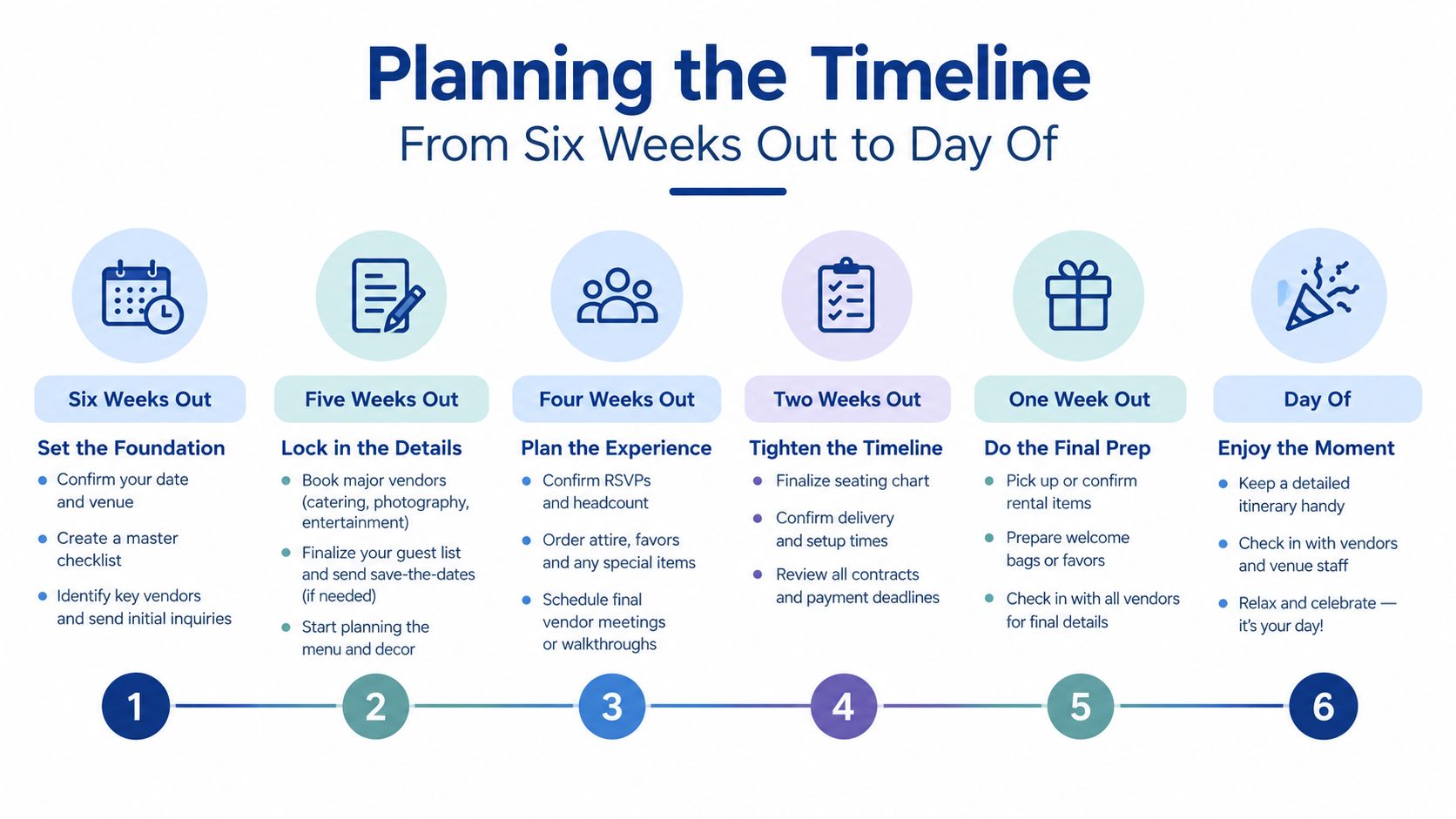
A six-week plan can still produce a relaxed engagement party, but only if decisions happen in the right order. Lock the venue, date, budget, guest-list framework, and vendor responsibilities before spending time on details that can wait.
The six-to-eight-week planning track
A six-to-eight-week lead time gives many engagement parties enough room for firm decisions and vendor coordination. Start by confirming the host, budget, venue, date, and approximate guest count. If those items are still changing, skip napkin colors and signature-drink names. They will not rescue a party with an unsettled layout or missing vendors.
At the next stage, send invitations, shortlist catering, choose the design direction, and confirm the bar plan. For a BYOB venue, verify whether the contract requires an approved bartender before purchasing alcohol. Four to six weeks before the event is a practical invitation window, as outlined by WithJoy's engagement-party planning guide.
Two weeks before the party, confirm the headcount, menu, bartender, rentals, dietary notes, seating needs, and whether guests will move between an outdoor ceremony or arrival area and the indoor hall. That flow affects signage, furniture placement, and vendor instructions. During the final week, prepare signage, finalize the playlist, confirm arrival details, and print a timeline with phone numbers and access information.
The day-of run-of-show
A long rental window changes the planning math. With a 16-hour access period from 8 a.m. to midnight, a Central Texas venue can separate load-in, setup, guest arrival, and load-out instead of forcing every vendor into the hour before the party.
A workable Saturday schedule might look like this:
- 8 a.m.: Vendor load-in begins.
- 11 a.m.: Décor, rentals, bar, and catering setup are underway.
- 4 p.m.: Guest arrival.
- 5 p.m.: Cocktail hour.
- 6 p.m.: Dinner or the main food service.
- 8 p.m.: Cake and toasts.
- 10 p.m.: Music ends.
- Midnight: Load-out is complete.
Give each vendor an arrival window rather than one shared call time. Assign one person to monitor bar supplies and another to direct parking, guest movement, or late vendor questions. The couple should greet relatives and take photographs, not hunt for extra chairs.
Protect cocktail hour and the cake or toast moment as fixed anchors. Dinner can flex if service runs long or a family member arrives late. A printed schedule keeps the host, caterer, bartender, DJ, photographer, and venue manager working from the same plan.
Central Texas Venue Features That Make Planning Easier
The most valuable venue features aren't the ones that look impressive on a tour. They're the ones that remove decisions on the party day. For a Central Texas engagement party, prioritize an on-site venue manager and a long rental window before spending more on decorative upgrades.
An on-site manager gives vendors one point of contact for access, furniture placement, sound, cleanup, and venue rules. That person can answer questions while the host stays with guests. A long rental window prevents the familiar rush where the caterer, florist, rental company, and bartender all arrive at once and try to build the party in the same narrow period.
Why indoor-and-outdoor flow matters
A property with an outdoor ceremony or arrival area and an indoor climate-controlled hall gives you options when the weather changes. Guests can start outside, move inside for dinner, and use the ceremony space for photographs without requiring a shuttle between separate addresses.
A single property can also simplify parking, deliveries, vendor directions, and guest movement. If the venue includes furniture, a prep kitchen, beverage bar, sound equipment, dressing areas, and cleanup support, the host has fewer outside rentals to coordinate. The specific services still need to be confirmed in the contract, but the operating model is straightforward.
The Kyle venue at Texas Old Town's Central Texas event venue provides four private halls, indoor and outdoor ceremony options, a 16-hour rental window, on-site management, a prep kitchen, a host-provided beverage structure with an approved bartending company, private parking, and included cleanup and furniture breakdown. Those details make it a relevant option for couples who want the party and its logistics handled on one Hill Country property.
Test the venue with a real schedule
Before signing, walk through the event as if it were already booked:
- Morning access: Can décor, rentals, and catering load in without crossing guest paths?
- Weather change: Can the ceremony or cocktail portion move indoors without rebuilding the entire room?
- Bar operation: Where will beverages be stored, served, chilled, and restocked?
- Guest movement: Can older guests and guests with mobility needs reach every important area easily?
- End of night: Who removes rentals, clears trash, breaks down furniture, and confirms load-out?
Watch for two red flags. The first is a venue that advertises a large capacity but can't explain how tables, bar service, food stations, dance space, and accessible paths will fit. The second is a venue that promises flexibility verbally but won't state setup access, weather backup, bar requirements, cleanup, and manager availability in the contract.
Ask for the practical answer to every question, not just a brochure description. You need to know who arrives, where they unload, what they use, when they leave, and who handles a problem after the couple walks into the party.
Texas Old Town offers four private event halls, indoor and outdoor ceremony settings, a 16-hour rental window, on-site management, flexible catering options, and a structured BYOB arrangement with an approved bartending company. Visit Texas Old Town to compare the property with your guest count, budget, preferred flow, and Central Texas event plans.