You're engaged, the venue tour is on the calendar, and the budget is still a moving target. That's the moment couples usually get into trouble. They start with a number that feels reasonable, then let guest count, upgrades, and contract fine print drag them into a wedding they didn't plan to buy.
If you want a clean answer to how to plan wedding budget, stop treating the budget like a wish list. Build it from cash, not vibes, then let the venue and guest list tell you what kind of wedding you can afford. That's the only way to avoid falling in love with a date, a room, and a menu before you know what the math can support.
Table of Contents
- Setting a Realistic Total Before You Book Anything
- What a Wedding Budget Actually Looks Like in Central Texas
- Building a Sample Budget You Can Actually Customize
- Four Realistic Budget Templates by Guest Count
- Negotiating Contracts and Tracking Every Payment
- Payment Timeline and What to Pay When
- Building a Contingency You Will Actually Use
Setting a Realistic Total Before You Book Anything
The first mistake couples make is calling a number a budget when it's really just a hope. You don't need a prettier guess. You need a hard ceiling built from what's available, then a working budget underneath it.
Start with three buckets. Add up liquid savings, confirmed family contributions, and the monthly amount you can set aside before the wedding date. That total is your ceiling, not your spending target. Keep a separate working budget below it, because you should reserve contingency money before you assign a dollar to flowers, linens, or signature drinks.
Practical rule: Don't touch a vendor spreadsheet until you've carved out your cushion. If you spend the contingency on upgrades, you're not “staying flexible,” you're just removing the only protection you have.
Couples usually need a reality check from someone who sees contracts all day. Budget planning guides from EasyRegistry's budget wedding advice make the same basic point, keep the total honest and cut waste early. That's right, but it's still too vague on its own. The better move is to decide, in writing, what the wedding can cost before you tour a venue with gorgeous landscaping and a seductive cocktail hour.
Use the venue hunt as a filter, not a fantasy builder. If you're still narrowing where to marry, this wedding venue selection guide helps you compare spaces without pretending every site costs the same. Book nothing until your ceiling, cushion, and first-priority categories are set.

What a Wedding Budget Actually Looks Like in Central Texas
National headlines are only useful if you know how to read them. In 2025, U.S. weddings averaged about $34,200 to $36,000, with The Knot reporting $34,200 from a survey of 10,474 couples and Zola projecting $36,000 for 2025. That tells you the center of gravity sits in the mid-$30,000s, not in fantasy-land bargain territory. Guest count moves that number fast. Zola reports weddings with 50–75 guests average $21,500, while 150–200 guests average $45,000 (The Knot).
Where the money goes first
The smartest budget planners don't start with decor. They start with the categories that swallow the biggest share. The Knot's 2026 Real Weddings Study found venue and rentals at 29%, catering, cake, and drinks at 24%, and photographer and videographer at 10% (The Knot). That's the practical map, because those are the lines that set the tone, eat the fastest, and punish underestimates.
Now add a Hill Country venue into the equation. A property with tables, chairs, cleanup, on-site management, and a long rental window absorbs expenses many generic budget guides assume you'll pay separately. That doesn't make the venue cheap. It makes the math more honest. You're not just buying a room, you're removing several outside rentals and a chunk of day-of coordination from your budget.
| Category | Share of Budget | Central Texas Note |
|---|---|---|
| Venue and rentals | 29% | Included furniture and cleanup can reduce outside rental line items |
| Catering, cake, and drinks | 24% | Guest count and service style drive this bucket hardest |
| Photography and videography | 10% | Often worth protecting if you care about the full story of the day |
| Other categories | Qualitative remainder | Dress, florals, stationery, music, and small logistics still add up |
A venue quote that includes logistics is more useful than a lower sticker price with a pile of extras. That's especially true when the site already gives you a real rental window, because a rushed timeline often creates add-on costs later.
Building a Sample Budget You Can Actually Customize
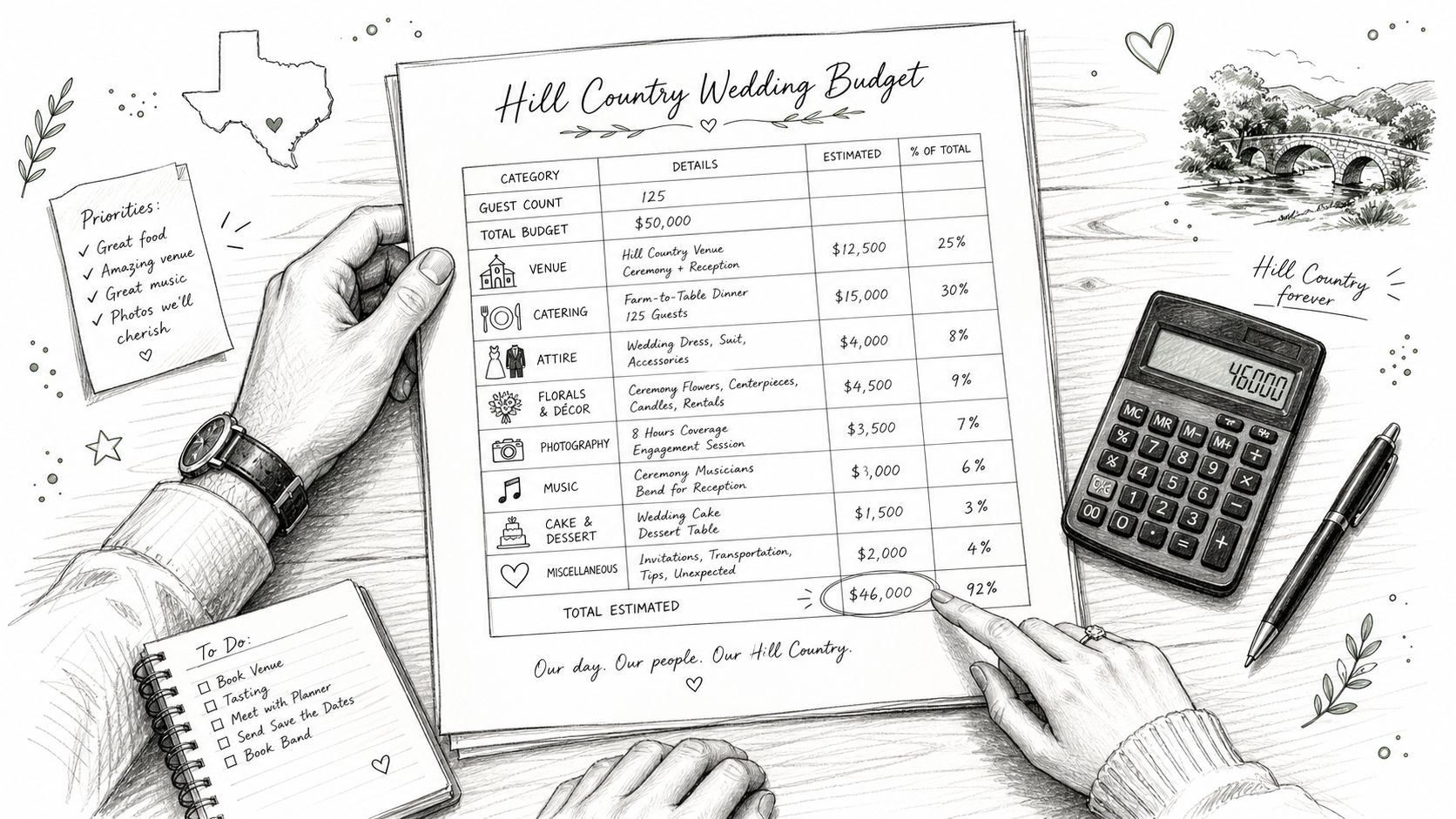
A sample budget only works if it forces choices. For a 180-guest Hill Country wedding, the per-guest math needs to be clean before you fall in love with menu upgrades or extra décor. The useful benchmark is a sit-down meal target of roughly $100 per guest in major U.S. markets, then adjust from there using your guest list and venue inclusions (YouTube budgeting guidance).
A workable 180-guest template
If you're building a full-service wedding, start with the categories that drive the total:
- Venue and site access: Budget as a core line first, then subtract anything included in the rental.
- Food and bar: Treat this as the anchor if you're serving a seated meal.
- Photography and video: Protect this before you start trimming décor.
- Music and entertainment: Decide whether you want one strong vendor or several smaller add-ons.
- Florals and décor: Keep this disciplined, because it expands fast when the room looks bare.
- Attire, stationery, and small logistics: These are not glamorous, but they're real money.
Here's the part generic percentage charts miss. If your venue already includes tables, chairs, cleanup, on-site management, rehearsal access, and a long rental window, remove the replacement cost of those items from your outside rental estimate. Then move those dollars into the things guests notice, better food, stronger photography coverage, or live music that changes the energy of the room. That's not a luxury move. That's a smarter allocation.
Budgeting truth: The venue's included services are not “extras.” They are savings only if you actually subtract them from the categories you would have rented elsewhere.
For couples who like to see this inside a real property context, Texas Old Town's published offerings make the point clearly. The venue provides exclusive 16-hour access, furniture counts, cleanup, and on-site management, plus flexible catering choices and a built-in beverage bar structure. That's exactly the kind of inclusion that should change the numbers on your spreadsheet, not just the mood of the tour.
The right way to customize a budget is simple, even if the contract language isn't. Start with the full amount, strip out what the venue already covers, and then reassign those savings by priority. If photos matter most, protect the photographer. If the reception is the heart of the event, protect catering and bar service.
Four Realistic Budget Templates by Guest Count
No single budget template works for every couple, because guest count changes the shape of the day. A small wedding can feel polished and generous if the spending is concentrated. A larger one has to spread the money farther, which means priorities have to be sharper.
Compare the budget style before you compare the price
- Intimate 80-guest celebration: Put more of the budget into food quality, service, and atmosphere. A tighter guest list lets you spend more per person without bloating the room.
- Balanced 150-guest wedding: At this point, venue efficiency matters most. If your venue already includes tables, chairs, and cleanup, you can shift funds into photography or entertainment instead of rentals.
- Large 220-guest gathering: Keep the menu and bar realistic. Bigger guest counts reward disciplined choices because every upgrade multiplies.
- Premium 100-guest experience: This is the point where couples usually choose quality over scale. They often prioritize design, service, and coverage over sheer size.
If you're looking for a venue fit for a mid-size celebration, this venue guide for 150 guests is a practical reference point for matching guest count to space instead of forcing the other way around.
Rule of thumb: The fewer people you invite, the more leverage you have over every dollar. The more people you invite, the more important it becomes to strip out anything the venue already includes.
The mistake I see most often is couples using one percentage formula for all four of these scenarios. That doesn't work. A 100-guest premium wedding and a 220-guest large wedding can't share the same spending logic because the pressure points are different. In the smaller event, you can afford to make each guest experience richer. In the larger one, you have to guard the food and service budget so the reception doesn't feel thin.
The best template is the one that matches your real headcount and your venue's actual inclusions. If the site absorbs logistics, your money should move to guest experience. If the site is bare-bones, your budget needs to absorb the rentals, staffing, and cleanup that someone has to pay for.
Negotiating Contracts and Tracking Every Payment
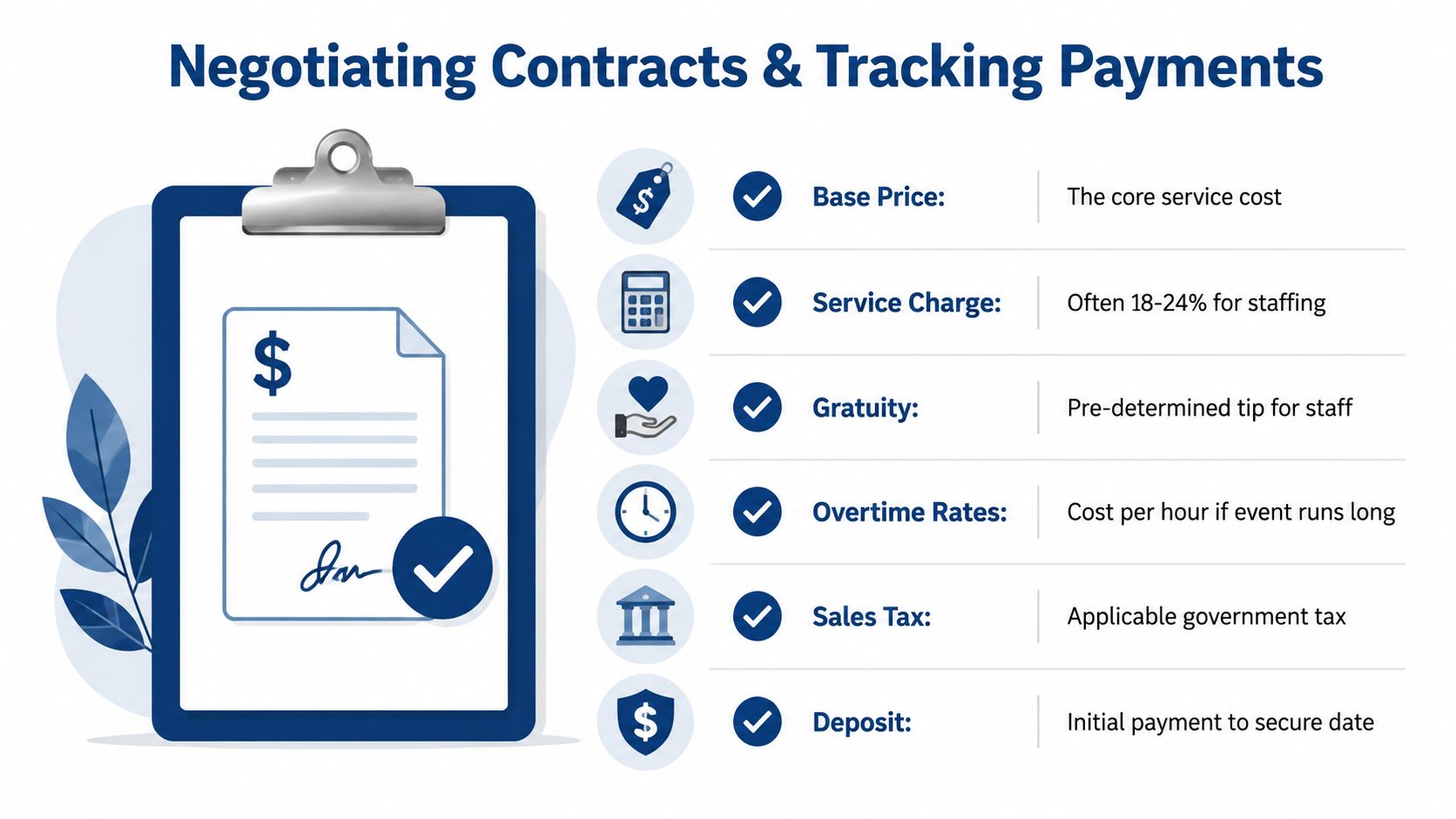
A vendor contract isn't just a price. It's a stack of costs hiding inside one line. Read for the base price, service charge, gratuity, overtime, tax, deposit schedule, and cancellation terms. Those are the figures that change what you owe.
What to push on and what to leave alone
Some line items can move. Others won't budge.
- Flexible items: bar minimums, add-on photo hours, some package upgrades, and extras that sit outside the core service.
- Less flexible items: peak-season Saturdays, food minimums, and policies tied to staffing or hard venue rules.
Negotiate like a professional, not like a nuisance. Ask whether the contract can be narrowed to what you'll use, then stop there. A venue manager or caterer is far more likely to work with you on scope than on core pricing.
A clean tracking system prevents the ugly surprise that hits three weeks before the wedding. Keep one spreadsheet with estimated cost, actual cost, payment due date, and balance remaining for every vendor. Put deposits, milestone payments, and final balances on the same sheet so you can see the whole load at once.
If you're using a venue with a structured payment plan, use that as the spine of the whole budget. Texas Old Town's payment plans for weddings are a good example of why that matters, because the venue payment can anchor the rest of the calendar instead of forcing a last-minute scramble.
Payment Timeline and What to Pay When
The payment calendar should feel boring. That's a compliment. If you know what leaves your account and when, you won't panic-buy with a credit card because three vendor balances landed in the same week.
Put the biggest checks first
Venue and photography deposits usually deserve first place because they secure the date and the visual record. After that, tackle food, bar, and the vendors with limited calendars. Attire, alterations, invitations, and marriage license fees fit into the middle of the timeline, not the end, because they're easy to forget until the receipt pile gets messy.
A disciplined 12-month countdown keeps the whole thing under control. The venue often sets the rhythm, especially when it offers a predictable monthly plan. That's far cleaner than trying to build a separate savings system from scratch while every vendor asks for money on a different schedule.
Practical rule: Put the final balances on a calendar before you book the honeymoon. The week before the wedding should not be the first time you notice a payment is due.
Don't forget rehearsal dinner and day-after brunch if those events are part of your plan. They can sit outside the core wedding budget and still land on the same household cash flow. If you don't assign them a line early, they'll borrow from the categories that matter most on the wedding day.
The timing of payments matters because wedding spending is front-loaded. The earlier you build the schedule, the less likely you are to raid your contingency fund just to stay current. That's the difference between a budget and a mess.
Building a Contingency You Will Actually Use
The contingency is not extra spending money. It's the part of the budget that keeps one overtime charge or last-minute replacement from wrecking the plan. Size it at 10 to 15 percent, keep it separate from the working budget, and stop pretending it's optional.
Use it for the surprises, not for impulse upgrades. Overtime, weather-related adjustments, attire alterations, small service charges, taxes, and replacement décor are exactly what this money is for. If you keep that bucket visible and untouched, you'll make calmer decisions when the invoices start landing.
Final budget order: set the ceiling, reserve the contingency, fund the big categories, then track every payment line by line.
The most common surprise costs are the ones couples think are too small to matter, until they're not. Overtime runs. Weather shifts. Last-minute décor replacements. Alterations. Service charges and taxes. Those are the budget leaks that turn a careful plan into a scramble.
Quick FAQ
Can I use the contingency for upgrades? Only if you're done covering the risk items first.
What's the first category I should price? Venue and guest-count-dependent food costs.
What if my venue includes a lot of services? Subtract those values from the outside rental lines and reassign the savings.
Texas Old Town gives couples a real Hill Country setting with four venues, a 16-hour rental window, included furniture, cleanup, on-site management, and flexible vendor options, which makes the math easier to see before contracts pile up. If you're comparing spaces and trying to build a wedding budget that reflects what the venue absorbs, visit Texas Old Town and look at how the included logistics change the numbers on your sheet.