You're standing in a Hill Country field with a Pinterest board open on your phone. The board is full of peonies, garden roses, and eucalyptus runners, while the September thermometer sits near 90 degrees. The ceremony is still hours away, but you're already wondering whether those flowers will look fresh through the toasts.
That concern is practical, not pessimistic. Inspiration photos often reflect different climates, growers, transportation systems, and hydration schedules. A stem that photographs beautifully in a cool studio can lose its shape quickly in full Central Texas sun. Native floral designs solve that execution problem first, then deliver the style.

The right regionally adapted flowers can hold their structure through outdoor vows, photographs, dinner, and dancing. Black-eyed Susan, Mexican sunflower, horsemint, and Gregg's mistflower fit the heat, low humidity, and limestone conditions that define many Hill Country sites. Texas Old Town's halls and outdoor ceremony areas also create different demands, from ornate indoor millwork to exposed lawns and arbors.
If you're planning a rustic Texas celebration, start with the practical questions. What blooms during your wedding month? Which stems tolerate heat? Where should each arrangement go? Which pieces deserve professional labor, and which can be simplified? The recommendations below answer those questions directly, including the trade-offs that matter at a real venue. For broader planning considerations, review these essential tips for planning a rustic Texas Hill Country wedding.
Table of Contents
- When Hill Country Inspiration Meets a Real Wedding Day
- What Makes a Floral Design Native
- Texas Hill Country Seasonal Bloom Calendar
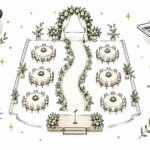
- Styling Native Florals Across the Four Halls and Outdoor Ceremony Site
- Bouquet, Centerpiece, and Arbor Concepts That Travel Well
- Budgeting Native Florals for a 150 to 200 Guest Hill Country Wedding
- Vendor, Hybrid, and DIY Execution Paths Compared
- Your Native Floral Planning Checklist and Common Pitfalls
When Hill Country Inspiration Meets a Real Wedding Day
A wedding flower plan fails when it's designed for the photograph instead of the schedule. A bridal bouquet may leave the cooler in good condition, sit through a first look, travel to the ceremony, wait through family portraits, and remain in the reception room for hours. Outdoor arches face an even harder test because their mechanics, foliage, and water sources absorb heat before guests arrive.
Design for the conditions you actually have
I'd rather build a restrained arrangement from durable regional material than promise a lush imported design that needs constant rescue. The Hill Country is not a mild garden climate. From late spring through early fall, ceremony pieces may face direct sun, reflected heat from stone or pale surfaces, wind, and long stretches without convenient shade.
Native floral designs work because the plant palette starts with local performance. Black-eyed Susan gives you a strong yellow focal point, Mexican sunflower brings height and saturated orange, horsemint adds airy vertical texture, and Gregg's mistflower contributes cool purple tones. These choices don't make a wedding look rough or unfinished. They give the designer material that can stay visually intentional after the weather starts working against it.
Field rule: If a centerpiece only looks right inside a cooler, it isn't ready for an outdoor ceremony.
Build around the venue schedule
Put fragile flowers in shaded or climate-controlled locations. Reserve the toughest stems for the aisle, arbor, welcome sign, and other pieces that sit outside before guests arrive. Keep bouquets out of direct sun, and make sure someone knows exactly when ceremony flowers move to the reception.
That level of planning also supports the property itself. Native planting guidance recommends clustered patches, layered vegetation, and regionally adapted species because those choices support pollinators, reduce water demand, and create more reliable habitat function than isolated ornamental planting. The same logic applies to event design. A palette that belongs to the surrounding area usually looks more convincing and requires fewer artificial corrections.
What Makes a Floral Design Native
A floral design isn't native because it looks loose, meadow-like, or slightly untamed. Wildflower style describes an aesthetic. Native describes origin, ecological fit, and seasonal availability.
Three tests make the distinction useful:
- Regional origin. The plants naturally occur within the local Hill Country ecoregion or come from a closely adapted regional palette.
- Ecological fitness. The plants can handle local soil, heat, drought patterns, and growing conditions.
- Seasonal availability. The flowers are used when they naturally grow and can be sourced, rather than being forced year-round in a greenhouse.
A bouquet of imported cosmos and Mediterranean annuals can look like a native meadow, but the label doesn't make it locally adapted. Conversely, a refined arrangement of native grasses, salvia, yarrow, and silver foliage can look polished enough for a formal hall while still reflecting Central Texas.

Native doesn't mean sparse
The old idea that native plants look like weeds belongs in the bin. Hill Country selections offer warm yellows, orange, dusty purple, white, pale pink, and silvery green, along with varied heights and flower forms. A designer can create a compact Victorian-inspired bouquet, a structured modern centerpiece, or a loose field-style arbor without relying on imported garden roses.
Native plants also make sense around wedding properties that border natural habitat. Clustered blooms give pollinators easier access than scattered single plants, while grasses, shrubs, and trees provide vertical layers. Guidance on native plantings similarly emphasizes grouping plants and combining flowering species with broader habitat structure. Couples interested in carrying the idea into their home garden can use this practical overview of using natives in your yard.
The strongest native floral designs sit at the intersection of beauty and logistics. They respect the wedding's visual language, but they also account for harvest timing, hydration, transport, installation, and the actual conditions at the venue.
Texas Hill Country Seasonal Bloom Calendar
A wedding date should determine the floral palette, not the other way around. Availability varies by grower, weather, and whether a flower is being harvested for design or photographed in a garden, so treat the calendar as a planning framework and confirm the final list with a local florist or farm.
| Month | Anchor Native Species | Color Range | Typical Sourcing |
|---|---|---|---|
| March | Anemones, native poppies, bluebonnets, Mexican plum branches | Blue, white, red, coral, soft pink, green | Hill Country growers, seasonal farms, responsible local foraging |
| April | Bluebonnets, native poppies, Mexican plum, early sage | Blue, white, red, purple, blush | Local farms, specialty growers, florist-sourced seasonal material |
| May | White prickly poppy, blackfoot daisy, early sages, Indian blanket | White, cream, yellow, red, burgundy, lavender | Native growers, regional flower farms, florist networks |
| June | Blackfoot daisy, sages, Indian blanket, lantana | White, purple, yellow, orange, red | Hill Country farms, native nurseries, local growers |
| July | Crape myrtle, goldenrod, Mexican sunflower, heat-tolerant sages | Pink, purple, yellow, orange, red | Regional growers, cultivated landscape cuts, florist sourcing |
| August | Mexican sunflower, goldenrod, crape myrtle, dried grasses | Orange, yellow, pink, purple, tan | Local farms, specialty growers, dried-material suppliers |
| September | Horsemint, Gregg's mistflower, frostweed, Maximilian sunflower | Purple, blue, white, yellow, gold | Hill Country growers and seasonal native farms |
| October | Gregg's mistflower, frostweed, horsemint, Maximilian sunflower | Purple, white, lavender, yellow, gold | Local growers, native farms, florist-sourced seasonal cuts |
| November | Texas mountain laurel foliage, agarita, yaupon holly | Deep green, silver green, burgundy accents | Native nurseries, cultivated landscape cuts, florist sourcing |
The late-summer gap needs a different strategy
July and August are where conventional inspiration often breaks down. Many temperate imports arrive after long transport or struggle once they're placed outdoors. Native options become more than a stylistic preference in this period. Mexican sunflower, goldenrod, crape myrtle, and durable grasses provide height, movement, and color without pretending the season is spring.
For a simple planning aid, couples can sketch ceremony sightlines, table groupings, and repurposing routes with a free garden design software option. Use it to test scale and placement, not to promise exact bloom availability.
September and October offer the richest opportunity for a true Hill Country identity. Horsemint, Gregg's mistflower, frostweed, and Maximilian sunflower can create a layered meadow effect that feels tied to the region. November shifts toward foliage, berries, branches, and texture, which suits intimate indoor designs especially well.
Styling Native Florals Across the Four Halls and Outdoor Ceremony Site
Each room needs a different floral scale. The same low arrangement that looks elegant in a bright room can disappear against timber beams, while a tall design that works in a large hall can compete with ornate architectural details.
Magnolia
The Victorian-inspired Magnolia calls for compact, scent-forward arrangements. Use yarrow, salvia, and Texas mountain laurel on escort tables, where guests can appreciate their texture without blocking conversation. Keep the head table runner low, and place single-stem succulents in small bud vases so the design follows the table instead of fighting the chandeliers and millwork.
Stone
Stone can carry more visual weight. Exposed timber needs structural material that registers from a distance, so consider agave bloom cuttings, twisted cedar, yucca pods, and broad native foliage in taller, wider vessels. Avoid making every arrangement narrow and delicate. The room's architecture will swallow undersized pieces.
Scheel
Scheel's barn character suits softer meadow natives. Bluebonnet bunches work only during their real season, while coreopsis, Mexican feathergrass, and related field textures can carry the look at other times. Keep arrangements loose but controlled, with enough negative space to complement the weathered wood and preserve the barn's vertical lines.
Lilian
The light-filled Lilian rewards brightness and air. Black-eyed Susans, Indian paintbrush, gomphrena, pale grasses, and open foliage will show clearly against white shiplap and natural window light. Use transparent or light-colored vessels where possible, and avoid dense dark masses that flatten the room in photographs.
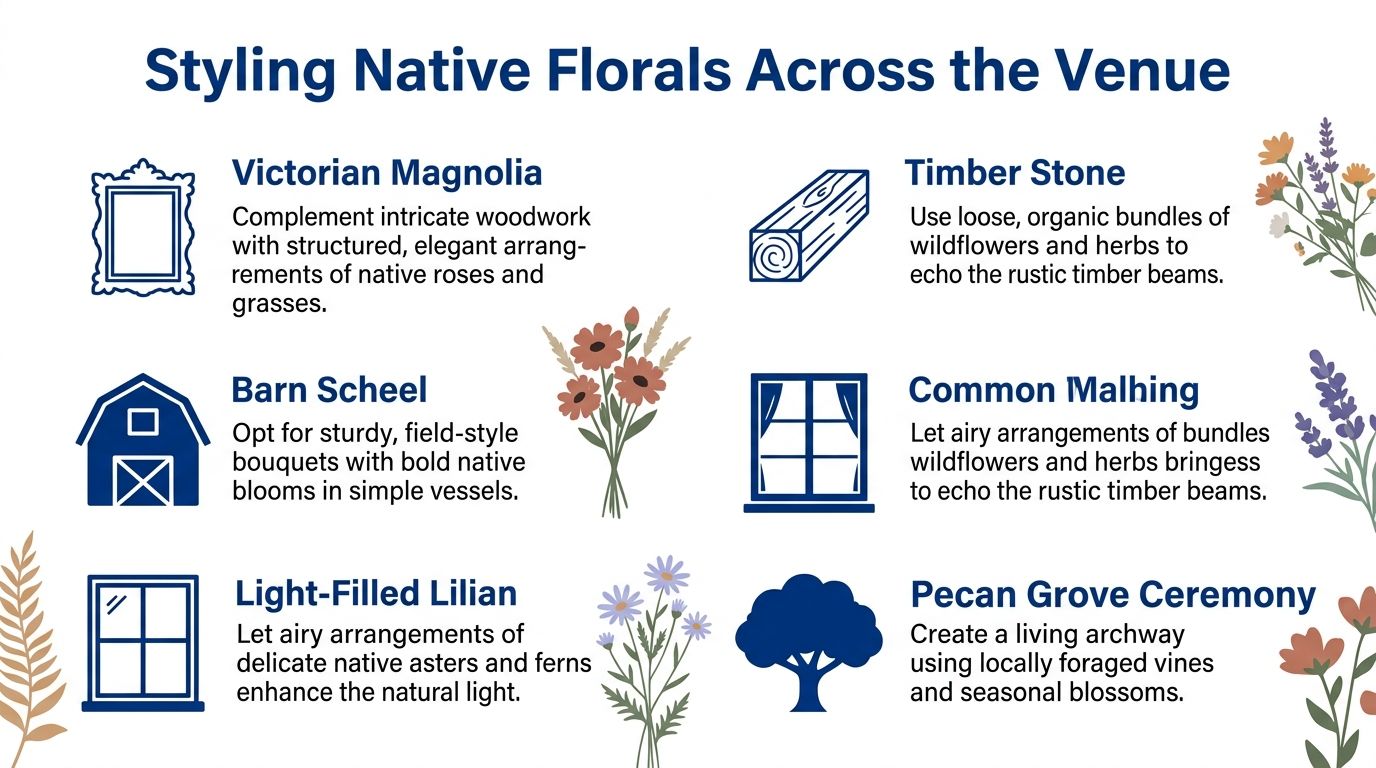
Pecan Grove
Outdoor work needs mechanics before color. Build meadow-style ground arrangements into chicken wire, secure smilax garlands to the wooden arbor without damaging the structure, and weight aisle vessels with sand or another concealed stabilizer. Test every installation for wind before guests arrive.
A venue with indoor and outdoor options changes the contingency conversation. Texas Old Town describes its indoor and outdoor event space as offering both ceremony settings, which lets couples create a backup plan without abandoning the floral concept. Design the same palette in two scales, one for the lawn and one for the hall, so a weather move doesn't make the flowers look improvised.
Bouquet, Centerpiece, and Arbor Concepts That Travel Well
A cohesive wedding palette should survive movement. The bridal bouquet, guest tables, ceremony arbor, and repurposed reception pieces don't need identical flowers, but they should share a recognizable color story and texture.
| Concept | Bouquet | Low Centerpiece | Tall Centerpiece | Arbor Install |
|---|---|---|---|---|
| Loose Hill Country | Bluebonnets, Queen Anne's lace, silver-leafed sage, raw linen wrap | Mercury-glass clusters of salvia and larkspur | Airy branches, meadow stems, and sage | Smilax, dried echinacea pods, trailing love-in-a-mist |
| Sculpted Native | Artichoke blooms, poppy anemone, seeded eucalyptus | Succulent orbs and compact foliage | Strong vertical stems with geometric spacing | Dense panel with camellia foliage and magnolia leaves |
| Foraged Wild | Black-eyed Susans or zinnias tied in simple bundles | Vintage bottles of thyme and rosemary | Olive branches, dried wheat, pepperberry | Loose asymmetrical greenery and dried texture |
Loose Hill Country
This is the most naturally romantic option. It photographs beautifully in Scheel or outdoors, especially when the bouquet has movement rather than a tight dome. Keep the fragile trailing elements shaded until portraits and move the arbor installation as close to the ceremony start as the schedule allows.
Sculpted Native
Choose this family for Magnolia or Stone. Succulents, artichoke forms, sturdy foliage, and strong lines hold a composed silhouette. It costs more in design labor because the shape has to be built deliberately, but it remains visually organized when the room or weather is demanding.
Foraged Wild
Foraged Wild is the practical choice for couples who want high texture without a large flower count. Single-species bridesmaid bundles and small herb bottles can lower design complexity, while dried wheat and branches reduce the pressure on same-day hydration. Still, don't confuse simple with unattended. Every stem needs conditioning, clean vessels, and a defined installation window.
For a 90-degree afternoon, place the most durable material outdoors and stage delicate anemones, bluebonnet foliage, and soft trailing stems in shade or refrigeration. The best design is the one that can be moved without losing its identity.
Budgeting Native Florals for a 150 to 200 Guest Hill Country Wedding
Native materials can reduce waste and improve seasonal fit, but they don't make labor disappear. A florist still has to source stems, condition them, design the pieces, transport them, install the arbor, move ceremony arrangements, and collect rental vessels.
The figures below use the requested 2026 Hill Country planning bands for a 175-guest example. They're a working worksheet, not a universal quote. Travel distance, flower scarcity, design complexity, vessel rentals, and weather protection can move the final number.
| Line Item | Qty | Low ($) | High ($) | Cuttable? |
|---|---|---|---|---|
| Bridal bouquet | 1 | 180 | 325 | No |
| Bridesmaid bouquets | 6 | 95 | 150 each | Simplify |
| Boutonnieres | 8 | 18 | 28 each | Yes |
| Low centerpieces | 14 | 85 | 145 each | Simplify |
| Ceremony-to-reception arrangements | 2 | 275 | 425 each | No, repurpose |
| Arbor install | 1 | 650 | 1,400 | Simplify |
| Ceremony aisle pieces | 6 | 65 | 110 each | Yes |
The listed line items don't represent the entire package. Delivery, setup, breakdown, travel, rental vessels, conditioning, and labor can sit outside the visible flower costs. Ask the florist to separate product, design labor, delivery, installation, repurposing, and strike so you can see what you're paying for.
Three workable budget tiers
- Full vendor package, $7,200 to $11,800. The florist handles sourcing, conditioning, personal flowers, tables, ceremony pieces, installation, repurposing, and breakdown.
- Hybrid package, $5,400 to $8,900. The couple takes on simpler personal flowers or table work while the florist retains the arbor, larger ceremony pieces, and transition logistics.
- Full DIY package, $2,800 to $4,600. The couple sources from grocery or wholesale channels and accepts responsibility for storage, design, transport, setup, repairs, and cleanup.
Cut boutonnieres before you cut the arbor structure. Guests notice the ceremony focal point and reception tables far more than small lapel flowers. A useful budgeting framework is this wedding budget planning guide, then add a specific line for floral travel and strike rather than treating them as surprises.
Vendor, Hybrid, and DIY Execution Paths Compared
For a 150-guest wedding with ceremony florals, eight bridesmaid bouquets, ten centerpieces, and one arbor install, the choice isn't only about flower cost. It's about who owns the failure points.
| Execution Path | Typical Cost Band | Effort From Couple | Heat/Durability Risk | What You Still Handle |
|---|---|---|---|---|
| Full vendor | Higher, based on scope and labor | Low | Lowest when professionally conditioned and staged | Approvals, final counts, weather decisions |
| Hybrid | Moderate | Medium | Shared | Personal flowers, simple table pieces, handoff timing |
| DIY | Lowest listed option | High | Highest | Sourcing, cooler space, setup, repairs, repurposing, strike |
Full vendor
A full-service florist manages the cooler, stem conditioning, delivery window, arbor mechanics, and Saturday strike. This path removes the most stress from ceremony-to-reception transitions, especially when the design includes heat-sensitive materials or ladder work. You still need to approve substitutions and confirm who receives the flowers if the delivery arrives before the wedding party is ready.
Hybrid
Hybrid works when the couple is organized and wants control over personal flowers. You might make bouquets, boutonnieres, and simple mason-jar centerpieces, while a florist designs and installs the arbor, altar arrangements, and head table.
Plan for two separate workflows. The florist needs access and installation timing, while your personal-flower team needs cooler space, clean water, tools, and a person assigned to repair broken stems. This saves money, but it adds meetings and coordination.
DIY
DIY eliminates vendor labor pressure but creates a demanding wedding morning. Someone must receive the flowers, inspect damage, condition the stems, maintain hydration, transport pieces, install at the venue, and return or dispose of materials. A 6 a.m. setup can also put the couple's family in the middle of a job that requires ladders, mechanics, and weather judgment.
My recommendation is simple. Use full service for outdoor arbors and ceremony installations, hybrid for personal flowers and easy table pieces, and full DIY only when you have a capable team that wants the work.
Your Native Floral Planning Checklist and Common Pitfalls
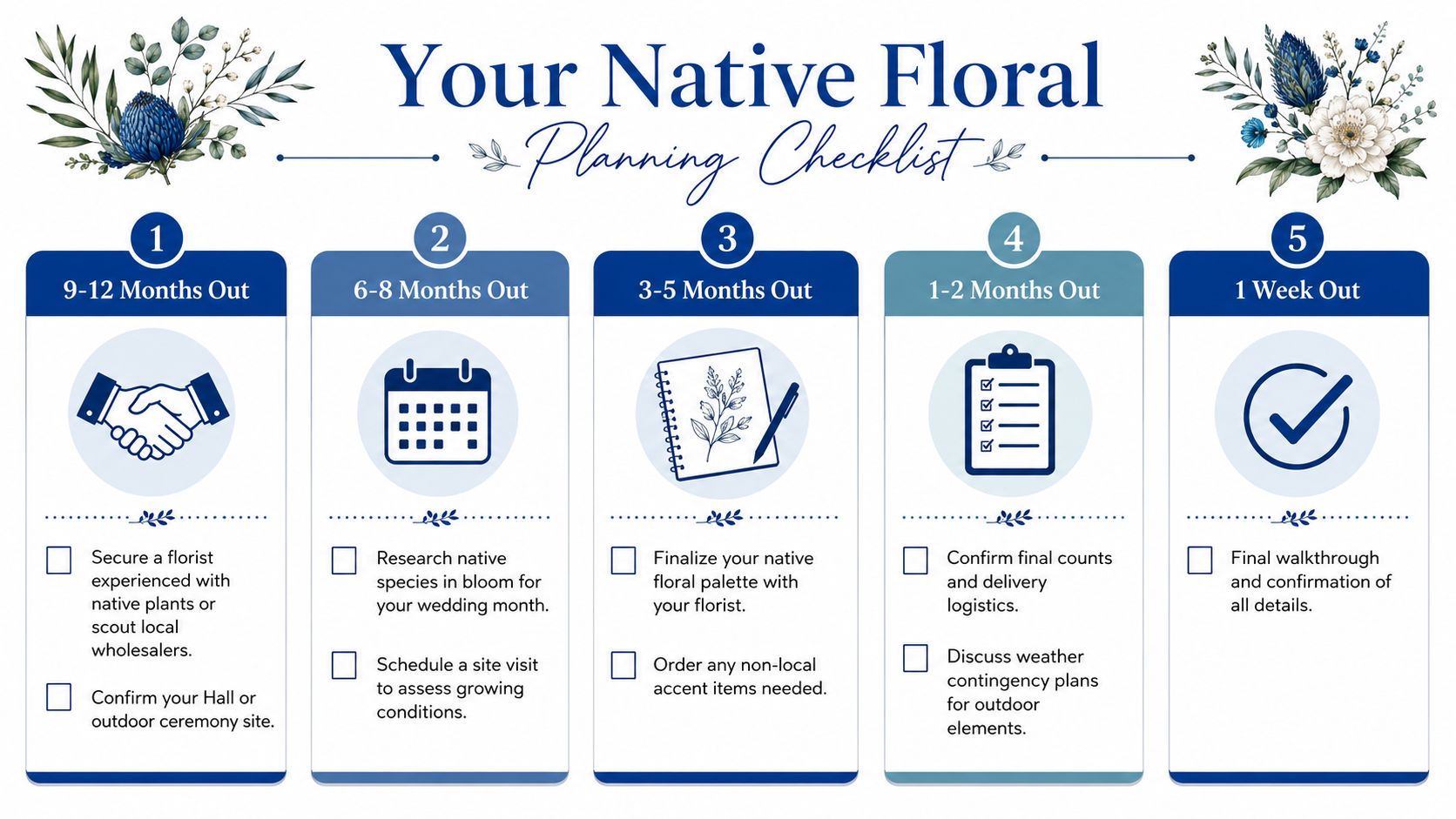
Use this timeline as a working document, then attach your wedding date, venue layout, bloom list, vessel plan, and weather contingency to it.
Start early
- Nine to twelve months out: Secure a florist who understands native plants, or scout reliable regional growers and wholesalers. Confirm floral rules, access, and ceremony policies with the venue.
- Six to eight months out: Match the wedding date to realistic native bloom windows. Schedule a site visit and identify sun exposure, wind direction, shade, power, water, and the ceremony-to-reception route.
- Three to five months out: Finalize the palette, approve substitutions, reserve the arbor mechanics, and decide which pieces will be repurposed.
- One to two months out: Confirm counts, delivery windows, cooler access, vessel quantities, installation labor, and the weather plan. Label every piece by destination.
- One week out: Condition stems in cool water, prepare hydration supplies, confirm the receiving person, and keep a written move-and-strike list.
Avoid predictable mistakes
Bluebonnets aren't guaranteed commercial material, so don't build the entire wedding around them. Peonies can also create a mismatch when a couple expects reliable Hill Country availability beyond their natural season. September arches need special attention because sun, wind, and heat attack the exposed mechanics before guests see them.
Low centerpieces can disappear beneath chandeliers and large architectural details, especially in ornate rooms. Check the sightline from seated guests, the dance floor, the head table, and the photographer's main angles.
Final filter: If a bloom can't survive four hours outside in 90-degree sun without water, it doesn't belong in the ceremony space.
Native floral designs work best when the plan respects the season, the venue, and the labor required to keep every piece presentable. Texas Old Town offers four distinct halls, outdoor ceremony settings, extended access for event preparation, and on-site management that can support a carefully timed floral installation. Visit Texas Old Town to tour the spaces, test your floral sightlines, and discuss a Hill Country wedding plan built for the actual weather.