You've chosen the drinks, saved a photo of a rustic bar, and started debating signature cocktails. Then your bartender asks where the reserve ice will go, your rental company asks about power, and someone asks what happens if the afternoon is too hot for outdoor service. The bar looks ready on paper, but the operating plan isn't finished.
An outdoor wedding bar works when the people, equipment, and weather decisions fit together. Before committing to a drinks package, make sure someone can explain how guests will get served, how staff will replenish supplies, and who can change the plan when conditions change.
Table of Contents
- Start With the Venue Rules and Service Promise
- Secure Venue Rules and Build the Infrastructure
- Estimate Drinks and Choose the Bar Format
- Design the Bar Around Guest Flow
- Match Bartenders to Service Complexity
- Make Heat Safety Part of Bar Service
- Finalize the Guest Experience and Contingency Plan
Start With the Venue Rules and Service Promise
Consider a planning scenario: the drinks are ordered and the counter is reserved, but nobody has confirmed whether outside alcohol is allowed. The bartender expects a sheltered workspace. The couple expects service on the lawn. Both assumptions can't remain unresolved until delivery day.
Start by defining what you're promising guests, then check whether the venue and bartender can deliver it. A full hosted bar, wine with dinner, and a short outdoor cocktail service are different commitments. They need different menus, service arrangements, and handoffs.
Define the experience before booking it
Describe the service in plain language. Specify where drinks will be available, which categories you'll offer, whether guests will pay anything, and when service will end. Include the transition from ceremony to reception, not just the reception itself.
Ask the venue and prospective bartender to resolve the questions that affect that promise:
- Alcohol arrangements: Who may supply, serve, or sell alcohol, and what approvals apply to the proposed format?
- Guest access: Are outside drinks permitted, and how will staff explain the policy?
- Working location: Is the outdoor counter an approved service location or a decorative rental?
- Decision authority: Who can change the menu, pause service, or move guests inside?
Don't assume a vendor who supplies a specialty beverage can operate under the same arrangements as your alcohol provider. If you're considering a separate tea or matcha experience, The Matcha Bike's pop-up matcha service dates provide a starting point for exploring that idea before asking about private-event availability and requirements.
Practical rule: Promise the service your team can operate reliably, not the menu that looks most impressive on a sign.
Keep the couple out of routine service decisions once the celebration begins. Name a planning contact who can answer vendor questions and a venue contact who can approve location changes. The bartender should also know who handles guest concerns that fall outside beverage service.
That clarity matters more than an elaborate display. Guests experience the bar through availability, communication, and comfort, not through the amount of equipment you rented.
Secure Venue Rules and Build the Infrastructure
Get written venue approval before buying equipment or committing to a mobile bar. Ask the venue and approved service provider to identify any permits, insurance documents, or other permissions required for your arrangement. Don't treat a rental company's willingness to deliver as approval to operate.
Use the venue's contract conversation to distinguish included amenities from responsibilities you retain. Bring a written question list when reviewing venue rental contracts, especially around beverage supply, approved bartenders, delivery access, and cleanup boundaries.
Inspect the working space
Walk behind the proposed counter, not just in front of it. Ask the bartender to identify where staff will prepare drinks, wash or manage utensils, hold cold products, and place used equipment. A handsome counter may still need substantial support equipment.
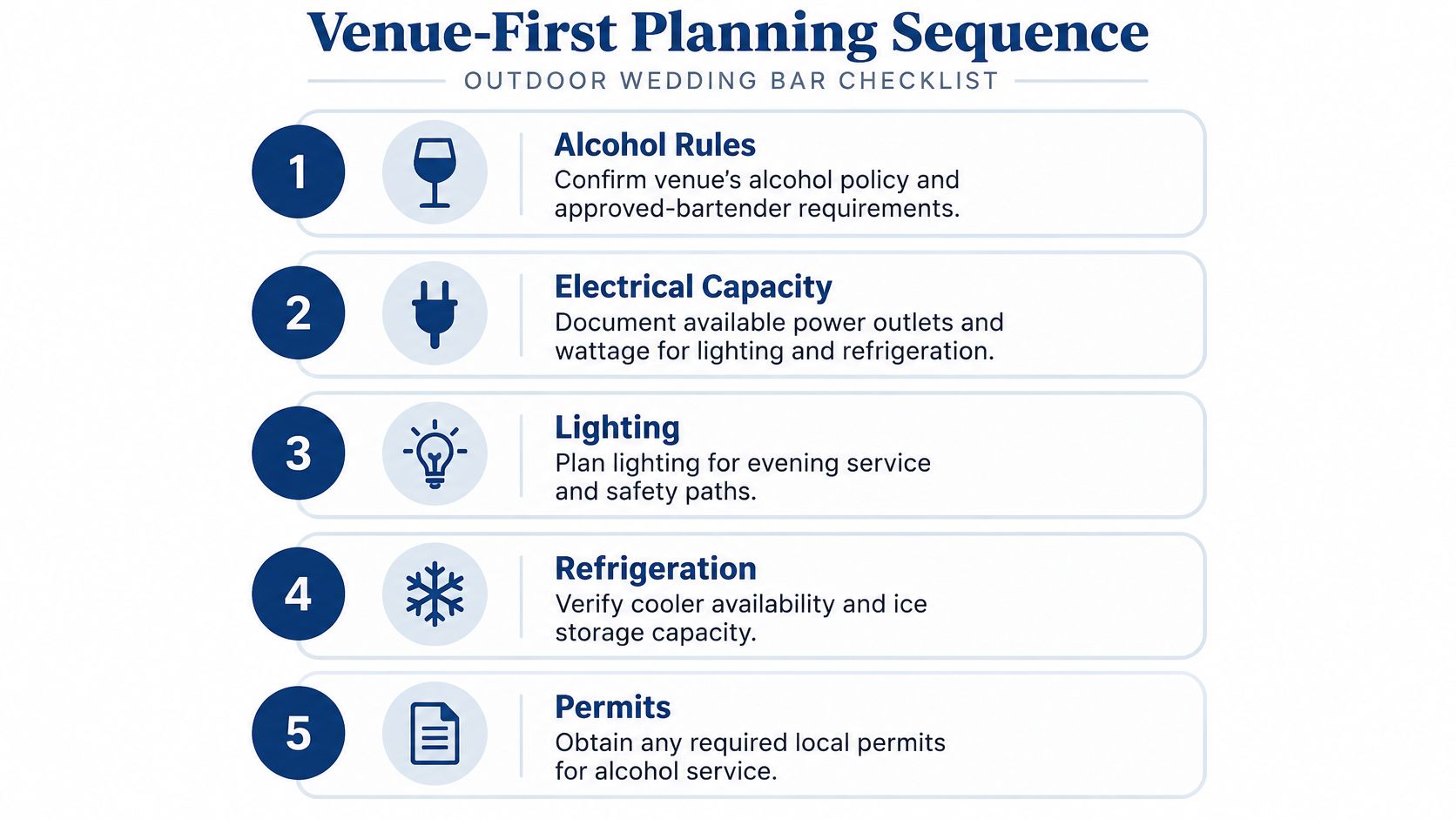
Have vendors document their actual requirements rather than accepting “we just need an outlet.”
- Power: List refrigeration, lighting, dispensing equipment, and payment devices. Have the venue confirm suitable circuits and approved cable routes.
- Lighting: Illuminate the work surface, menu, guest approach, and staff route. Decorative lighting alone shouldn't be the working-light plan.
- Cold storage: Confirm what equipment is included, what must be rented, and whether it can hold incoming deliveries.
- Water and drainage: Identify approved water access and disposal arrangements. Don't leave cooler drainage or wastewater placement to improvisation.
- Shelter: Confirm an approved shaded work area and how any temporary shelter will be installed.
Draft beer deserves its own equipment discussion. Carbon 6 Brewing Pty Ltd.’s guide to choosing taps for craft beer can help frame questions for the dispensing vendor. Have that vendor specify the complete setup, including cooling, compatible components, installation, and removal.
Put ownership on the site plan
Mark delivery entrances, storage, furniture placement, waste collection, and the indoor alternative. Label who owns each task and when it must happen. “The caterer will probably handle it” isn't an assignment.
A built-in beverage bar can be an indoor service base, while an outdoor counter serves a shorter portion of the celebration. Confirm whether the same equipment must move between them or whether each location needs a separate setup.
Before approving the plan, ask the venue manager and bartender to review it together. Their agreement should cover the practical handoffs: who receives beverages, who checks equipment, who opens storage, and who closes the service area.
Estimate Drinks and Choose the Bar Format
Start with attendance and service duration, then adjust for the people you're hosting. Don't buy the same package you'd choose for a different guest list just because the reception looks similar.
For budget context, The Knot's wedding alcohol cost research reports a $2,800 national average alcohol expenditure in its 2025 study, with 58% of couples offering a full open bar. Those figures aren't a Central Texas quote. Ask vendors to separate beverages, labor, equipment, delivery, and other charges so you can compare equivalent proposals.
Outdoor Wedding Bar Quantity Planning
| Planning Input | Reference Method | Planning Question |
|---|---|---|
| Guest attendance | Use the expected reception audience | Who will actually be present during beverage service? |
| Service duration | Count the hours drinks will be available | Does the schedule include cocktail service and dinner? |
| Beverage preferences | Divide expected demand by category | What do these guests prefer, including alcohol-free drinks? |
| Purchasing units | Convert planned servings into bottles and cases | What sizes and pack formats does the supplier sell? |
| Reserve stock | Schedule replenishment away from the counter | Who monitors inventory and authorizes opening backups? |
As a starting estimate, use approximately one drink per guest per reception hour: a 100-person, five-hour reception suggests about 500 drinks; a commonly used allocation is 50% wine, 30% beer, and 20% spirits, with purchasing conversions of roughly five 5-ounce wine servings per 750-mL bottle, sixteen 1.5-ounce spirit servings per 750-mL bottle, and twenty-four beers per case, according to Plana's wedding bar planning guide.
Treat that example as a worksheet, not a consumption target. Adjust the category mix for your guests, and deliberately allocate alcohol-free demand rather than adding it as an unbudgeted extra. Reception length, attendance changes, and the service menu should all be reflected in the final order.
For the wine portion, use the McLaren Vale Cellars wine checklist as a companion resource when preparing questions for your supplier.
Choose selection and payment separately
Beer-and-wine service keeps the menu focused but offers less customization. A full bar gives guests more choice while requiring a more involved equipment and staffing plan.
“Hosted” describes who pays, not how extensive the selection must be. You can host a restrained menu rather than promise every possible drink.
A consumption-limited arrangement needs an agreed spending or inventory boundary, a monitoring owner, and a clear response when that boundary approaches. Don't ask bartenders to negotiate a budget extension with the couple during dinner. Decide beforehand whether service ends, the menu narrows, or an authorized contact approves more.
Design the Bar Around Guest Flow
Plan the route a guest follows, not just the counter's position. Someone should be able to approach, read the menu, order, collect a drink, and leave without crossing through the next group waiting.
Use the venue's wedding venue floor plans to begin that conversation, then verify the arrangement on the ground. A clear rectangle on a drawing doesn't show a soft lawn, a door swing, or a delivery cart's turning space.
Give each activity a place
Keep the menu visible before the ordering point. Mark where guests should wait and where completed drinks will be handed over. Separate pickup only when the bartender can manage it clearly, otherwise guests may struggle to tell whose order is ready.
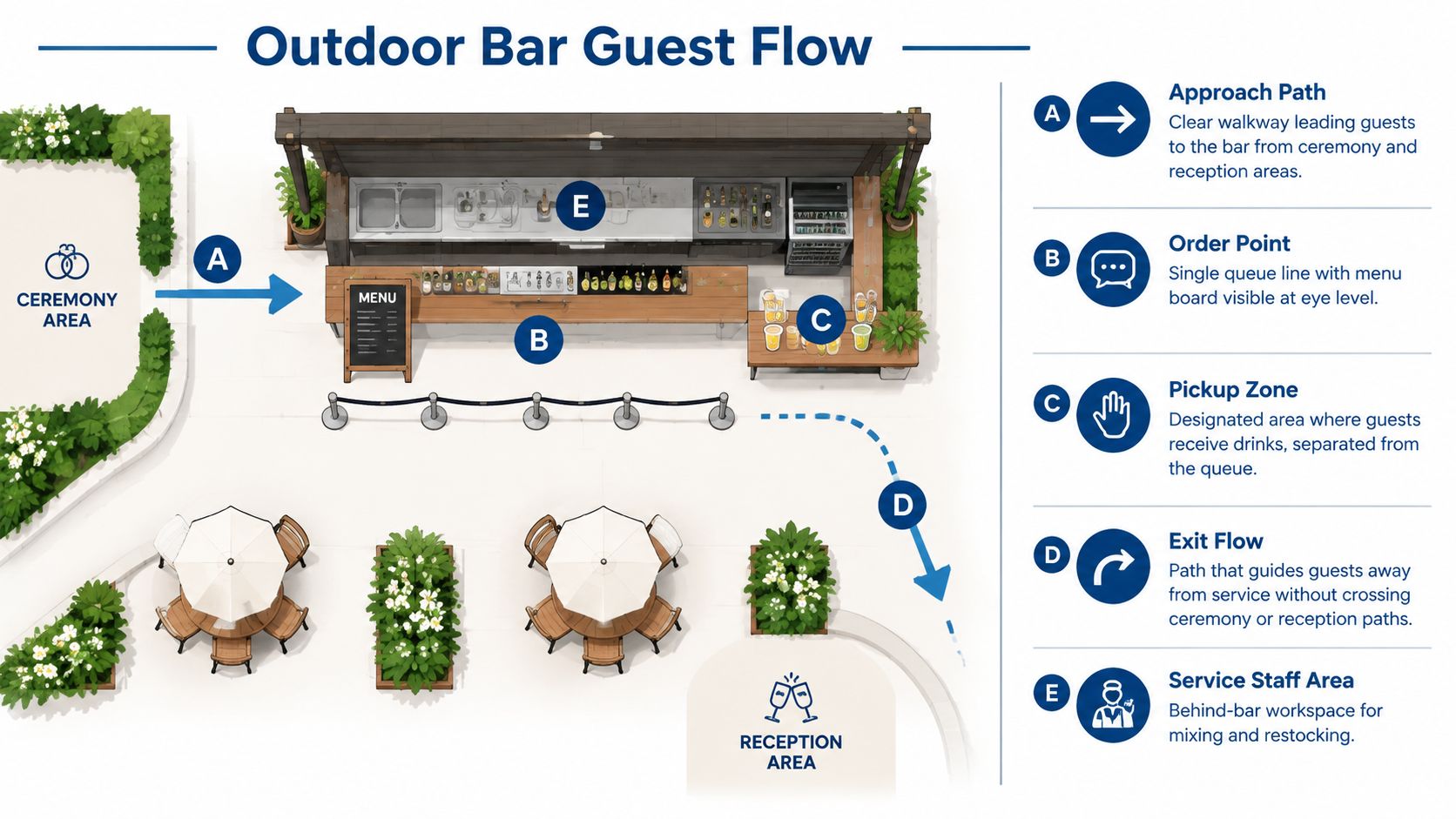
Place supporting functions deliberately:
- Glassware and cups: Keep clean stock within staff reach, with a defined location for used items.
- Water and alcohol-free pickup: Make these visible without requiring guests to join the alcoholic-drink queue.
- Replenishment: Reserve a staff route behind or beside service, away from the guest approach.
- Ice storage: Position working stock for staff access without turning the guest side into a cooler-opening area.
- Waste: Provide disposal near the exit from the bar area, without obstructing circulation.
For a large reception, a single decorative counter may concentrate too many activities in the same place. Rather than making that counter longer by default, consider which tasks can happen elsewhere. Ready-to-pour alcohol-free drinks don't necessarily belong beside made-to-order cocktails.
Test the layout with people
Walk from the ceremony exit toward the bar while someone else approaches from the reception hall. Then have a staff member follow the proposed replenishment route carrying an empty delivery container.
Check whether guests can see the menu from the approach, whether the queue blocks seating, and whether someone using a mobility aid can reach service without navigating through furniture. Keep cords and equipment out of that route.
A useful layout lets a guest leave with a drink while staff bring supplies in, without either person having to negotiate passage.
Repeat the walk-through from the bartender's side. Where will an opened bottle go? Where does used glassware land? Can staff reach backups without abandoning the workspace?
Finally, test the evening version. Ask what guests and staff will be able to see after daylight fades. A layout that works during a venue tour still needs a usable lighting plan for reception service.
Match Bartenders to Service Complexity
Inventory tells you what to buy. Staffing determines how you'll serve it. A sufficient beverage order doesn't tell you whether the team can handle the rush after the ceremony.
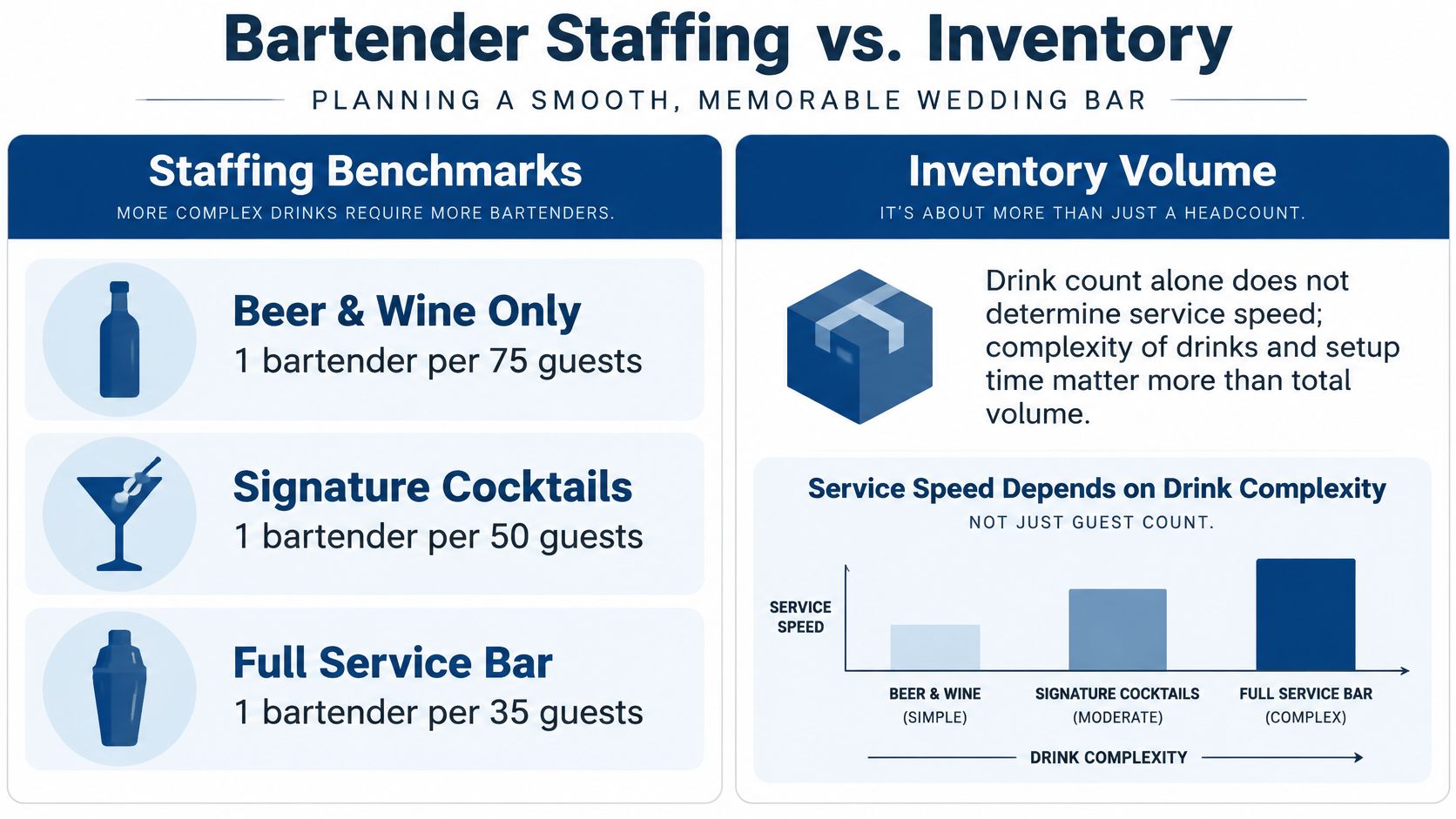
The planning guide cited earlier gives these staffing benchmarks: at least one bartender per 75 guests for beer and wine, one per 50 for a full bar, and one per 35–40 for premium or cocktail-heavy service. Under those same benchmarks, a 300-guest reception requires at least six bartenders for a full bar or four for beer-and-wine service. Treat those as starting points for a vendor staffing proposal, not guarantees of queue length.
Compare the work behind each order
| Service Style | Main Workload | Decision Before Booking |
|---|---|---|
| Beer and wine | Opening, pouring, and maintaining cold stock | Where will replenishment happen? |
| Full bar | Managing broader choice, mixers, and equipment | Which drinks are included? |
| Cocktail-heavy menu | Preparation, mixing, garnishing, and cleanup | What can staff prepare in advance? |
| Guest-paid service | Ordering plus payment handling | How will payment work if connectivity fails? |
The visual below reinforces the distinction between stock and service labor. Its category labels simplify the staffing tiers, so use the benchmarks in the text and your bartender's written assessment when contracting.
A signature cocktail deserves a realistic preparation test. Ask the bartender to describe the steps from order to handoff, including garnish and cleanup. If the drink requires repeated preparation during service, simplify the recipe or budget for the labor it needs.
Cashless payment also belongs in the workflow discussion. Don't assume that removing cash removes the payment task.
Assign replenishment separately
Ask who will fetch backup wine, replace ice, remove waste, and replenish cups. If every bartender must leave the counter to do those jobs, the quoted headcount doesn't describe the team available to serve guests.
A dedicated support role may be more useful than adding another person to an already crowded counter. Conversely, another service point won't help if it lacks supplies or an assigned bartender.
Have the provider document opening duties, service positions, support responsibilities, breaks, and closing tasks. Request a backup arrangement for a staff absence and agree on who can authorize extra labor. Don't leave those decisions until the queue forms.
Make Heat Safety Part of Bar Service
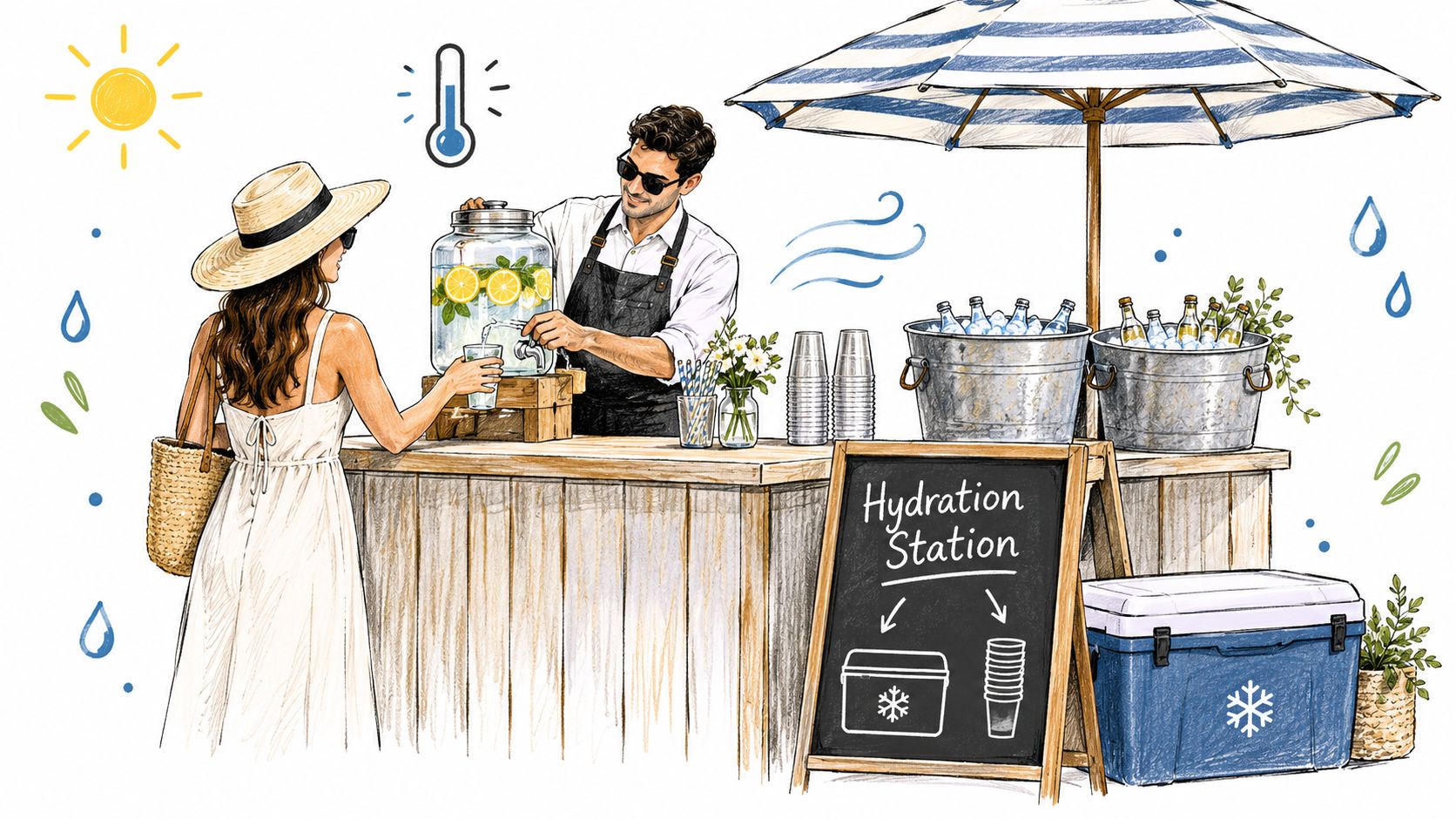
An unlimited bar isn't automatically the most hospitable option on a hot afternoon. Free water, shade, and an agreed service adjustment should be part of the plan, not emergency additions.
New York City's public-health guidance for outdoor events recommends increasing access to free water and limiting or eliminating alcohol when the heat index reaches 95–99°F. Use that guidance to establish operating decisions with the venue and bartender, rather than asking wedding-party members to make health judgments.
Order ice for distinct jobs
Ice for drinks and ice for chilling stock are separate requirements. According to The Forager Bar's event ice calculator, a useful baseline is 1.5 pounds per guest, rising to 2 pounds for warm outdoor conditions or cocktail-heavy service; for 300 guests, that means roughly 450 pounds at baseline or 600 pounds in hotter conditions.
Divide the order into drink-service ice, chilling ice, and reserve replenishment. Ask the bartender to adjust the allocation for refrigeration, menu design, and delivery temperature. Don't assume buying enough for glasses also covers keeping backup beverages cold.
Store reserves in a shaded, raised, drainable location that is protected from contamination. Document delivery timing and who monitors the remaining supply.
Give alcohol-free service equal visibility
A European wedding beverage survey published by Henkell Freixenet found that 23.1% of more than 7,600 surveyed couples said a substantial share of their guests didn't drink alcohol. That's directional evidence, not a forecast of Texas demand, but it supports asking about preferences rather than assuming everyone wants alcohol.
Offer an attractive alcohol-free choice with clear ingredients and designated preparation tools. Guests shouldn't have to explain pregnancy, sobriety, medication, driving plans, or personal preference to receive thoughtful service.
Build the heat response around concrete assignments:
- Water access: Open free-water service before alcoholic service and maintain access away from the main queue.
- Guest comfort: Shade waiting areas and identify nearby indoor seating.
- Service changes: Agree who can narrow, slow, pause, or end alcohol service.
- Relocation: Name the person who authorizes moving inside and the staff who carry it out.
Use these summer wedding heat-planning tips to connect the beverage plan with the wider event schedule. The bar shouldn't operate independently of decisions about ceremony timing, cooling spaces, and guest transportation.
Finalize the Guest Experience and Contingency Plan
The final review should test decisions, not reopen the entire design. Send the venue, bartender, caterer, and coordinator the same approved plan, with a revision date and named contacts. Ask each provider to confirm their responsibilities rather than assuming silence means agreement.
Verify the handoffs
Use a compact closeout checklist:
- Approvals: Confirm venue permission, service-provider approval, and any required documentation.
- Purchasing: Reconcile the guest count, menu, alcohol-free selection, and supplier arrangements.
- Cold storage: Confirm ice delivery, cooler capacity, reserve placement, and drainage.
- Equipment: Sign off on power, lighting, furniture, and required rentals.
- People: Confirm service roles, replenishment ownership, and backup coverage.
- Guest routes: Approve queues, water access, shade, accessible approaches, and waste locations.
- Weather response: Confirm the indoor location, decision authority, and communication method.
Keep guest-facing information simple. The menu should identify available drinks and ingredients clearly; staff should know how to explain changes without turning a weather adjustment into a debate at the counter.
Rehearse the indoor changeover
For a Central Texas venue with outdoor gathering space and an indoor reception hall, the fallback might mean ending lawn service and directing guests to an already prepared indoor bar. That's a different task from moving the entire outdoor setup while guests wait.
Ask what remains outside, what moves, and what must already be available indoors. Check whether the indoor layout still works with dinner seating and the planned entertainment. Don't call a room a fallback until the people operating it have reviewed the arrangement.
Before locking the final guest count, secure venue approval, agree on the service format, approve the equipment and layout, and then finalize purchasing and labor. Record who receives any last-minute changes.
The best bar isn't the one with the most drinks. It's the one that keeps service calm, guests informed, and weather decisions manageable.
Your last question to the team should be practical: can everyone explain what they'll do if outdoor service can't continue? A shared answer is more valuable than another decorative detail.
Texas Old Town offers outdoor ceremony settings, climate-controlled reception halls, and built-in beverage bars, with host-provided beverages served by an approved bartending company. Visit Texas Old Town to arrange a tour and review your proposed bar location, vendor access, and indoor fallback before booking beverage service.