The floor plan is blank, the rehearsal dinner is only days away, and both families have started asking where they'll sit. One parent wants to be near the couple. Another parent's remarried spouse shouldn't share a table with an ex. The officiant knows nobody, a grandparent needs step-free access, and an out-of-town guest is hoping not to spend the evening alone.
That's where a rehearsal dinner seating chart earns its keep. A good plan makes the dinner feel welcoming and effortless. A careless one turns the first shared family event into a public negotiation. The advice below will help you choose the right level of formality, build the chart in the right order, manage complicated family relationships, and hand the final plan to the venue without last-minute chaos.
Table of Contents
- Why the Rehearsal Dinner Needs Its Own Seating Plan
- Deciding How Formal Your Seating Needs to Be
- Building Your Chart in the Right Order
- Grouping Guests So Conversation Actually Happens
- Handling Divorced Parents, Blended Families, and Tricky Dynamics
- Finalizing the Chart and Your Venue Walkthrough
Why the Rehearsal Dinner Needs Its Own Seating Plan
A rehearsal dinner often brings the couple, wedding party, immediate family, officiant, and traveling guests into one room for the first time. Everyone arrives carrying different expectations. Some people want to meet relatives. Others want familiar company. A few may already know exactly whom they should avoid.
The couple in this situation usually starts with a harmless idea: “We'll let everyone sit wherever they want.” Then guests enter, claim seats beside the people they already know, and create separate conversational islands. One family settles at one end of the room, the wedding party forms another group, and the officiant ends up beside people who assume someone else will include them.
That outcome isn't caused by bad manners. It's caused by a missing plan.
Practical rule: Treat the seating chart as a hospitality tool, not a test of wedding formality.
Rehearsal dinners are a relatively modern wedding tradition, with historical accounts generally placing their emergence in the late nineteenth century in the United States and wedding-industry historians identifying the 1950s as the period when they became more widely established. The tradition grew alongside larger, more coordinated weddings where participants needed to practice entrances, positions, music cues, and ceremony timing. The Los Angeles Times' rehearsal-dinner guide reflects that shift from a practical walk-through to a social pre-wedding gathering.
That history explains why the chart has two jobs. It must support room logistics, including service, movement, and toasts, while also managing relationships and introductions. Parents should feel acknowledged, the couple should remain central, and guests who have traveled should have a familiar anchor.
The person paying for or hosting the dinner may not be the person creating the layout, so settle ownership early. Couples often ask a parent, planner, or venue coordinator to handle the working chart, while they make the decisions about sensitive relationships. This practical division is also consistent with guidance on who plans the rehearsal dinner.
By the time you print anything, you should know whether you need open seating, table assignments, or individual places. You should also know which family members need distance, which guests can bridge unfamiliar groups, and how the actual room will affect the plan.
Deciding How Formal Your Seating Needs to Be
Don't assign individual chairs just because wedding planning websites make it sound proper. Choose the format that matches the size and social complexity of the dinner.
For a dinner under approximately 20 guests, open seating can work well if the group already knows one another or will sit at one shared table. From roughly 20 to 40 guests, assigned seats become useful because several social circles may need gentle direction. Above 40 guests, manage the dinner like a small reception and assign tables explicitly. These thresholds come from rehearsal-dinner seating guidance at PlanSeats.
Use this decision table
| Guest Count | Recommended Format | Main Risk If Wrong |
|---|---|---|
| Under approximately 20 | Open seating, with reserved places for priority guests if needed | Guests may still cluster by familiarity, leaving one or two people outside the conversation |
| Roughly 20 to 40 | Assigned seats or clearly assigned tables | Guests may choose comfortable groups and avoid meeting the other family |
| Above 40 | Explicit table assignments, with an alphabetical guest index | Unassigned guests can scatter unevenly, confuse service, or miss natural introductions |
Open seating is appropriate when it gives guests freedom without creating uncertainty. A small backyard dinner with one long table may not need place cards. A restaurant dinner with several tables, timed toasts, and guests who have never met is a different matter, even if the atmosphere is casual.
The hidden problem with unassigned seating is social self-sorting. People choose the safest available option. A group of college friends sits together, a parent brings a sibling into the same cluster, and an out-of-town guest waits too long before taking a chair. By the time that guest sits down, the table may contain strangers with no obvious connection.
Don't confuse casual with unplanned
You can keep the dinner relaxed while still assigning tables. Let guests choose their own chair once they reach the right table, or use a simple display that directs them without making the room feel ceremonial. Individual place cards make more sense when the dinner is intimate, the host wants precise relationships, or dietary and accessibility requirements make seat-level control important.
A larger dinner should also include an alphabetical guest index with table numbers. It's faster than asking guests to inspect every table, especially when several people arrive together. Keep the guest-facing system simple. The complexity belongs in your planning file, not at the entrance.
Building Your Chart in the Right Order
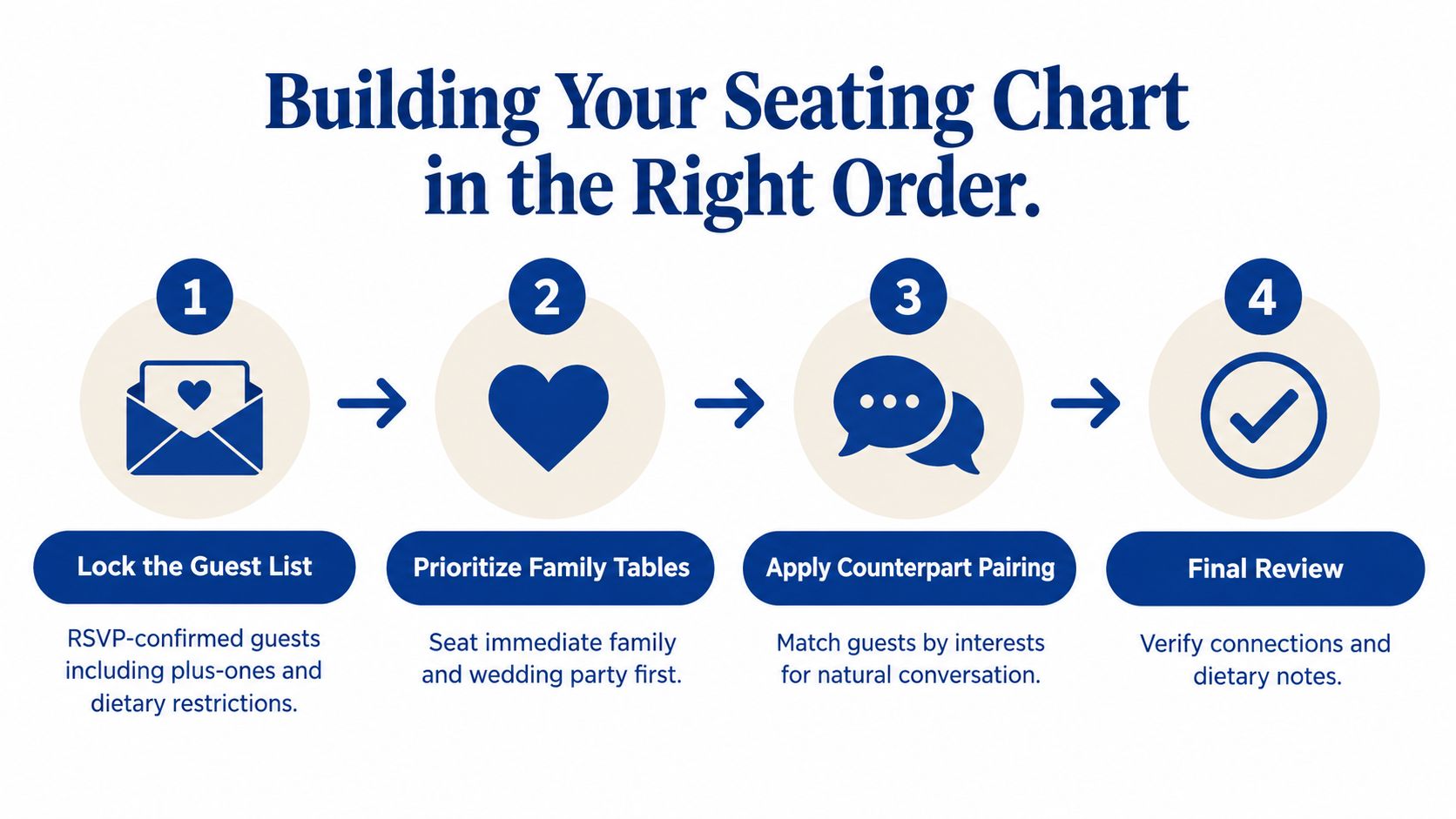
Most seating-chart disasters start with the same mistake: someone begins moving names around before confirming the guest list or understanding the room. The fix is a four-pass process. Complete each pass before moving to the next.
Pass one locks the people
Start with the RSVP-confirmed list, not an old spreadsheet or a family group chat. Record every plus-one, correct name spelling, dietary restriction, accessibility need, and relevant seating sensitivity.
Create one working row per guest. A useful note might say “needs step-free access,” “avoid speaker,” “knows couple only,” or “do not seat with former spouse.” Keep sensitive notes private. Your venue team needs operational information, not family history.
Check that every meal or allergy note belongs to the correct person. A beautifully printed chart still fails if the caterer receives dietary information attached to the wrong seat.
Pass two maps the room
Before assigning names, sketch the actual venue. Mark entrances, exits, restrooms, service paths, toast locations, speakers, bars, kitchen access, and noise sources. Note whether the dinner uses one room, several rooms, or an indoor and outdoor combination.
Furniture changes matter. A table that fits on a generic template may block a service route in the actual room. If the venue supplies round guest tables, rectangular banquet tables, or a sweetheart table, work from its documented furniture dimensions and counts rather than guessing.
Pass three places the constrained guests
Put the couple, hosts, parents, grandparents, wedding party, and guests needing step-free access on the plan first. Place grandparents where they can hear conversation, reach the restroom comfortably, and receive help from a relative if needed. Keep anyone sensitive to noise away from speakers, doorways, and busy service areas.
This order prevents flexible guests from occupying the seats that constrained guests need.
Pass four fills the flexible seats
Now group everyone else by relationship and conversational compatibility. Never place names alphabetically. Alphabetical order helps guests find their table later, but it's a poor method for creating the table.
For larger dinners, use custom name labels for events when you need clear, polished place identification without making guests decode handwritten notes. The labels should support the plan, not replace it.
Finish by preparing an alphabetical index with table numbers if the dinner is large. The index is a navigation aid, while the chart remains your operational blueprint.
Grouping Guests So Conversation Actually Happens
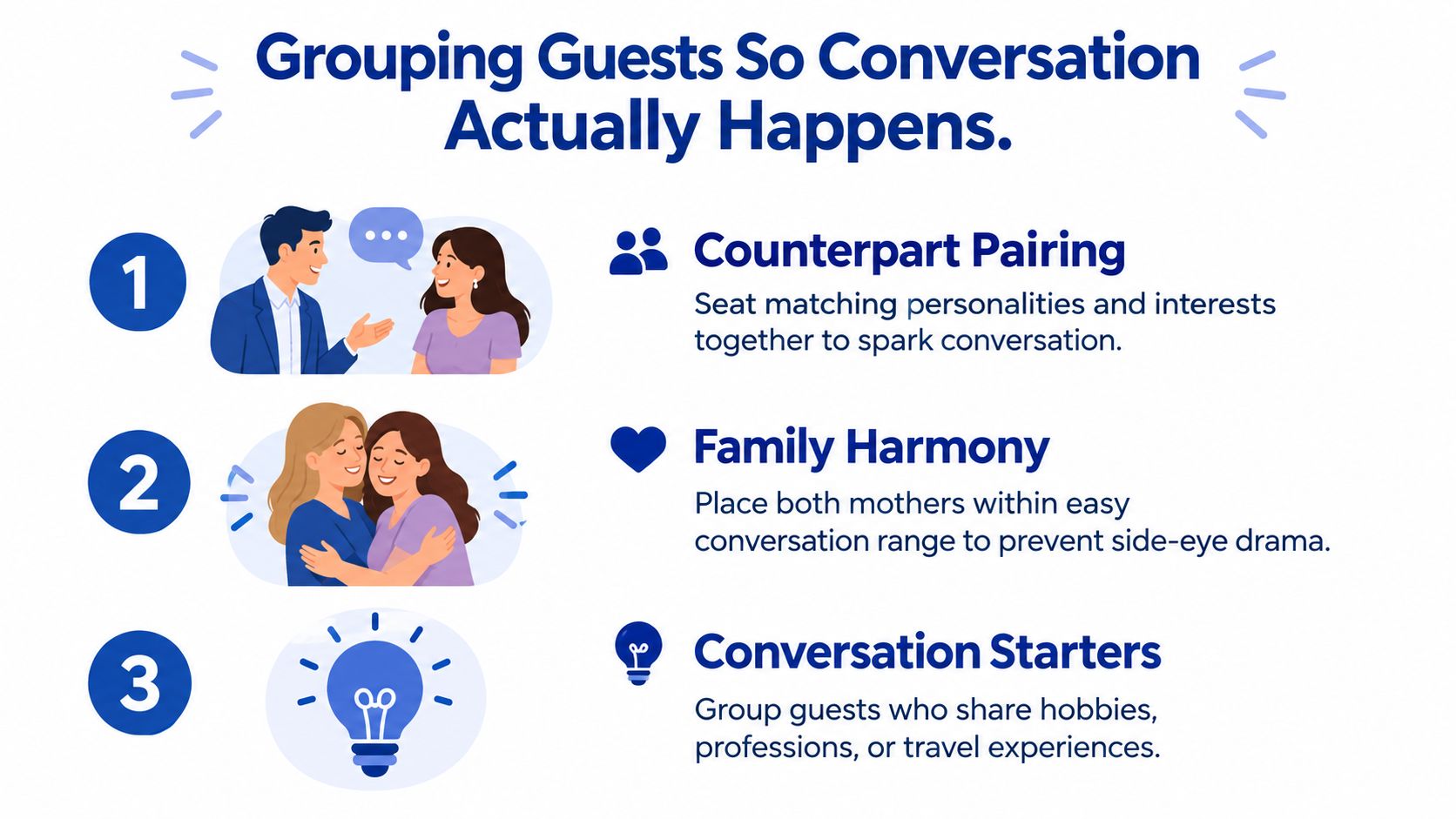
A seating chart can be physically perfect and socially flat. The answer isn't to force every guest into a dramatic family merger. It's to create conversational bridges.
Counterpart pairing is the most reliable starting point. Seat the two mothers within easy conversation range, do the same for the fathers, group siblings or attendants with similar ages or interests, and place grandparents near relatives who can assist them. “Within easy conversation range” doesn't necessarily mean beside each other. It may mean across a round table, at neighboring tables, or separated by one comfortable buffer.
Consider three common situations.
A friend-heavy wedding party may arrive with plus-ones who know nobody. Don't put every attendant together and leave all dates at the edge. Keep enough of the wedding party together for comfort, then place unfamiliar plus-ones beside outgoing guests who can explain the connections and include them naturally.
An officiant may know the couple well but have no relationship with either family. Give the officiant a seat near the couple or a host who can introduce people, not a remote place where every conversation requires an explanation.
A table of college friends and a table of young cousins may look like separate social units, but merging a few compatible people can create energy. Choose the cousin who enjoys travel or music, pair that person with a friend who shares the interest, and keep a familiar contact nearby. Don't merge groups just because you can. Merge them when someone can truly open the conversation.
Run the lonely-guest audit
Before printing, inspect each table and ask one direct question: Who would struggle if the person they know left the table?
Mark every guest without a familiar contact. Then swap one or two seats with a compatible tablemate. You're not trying to make everyone best friends. You're giving each person a conversational foothold.
Good floor-plan work supports this social design. Review the venue's wedding venue floor plans alongside your guest groupings so a table's position supports the intended interaction. A lively bridge guest placed beside a loud speaker may stop bridging altogether. A grandparent placed near a high-traffic doorway may spend the meal managing movement instead of enjoying conversation.
A successful table doesn't contain people with identical backgrounds. It contains enough familiarity, curiosity, and social support for nobody to feel stranded.
Handling Divorced Parents, Blended Families, and Tricky Dynamics
The advice to “mix both families” sounds warm until proximity itself creates conflict. Divorced parents, remarried parents, blended families, estranged relatives, LGBTQ+ family structures, and different cultural hosting traditions can make a single family table the worst possible choice.

Start with private conversations. Ask the couple and hosts what must not happen, who needs a familiar anchor, and which interactions are welcome rather than merely expected. Don't ask relatives to negotiate this at the venue entrance. The couple should decide the boundaries before the chart becomes public.
Choose the structure families can handle
A single head table works when the key people can share attention without tension. It's a poor choice when every seat communicates status or alliance.
Separate host tables can work better for divorced or remarried parents. Each table can include supportive relatives and friends, with the couple positioned where they can visit both groups. A sweetheart table gives the couple breathing room when the family arrangement carries too much emotional weight, while open seating can be appropriate when assigned proximity would feel controlling.
Use buffers deliberately. A buffer might be a trusted sibling, a close friend, or a calm relative who can keep conversation moving. It shouldn't be a person who feels responsible for mediating a dispute all evening. If two guests should not share a table, don't place them at opposite ends of one long table and call the problem solved. Give them separate conversational ecosystems.
Traveling guests still need familiar anchors. Place them with someone they know, or with a guest who understands the family and will actively include them. For LGBTQ+ families, don't assume titles, pairings, or seating roles based on traditional parent categories. Ask the couple how each person should be recognized and placed.
Communicate a nontraditional plan without embarrassment
Guests don't need an explanation for every seating decision. Tell them the practical instruction: “We've arranged tables to make conversation easy,” or “Please follow the table assignments at the entrance.” Avoid announcing that someone has been separated from an ex or placed away from a parent.
If a guest asks why the couple isn't using one head table, answer with confidence. “This layout gives everyone a comfortable place to enjoy dinner” is enough. A deliberately nontraditional plan becomes awkward only when the hosts treat it like an apology.
Finalizing the Chart and Your Venue Walkthrough
The final review should happen against the actual floor plan, especially when the dinner uses multiple rooms or indoor and outdoor spaces. Walk the route from entrance to seat, then from seat to restroom, bar, exit, and toast area. Check the room again after any furniture change.
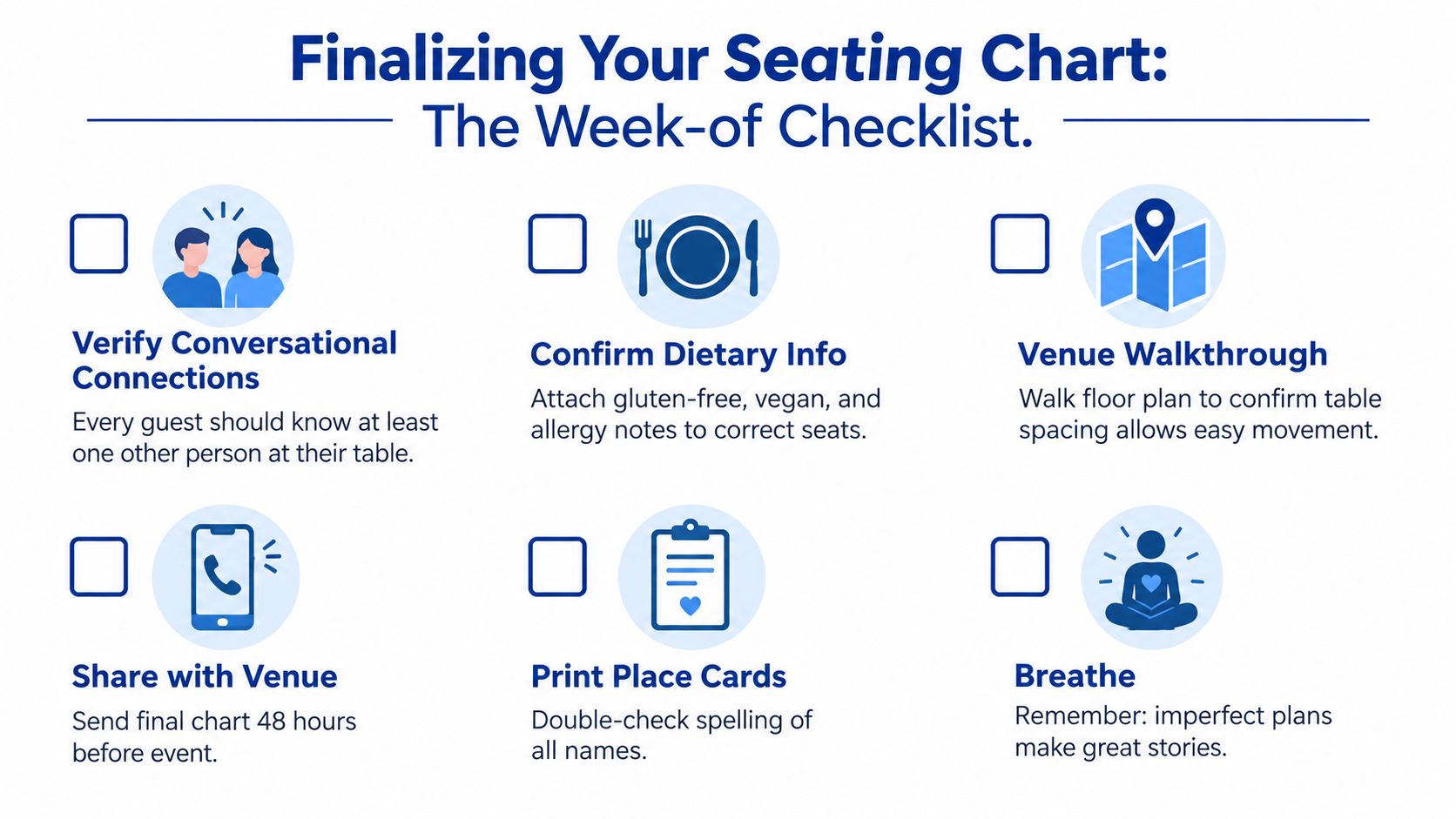
Use this final-week checklist:
- Confirm connections: Every guest should have a known conversational connection or a clear bridge.
- Verify dietary notes: Attach each meal, allergy, and dietary requirement to the correct guest or table.
- Inspect service paths: Servers must reach every guest without crossing toast or presentation areas.
- Recheck access: Confirm step-free routes, comfortable seating, restroom access, and manageable noise levels.
- Share one final version: Send the locked chart to the venue, caterer, banquet captain, and toast coordinator.
- Prepare guest navigation: Print place cards, table signs, or an alphabetical index with accurate spellings.
Lock the chart three to four days before the dinner, then communicate any unavoidable change directly to the venue or caterer. If you're comparing venues or coordinating several vendors, the same disciplined approach used for corporate event budgeting and vendor selection can help keep responsibilities and handoffs clear.
A venue with on-site management, documented furniture counts, and included setup or breakdown support can make this handoff far easier. Walk the room with the venue team, mark the table positions, and arrive at the dinner knowing the chart works in the space, not just on paper.
Texas Old Town offers rehearsal dinner settings with indoor and outdoor options, venue furniture specifications, on-site management, and layout support for practical seating decisions. If you want to review a real floor plan with your guest dynamics in mind, visit Texas Old Town and schedule a venue tour.