What Is Sound Equipment? a Guide for Event Planners
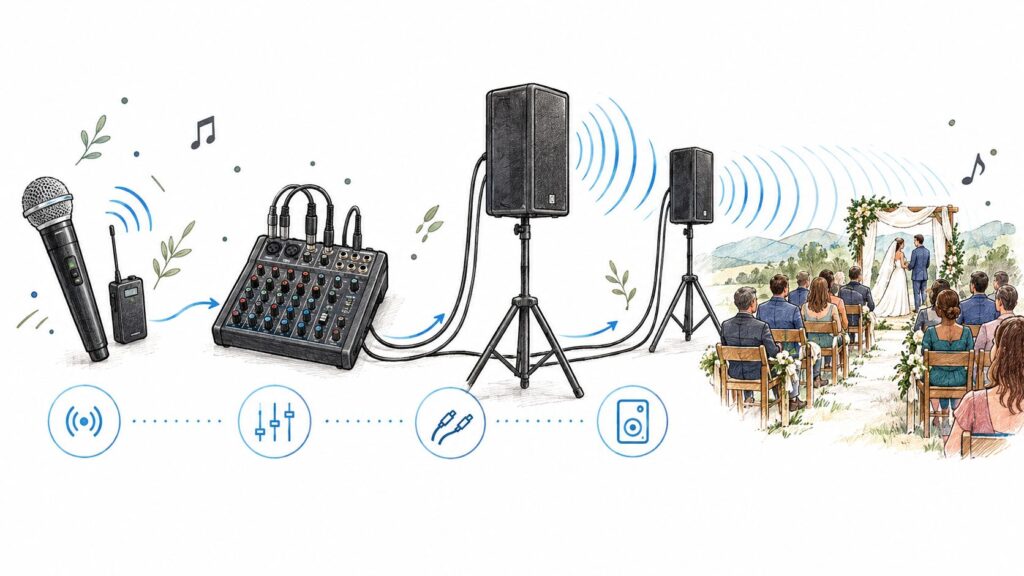
Sound equipment is the collection of technologies that capture, process, amplify, transmit, and reproduce audible sound. Events depend on that chain because the ear hears pressure from about 20 micropascals up to 200 pascals, a span so wide that a toast and a dance floor only stay clear when level, coverage, and distance are managed together. You are three rows back at a ceremony. The couple is saying the vows, and you catch every other word. A gust rolls across the lawn, the handheld mic dips, and the sentence disappears. An hour later the best man raises a glass, the speaker howls, and half the room winces. Nobody bought the wrong playlist. The signal never made a clean trip from mouth to ear. That trip is what planners mean when they ask what is sound equipment. It is not a single speaker on a stick. It is a relay. One device catches the voice, the next shapes it, the next adds power, and the last one turns electricity back into air the guests can hear. Table of Contents What Is Sound Equipment and Why It Matters A chain, not a louder box How Sound Equipment Evolved Over Time From parlor sets to a full signal chain The Core Components of a Sound System Source equipment Control, distribution, and support How Sound Equipment Works Together at Events What good coverage actually sounds like Choosing the Right Sound Equipment for Your Event Needs by moment What changes the list How Texas Old Town Handles Sound for Events Rooms, time, and a person on site A placement habit that protects the day Putting Your Sound Plan Into Action What Is Sound Equipment and Why It Matters A working system is a handoff, not a pile of boxes. The microphone starts the race. The mixer decides how loud that voice sits against music. The amplifier supplies the muscle. The loudspeaker finishes by moving air toward the people who need the words. Drop any baton and the back row loses the vow, or the toast turns into a squeal. Planners get stuck because catalogs describe gear as objects. Events need jobs. Vows need a close, steady voice. Announcements need speech that cuts through chatter. Dancing needs music that fills the floor without burying the next speech. The same room can do all three if someone changes level, mic position, and where the speakers point between moments. A chain, not a louder box Source gear starts the signal: a wireless mic, a phone, a laptop, or a live instrument. Control gear sets volume and tone so a quiet reader and a loud playlist do not fight. Distribution gear carries power and sound into the room through amplifiers, loudspeakers, and cables. Support gear keeps the chain alive: stands, power, spare batteries, and covers when the sky turns. Practical rule: If guests cannot repeat the last sentence, the system failed, even when the speakers look impressive. Aim matters as much as wattage. Speakers pointed at a hard wall bounce energy back into the mic and invite feedback. Speakers aimed at guests put the words where people sit. A venue can already own a solid PA and still sound thin if the mic is far from the speaker's mouth or the outdoor coverage was never checked. You do not need an engineer's vocabulary to run the day. You need to know which link does which job, then match that job to vows, toasts, announcements, and dancing. The built-in PA at many halls already supplies much of the chain. The planning question shifts from "what do I buy" to "how do I use what is already here." How Sound Equipment Evolved Over Time Modern event gear looks obvious until you see how recently playback even existed. In Paris in 1857, Édouard-Léon Scott de Martinville built the phonautograph, the first device to record sound vibrations, and it could not play them back. It drew the shape of sound. It did not return a voice to a room. The Museum of Communication traces that line from mechanical tracing to electrical and digital systems. Thomas Edison's 1877 phonograph changed the bargain. For the first time a machine could both record and reproduce sound. A captured moment could be heard again. That is still the job at a reception when a recorded entrance song has to arrive on cue and a live vow has to arrive in the same seats. From parlor sets to a full signal chain Domestic radio grew fast in the 1920s and pulled better microphones and loudspeakers into homes, theaters, and public address. People expected speech they could follow, not a faint horn in the corner. Event systems inherit that demand every time a host introduces a family or a CEO opens a meeting. Stereo took even longer to become normal. Experiments began in the 1880s, yet mono stayed standard for home listening until the mid-1950s. Cinemas did not commonly get stereo until Dolby Stereo in the 1970s, and live amplification adopted it later still. The lesson is not nostalgia. Clarity for a seated audience arrived in stages, and each stage added a job: capture, shape, then deliver. Today's wireless mic, mixer, and powered speakers are that same progression in one rack. History is why a single speaker is not the whole answer. The chain exists because capturing a voice and handing it cleanly to a crowd took more than a century of separate inventions learning to work as one system. The Core Components of a Sound System Walk the chain in the order a voice travels. Each group solves a different failure. Knowing the groups lets you ask a venue specific questions instead of "do you have sound." Source equipment Microphones, phones, laptops, and instruments supply the audio. A wireless handheld is the usual choice for vows because the couple can stand close and the officiant can pass it without a cable across the aisle. A lapel mic frees a presenter's hands during a corporate welcome. A phone