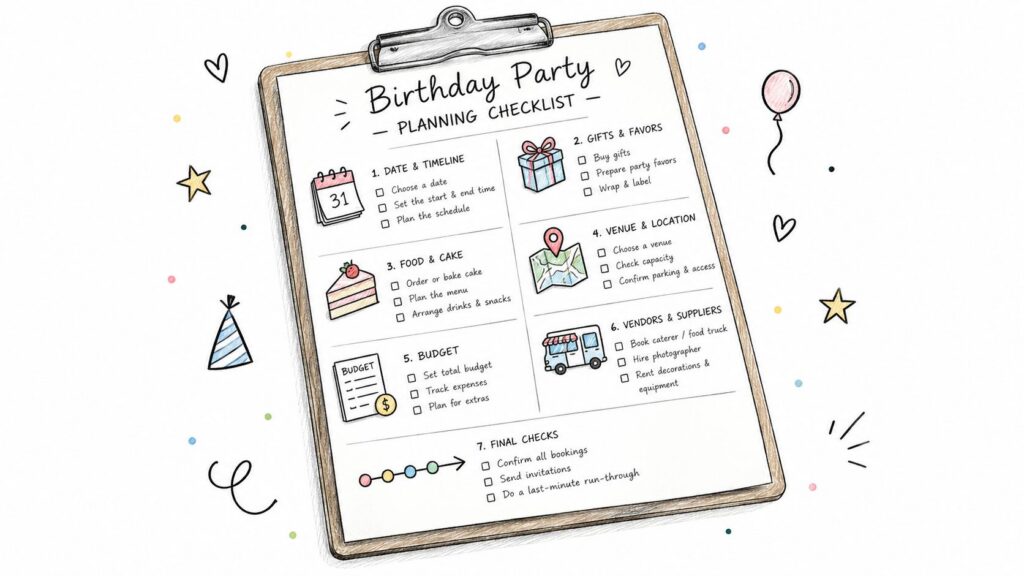
Birthday Party Planning Checklist: 10 Steps
A birthday party can look simple on the invitation and still create a complicated production schedule behind the scenes. The host must coordinate the guest list, venue access, food, beverages, entertainment, weather plans, parking, special moments, and cleanup, often while family members and vendors work from different assumptions. A reliable birthday party planning checklist should function as a timeline system, not a loose collection of reminders. Start with the decisions that affect every later task, then move toward confirmations, packing, setup, and follow-up. This guide runs from 12 or more weeks before the event through the week after it, with practical checkboxes, budget controls, vendor coordination prompts, a packing list, an email template, and a run-of-show format. For Texas Old Town, confirm the selected hall, guest capacity, exclusive 8:00 a.m. to midnight rental window, indoor and outdoor options, PA systems, dressing suites, parking, prep kitchen, beverage rules, furniture, cleanup, and on-site management. Those details affect how guests arrive, where vendors load in, how activities flow, and who handles problems on the day. Table of Contents 1. Select Venue and Confirm Capacity Venue checks before signing 2. Establish Budget and Secure Financing Turn the plan into a payment tracker 3. Book Caterer and Confirm Menu Details Build the menu around service 4. Arrange Beverages and Hire Bartending Service Build the bar plan 5. Plan Entertainment and Activities Design the energy curve 6. Coordinate Décor and Setup Requirements Turn the décor plan into a setup timeline Check the room at event lighting levels 7. Create and Distribute Invitations and Guest List Build the invitation around decisions guests must make Turn replies into an event-day handoff 8. Arrange Photography and Videography Give the photographer a useful brief 9. Confirm Logistics, Create the Event Day Timeline, and Plan Special Moments Assemble the schedule from fixed points 10. Complete Post-Event Follow-Up and Gratitude Close the administrative loop 10-Point Birthday Party Planning Comparison Print the Checklist and Hand Off the Details Printable packing prompts Vendor email template Run-of-show format 1. Select Venue and Confirm Capacity A 75-person birthday party can feel cramped if the room must also hold a buffet, cake table, DJ, gifts, and activity stations. Start with the venue because its capacity, layout, access rules, and included equipment shape every later vendor decision. Texas Old Town offers four private halls with different capacities and styles. Tejas accommodates up to 320 guests and suits a large Texas-themed celebration with dancing. Sage and Stone each accommodate up to 300 guests. The rustic Redbud hall accommodates up to 150 guests and may suit a smaller, more intimate gathering. Review the Texas Old Town venues for up to 150 guests before choosing a room for a smaller celebration. Match the hall to the event you are producing: Choose Redbud when a smaller guest list needs comfortable spacing without making the room feel sparse. Consider Tejas for a larger milestone celebration that needs a dance floor, entertainment setup, and clear guest movement. Compare Sage and Stone against the expected layout, not capacity alone. Venue checks before signing Walk through the event as a guest, vendor, and host. Record the answers in the master planning file, then use the approved floor plan for the catering order, décor brief, packing checklist, and run-of-show. Trace the guest route: Walk from parking to the entrance, restrooms, dining area, bar, activity stations, and outdoor spaces. Note congestion points and accessibility concerns. Request the floor plan: Confirm furniture counts and test whether the table arrangement leaves room for servers, activities, gifts, dancing, and comfortable movement. Confirm weather locations: Decide where guests will go if heat, rain, wind, or another weather issue affects outdoor plans. List included amenities: Get tables, chairs, PA access, dressing suites, prep-kitchen details, parking, and cleanup responsibilities in writing. Check service placement: Mark the buffet, bar, cake table, DJ or band, gift area, and activity stations before finalizing vendor plans. Save the approved version: Keep the hall name, capacity, layout, access instructions, venue contact, and open questions together with the printable packing prompts. Capacity is a comfort decision as well as a legal limit. A room may hold the guest count and still feel crowded once furniture, food service, entertainment, and special moments are added. Practical rule: Do not finalize catering, entertainment, or décor until you know where each service will physically go. Planning lead time should match the booking risk. One planning guide recommends starting three to four weeks ahead for a kids' party at home, six to eight weeks for a booked venue, and 12 weeks for a milestone party with 50 or more guests. It also recommends adding two weeks for a surprise party and two to three extra weeks during the holiday season. Treat those timelines as minimum planning signals. Review the birthday party planning timeline before committing to a date. 2. Establish Budget and Secure Financing Set the spending limit before comparing menus, entertainment packages, décor, or rentals. The number should cover the party without creating financial stress afterward. Divide it into committed costs, flexible costs, and a visible contingency reserve. Start with five decisions that shape the rest of the plan: guest count, venue, catering format, beverage service, and entertainment. Décor can add personality, but it should not reduce the money available for food, staffing, venue access, or weather protection. A 2026 industry summary reports average spending of over $1,185 for an adult birthday celebration and about $314 for a kids' party. It also reports that food and drinks account for 35% to 40% of the average party budget, while 33% of parents have gone into debt to fund birthday festivities. Use those figures as a warning to set a firm ceiling before expanding the guest list or approving upgrades. Read the birthday party budget guidance for the underlying context. Turn the plan into a payment tracker Use one shared spreadsheet for the family, planner, and vendors. A single record makes overdue deposits and scope changes visible. Track Record Budget category Venue, food, beverages, entertainment,