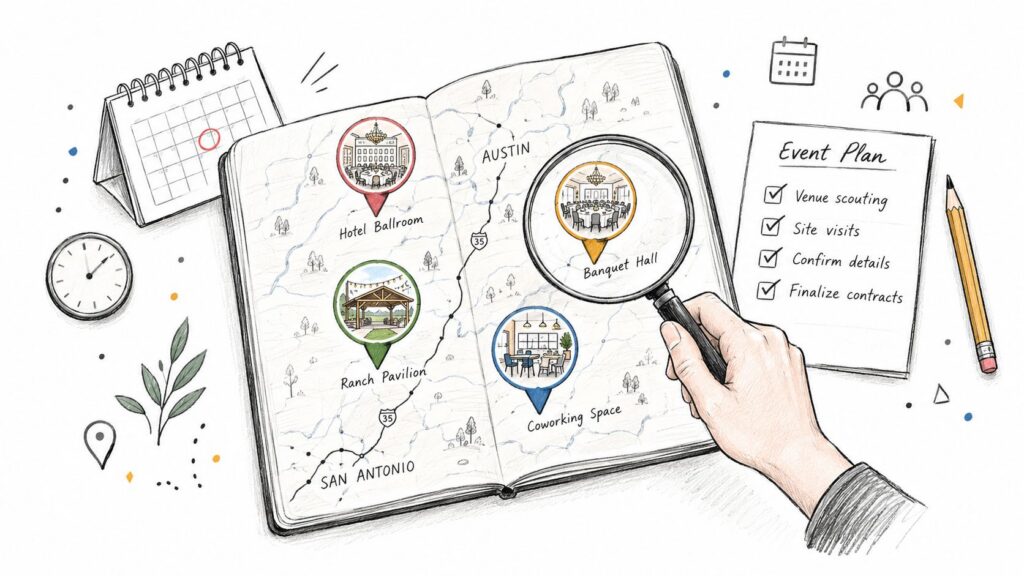
Venues for Business Events: How to Choose the Right One
You're comparing venues for business events because the event itself has already outgrown the easy options. The CFO wants a premium setting, the CEO doesn't want another hotel ballroom, and your AV partner needs access long before attendees arrive. Meanwhile, the agenda keeps changing, the guest count is moving, and every venue proposal seems to hide one more restriction in the contract. That's the actual decision. A venue isn't successful because it photographs well in a sales deck. It succeeds because vendors can load in, speakers can be heard, guests can park, rooms can transition, and the schedule survives ordinary corporate-event disruption. Use four lenses throughout the search: operational access, vendor flexibility, capacity fit, and schedule risk. Table of Contents What Makes a Business Event Venue Work Four questions to ask before the tour The Four Main Types of Business Event Venues Hotels and conference centers Dedicated halls and banquet facilities Outdoor and ranch-style properties Coworking and hybrid spaces Nine Decision Criteria That Matter Most to Planners 1. Load-in and load-out window 2. Vendor policy 3. Parking and arrival 4. Ceiling height and AV clearance 5. Climate control 6. On-site coordinator support 7. Catering flexibility 8. Airport and hotel distance 9. Force majeure and weather backup Why Rental Windows Are the Hidden Dealbreaker Read the clock before you read the décor Matching Venue Style to Event Type in the Hill Country Smaller rooms for leadership work Mid-size rooms for training and sales programs The largest room for public-facing moments A Realistic 90-Day Booking Timeline Days 90 to 75 Days 75 to 60 Days 60 to 45 Days 45 to 30 Days 30 to 7 Days 7 to 0 The Case for Operational Fit Over Visual Polish Three failures that look attractive in the proposal Your Next Step and Final Checklist What Makes a Business Event Venue Work The AV team arrives to an unfinished room, the keynote slides have not been tested, and guests are already lining up at registration. That failure starts with venue selection, not with the run sheet. A business event venue must remove operational risks before they reach event day. Start with access. If the AV vendor cannot enter until shortly before doors open, the team must test microphones, stage lighting, presentation playback, and room transitions under pressure. The keynote, executive remarks, and attendee arrival then compete for the same limited time. Vendor flexibility creates another pressure point. An exclusive catering or AV list may simplify coordination, but it can also eliminate suppliers your company trusts. An open policy gives you more control if the venue sets clear requirements for insurance, arrival times, power, food service, alcohol, and cleanup. Get those rules in writing before you commit. Four questions to ask before the tour Use these questions to screen every candidate: Can suppliers get in early? Ask for the exact load-in start time, not “full-day access.” Can the room support the program? Confirm seating layouts, staging, breakout privacy, registration, catering, and speaker movement. Can the venue absorb change? Ask what happens if the headcount shifts, the agenda runs long, or the weather changes. Who owns the day-of decisions? Identify the person authorized to approve room changes, vendor access, and timing adjustments. The meetings and conventions sector generated $1.6 trillion in global economic output in 2022 and supported 35 million full-time jobs worldwide, according to meetings and conventions industry data from ZipDo. That scale helps explain why venues now function as specialized operating environments, not simple rooms for rent. Practical rule: If a venue manager answers a logistics question with “we'll figure it out later,” treat the issue as unresolved. Capacity fit matters as much as total capacity. A room may hold your group on paper and still fail once you add a registration desk, sponsor displays, stage sightlines, buffet service, and comfortable circulation. A multi-hall Hill Country property can reduce that pressure by giving planners separate spaces for presentations, meals, breakouts, and transitions within one booking. That arrangement also gives the team a practical response when attendance or the agenda changes. Calculate schedule risk before signing. Rentals arrive before staging, staging supports AV, AV testing precedes rehearsal, and rehearsal precedes doors. Choose the property that protects that chain, even when another venue has more dramatic finishes. The Four Main Types of Business Event Venues Business-event planners usually choose among four formats, and each solves a different operating problem. The global event venues market was valued at $80.2 billion in 2023 and is projected to grow at a 5.3% CAGR from 2023 to 2030, according to World Metrics' event venues industry statistics. More demand means more choice, but it also means more opportunities to select a venue that looks right while functioning badly. Venue Format Best Suited For Operational Strength Common Limitation Hotel or conference center ballroom Multi-day conventions, room-block events, large meetings Sleeping rooms, built-in food service, breakout infrastructure Vendor and catering restrictions can be rigid Dedicated event hall or banquet facility Single-day meetings, award dinners, receptions Controlled setup, clear event footprint, efficient transitions May lack guest accommodations or extensive breakout rooms Outdoor or ranch-style property Offsites, retreats, team-building, experiential events Strong atmosphere, flexible indoor-outdoor programming Weather, heat, lighting, and sound require contingency planning Coworking or hybrid meeting space Small working sessions, workshops, remote-friendly gatherings Strong connectivity and easy access for focused groups Limited banquet capacity and production flexibility Hotels and conference centers Choose this format when attendees need sleeping rooms, several breakout rooms, and centralized food service. Hotels can reduce vendor coordination because accommodation, meeting rooms, catering, and basic event support sit under one operating structure. The limitation is control. Exclusive AV, in-house catering, food-and-beverage minimums, room-block terms, and strict access rules can make a hotel less attractive when you need specialty suppliers or a highly customized layout. Dedicated halls and banquet facilities These spaces work well for a single program with a defined footprint. Awards dinners, sales meetings, receptions, and company celebrations benefit from a room that can be staged, dressed, and cleared