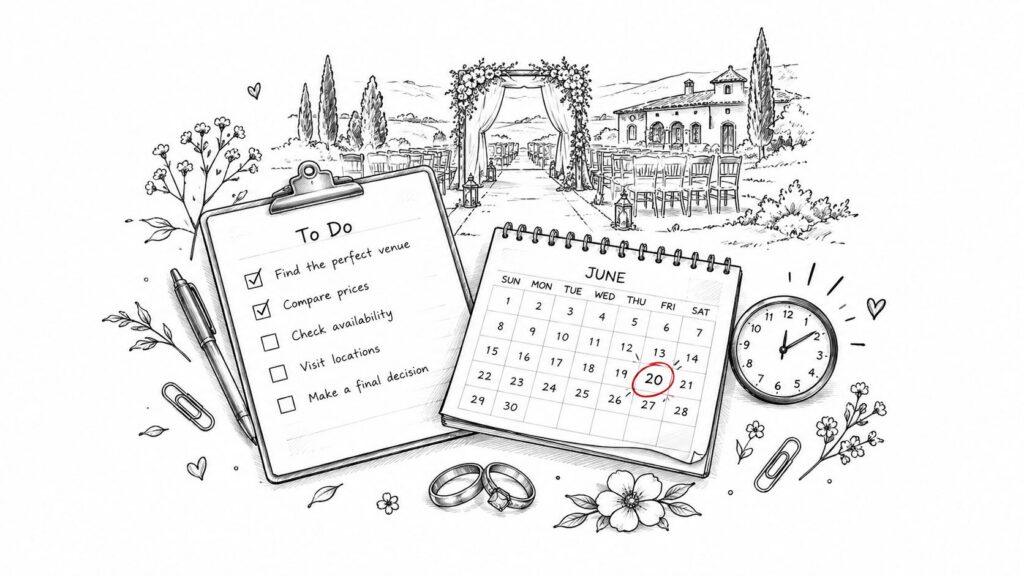
Last Minute Wedding Venue Availability Guide
You're probably in one of two situations right now. Your original venue fell through, or life moved faster than your wedding timeline and now you need a real place, on a real date, without downgrading the whole event into a courthouse-plus-dinner situation. Good. Ignore the advice telling you to cut the guest list in half and call it a day. Last minute wedding venue availability is tough, but the problem usually isn't the calendar by itself. The problem is choosing the wrong type of venue, asking the wrong questions, and moving too slowly once an opening appears. If you want to keep a full-size wedding intact, you need a venue with enough rental time, enough operational flexibility, and enough administrative speed to absorb a compressed planning window. Table of Contents Why Last Minute Bookings Are Harder Than They Look What couples are actually competing against The friction nobody warns you about Building a Compressed Planning Timeline At 90 days out At 60 days out At 30 days out Where Open Dates Actually Hide The date categories worth chasing Prime Saturdays are not the place to start Speed Wins the Booking The same-day inquiry playbook What your first message should say Negotiating the Contract Without Losing the Experience What venues can often move on What you should trade, and what you shouldn't Keep the negotiation grounded A Real Short Timeline Booking in Central Texas The decisions that matter What changed, and what didn't Your Final Weeks Before the Wedding T minus 6 to 4 weeks T minus 3 to 1 week Day before and day of Why Last Minute Bookings Are Harder Than They Look Most couples assume a short timeline automatically means a smaller wedding. That's lazy advice. A short timeline means you need a venue built for logistics, not just pretty photos. The market tells you how early dates usually disappear. In a 2026 wedding-weekend dataset, couples who booked a venue did so a median of 267 days before the wedding, and the first inquiry happened a median of 361 days out. The same report says the typical U.S. booking range was 200 to 344 days, based on 3,353 inquiries in the sample, which is why true late inventory is limited in major markets (wedding-weekend booking lead time benchmarks). That doesn't mean nothing is left. It means the easy inventory is gone and the remaining inventory is uneven. What couples are actually competing against You're not competing against the length of your engagement. You're competing against three things: Fast-moving reopened dates caused by cancellations, expired holds, and couples who don't complete paperwork Vendor availability for catering, photo, entertainment, transportation, and staffing Venue policies that either help a short timeline or kill it A venue can have your date open and still be a bad fit. If it only gives you a short rental window, requires rigid vendor rules, or takes too long to turn contracts, your planning window gets crushed even further. Practical rule: Don't ask only, “Is my date available?” Ask, “How fast can we contract, how long do we have on site, and how flexible are your vendor rules?” The friction nobody warns you about The hardest part of late booking usually isn't ceremony space. It's everything attached to it. A caterer may still be available but unwilling to bend on timing. A photographer may be open but already committed to a travel-heavy weekend. Insurance paperwork, family decision-making, and final guest count wrangling can eat days you don't have. Meanwhile, venues that quote long planning lead times are often describing their normal booking cycle, not the only way they operate. That's a marketing default, not a universal operational truth. If you want context on standard timing versus your actual options, read Texas Old Town's guide on how far in advance to book a wedding venue. Then stop treating the default planning calendar like a law of physics. Building a Compressed Planning Timeline A short timeline only works when you stop planning in a neat sequence and start planning in parallel. Venue, guest list, catering, attire, and photography can't wait for one another. They all move together. This is the mindset shift: don't think in months. Think in decision windows. At 90 days out This phase is about locking the framework. If the venue isn't set, almost nothing downstream stays stable. Handle these first: Venue shortlist and tours. Pick a small list and move fast. You need spaces that can host your guest count, your ceremony plan, and your backup weather plan without requiring a total redesign. Guest list ceiling. Stop saying “around 150” if the number might be much higher. Capacity drives venue choice, catering style, table layout, parking, and staffing. Parallel vendor outreach. Contact catering, photography, officiant, DJ or band, and planner or coordinator immediately. Don't wait until the venue contract is fully signed to start those conversations. Date flexibility. Give yourself alternates. Friday evening, Sunday, and off-peak dates often save the event. A venue with a long rental window matters most here. If setup, ceremony, cocktail hour, reception, and teardown all have to fit into a narrow access period, every vendor becomes harder to schedule. At 60 days out Now you're converting ideas into operating decisions. Priorities at this stage: Sign venue and major vendor contracts Book attire fittings and alterations Send invitations or digital invitations immediately Confirm menu direction and service style Walk the property or floor plan with layout decisions in mind This is also when venue flexibility starts showing its value. If the venue allows outside caterers, you have more paths to solve availability. If it offers indoor and outdoor ceremony options, you don't need a separate weather panic plan. If it gives you room to rehearse on site, your timeline tightens in a manageable way instead of becoming chaotic. For couples trying to map this out fast, Texas Old Town's event planning timeline is useful because it forces you to assign real tasks to real windows instead of leaving everything