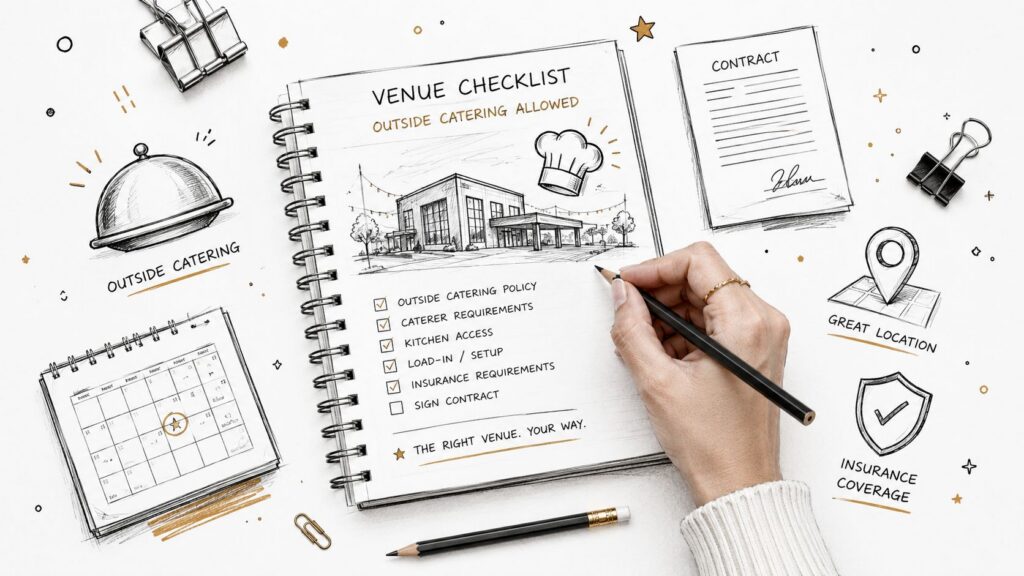
Venues That Allow Outside Catering: Your Complete Booking
You've spent months refining a menu around a family recipe, a cultural tradition, or a caterer you already trust. Then, during a venue meeting, someone casually mentions that the property only permits its exclusive food partner. Your date, guest count, floor plan, and budget may all look workable, but the event you designed no longer is. That's the problem with treating catering permission as a detail. At venues that allow outside catering, the advantage isn't the ability to choose a different chef. It's the chance to control the menu, compare service models, and build an event around the way your guests eat. The risk is that “outside catering allowed” can conceal fees, insurance conditions, weak service access, or a kitchen that was never designed for your caterer's operation. Table of Contents Why Outside Catering Is the First Decision You Should Make Start with the food model What the Market Data Tells Planners About Outside-Catering Venues Outside Catering vs Bundled Venue Catering Where bundled service still works The Site Visit Checklist Every Planner Needs Start in the kitchen and service areas Trace the vendor's movement Don't leave alcohol and waste until the end Contracts Insurance and Vendor Agreements That Actually Protect You Read the fee schedule beside the contract Timeline and Vendor Coordination From Booking to Load-In Build the calendar around decisions, not just meetings Keep one version of the run-of-show How Texas Old Town Puts These Policies Into Practice Why Outside Catering Is the First Decision You Should Make A planner who discovers a caterer restriction late in the process usually has to rebuild the shortlist. The venue may have the right ceremony setting, capacity, and date, but an exclusive catering policy can eliminate the menu, cuisine, or family vendor that shaped the event in the first place. Catering permission affects more than food. It influences the guest-count ceiling, the budget structure, the amount of kitchen and storage space required, and the date options available to the caterer. If the venue requires a particular company, you're not comparing venue hire alone. You're comparing a bundled operating model, including its menu limits, staffing approach, service charges, and availability. Start with the food model Decide what kind of meal you're planning before you fall in love with a room. A plated dinner, buffet, barbecue, food truck, family-style service, late-night snack station, or interactive chef setup each creates different demands for power, prep, refrigeration, service access, and waste removal. Then ask every venue the same question in writing: Can we hire any licensed and insured caterer, or must we choose from your list? “Preferred” and “required” aren't interchangeable. A preferred list gives you recommendations. A required list limits your choice, even if the venue's marketing copy uses the language of flexibility. Three signals deserve close attention: Kitchen wording: “Prep area available” may mean a full service kitchen, a counter near an outlet, or no cooking access at all. Ask what equipment the venue supplies and what the caterer must bring. Corkage language: A venue may allow outside food but charge for outside alcohol, cakes, or specific beverage formats. Ask whether any corkage waiver applies and what conditions trigger it. Vendor-list terminology: Request the current list and the approval process. A list that looks open may still require advance review, insurance certificates, licensing documents, or a venue-specific agreement. Practical rule: A verbal “yes” is only a starting point. The catering policy, fee schedule, access rules, and document deadlines belong in the contract or a signed addendum. Outside catering also intersects with broader event controls, including access, staffing, deliveries, and property protection. Planners building a complete operating plan can use these venue security best practices alongside catering questions, especially for outdoor receptions with multiple independent vendors. The rest of your evaluation should follow a working sequence: confirm permission, price the full model, walk the service route, verify insurance, and synchronize the caterer's schedule with the venue's run-of-show. That sequence prevents a flexible policy from becoming an expensive surprise. What the Market Data Tells Planners About Outside-Catering Venues A venue can approve an outside caterer and still create a difficult operating model. The question is whether its rules support deliveries, service, rentals, staffing, alcohol, waste, and weather changes without adding fees that appear late in the planning process. The U.S. market shows why this deserves early attention. Approximately 35,829 wedding venues were operating in the United States as of late 2025, according to an investment analysis of the U.S. wedding venue market. That analysis reports that 41% of venues include catering, while only 16% offer space-only rental. A fully flexible venue model is therefore a meaningful point of differentiation, but permission alone does not prove that the model is affordable or workable. The same analysis reports that 73% of venues include rentals such as tables, chairs, and linens. That separation matters. Furniture may be included while food preparation, service staff, kitchen access, trash removal, and loading remain the client's responsibility. Planners should price those obligations as part of the venue decision, not treat them as caterer-only details. Worldmetrics reports that 85% of event venues in Europe offer flexible catering options, while 30% of U.S. venues offer outdoor spaces and 15% specialize solely in outdoor events. The source also places the global event venue market at $450 billion in 2023, with a projected $620 billion by 2030, and reports venue rental at 55% of venue revenue compared with 30% from catering and beverage services. These figures point to a market where venue access and food service are often separate revenue decisions, which helps explain why outside-catering policies can carry their own charges. Indicator What the number shows Planner implication U.S. wedding venues operating in late 2025 Approximately 35,829 venues were operating. Use catering policy as an early screening question. Venues including catering 41% include catering. Bundled food service remains common, so outside-catering permission can narrow the shortlist. Space-only rental Only 16% offer space-only rental. Confirm what the rental includes before assuming vendor freedom. Physical rentals 73%