You've spent months refining a menu around a family recipe, a cultural tradition, or a caterer you already trust. Then, during a venue meeting, someone casually mentions that the property only permits its exclusive food partner. Your date, guest count, floor plan, and budget may all look workable, but the event you designed no longer is.
That's the problem with treating catering permission as a detail. At venues that allow outside catering, the advantage isn't the ability to choose a different chef. It's the chance to control the menu, compare service models, and build an event around the way your guests eat. The risk is that “outside catering allowed” can conceal fees, insurance conditions, weak service access, or a kitchen that was never designed for your caterer's operation.
Table of Contents
- Why Outside Catering Is the First Decision You Should Make
- What the Market Data Tells Planners About Outside-Catering Venues
- Outside Catering vs Bundled Venue Catering
- The Site Visit Checklist Every Planner Needs
- Contracts Insurance and Vendor Agreements That Actually Protect You
- Timeline and Vendor Coordination From Booking to Load-In
- How Texas Old Town Puts These Policies Into Practice
Why Outside Catering Is the First Decision You Should Make
A planner who discovers a caterer restriction late in the process usually has to rebuild the shortlist. The venue may have the right ceremony setting, capacity, and date, but an exclusive catering policy can eliminate the menu, cuisine, or family vendor that shaped the event in the first place.
Catering permission affects more than food. It influences the guest-count ceiling, the budget structure, the amount of kitchen and storage space required, and the date options available to the caterer. If the venue requires a particular company, you're not comparing venue hire alone. You're comparing a bundled operating model, including its menu limits, staffing approach, service charges, and availability.
Start with the food model
Decide what kind of meal you're planning before you fall in love with a room. A plated dinner, buffet, barbecue, food truck, family-style service, late-night snack station, or interactive chef setup each creates different demands for power, prep, refrigeration, service access, and waste removal.
Then ask every venue the same question in writing: Can we hire any licensed and insured caterer, or must we choose from your list? “Preferred” and “required” aren't interchangeable. A preferred list gives you recommendations. A required list limits your choice, even if the venue's marketing copy uses the language of flexibility.
Three signals deserve close attention:
- Kitchen wording: “Prep area available” may mean a full service kitchen, a counter near an outlet, or no cooking access at all. Ask what equipment the venue supplies and what the caterer must bring.
- Corkage language: A venue may allow outside food but charge for outside alcohol, cakes, or specific beverage formats. Ask whether any corkage waiver applies and what conditions trigger it.
- Vendor-list terminology: Request the current list and the approval process. A list that looks open may still require advance review, insurance certificates, licensing documents, or a venue-specific agreement.
Practical rule: A verbal “yes” is only a starting point. The catering policy, fee schedule, access rules, and document deadlines belong in the contract or a signed addendum.
Outside catering also intersects with broader event controls, including access, staffing, deliveries, and property protection. Planners building a complete operating plan can use these venue security best practices alongside catering questions, especially for outdoor receptions with multiple independent vendors.
The rest of your evaluation should follow a working sequence: confirm permission, price the full model, walk the service route, verify insurance, and synchronize the caterer's schedule with the venue's run-of-show. That sequence prevents a flexible policy from becoming an expensive surprise.
What the Market Data Tells Planners About Outside-Catering Venues
A venue can approve an outside caterer and still create a difficult operating model. The question is whether its rules support deliveries, service, rentals, staffing, alcohol, waste, and weather changes without adding fees that appear late in the planning process.
The U.S. market shows why this deserves early attention. Approximately 35,829 wedding venues were operating in the United States as of late 2025, according to an investment analysis of the U.S. wedding venue market. That analysis reports that 41% of venues include catering, while only 16% offer space-only rental. A fully flexible venue model is therefore a meaningful point of differentiation, but permission alone does not prove that the model is affordable or workable.
The same analysis reports that 73% of venues include rentals such as tables, chairs, and linens. That separation matters. Furniture may be included while food preparation, service staff, kitchen access, trash removal, and loading remain the client's responsibility. Planners should price those obligations as part of the venue decision, not treat them as caterer-only details.
Worldmetrics reports that 85% of event venues in Europe offer flexible catering options, while 30% of U.S. venues offer outdoor spaces and 15% specialize solely in outdoor events. The source also places the global event venue market at $450 billion in 2023, with a projected $620 billion by 2030, and reports venue rental at 55% of venue revenue compared with 30% from catering and beverage services. These figures point to a market where venue access and food service are often separate revenue decisions, which helps explain why outside-catering policies can carry their own charges.
| Indicator | What the number shows | Planner implication |
|---|---|---|
| U.S. wedding venues operating in late 2025 | Approximately 35,829 venues were operating. | Use catering policy as an early screening question. |
| Venues including catering | 41% include catering. | Bundled food service remains common, so outside-catering permission can narrow the shortlist. |
| Space-only rental | Only 16% offer space-only rental. | Confirm what the rental includes before assuming vendor freedom. |
| Physical rentals | 73% include items such as tables, chairs, and linens. | Furniture inclusion does not answer questions about prep, staffing, or cleanup. |
| Flexible catering in Europe | 85% of event venues offer flexible catering options. | Flexible catering is an established differentiator, not a niche request. |
| Outdoor U.S. venues | 30% offer outdoor spaces, and 15% specialize solely in outdoor events. | Check utility access, loading, waste handling, and weather contingencies. |
For Central Texas planners, the practical distinction is infrastructure. Hill Country barns and private properties may offer more layout freedom than hotel ballrooms, yet long drives, uneven ground, heat, sudden weather, and limited utility access can expose gaps in a flexible policy. Confirm where a delivery truck can stage, how vendors reach the service area, and who handles waste after the last guest leaves.
Texas Old Town's vendor-flexible model addresses that concern only when the policy is matched by clear operating expectations. Ask for the fee schedule, access windows, equipment responsibilities, and cleanup standards in writing. That is how planners distinguish usable flexibility from paperwork that merely says outside catering is allowed.
Small equipment still belongs in the plan. A late-service coffee station may require a commercial filter coffee maker from Allied Drinks, along with suitable power, placement, and cleanup arrangements. Every item brought onto the property should have an identified supplier, location, power source, and removal plan.
Outside Catering vs Bundled Venue Catering
A couple chooses a Hill Country venue for its setting, then discovers that the preferred caterer needs a prep kitchen, refrigerated storage, extra service staff, and a separate cleanup crew. The venue allows outside vendors, but the final bill and operating plan look very different from the original quote. That gap is the comparison.
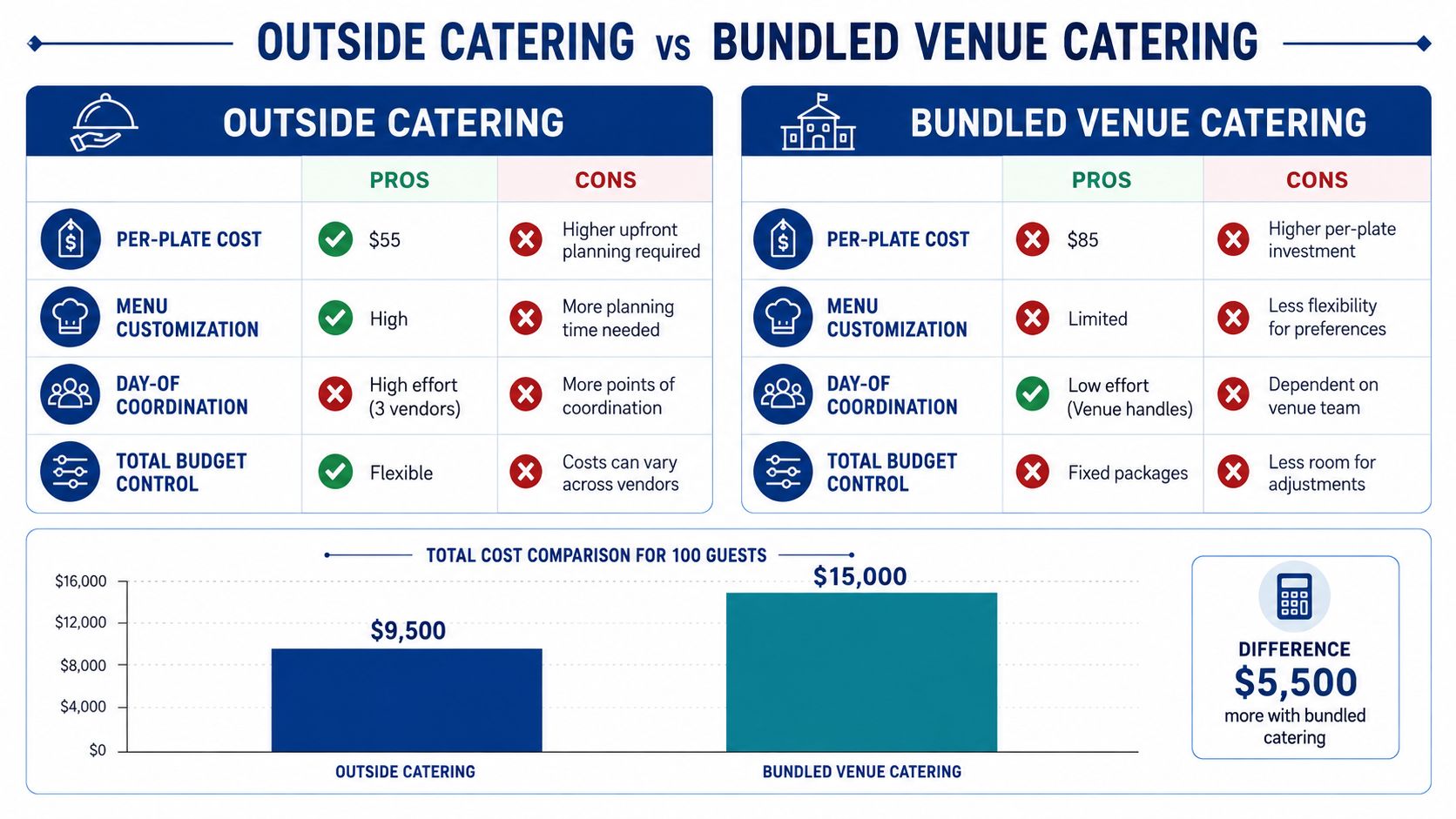
Outside catering makes sense when cuisine and customization shape the event. A trusted specialist may handle halal, kosher, regional, allergen-aware, vegan, or family-style service more effectively than a general banquet menu. The same applies when a family recipe or a particular chef carries meaning for the couple or host.
The financial advantage depends on the complete operating cost. A lower caterer quote can be offset by kitchen-use charges, service-entrance fees, mandatory staffing, corkage, cleanup, security, rentals, or venue minimums. Compare the venue, caterer, bar team, rentals, staffing, and cleanup as one arrangement. Per-person pricing alone hides the gaps that create budget surprises.
Where bundled service still works
Bundled catering fits planners who value one point of contact more than broad menu choice. The venue or its catering partner may already know the room, service timing, equipment, staffing pattern, and cleanup expectations. That familiarity reduces handoffs during a complicated reception and gives the planner fewer independent companies to coordinate.
A bundled agreement can also make liability and gratuity easier to interpret because food service sits within one established contract. The trade-off is less cultural or dietary flexibility, along with fewer opportunities to select an independent caterer. Review package exclusions before treating the quoted price as the final price.
| Planning factor | Outside catering | Bundled venue catering |
|---|---|---|
| Menu control | High, subject to venue approval and infrastructure | Usually limited to package or partner menus |
| Vendor management | Planner coordinates caterer, venue, bar, and rentals | Venue may coordinate more of the service chain |
| Cost visibility | Flexible, but separate charges can accumulate | Easier to read initially, though package exclusions still matter |
| Accountability | Responsibilities must be divided in writing | More centralized, but less independent choice |
| Best fit | Specific cuisine, trusted vendor, or unusual service format | Predictable service and reduced coordination workload |
Use the same guest count, menu scope, service level, rental needs, and cleanup expectations when comparing both models. Select outside catering when the food is a priority, the service route works, and the planning team can manage vendor documents and schedules. Select bundled catering when standardized execution and a shorter coordination chain carry more value.
For a Central Texas property, compare BYOB wedding venues with venues that bundle food and beverage service. Texas Old Town's vendor-flexible model still requires clear answers about access, equipment, staffing, and cleanup. Flexibility is useful only when those responsibilities are priced and assigned in writing.
The Site Visit Checklist Every Planner Needs
A catering policy becomes real during the site visit. Don't stand in the reception room asking only where the sweetheart table goes. Walk the route a vendor will take from vehicle to prep area, from prep area to dining room, and from dining room to waste removal.
Start in the kitchen and service areas
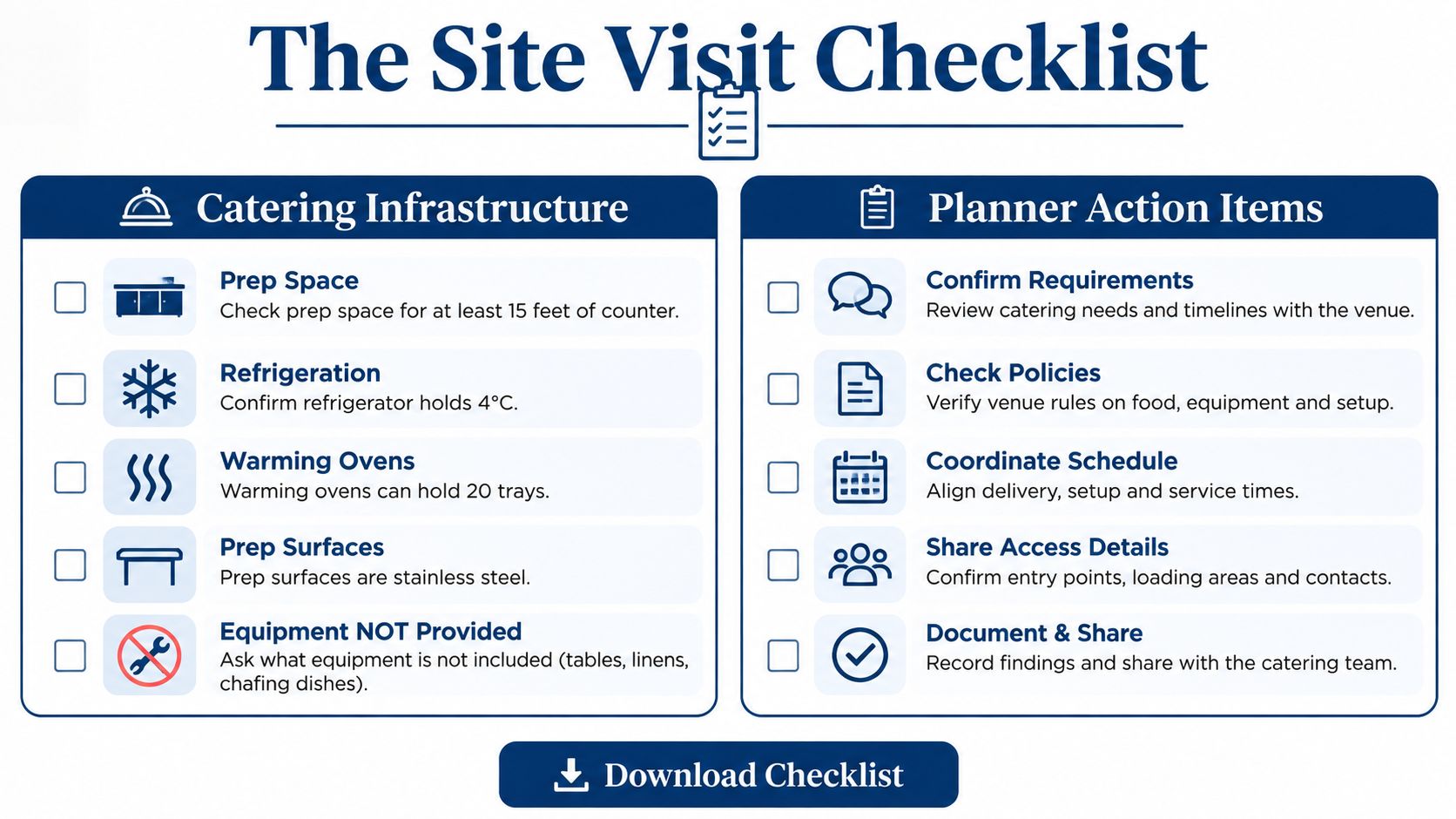
Ask the venue manager to identify every surface, appliance, outlet, sink, cooler, oven, and storage area the caterer may use. Write down what isn't included. A prep kitchen can sound substantial in a brochure while offering little room for a full team to stage food.
Confirm these points during the walk:
- Prep area: Find out whether the caterer can work there or only place finished food there.
- Refrigeration: Ask whether cold storage is available, reserved, and large enough for the menu.
- Heating equipment: Confirm warming ovens, hot boxes, chafing-dish rules, and power limits.
- Service surfaces: Check where plating, buffet assembly, and beverage staging will occur.
- Missing equipment: List tables, linens, shelving, ice, cookware, chafing dishes, and carts the venue doesn't provide.
A red flag is any answer that relies on “your caterer will figure it out.” The caterer can bring equipment, but only after knowing the dimensions, electrical capacity, access restrictions, and venue rules.
Trace the vendor's movement
Ask which doors vendors use, whether a dock or service entrance exists, and how vehicles reach it. Confirm elevator access, load-in windows, parking restrictions, delivery staging, and whether the venue allows the catering team to rehearse the service pass.
Outdoor events demand a more technical review. Confirm dedicated prep space, electrical capacity, clean water, waste disposal, refrigeration, and load-in routes with the relevant venue managers. Guidance for outdoor weddings recommends a walkthrough 4 to 6 months before the event, as documented by Food Network's outdoor wedding planning guidance.
If the caterer can't explain how food arrives, holds, gets served, and leaves the property, the menu isn't ready for contract approval.
Don't leave alcohol and waste until the end
Ask whether outside bartenders are allowed, whether the venue requires a particular bar company, and what certifications or insurance documents apply. Clarify corkage, cash-bar rules, host-provided alcohol, ice storage, glassware, and who closes the bar.
Then inspect the waste route. Who removes trash, food scraps, grease, cardboard, and broken glass? Does the venue provide bins, or must the caterer arrange disposal? A red flag is a vague promise that cleanup is “included” without defining whether that covers kitchen degreasing, grease disposal, food waste, rental crates, and exterior service areas.
Finally, check generator placement, guest parking, pedestrian paths, lighting, amplified sound limits, and noise curfews. Use a written venue inspection checklist and attach the completed version to your planning file. If the venue won't answer a basic infrastructure question during the tour, don't assume the answer will improve after signing.
Contracts Insurance and Vendor Agreements That Actually Protect You
A venue can approve your caterer and still disqualify the company later if documents arrive late or fail to meet the contract. Treat the approval process as procurement, not paperwork theater.
Industry guidance recommends recording each venue's capacity, event type, load-in rules, and pricing point in a comparison sheet, then confirming licenses, insurance, and a written vendor agreement before booking. The preferred-vendor workflow guidance is useful because it turns a casual vendor conversation into a documented approval trail.
Request the venue's insurance requirements before you sign with the caterer. Confirm the required liability limits, whether workers' compensation applies, whether the venue must be named as an additional insured, and when the certificate of insurance is due. The caterer should send the certificate directly or through the venue's approved process, not promise that it can be produced later.
Read the fee schedule beside the contract
Hidden charges often sit outside the headline rental figure. Review venue hire, food-and-beverage minimums, deposits, kitchen or production fees, corkage, cake-cutting, outside alcohol, security, staffing, and cleanup. Event fee guidance specifically highlights the way prep-space charges, outside cakes, alcohol fees, minimum spends, and deposits can alter the apparent price.
| Clause | Typical cost exposure | Negotiable? | Planner action |
|---|---|---|---|
| Kitchen or production use | Additional venue charge or required equipment rental | Sometimes | Ask for the exact amount, inclusions, and operating hours in writing. |
| Corkage and outside beverage rules | Per-bottle, service, or mandatory bar charges | Often policy-dependent | Confirm what counts as outside alcohol and whether waivers exist. |
| Staffing minimums | Extra labor for setup, service, bar, or cleanup | Sometimes | Match staffing requirements to the caterer's proposal. |
| Security requirements | Required guard coverage or minimum staffing | Venue-specific | Ask who hires the guards and whether the charge is separate. |
| Cleanup and disposal | End-of-night labor, grease, trash, and rental removal | Frequently clarified by addendum | Define the exact handoff point and included tasks. |
Read the hold-harmless clause with both the venue and caterer agreement open. A broad indemnity provision can shift responsibility for a vendor's accident or property damage onto the client. Ask counsel or your insurance broker to review language that makes you responsible for acts outside your control. For practical insurance context, this guide on protecting a food business with insurance can help your caterer identify coverage questions to raise with its broker.
Finally, align the vendor agreement with the venue contract. Load-in times, cancellation terms, force majeure language, payment deadlines, cleanup duties, and damage responsibility should not conflict. Include a clause requiring the caterer to follow the venue's rules and requiring the venue to notify the client promptly if the vendor's approval status changes.
Timeline and Vendor Coordination From Booking to Load-In
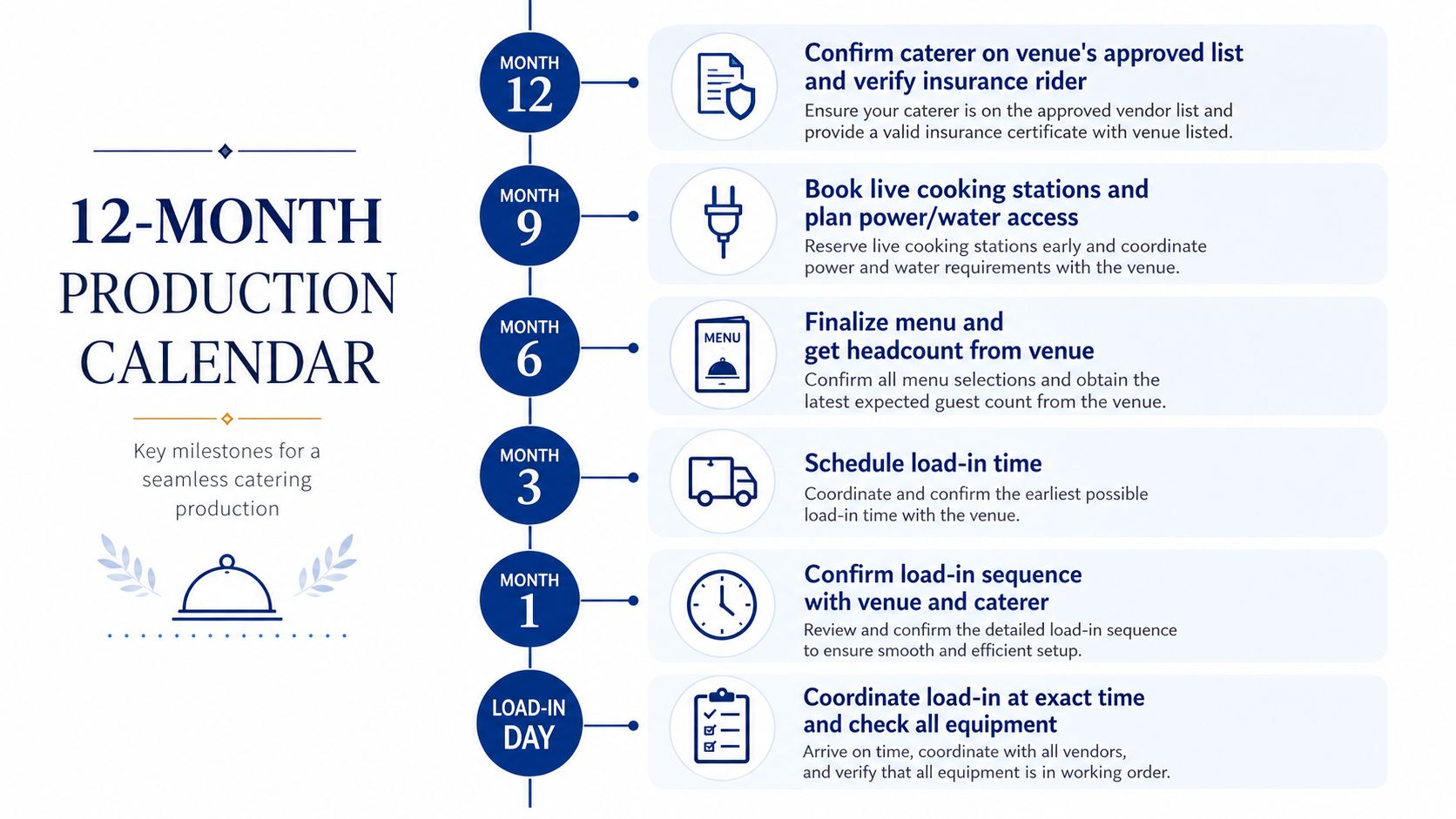
A flexible catering policy can still produce a costly event if the venue, caterer, bar company, rental team, planner, and client work from different assumptions. Put one production calendar in front of every party. Include document deadlines, delivery windows, service times, and physical access rules.
Build the calendar around decisions, not just meetings
At booking, confirm that the venue accepts the caterer and request its insurance certificate or rider requirements. Waiting until the final planning month can expose a separate vendor agreement, an unavailable service format, or an approval problem that affects the budget and schedule.
Use this sequence as a working template:
- Twelve months out: Confirm the outside-vendor policy, identify the caterer, and verify insurance requirements.
- Nine months out: Reserve live cooking stations or mobile service units. Plan power, water, parking, and guest-flow access before signing off on the setup.
- Six months out: Hold the kitchen walkthrough and tasting. Finalize the equipment list, menu style, service method, and process for confirming the venue headcount.
- Three months out: Schedule the load-in window and list every delivery vehicle, rental drop, and service crew.
- Two months out: Complete the signed vendor agreement, upload the certificate of insurance, and confirm the guest-count deadline.
- Two weeks out: Review the run-of-show, delivery windows, bar inventory, refrigeration plan, waste plan, and emergency contacts.
- The day before: Coordinate rental, floral, beverage, and cold-storage deliveries. Confirm who may enter the property and where each item will stage.
- Load-in day: Bring in the caterer, bartender, and rental crew in a controlled sequence. Check equipment against the approved list before guests arrive.
- Load-out: Reverse the sequence. Remove food, rentals, waste, and equipment according to the venue's closing instructions.
Keep one version of the run-of-show
Send a coordination email after each major planning call. State the current arrival times, service start, meal duration, bar close, cleanup handoff, and departure responsibilities. Give every vendor a correction deadline, then update the master file rather than allowing parallel versions to circulate.
Conflicting instructions create the common failure point. The caterer may plan to use the service entrance while the venue expects delivery through guest parking. A bar team may order inventory for a hosted bar even though the contract sets a different arrangement. A rental company may schedule pickup before the caterer finishes breakdown.
Coordination standard: One master schedule, one equipment list, one contact sheet, and one written approval trail.
Store current files in a shared folder and label superseded versions clearly. The venue coordinator needs the caterer's cell number, while the caterer needs to know who can authorize on-site changes. Use this event planning timeline as a reference, then adjust it to the selected venue's access rules and contract deadlines.
How Texas Old Town Puts These Policies Into Practice
A vendor-flexible policy only helps when the property supports the caterer's work. Texas Old Town offers a useful Central Texas example because its venue details allow clients to choose any caterer, while still requiring the operational controls that protect the property and event.
The planner's questions can be matched to specific venue features:
- Can we choose our own food vendor? The property permits outside caterers and also maintains a preferred vendor list for planners who want recommendations.
- Where does food enter and stage? The venues include a prep kitchen with a separate service entry, so the caterer's route can be planned away from the main guest entrance.
- How does beverage service work? The venue supports host-provided beverages through a structured BYOB framework and requires an approved bartending company. That gives clients beverage flexibility without treating alcohol service as an informal add-on.
- Who handles the final room reset? On-site management oversees the event, while cleanup and furniture breakdown are included. The caterer still needs to confirm its own food, equipment, grease, and waste responsibilities.
- How much time is available for production? Exclusive access runs for 16 hours, from 8:00 a.m. to midnight, giving the planner a defined setup and breakdown window.
- What does the venue supply? Published furniture counts, beverage bars, climate-controlled reception spaces, sound systems, dressing suites, parking, and indoor and outdoor ceremony options help the planner separate venue inclusions from caterer rentals.
The policies are planner-friendly because they answer the main flexibility questions without removing the need for diligence. Outside catering doesn't mean unlicensed vendors can arrive without documents. The caterer still needs to meet the venue's approval, insurance, access, service, and cleanup conditions. The BYOB model also requires the planner to coordinate the bartending company and understand exactly what the bar team provides.
Request the venue's vendor packet before booking. Then schedule a coordination call 72 hours before the event with the venue manager, caterer, bar company, and planner. Confirm the final guest count, arrival order, equipment, food holding, beverage inventory, waste removal, weather plan, and emergency contacts in one written record.
Texas Old Town offers four private halls, indoor and outdoor ceremony settings, a prep kitchen with separate service entry, outside-caterer flexibility, structured BYOB service, on-site management, and included cleanup and furniture breakdown. If you're comparing venues that allow outside catering in Central Texas, visit Texas Old Town to tour the property and request the vendor packet before you commit.