You're probably looking at a venue listing that says BYOB and thinking, good, we'll save money on the bar. Sometimes you will. Sometimes you won't. The difference comes down to one thing most couples miss: total beverage expenditure, not the alcohol purchase alone.
That's where BYOB wedding planning goes sideways. Couples compare bottle prices but forget bartenders, insurance, ice, mixers, setup rules, delivery timing, storage, cleanup, and venue restrictions. Then the contract shows up and the “cheap bar” suddenly looks a lot less simple.
I'm firmly pro-BYOB when the venue has a clean process and you understand the rules before you sign. I'm against it when the venue markets freedom but hands you a maze of operational requirements after the deposit clears. Good BYOB wedding venues give you control. Bad ones give you chores.
Table of Contents
- What Exactly Are BYOB Wedding Venues
- The Pros and Cons of a BYOB Policy
- Navigating the Rules and Logistics of BYOB
- Cost Comparison BYOB Venue vs All-Inclusive Bar
- Your BYOB Wedding Planning Checklist and Timeline
- How Texas Old Town Perfects the BYOB Experience
- Essential Questions to Ask Every BYOB Venue
What Exactly Are BYOB Wedding Venues
A BYOB wedding venue doesn't always mean you can haul in coolers, assign your cousin to pour wine, and call it done. In practice, BYOB usually means you provide the alcohol, while the venue controls how service happens.
That distinction matters. A lot of confusion starts because venues use the same phrase for completely different operating models. One venue means true outside alcohol freedom. Another means you buy the alcohol, but only their approved bartending partner can touch it. Both get labeled BYOB.
BYOB is a policy family, not one single setup
Think of BYOB like airline tickets. “You booked a seat” doesn't tell you whether bags, seat selection, or flexibility are included. “BYOB” works the same way.
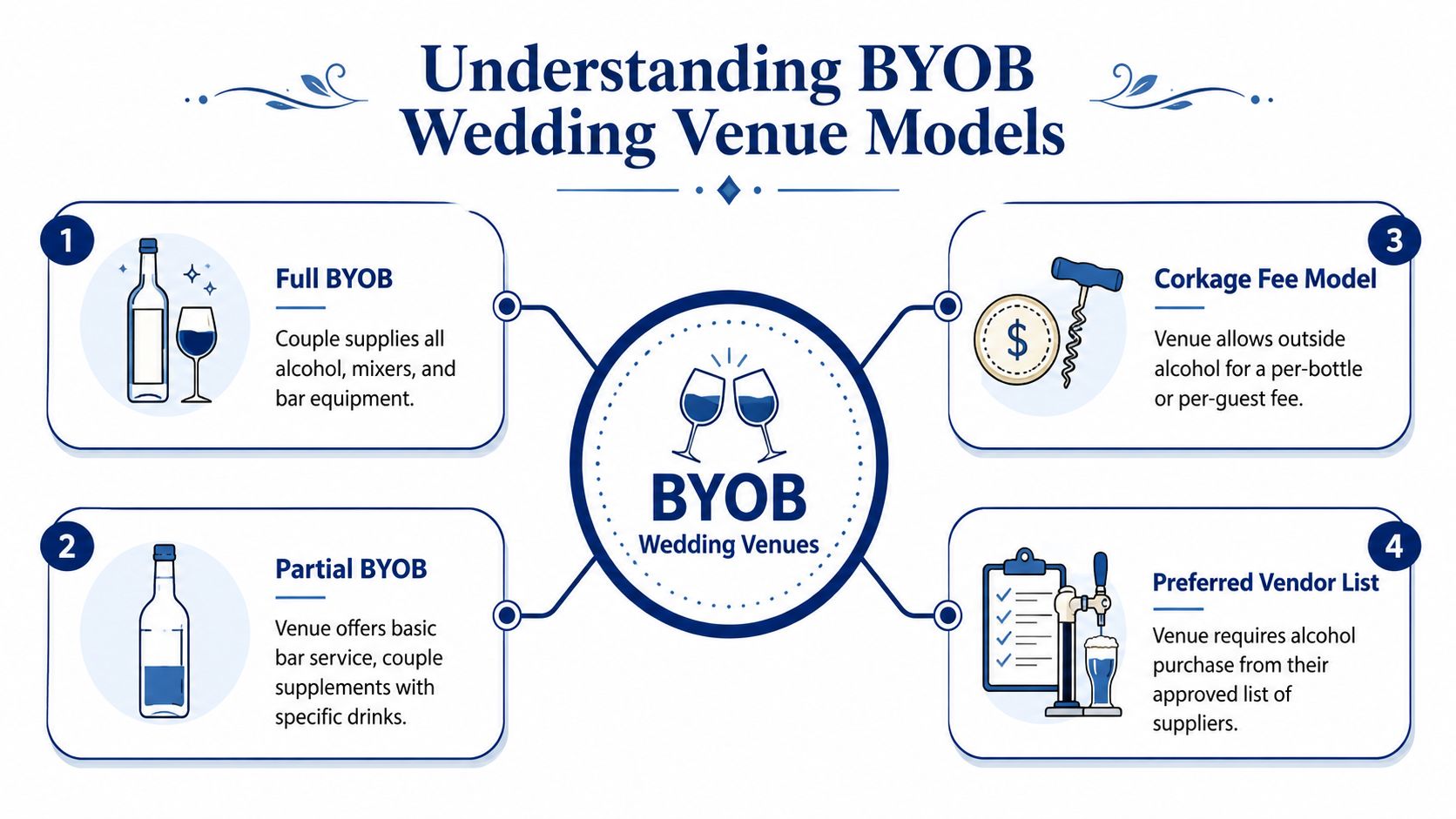
Here are the models you'll run into:
- Full BYOB: You supply alcohol, mixers, bar tools, and often much of the service planning.
- Partial BYOB: The venue covers part of the beverage setup and you supplement specific items.
- Corkage fee model: Outside alcohol is allowed, but only with added per-bottle or per-guest charges.
- Preferred vendor list model: You bring alcohol or choose from approved supply channels, but the venue limits who serves it.
The most common version today is structured BYOB. That means the venue gives you bar access, may allow broad alcohol choice, but requires insured professionals to manage service. That's the model I recommend most often because it keeps the control where it helps and removes the chaos where it hurts.
Practical rule: If the venue says “BYOB,” your next question should be, “Who is allowed to serve it, store it, and clean it up?”
How to read the policy without getting burned
Don't rely on the venue listing headline. Read the alcohol clause in the contract and look for four things:
Service rules
Does the venue require approved bartenders, or can your caterer's team serve?Supply boundaries
Are you bringing only alcohol, or also mixers, ice, garnishes, cups, and napkins?Timing rules
When can alcohol be delivered, unloaded, chilled, and removed?Fee triggers
Corkage, bar setup, cleanup, security, trash handling, and insurance requirements all belong in writing.
A strong BYOB policy is boring in the best way. It's specific, operational, and easy to price. A weak one sounds flexible until you start asking questions.
The Pros and Cons of a BYOB Policy
BYOB wedding venues can be smart. They can also be exhausting. The right fit depends less on your taste in wine and more on your tolerance for coordination.
Why couples love it
The upside is obvious first. You control the bar menu. If you want a Texas craft beer, a family-favorite tequila, a natural wine selection, or just a simple beer-and-wine setup, you can build that deliberately instead of buying a generic package.

That control usually creates a better guest experience than couples expect. Guests notice when the bar feels personal instead of copied from a banquet menu. BYOB also helps couples avoid paying for beverage options they don't even want served.
The less obvious advantage is decision clarity. With BYOB, you make intentional calls on bar style:
- Beer and wine only for a simpler, cleaner service flow
- One signature drink if you want personality without overcomplicating prep
- Full bar if your guest list expects variety and you're willing to manage the moving parts
Why some couples regret it
The downside is work. BYOB adds a planning category that many couples underestimate. Somebody has to count, order, transport, chill, restock, and remove everything connected to the bar.
And no, “we'll figure it out later” doesn't work here. Beverage service breaks down fast when nobody owns the details.
A BYOB bar succeeds because someone built a system for it. It fails when everyone assumes someone else is handling it.
The other problem is emotional. Couples choose BYOB for freedom, then discover they've signed up to manage inventory on top of seating charts, catering, rentals, and family politics. If you hate logistics, BYOB can become a bad bargain.
Here's the blunt version:
| Good fit for BYOB | Bad fit for BYOB |
|---|---|
| You want control over drink choices | You want bar service fully handled |
| You're comfortable comparing vendor rules | You don't want to read fine print |
| You have an organized planner or coordinator | You're already overloaded |
| You like transparent cost-building | You prefer one packaged number |
BYOB is strongest when you treat it as a managed project, not a shortcut.
Navigating the Rules and Logistics of BYOB
Most couples think the hard part is choosing wine. It isn't. The hard part is building a beverage operation that is legal, safe, and efficient for one night.
Approved bartenders are not a nuisance
When venues require approved bartending partners, they're not being difficult. They're reducing risk. In BYOB wedding venues, venues that mandate approved bartenders reduce liability incidents by 68% compared to venues allowing self-service, according to 7 Centerpieces on BYOB venue policies.
That's why I push couples away from DIY pouring stations for anything beyond a tiny private gathering. Trained bar staff handle pacing, guest intoxication issues, bar cleanliness, refill timing, and the basic reality that weddings get messy once dancing starts.
Professional service also protects your timeline. Guests don't care who supplied the alcohol. They care whether they had to stand in a slow line while someone searched for more ice.
The hidden line items that change the budget
The biggest planning mistake with BYOB wedding venues is pricing bottles and stopping there. The gap between “alcohol cost” and “total beverage expenditure” is where couples get surprised.
According to Peerspace's discussion of BYOB wedding venue costs, hidden beverage costs such as corkage, bartender fees, and insurance can add 20–30% to the initial budget estimate. That's a major swing. It's also why some couples feel blindsided.
Watch for these line items:
- Bartending labor: If the venue requires a licensed service team, that labor is not optional.
- Insurance requirements: Some venues require proof before service starts.
- Corkage or service fees: Outside alcohol doesn't always mean free alcohol access.
- Mixers and nonalcoholic drinks: These are easy to forget and annoying to source late.
- Ice: It sounds minor until you realize how much volume a full wedding bar burns through.
- Bottle disposal and end-of-night removal: Ask who handles empties and leftovers.
If you're trying to reduce waste for water stations or soft drink service at related events, this guide to compostable cups for UK businesses is useful for thinking through disposable serviceware choices in a more structured way.
What organized beverage service looks like
A strong BYOB setup runs like a chain of custody. Alcohol arrives on time, gets stored correctly, gets handed to the right staff, and is served from a bar designed for flow.
For couples evaluating a DIY-friendly property, it helps to review how a venue defines setup responsibility and service structure. This DIY venue planning resource from Texas Old Town is a good example of the kind of operational detail you should look for before assuming “bring your own” means “do whatever you want.”
Ask yourself one practical question: if fifty guests walk to the bar at once, who has already solved that problem? If the answer is unclear, the venue's BYOB process isn't ready.
Cost Comparison BYOB Venue vs All-Inclusive Bar
A couple chooses a BYOB venue because the bar package at an all-inclusive property looks expensive. Six weeks later, they are paying for bartenders, mixers, ice, glassware, delivery windows, and extra labor they never put in the first draft of the budget. That is the actual comparison. You are not comparing bottle prices. You are comparing total beverage expenditure and the system required to serve those drinks correctly.
Industry planning data from neutral wedding budget trackers such as The Knot and Wedding Report is useful for setting expectations, but the decision usually comes down to your guest count, drinking habits, service style, and venue rules. A 150-person wedding with beer, wine, and one signature cocktail runs on a very different cost structure than a 250-person wedding with a full mixed bar and multiple service points.
Compare total beverage expenditure, not just alcohol
All-inclusive bars are expensive because labor, licensing, setup, inventory risk, mixers, and cleanup are already baked into the package. BYOB can come in lower, but only if you price the whole bar operation before you sign the venue contract.
Use this framework:
Alcohol purchase cost
Beer, wine, spirits, and enough product to cover your full service window.Bar labor
Professional bartenders, barbacks, and any overtime charges tied to your timeline.Support inventory
Mixers, garnishes, syrups, sodas, water, juices, and coffee service if it touches the bar plan.Service materials
Cups or glassware, napkins, straws, coolers, tubs, and bar tools if they are not included.Handling costs
Delivery, pickup, chilling, restocking, and end-of-night removal.Venue and vendor fees
Corkage, security, permit-related requirements, or coordination fees attached to outside alcohol service.
That is your true number.
Where BYOB actually saves money
BYOB usually works best for couples who want control, not couples who want a completely hands-off bar. The savings are strongest when the menu is narrow, the guest count is predictable, and the service plan matches the room.
Three setups usually pencil out well:
- Beer and wine only
- Beer, wine, and one batch-friendly signature cocktail
- Limited bar hours instead of full-night open service
Those formats cut product waste, simplify staffing, and reduce the chance that you overbuy liquor no one drinks.
Where all-inclusive often wins
All-inclusive bars often make more financial sense when your wedding has a high guest count, a long reception, complex room flow, or a crowd that expects a full bar. In those cases, the convenience premium buys real protection. One vendor owns the inventory, staffing, timing, and service problems.
That matters because bar costs do not rise only from what guests drink. They rise from operational friction. Slow lines lead to pressure for more staff. Poor coordination between dinner and bar service creates bunching. Last-minute shortages trigger expensive emergency purchases.
If your event design already has a lot of moving parts, simplicity has value.
The practical recommendation
Run two side-by-side budgets. One should be a BYOB model with every labor and supply cost listed. The other should be the venue's all-inclusive package with tax, gratuity, and any upgrades added in. Then compare cost per guest and management burden, not just the headline number.
If you are building a BYOB plan, food service and bar service need to be coordinated from the start. A strong catering plan affects bar placement, line length, refill timing, and labor counts. This guide to wedding event catering near Austin and San Antonio is a smart companion if you are mapping dinner service and beverage flow together.
One rule is simple. BYOB saves money only when the logistics are disciplined. If the plan is loose, the savings disappear fast.
Your BYOB Wedding Planning Checklist and Timeline
A week before the wedding is a terrible time to learn nobody ordered ice, the bartender needs a different mixer count, and the venue will not accept an alcohol delivery without a named contact on-site. That is how BYOB savings turn into rush fees, extra store runs, and a stressed-out wedding morning.
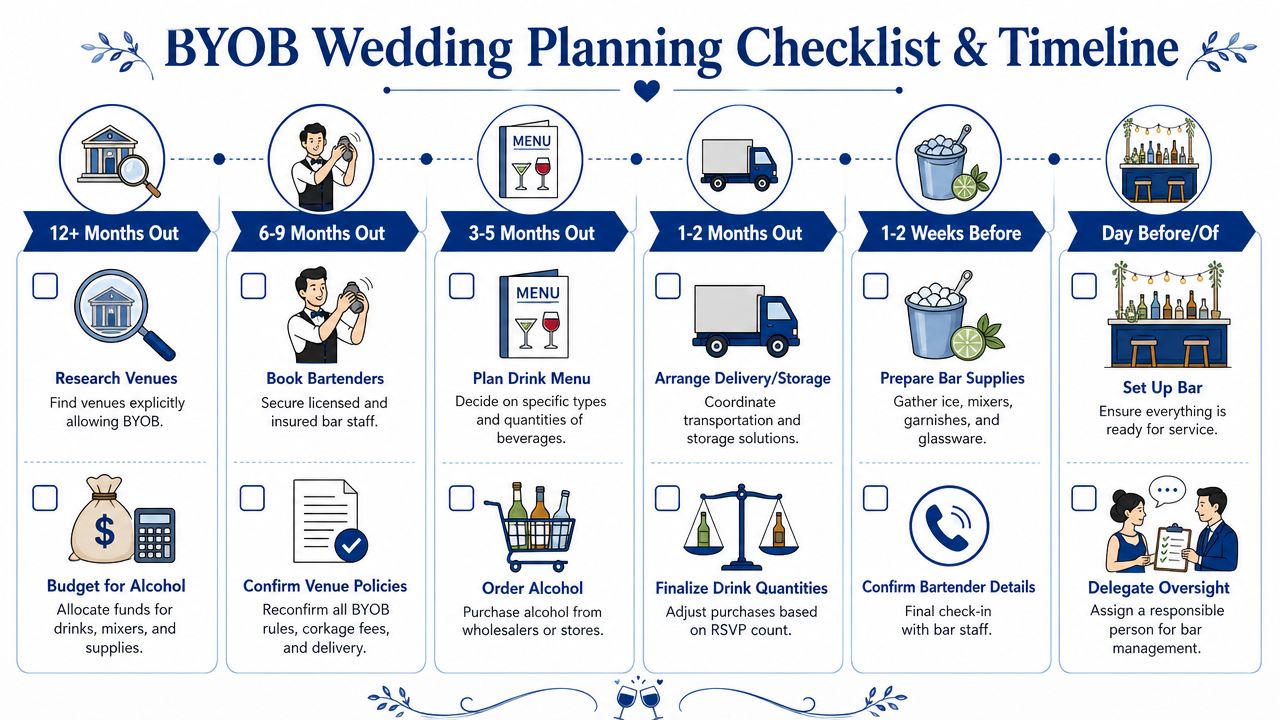
Treat your beverage plan like an operating schedule, not a shopping list. The job is controlling total beverage expenditure while assigning every task to a specific person, vendor, or deadline. Couples who do this well usually start with venue rules, bartending requirements, service hours, and delivery logistics. Couples who skip that order usually overspend.
12 plus months to 6 months out
Start with the contract. Confirm the alcohol policy in writing, then build the bar plan around it. You need clear answers on outside alcohol, approved bartending companies, service cutoff times, storage access, delivery windows, cleanup rules, and leftover pickup.
Book your bartender early. BYOB only works when a licensed, insured team can execute your plan within the venue's rules. Ask exactly what they bring and what you must provide, including ice, mixers, garnishes, bar tools, cups, napkins, and trash handling.
Set your beverage format early too. Beer and wine is the simplest model to control. Beer, wine, and one signature cocktail gives guests more choice without creating a full-bar problem. A broad liquor setup costs more to stock, takes more planning, and increases the odds of leftover product you cannot return.
Your early checklist should include:
- Get the alcohol policy in writing: Ask for service requirements, approved vendors, timing restrictions, and any fees tied to bar service.
- Choose the bar format: Decide whether you are serving beer and wine only, adding one signature drink, or offering a fuller bar.
- Hire bartending service: Confirm licensing, insurance, setup needs, and what supplies are included.
- Assign beverage oversight: One person should own ordering, delivery coordination, and day-of handoff.
- Review venue logistics: Storage, loading access, ice handling, and bar placement affect labor and product needs. A venue built for events makes this easier, which is one reason couples compare properties like this wedding venue near San Antonio with a structured BYOB setup.
3 months out to wedding week
This is the control phase. Your guest count sharpens. Your order should tighten with it.
Three to five months out, finalize the menu and convert it into a purchase list by category: alcohol, mixers, water, soft drinks, ice, garnishes, cups, napkins, and bar extras. Confirm who is chilling what, where it will be stored, and when it can arrive.
One to two months out, update quantities to match RSVPs and actual drink preferences. This is also when you should confirm delivery timing, pickup timing, and whether anyone needs authority to sign for the order. If alcohol arrives and nobody can accept it, the whole schedule slips.
One to two weeks before, review the floor plan with your bartender or coordinator. Confirm bar location, backup stock placement, restocking access, and who handles empties and trash. If your reception has multiple spaces, spell out where drinks are served during cocktail hour, dinner, and dancing. Room flow changes beverage labor.
For the final stretch, use this checklist:
Three to five months out
Finalize the drink menu, build the full purchase list, and confirm storage and chilling needs.One to two months out
Adjust quantities to RSVPs, confirm mixers and nonalcoholic drinks, and lock delivery and pickup timing.One to two weeks before
Reconfirm bartenders, bar layout, setup access, and who receives the alcohol order.Day before or day of
Verify setup, restocking, ice delivery, empties removal, and leftover alcohol pickup.
One rule matters more than all the others. If the bar handoff does not have a named owner, expect problems.
How Texas Old Town Perfects the BYOB Experience
You save money on alcohol, then lose it on preventable bar problems. That is what happens at venues that say BYOB is allowed but do very little to support it. The critical factor is not whether you can bring your own bottles. The crucial consideration is whether the venue has the infrastructure and rules to keep service moving, protect product, and keep your total beverage expenditure under control.

The venue solves the expensive problems
Texas Old Town stands out because its BYOB model is built around operations, not just permission. The property includes built-in beverage bars, a prep kitchen, indoor and outdoor PA systems with Bluetooth hookup, and a long rental window that gives vendors and families time to load in, stock the bar, and set up without compressing the whole schedule.
That matters because beverage costs are not limited to the alcohol order. Total beverage expenditure also includes waste, extra ice runs, duplicate mixer purchases, delayed service, and labor inefficiency when the bar is hard to access or poorly staged. A venue with dedicated bar areas and prep support helps reduce those problems before they hit your budget.
Why the structure works
Texas Old Town also uses the right service model. Couples supply the beverages. Approved bartending companies serve them. That is the setup I recommend.
You keep control over what you buy and how much you spend. The venue keeps service in the hands of teams who already know the property, the setup points, and the flow of the event. That lowers the odds of common BYOB failures like slow cocktail hour lines, understocked bars, and confusion about who is responsible for restocking, cleanup, and leftover alcohol.
The 16-hour rental window is another practical advantage. Extra access time protects your beverage plan. It gives your bartender or coordinator time to receive deliveries, organize back stock, chill what needs chilling, and prep the bar before guests arrive. It also gives the team time to break down correctly at the end of the night instead of rushing through inventory and cleanup.
If you want a better sense of how the property supports events in this part of Central Texas, read why Texas Old Town is a strong wedding venue option near San Antonio.
That is what couples should look for in a BYOB venue. Freedom over the purchase. Structure around the execution.
Essential Questions to Ask Every BYOB Venue
Take these questions on every venue tour and don't leave without direct answers.
- Who can serve the alcohol? Ask whether you can hire your own insured bartender or whether the venue requires approved bartending companies.
- What exactly does BYOB include? Clarify whether you're only bringing alcohol or also mixers, ice, cups, garnishes, and bar tools.
- Are there corkage, service, insurance, or cleanup fees? If they exist, ask how they're calculated.
- What are the delivery and storage rules? You need clear timing for drop-off, chilling, setup, and removal.
- Who clears empty bottles and who takes leftover alcohol? Don't assume the answer.
- Does the venue restrict other vendors while marketing itself as flexible? That “vendor policy paradox” is a real issue, and Atlanta Bridal's BYOB venue discussion highlights how couples often discover approved bartending restrictions only during contract review.
A good venue answers these questions quickly. A bad one gets vague.
If you want a Central Texas venue that gives couples BYOB flexibility without the usual confusion, take a serious look at Texas Old Town. Its structured bar policy, long rental access, built-in beverage bars, and practical event setup make it a strong fit for couples who want control over the drinks without turning their wedding into a bar management project.