You're comparing venue quotes, and the lower number looks like the obvious choice. Then you notice the fine print: the cheaper proposal excludes ceremony access, overtime, tax, and service charges. By the time those items appear, the “deal” may cost more than the higher quote.
That's the central problem with wedding package pricing. A package isn't just a rental fee. It's a bundle of access, labor, furniture, staffing, taxes, service rules, and assumptions about your guest count and schedule. The useful question isn't “Which venue has the lower starting price?” It's “Which quote gives me the most reliable all-in total?”
Table of Contents
- What Wedding Package Pricing Really Means in 2026
- What's Typically Included and What's Quietly Excluded
- The Four Biggest Cost Drivers Behind Any Quote
- Texas Old Town Venues and Per-Guest Pricing Math
- Payment Plans, Booking Windows, and Short-Timeline Tips
- Why an All-In Higher Quote Often Costs Less in Practice
- Smart Ways to Customize and Your Final Pricing Checklist
What Wedding Package Pricing Really Means in 2026
Maya and Jordan receive two venue quotes. One lists $14,000; the other lists $11,500. The lower quote excludes the ceremony fee, overtime, and tax, so the venues are not selling the same product. Comparing the top-line figures gives them a misleading answer.
Wedding package pricing means the disclosed cost of the service tier you are buying. A useful proposal identifies what the couple receives, what remains separate, and which guest count, date, and schedule assumptions set the price. Texas Old Town's transparent 16-hour access window, with tax and gratuity included, shows why access and included charges belong in the headline comparison, not buried in contract language.
Apply the same four-part test to every quote
Start with the base venue fee. Confirm whether it includes the ceremony, reception, exclusive use, and access to the property, or only one room for a limited period. A room rental and a full-day event package require different budgets.
Then examine the bundle. Tables, chairs, linens, tableware, setup, teardown, parking, dressing rooms, coordination, and cleanup all have labor or replacement costs. If they are absent, the lower rental price may shift those expenses to vendors.
List every add-on separately. Tax, gratuity, service charges, overtime, bar service, security, insurance, cake cutting, lighting, and vendor fees should each have a clear line. “Available upon request” is not a complete pricing answer.
Finally, record the assumptions. A quote based on 150 guests, a particular weekday, or a short event window can change when your guest list or schedule changes. Ask the venue to show the revised total under your actual plan.
Practical rule: Compare an all-in total with another all-in total, never one venue's headline price with another venue's completed estimate.
Published benchmarks also explain why quotes vary. Zola's Wedding Cost Index reports average U.S. venue and site fees of $8,573, with a typical range of $6,900 to $10,300 (Zola's wedding cost guide). A separate 2026 benchmark based on The Knot's Real Weddings Study reports an average venue cost of $12,900, while The Knot reports increases of $3,900 since 2016 and $700 from 2024 to 2025. These figures use different datasets, markets, and definitions of venue cost, so neither should replace a venue-specific proposal.
The right test is predictability. A transparent $14,000 package may be easier to fund than an $11,500 quote that leaves major categories unresolved. Ask what each dollar buys before deciding which number is lower.
What's Typically Included and What's Quietly Excluded
Most venue proposals look complete because the included items are easy to list. The risk sits in the omissions. Couples usually discover those omissions during contract review, catering selection, or the final guest-count update, when changing direction is expensive.
A conventional package often includes the ceremony and reception spaces, a defined event window, tables, chairs, basic linens, standard tableware, a bridal suite, a groom's room, setup, teardown, parking, and some form of day-of coordination. That's a solid foundation, but it doesn't tell you whether the venue handles the labor and services your wedding requires.
Read the package as an operating document
A venue with a 16-hour access window and tax and gratuity included gives you a different planning tool from a venue that sells a shorter rental and bills every extra service separately. Long access can absorb setup, rehearsal, ceremony, reception, and breakdown without forcing the wedding party to compress the day.
The same distinction applies to logistics. If you're arranging guest movement for a destination celebration, a practical resource such as this Cancun wedding transportation guide can help you think through transportation as an operational line item rather than an afterthought. The principle applies locally too: ask who handles parking, shuttles, loading, and guest flow.
| Line Item | Usually Included | Commonly Excluded |
|---|---|---|
| Space | Ceremony and reception room | Separate ceremony fee or room flip |
| Access | Set event hours | Earlier setup, rehearsal access, overtime |
| Furniture | Tables and chairs | Specialty furniture or extra seating |
| Textiles | Basic linens | Upgraded linens, napkins, specialty colors |
| Staffing | Setup, teardown, or venue manager | Additional labor, security, extended staffing |
| Food service | Sometimes catering coordination or kitchen access | Catering, vendor meals, cake cutting |
| Bar | Basic beverage area | Alcohol, bartending, corkage, upgraded bar |
| Administration | Contracted venue services | Tax, service charge, gratuity, insurance |
Compare two 150-guest scenarios
Consider a 150-guest wedding with the same ceremony and reception schedule. In an all-in model, tax and gratuity are already built into the quoted price, access lasts 16 hours, and the couple can use flexible vendors. The visible quote may be higher, but the couple has fewer unresolved categories.
In an à la carte model, the venue fee may exclude ceremony access, tax, service charges, overtime, bar labor, setup, and cleanup. Once those exclusions surface, the same wedding can move by $3,000 to $5,000, depending on the contract and services selected. The range reflects the structure of the quote, not a universal surcharge.
The best proposal makes exclusions as visible as inclusions. Ask the venue to produce one written number that includes every mandatory charge, then request a second list showing optional upgrades.
The Four Biggest Cost Drivers Behind Any Quote
A venue quote can change sharply because of four variables, not décor: guest count, time window, service intensity, and geography. The room is only part of the price. The cost also reflects the labor, staffing, equipment, and operating time attached to it.
Guest count usually creates the largest change. Every additional 25 guests can add $1,500 to $3,500 through food, seating, place settings, bar consumption, and staffing ratios, according to WeddingWire's wedding cost guide. Require every proposal to separate the fixed rental fee from per-person charges.
Guest count changes more than dinner
Adding guests affects chairs and table settings, while also changing the floor plan, service coverage, restroom demand, bar volume, catering labor, and cleanup. If you are comparing 150 and 175 guests, ask which line items scale with attendance and which remain fixed. A room's capacity does not tell you whether the larger guest list fits your budget.
Time creates another major cost. Full-service wedding planning typically requires 200 to 400 hours and costs around $7,500 to $18,000 nationally, with higher ranges in major metros and destination markets, according to Wedding Planner Central's pricing guide. A venue that includes setup, extended access, event management, and cleanup is covering labor that another venue may charge separately. Review the access schedule before comparing rental fees.
Service intensity changes the quote as well. Plated meals require more coordination and table-side labor than buffets. Bar policies can also shift staffing and purchasing responsibilities to the couple. “Catering included” tells you very little until you confirm the menu level, service style, staffing, rentals, beverage rules, and cleanup.
Geography sets the final major difference. A 2026 market snapshot places average venue cost around $27,710 in New Jersey and roughly $3,770 in Wyoming. International comparisons list London venues at about £4,700, Glasgow at £2,500, and Sydney at AUD $5,900, according to The Knot's reception venue pricing guide. Compare venues within the same market and service level before judging a package as expensive.
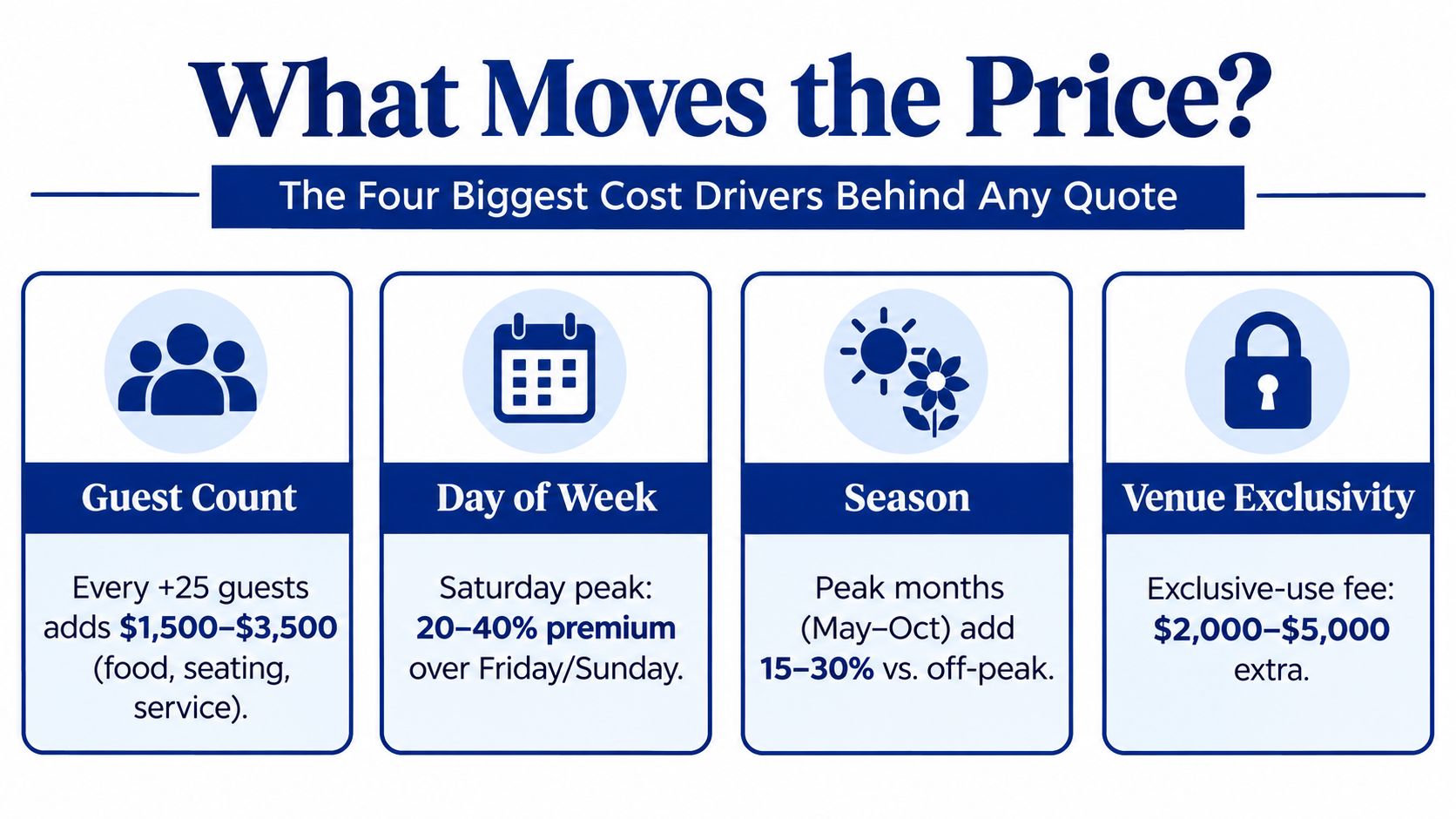
Audit every proposal using four questions:
- Guest count: Which fees are fixed, and which are per person?
- Time window: What access covers setup, rehearsal, celebration, and breakdown?
- Service intensity: Who provides food, staffing, rentals, bar service, and cleanup?
- Geography: Are you comparing similar markets and service levels?
Texas Old Town's transparent 16-hour model, with tax and gratuity included, shows why all-in predictability matters. A higher visible quote can be easier to budget than a lower base fee followed by overtime, labor, service charges, and other add-ons. A trustworthy proposal states the base fee, included services, optional upgrades, and assumptions behind the final number.
Texas Old Town Venues and Per-Guest Pricing Math
Capacity is where venue pricing becomes practical. A room that fits your guest list may still be a poor financial match if its seating minimum, access schedule, or vendor rules force you to buy services you don't need.
Texas Old Town offers four distinct halls in Kyle, Texas. Tejas accommodates up to 320 guests, Sage up to 300, Stone up to 300, and Redbud up to 150, based on the publisher's venue information. Those capacities help narrow the search, but they don't create a final price without the venue's current rate sheet and your event details.
Start with the seating minimum
A venue's starting price usually reflects its intended event scale. Redbud suits a smaller celebration because its capacity tops out at 150 guests. Tejas, Sage, and Stone give larger weddings more room to distribute fixed venue costs across a bigger guest count.
The published model includes 16-hour access from 8:00 a.m. to midnight, exclusive use of the selected venue, ceremony options, tables and chairs, dressing suites, sound equipment, an on-site manager, and cleanup and furniture breakdown. Sales tax and gratuity are included in the quoted price, according to the publisher's pricing information.
That structure changes the calculation. Instead of dividing a bare rental fee by the guest count, divide the quoted venue total by your expected attendance, then list catering, alcohol, photography, music, flowers, attire, and other remaining costs separately.
| Venue | Seated Capacity | Saturday Rate (2026) | 16-Hour Access | Per-Guest at 150 | Weekday Saving |
|---|---|---|---|---|---|
| Tejas | Up to 320 | Request current rate | Included | Current rate ÷ 150 | Ask for current weekday discount |
| Sage | Up to 300 | Request current rate | Included | Current rate ÷ 150 | Ask for current weekday discount |
| Stone | Up to 300 | Request current rate | Included | Current rate ÷ 150 | Ask for current weekday discount |
| Redbud | Up to 150 | Request current rate | Included | Current rate ÷ 150 | Ask for current weekday discount |
Work the math before you tour
For a 120-guest wedding, take the Saturday venue quote and divide it by 120. Then add the separately controlled costs, especially catering and beverages. A smaller guest count can produce a higher venue cost per person because fixed access, staffing, and property costs are spread across fewer attendees.
For a 220-guest wedding, divide the selected venue's quote by 220 and check whether the room's capacity and furniture inventory support the layout you want. Tejas, Sage, and Stone are the natural capacity candidates, while Redbud won't suit that guest count.
Weekday pricing can create meaningful savings. Texas Old Town's planning materials indicate weekday discounts that can reach 15% to 25%, so request a written weekday quote rather than assuming the Saturday figure is fixed. The exact saving depends on the date and venue.
The ceremony fee may be bundled into the venue package, but you'll still need an officiant and marriage license. Vendor flexibility also keeps the rest of the budget adjustable. Couples can choose their caterer and bring their own beverages under the venue's bar-service requirements, rather than accepting a locked per-guest catering and alcohol minimum.
Payment Plans, Booking Windows, and Short-Timeline Tips
A payment plan should make the contract easier to manage, not make the total harder to understand. Before signing, ask for the deposit, every milestone payment, the final balance date, and the consequences of cancellation or date changes in one schedule.
The common structure is straightforward: a non-refundable deposit secures the date, a second payment arrives several months before the wedding, and the final balance is due before the event. Texas Old Town lists personalized payment plans among its planning options, and couples can review the venue's wedding payment plan information before requesting terms.
Match the booking window to the date
Popular Saturdays at high-capacity venues often book 12 to 18 months ahead, according to Castle Farm's wedding venue guidance. That window gives couples more choice, especially for peak-season dates and larger guest counts.
Shorter engagements need a different strategy. Shoulder-season dates, less requested weekdays, and venues with flexible availability can open options that a Saturday search hides. Ask about micro-wedding packages, weekday pricing, and payment plans that don't require most of the total immediately.
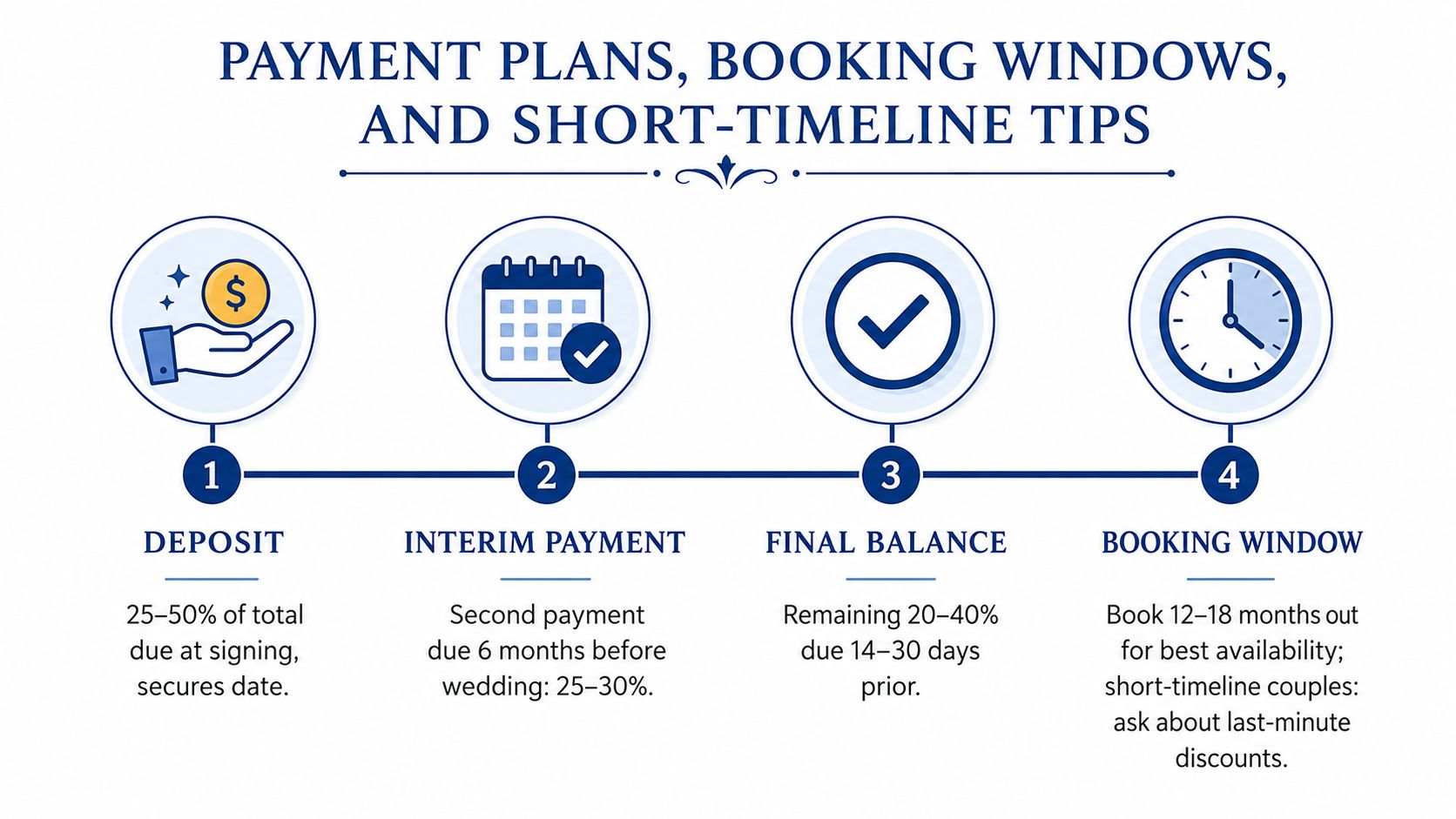
For couples under six months out, use this sequence:
- Ask about open inventory: Request dates the venue is actively trying to fill, including weekdays.
- Request a smaller package: A micro-wedding or reduced-service option may remove unused hours or guest-count minimums.
- Spread the payments: Ask whether the venue can front-load less of the total while keeping the final due date clear.
- Protect the date change terms: Find out whether a cancelled booking can transfer to another date or whether the deposit is forfeited.
Don't overlook related planning costs. If dance instruction is part of your budget, review this wedding dance lessons cost guide before allocating money to choreography, private lessons, or group sessions.
A payment plan doesn't reduce the contract total. It improves cash-flow control. Date-transfer language, however, can protect the money already paid if your plans change.
Why an All-In Higher Quote Often Costs Less in Practice
A higher sticker price can produce a lower final bill when it includes the costs that cheaper quotes leave outside the package. The value comes from removing uncertainty, not from adding luxury.
Consider three common sources of budget erosion. Overtime appears when setup starts early, the ceremony runs late, or cleanup extends past the contracted window. Tax and gratuity can stack on top of the visible price when the quote excludes them. Required vendors or markups can limit your ability to choose a lower-cost caterer, bar provider, or rental company.
Price the risk, not just the room
Industry guidance places hidden wedding costs at about $3,314 on average, or roughly 9% of total wedding spend, while venue-related extras can add 10% to 20% beyond the quote depending on service charges, gratuities, overtime, setup, and vendor fees (Fash's wedding venue cost guide). Those figures explain why a low starting price can become an unreliable budget anchor.
A venue model with 16-hour access, included tax and gratuity, and a flexible vendor policy addresses those risks directly. You're less likely to pay overtime for the transition from setup to ceremony, less likely to discover a tax charge at the final invoice, and less likely to accept a required vendor markup because the contract demands it.
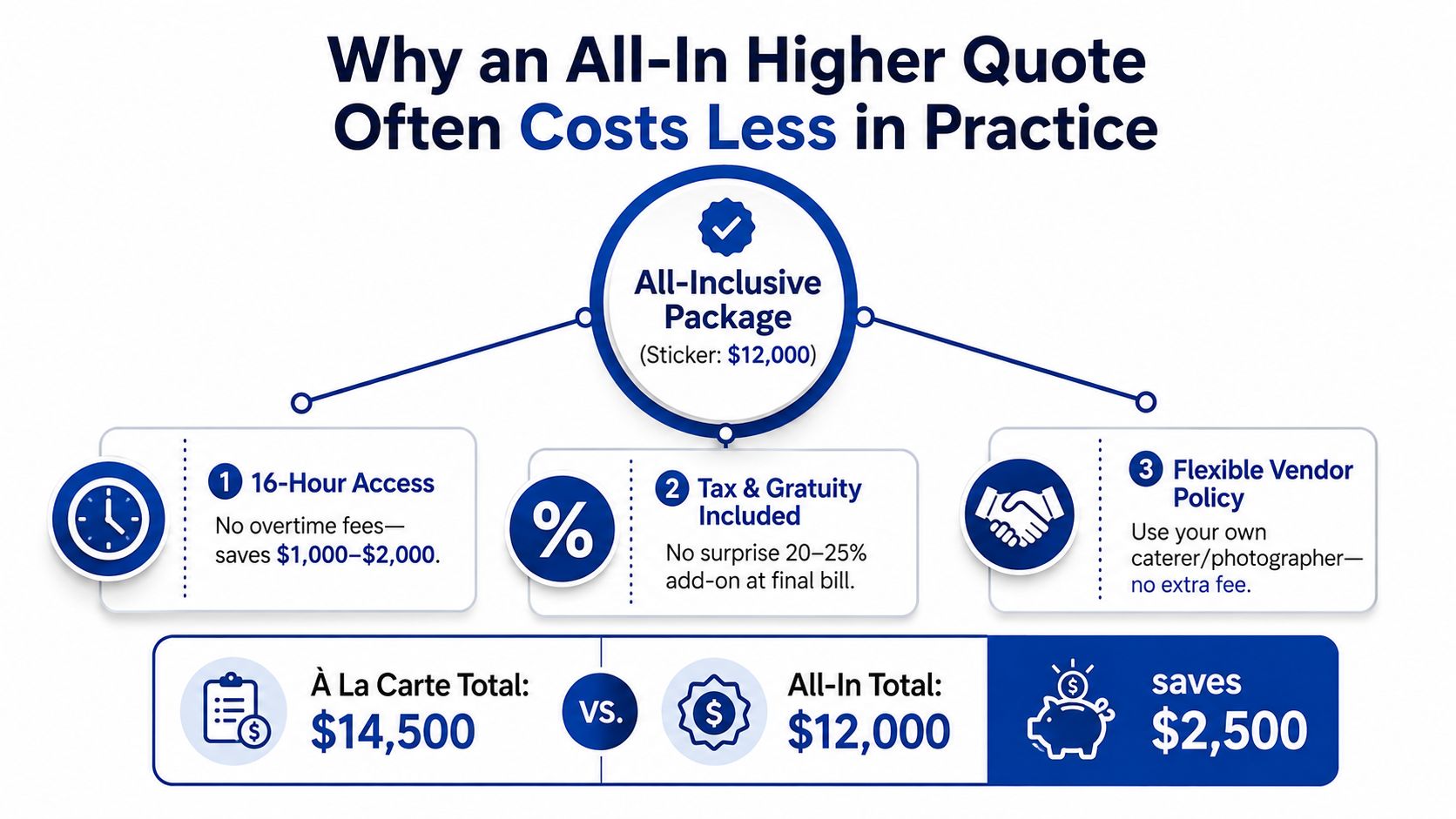
That doesn't mean every all-inclusive package is cheaper. It means the comparison must include the full operating cost of the wedding. A venue fee that includes access, furniture, management, cleanup, tax, and gratuity may be more useful than an à la carte rental that forces you to assemble those services separately.
Texas Old Town describes a pricing model with tax and gratuity included, flexible caterer selection, a bring-your-own-beverages policy with required bar-service arrangements, and cleanup and furniture breakdown included. Couples evaluating that model can compare it with affordable all-inclusive wedding venues using the same all-in worksheet.
The practical conclusion is simple: wedding package pricing is a risk-pricing problem. Pay for clarity where it protects the schedule and the final invoice. Customize the items that don't affect operational certainty.
Smart Ways to Customize and Your Final Pricing Checklist
The best customization starts with the event schedule and the services you will use. Remove unused hours, decline services already covered by your vendors, consider a less requested date, and avoid paying for duplicate spaces.
Review the venue flow before comparing packages. A ceremony and reception on the same site may eliminate transportation and room-transition costs. If an outside photographer suits your plans better, ask whether the venue permits that choice and whether an outside-vendor fee applies. Never accept a bundled service because it appears on the package sheet.
Use these twelve contract checks
Before signing, confirm every item in writing:
- Base rate: What does the rental fee cover?
- Time window: When may vendors arrive, and when must everyone leave?
- Tax handling: Is sales tax included or added later?
- Gratuity: Is gratuity included, optional, or calculated on selected services?
- Overtime rules: What triggers overtime, and how is it billed?
- Bar minimums: Are alcohol, bartending, corkage, or beverages separate?
- Vendor policy: May you choose your own caterer, photographer, DJ, florist, and baker?
- Cancellation terms: What happens to the deposit and later payments?
- Deposit schedule: What is due at signing, and when are the remaining payments due?
- Day-of coordinator: Is coordination included, and what does that person handle?
- Cleanup: Who handles teardown, trash, furniture breakdown, and end-of-night labor?
- Rehearsal access: Is rehearsal time included, optional, or charged separately?
Ask these questions before comparing proposals:
- What is the all-in number for our guest count and date?
- Which specific choices could raise that number?
- If our guest count drops, which charges change and which stay fixed?
Build one worksheet for every venue. Use columns for the base rate, included services, exclusions, required vendors, access hours, taxes, gratuity, overtime, payment schedule, and all-in total. Enter the same guest count and event schedule in each row, then use this wedding budget planning guide to place venue costs beside the rest of the celebration.
Texas Old Town lists four halls, indoor and outdoor ceremony options, 16-hour access, documented venue amenities, flexible caterer selection, and quoted pricing that includes sales tax and gratuity. Visit Texas Old Town to request a current quote, compare halls for your guest count, and ask for a payment schedule showing the full cost before you commit.