The Knot's 2026 Real Weddings Study puts the average U.S. wedding venue cost at $12,900, while Zola reports an average of $8,573, with a typical range of $6,900 to $10,300 (The Knot's venue-cost data, Zola's wedding cost guide). That gap tells you exactly why the cheapest venue rental rarely produces the cheapest wedding. The question isn't, “What's the site fee?” It's, “What will this venue cost after setup, furniture, staffing, cleanup, service charges, and required extras?”
For Central Texas couples, affordable all inclusive wedding venues should make the final price easier to understand, not merely make the first quote look attractive. A venue that bundles essential services can be worth more than a low-cost space that leaves you coordinating every logistical detail yourself.
Table of Contents
- What Affordable Really Means for Wedding Venues
- Building a True Total-Cost Wedding Budget
- What Genuine All-Inclusive Packages Actually Cover
- Texas Old Town as a Transparent Pricing Example
- Red Flags That Turn Affordable Quotes Into Expensive Mistakes
- Your Booking Timeline and Negotiation Playbook
What Affordable Really Means for Wedding Venues
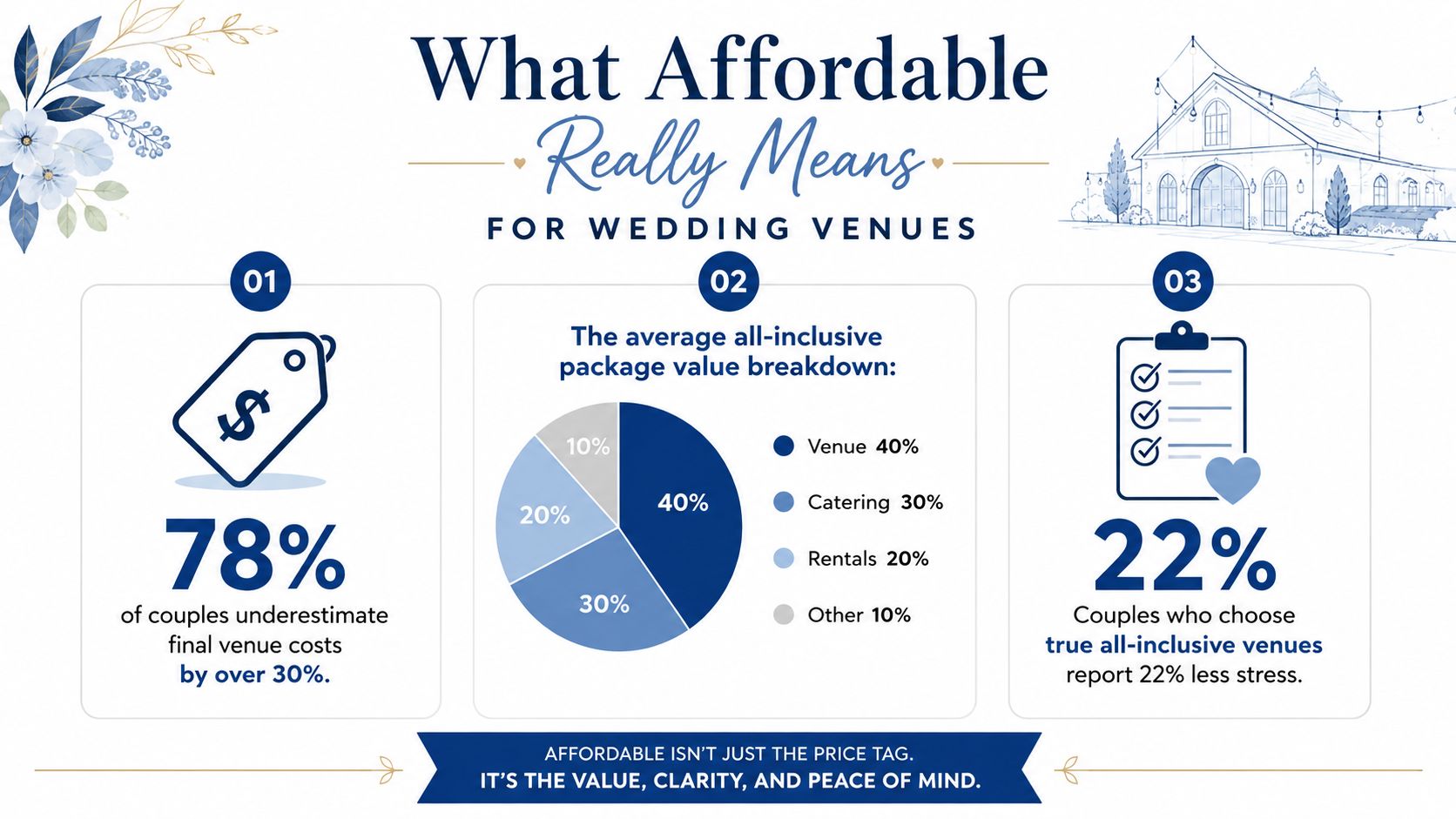
A rustic barn rental may appear below $3,000, while luxury private estates and metropolitan ballrooms can reach $20,000 to $30,000 or more before catering, according to industry pricing summarized by The Knot. Those figures describe different levels of service. The actual question isn't, “What's the site fee?” Ask instead, “What will this venue cost after setup, furniture, staffing, cleanup, service charges, overtime, and required extras?”
For Central Texas couples, affordability starts with total-package value. Texas Old Town is a useful case study because transparent pricing makes it easier to identify what the quoted package covers and what could still land on the final invoice. A low rental fee can become expensive once you add tables, chairs, ceremony seating, setup, breakdown, cleaning, venue staff, sound equipment, or a private dressing suite.
A basic rental buys access to a space for a defined period. It does not automatically include the labor and logistics needed to run a wedding. Those omissions create the hidden cost stack that makes an apparently affordable venue more expensive than a higher-priced package with clearer inclusions.
Read the quote as a complete product
A venue quote should answer four questions immediately:
- What do we receive? List furniture, access hours, ceremony spaces, staff, cleanup, and equipment.
- What must we purchase separately? Identify catering, bar service, linens, rentals, insurance, and labor.
- Which charges depend on guest count? Separate per-person pricing from fixed venue expenses.
- Which charges depend on the date? Ask about peak Saturdays, seasonal pricing, and overtime.
Venue spending has risen sharply over time. One industry summary reports increases since earlier years, with couples spending substantial amounts on the venue alone (venue-cost analysis from Pix). The exact benchmark matters less than the planning lesson: predictable bundled pricing protects couples from a series of late additions.
Use one comparison standard
Industry models place venues at roughly 24% to 40% of total wedding spending, while broader wedding budgets may run $34,000 to $36,000. Zola's average places the venue line at about 17% of the total wedding budget, illustrating how different budget frameworks produce different benchmarks (Zola's wedding cost guide).
Use your own all-in calculation. Add every venue-related charge, then divide the result by the services and access included. A higher quote can be the affordable choice when it includes labor, furniture, cleanup, and logistics that another venue bills separately.
Planner's rule: If two venues don't include the same services, you aren't comparing prices. You're comparing incomplete quotes.
Building a True Total-Cost Wedding Budget
Start your comparison with a spreadsheet, not a tour schedule. Give each venue its own column and list every charge that could reach the final invoice. Enter the quoted price, then separate required fees, selected upgrades, taxes, gratuity, and a contingency line.
Step one, isolate the venue line
Record the site fee, package fee, date category, access window, guest minimum, and maximum capacity. Confirm whether the ceremony and reception stay in one space or require a room change. A short access window can trigger extra labor or overtime, even when the starting quote looks affordable.
Check every charge outside the headline price. Service charges, setup fees, overtime, and administrative fees can add 15% to 25% to the final bill, according to all-inclusive venue fee guidance from Weymouth Hill. Treat that range as a prompt to investigate the contract, not as an automatic fee at every venue.
| Fee Category | Typical Cost Range | Included at All-Inclusive Venues |
|---|---|---|
| Service charges and administrative fees | 15% to 25% of the final bill when applied as a fee stack | Sometimes, verify in writing |
| Setup and breakdown labor | Varies by venue and scope | Often included, but confirm who handles furniture and décor |
| Overtime | Varies by contract | Included only when the access window explicitly covers it |
| Corkage and bar-related fees | Varies by beverage policy | May be included, waived, or charged separately |
| Cake-cutting | Varies by venue | Ask whether outside cake service is included |
| Vendor meals | Varies by caterer and contract | Confirm before final guest counts |
| Required insurance | Varies by policy | Do not assume it is included |
Step two, convert everything to an all-in number
Use this formula:
Quoted package or site fee + required charges + selected add-ons + tax and gratuity not already included = comparable venue total.
Divide that total by your expected guest count, then repeat the calculation with lower and higher guest counts. The comparison exposes per-person minimums and shows whether the quote still works if your invitation list changes.
A $5,000 site-fee venue can cost more than a $9,000 all-inclusive package after rentals, labor, catering, bar service, and cleanup. The contract determines the result, so build your spreadsheet from written prices rather than assumptions.
Use the wedding budget planning guide from Texas Old Town to organize the worksheet. Bring it to every tour and require the venue representative to complete every blank before you compare proposals. A low base fee means little if service fees, overtime, and add-ons remain undefined.
What Genuine All-Inclusive Packages Actually Cover
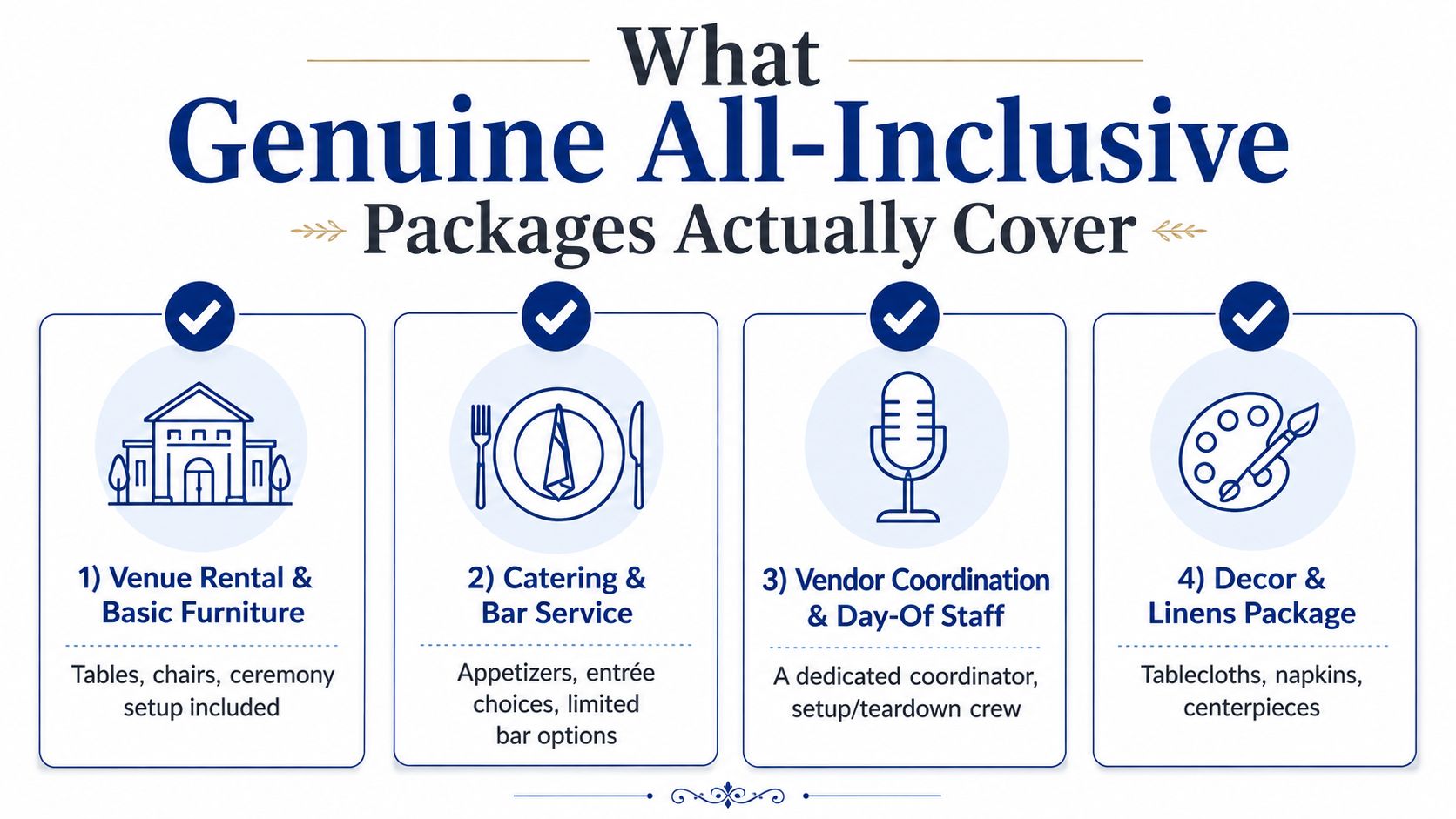
The phrase all-inclusive has no universal checklist. One venue may include catering and tables, while another includes only a preferred-vendor list and a coordinator. A genuine package should cover the operational pieces that would otherwise require separate contracts, labor, and scheduling.
The essentials that save real money
Look for these inclusions first:
- Venue access: Confirm the exact arrival, setup, ceremony, reception, and departure times.
- Furniture: Ask for the actual table and chair counts, not “basic rentals included.”
- Catering and bar: Verify menu choices, staffing, beverage rules, service timing, and whether outside caterers are permitted.
- Setup and breakdown: Establish who places ceremony chairs, moves reception furniture, clears décor, and handles final cleanup.
- On-site management: Separate a venue manager from a full wedding planner. Know who makes decisions during the event.
- Climate control: In Central Texas, indoor heating and cooling aren't decorative details. Confirm which spaces are climate-controlled.
- Dressing suites: Check private restrooms, vanity areas, access times, and whether both parties have usable preparation space.
- Sound equipment: Ask about indoor and outdoor PA systems, microphones, Bluetooth connections, and ceremony power.
- Parking: A large private lot can prevent shuttle, valet, and guest-arrival complications.
- Vendor flexibility: A package that forces costly in-house providers may be less affordable than one allowing licensed outside vendors.
Separate useful inclusions from marketing filler
A centerpiece sample has visual appeal, but cleanup, furniture breakdown, staffing, and access time affect your budget and your wedding day more directly. Ask the representative to mark each item as included, optional, restricted, or unavailable.
Couples should also consider how the venue will photograph. A photographer familiar with real wedding logistics, such as Liz by Design Photography weddings, can help you evaluate getting-ready areas, ceremony transitions, light, and guest movement during a tour. That perspective matters because a beautiful room can still create awkward timelines or crowded photo conditions.
If you prefer to supply your own beverages, study the bar rules carefully. A BYOB wedding venue guide can help you distinguish between bringing beverages and having a venue provide compliant bartending, service equipment, and responsible event operations.
Ask for the package inventory, not the brochure summary. The inventory should name quantities, responsibilities, access times, and exclusions.
Texas Old Town as a Transparent Pricing Example
Texas Old Town in Kyle offers a useful Central Texas example because its pricing model addresses the hidden-cost problem directly. The property sits on 55 acres in the Hill Country between Austin and San Antonio and includes four private halls, Tejas, Sage, Stone, and Redbud, with capacities ranging from 150 to 320 guests according to the venue's published information.
The important distinction isn't the setting. Each selected venue comes with an exclusive 16-hour access window, from 8:00 a.m. to midnight, which gives couples room for setup, getting ready, the ceremony, reception, and departure without compressing every task into a short rental period.
What the venue absorbs
Texas Old Town's published venue details include:
- Tables and chairs based on documented furniture counts.
- Indoor and outdoor ceremony options, with an indoor climate-controlled reception hall.
- Indoor and outdoor PA systems, Bluetooth connectivity, and a wireless microphone.
- Dressing suites with private restrooms and vanity areas.
- Built-in beverage bars with a structured host-provided beverage policy.
- Prep kitchens with separate service access.
- On-site management during the event.
- Cleanup and furniture breakdown.
- Private parking and an accessible layout.
- Flexible catering, allowing couples to choose their caterer.
That combination matters because it removes several common unknowns from the spreadsheet. Couples still need to review the specific contract and beverage requirements, but the venue's stated model provides clear categories to verify rather than leaving them to guess.
Why access and vendors change the calculation
A short rental window can force couples to pay for early access, rushed labor, or additional coordination. A restrictive vendor policy can also erase the savings advertised by a bundled package if the required providers cost more than the couple's preferred alternatives.
Texas Old Town combines extended access with a flexible vendor policy and a preferred-vendor list. Its published pricing position also states that sales tax and gratuity are included with no hidden fees, while personalized payment plans are available. Review the current details directly through the venue's pricing information and compare them against the same all-in worksheet you use for every other property.
The venue isn't automatically the right fit for every couple. Guest count, date availability, décor expectations, catering preferences, and budget still control the decision. Its value is that the package structure makes those trade-offs easier to identify before signing.
Red Flags That Turn Affordable Quotes Into Expensive Mistakes
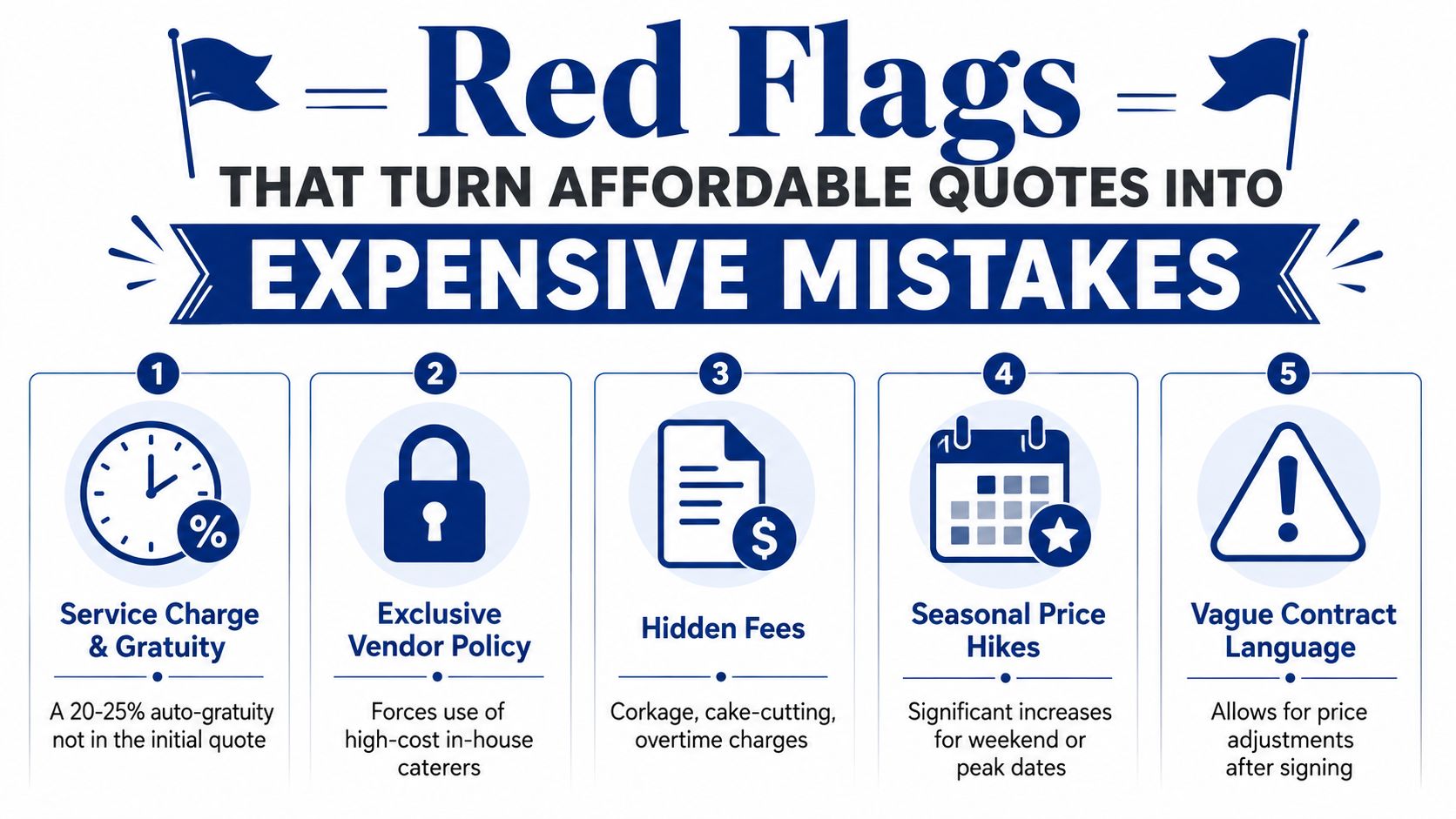
A low venue quote can still become an expensive booking. The hidden cost stack usually comes from service fees, overtime, required vendors, and add-ons that sit outside the advertised package. Treat every “all-inclusive” label as a starting point until the contract shows exactly what the venue includes.
Five contract warnings deserve immediate attention
Service charge and gratuity. Confirm whether the proposal includes sales tax, gratuity, administrative charges, staffing, and bartending. A percentage mentioned in conversation is not enough. Require the exact calculation, the taxable items, and the payment schedule in writing. As noted earlier, Texas Old Town stands out because its published pricing states that sales tax and gratuity are included with no hidden fees. Use that transparency as your comparison standard.
Exclusive vendor policy. A required caterer or bar company may simplify coordination while removing your ability to compare prices. Ask whether outside vendors are prohibited, approved with an additional fee, or permitted without restrictions. Also confirm whether the venue charges for outside cake, rentals, staffing, or specialty services.
Overtime and access limits. Identify when the rental clock starts. Some contracts count vendor arrival, décor setup, rehearsal time, or cleanup against the booked period. Get the overtime rate, minimum increment, and person authorized to approve additional time before signing.
Per-person minimums. A package can look affordable until a food-and-beverage minimum applies to a smaller guest list. Calculate the required spend at your expected attendance, then test the contract against a lower count. Ask whether the couple pays the shortfall when attendance drops.
Vague setup and breakdown language. “Venue cleanup included” may cover only ordinary facility cleaning. It may not include removing personal décor, packing gifts, clearing rentals, or breaking down ceremony furniture. Assign every task to the venue, caterer, rental company, or couple in writing.
Flexibility is part of affordability
A bundled package becomes costly when planning changes trigger penalties. Ask how the venue handles guest-count changes, vendor substitutions, date transfers, menu revisions, and weather-related ceremony moves. A lower starting quote with rigid fees can cost more than a higher quote with workable terms.
UK venue pricing offers a useful comparison method. Cost-per-head packages commonly range from £85 to £138, with a median of £112, while winter mid-week packages can start around £5,742 compared with about £14,138 for summer Saturdays (Guides for Brides venue pricing). Date class belongs beside package price in your worksheet.
Never sign from the summary page. Read the definitions, exclusions, minimums, cancellation terms, overtime rules, and fee schedule that control the final invoice.
Your Booking Timeline and Negotiation Playbook
A disciplined booking process prevents emotional decisions and gives you stronger negotiating power. Start by defining your total venue budget, expected guest count, preferred dates, ceremony format, and vendor requirements before you fall in love with a property.
Research and shortlist
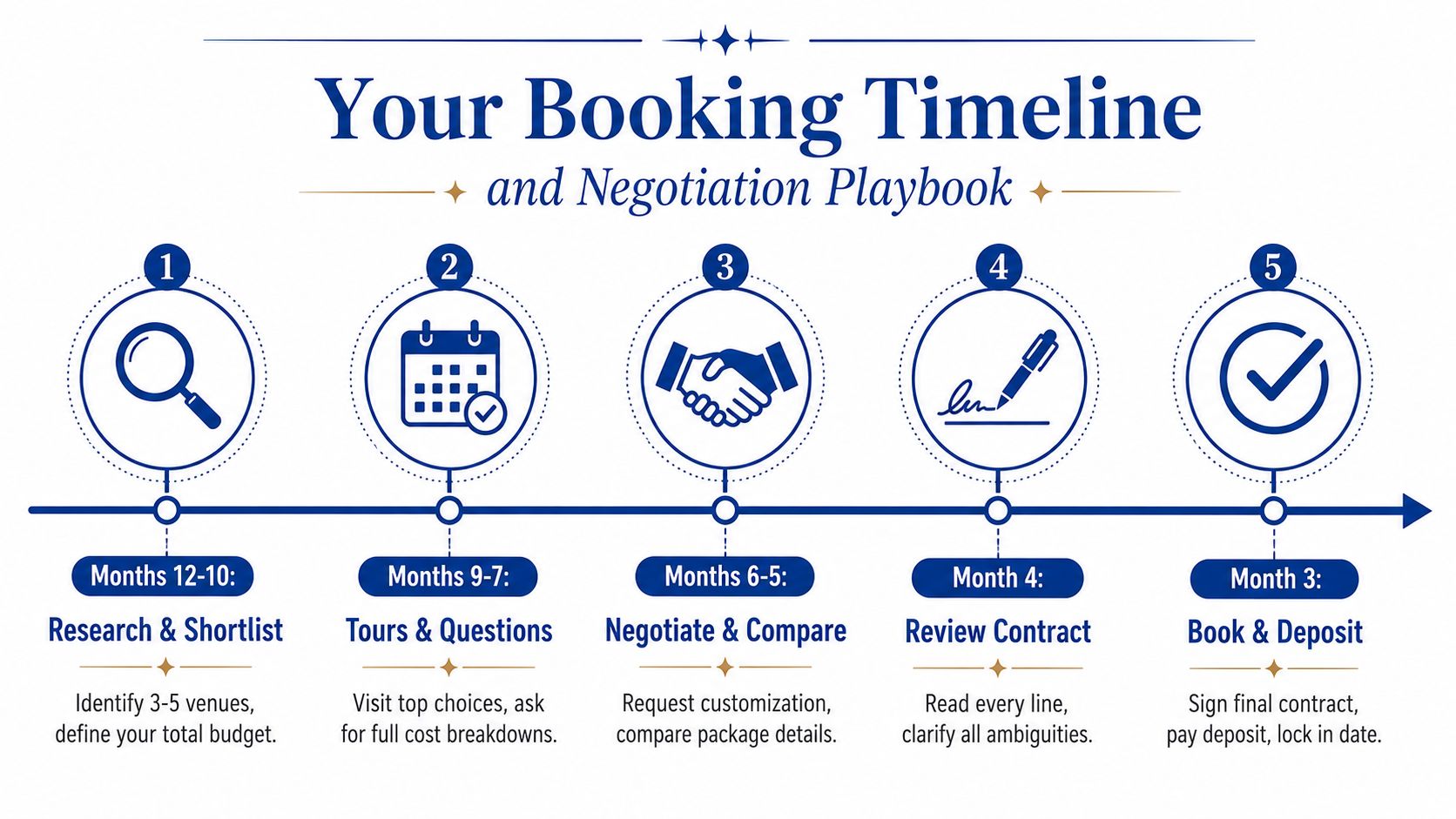
During months 12 to 10, identify three to five venues that match your capacity, location, access needs, and package priorities. Request a complete proposal before touring, including taxes, gratuity, staffing, rentals, bar rules, minimums, and overtime.
During months 9 to 7, tour the strongest options. Walk the route from parking to ceremony, ceremony to reception, dressing suite to aisle, and reception exit. Ask who handles setup, who stays during the event, what happens if weather changes, and which costs change with guest count.
Compare before you negotiate
During months 6 to 5, put every proposal into the same worksheet. Negotiate terms that affect value, such as payment-plan timing, included access, vendor flexibility, setup responsibilities, date changes, and upgrades you need. Don't waste energy negotiating decorative extras while the contract still contains undefined labor charges.
During month 4, review the contract line by line. Confirm the selected hall, date, access window, guest range, payment schedule, cancellation policy, refund rules, included furniture, cleanup responsibilities, bar requirements, and final-count deadline.
During month 3, sign only after every verbal promise appears in the agreement or an attached addendum. Pay the deposit through the documented process, save the final proposal, and share the contract with your planner or another trusted reviewer.
The strongest negotiation is a clean comparison. Venues respond more clearly when you know exactly which inclusion or contract term separates one proposal from another.
Look for practical savings through less competitive dates, alternative event timing, flexible menus, and payment plans. Don't assume a discount is valuable if it removes cleanup, access time, or vendor freedom. The right package lowers both the invoice uncertainty and the number of responsibilities your family must manage.
Texas Old Town offers four private halls, indoor and outdoor ceremony options, documented furniture, on-site management, cleanup, flexible catering, and an exclusive 16-hour rental window with transparent pricing. Visit Texas Old Town to schedule a tour, review the current pricing, and compare its package against your completed total-cost worksheet.