You arrive for a venue tour ready to fall in love with the grounds. The ceremony lawn looks beautiful, the reception hall photographs well, and then the practical questions start: Where will the wedding party get ready? Can guests hear the vows from the back row? What happens if rain moves the ceremony indoors?
Those aren't small details to sort out later. Wedding venue amenities are the operating system for the day, shaping your timeline, vendor needs, guest comfort, and final cost. A useful tour doesn't just show you what looks good. It reveals what the venue can handle, what you'll need to arrange, and what could derail the plan if nobody asks.
Table of Contents
- Why Wedding Venue Amenities Shape the Whole Day
- What Amenities Actually Do for Cost and Planning
- Ceremony, Reception, and Climate Control
- Dressing Suites, Catering, and Bar Logistics
- Accessibility as a Guest Journey
- Matching Amenities to Your Venue Style
- Your Venue Tour Checklist
Why Wedding Venue Amenities Shape the Whole Day
A venue is usually the first major vendor a couple books, and it affects how nearly every other vendor works. The caterer needs a workable kitchen and a clear service route. The DJ needs reliable power and sound coverage. The photographer needs time and space for portraits. Your guests need comfortable places to gather, eat, and move between parts of the celebration.
That's why a beautiful property can still be a difficult choice. During a tour, a couple might focus on the ceremony backdrop and forget to ask how long the walk is from the parking area, where the wedding party can change, or who's responsible for moving chairs if the ceremony plan changes. Each unanswered question becomes a task for someone to solve later, often while several other vendors are waiting for a decision.
Amenities are part of the schedule
Think through the day in order. The wedding party arrives, vendors unload, the couple gets ready, guests find their seats, the ceremony begins, and the room transitions into dinner and dancing. An amenity matters when it makes one of those moments easier or more reliable.
A private dressing suite can give the wedding party a place to prepare without competing for a public restroom. An indoor ceremony option can preserve the schedule when outdoor conditions aren't suitable. On-site management can help vendors follow the same timeline instead of asking the couple or family to direct setup.
Touring rule: For every feature that looks attractive, ask what job it performs on the wedding day and who is responsible for it.
The right setup gives you breathing room
The Knot's 2025 Venue Report analyzed responses from 16,956 U.S. couples married in 2024 and found that 70% favored open-air venues and natural settings. The same report noted that indoor ceremonies and ballroom receptions remained popular in some regional markets, reinforcing the value of having both outdoor atmosphere and a credible indoor alternative (The Knot's 2025 Venue Report).
The practical takeaway isn't that every couple needs every amenity. It's that the venue should support the kind of day you want without asking you to improvise the basics. When spaces, sound, preparation areas, and staff responsibilities are clear, you can spend less time solving operational problems and more time enjoying the event.
What Amenities Actually Do for Cost and Planning
A venue's amenities can reduce more than the rental list. They can remove separate vendor searches, added delivery windows, setup decisions, and last-minute labor charges. Compare the work and cost an amenity replaces, not just whether the venue lists it.
That distinction matters in a market where budgets are often uncertain. The Knot's 2026 Real Weddings Study surveyed 10,474 U.S. couples married in 2025; industry coverage reports that 41% went over budget and 21% had no formal budget. In that same coverage, 73% of venues included rentals such as tables, chairs, or linens, while only 16% offered space-only rentals (wedding industry statistics and study coverage).
Those figures make the right comparison clear. A venue fee that includes furniture, setup, cleanup, and an on-site manager may be easier to budget than a lower base rental that leaves those jobs to you. But don't assume an included item covers every related task. Ask whether setup, room changes, breakdown, and disposal are included, and get the answer in writing.
Turn features into planning inputs
Check the venue's proposal for documented furniture counts and the exact services included. Then identify what you'd otherwise have to rent, hire, or coordinate. Tables and chairs can save a rental order; included cleanup can spare you from arranging post-event labor; an on-site manager can keep vendors aligned without making a family member the event dispatcher.
Flexible vendor policies matter, too. A venue that lets you choose a caterer may give you options, but ask about kitchen access, insurance requirements, bar rules, and service charges. Freedom is useful only when the conditions are clear.
If you're comparing package details, review Texas Old Town's wedding package pricing alongside the written inclusions from other venues. Ask each property for a quote based on the same guest count, event duration, and service needs.
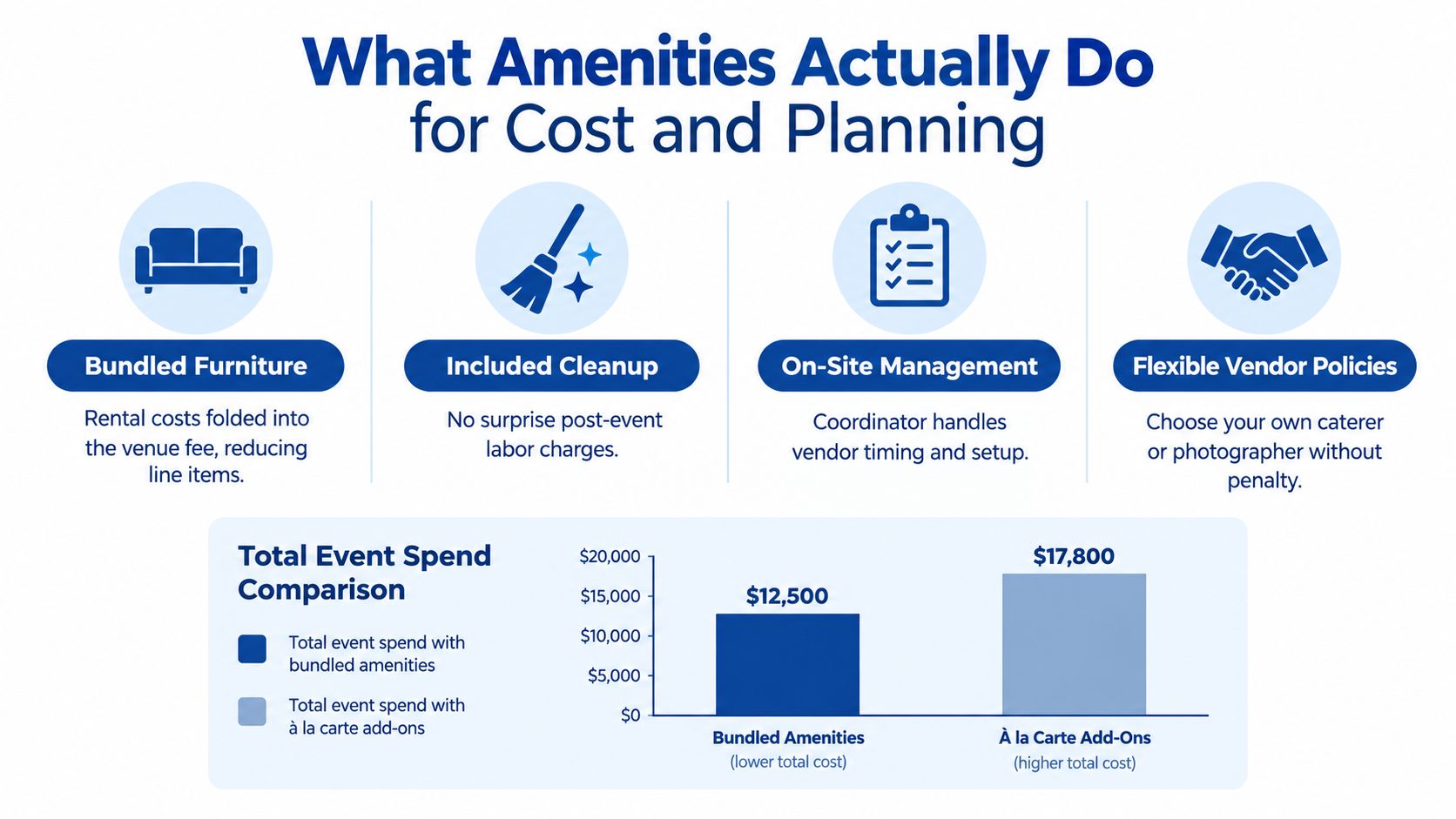
Use the chart as a reminder to compare the full plan, not as a promise that one pricing model will always cost less. The useful number is the written total for your actual event, including required vendors and any additional services you'll need.
Ceremony, Reception, and Climate Control
Outdoor ceremony space and indoor reception space work best as a coordinated plan. One gives you the setting you want; the other can protect the event from uncomfortable weather or changing conditions. During the tour, ask to see the actual backup space, not just hear that a backup exists.
Start by tracing the guest flow. Where will guests wait before the ceremony? How will they move to the reception? Can the indoor hall host the ceremony if the outdoor plan changes, and can it do so without a rushed room reset? A contingency is only credible if the space, staffing, sound, and timeline all support it.
Check the room at full occupancy
Climate control isn't just a question of whether the building has heating and air conditioning. Ask whether the system can handle the planned occupancy, how staff adjust it during a crowded reception, and whether ventilation reaches busy areas such as the dance floor, buffet, and dressing suites.
Research across 82 mechanically ventilated mass-event sessions found that 70% of monitored spaces achieved excellent or very good average indoor-air-quality ratings, while some spaces still had uneven conditions because air didn't mix well. A separate high-occupancy-building study found that pre-event ventilation could maintain acceptable carbon-dioxide levels below 1,000 ppm, with lower energy use than continuous operation in the studied buildings (indoor-air-quality and ventilation research). For your tour, focus on practical questions: when does the venue start conditioning the room, can staff make adjustments during dancing, and does the system serve the whole space?
For more detail on what to ask about a hall's system, see indoor climate control at Texas Old Town. Treat the answers as venue-specific and confirm what applies to your event.
Test the sound where guests will sit
Ask staff to test the PA system and wireless microphone from the actual ceremony seating area, not just beside the speaker. Check whether vows and announcements are clear without competing with background music. If ceremony and reception happen in different areas, ask what equipment serves each one and who manages the transition.
A simple weather plan shows how these amenities connect. If rain makes the lawn unsuitable, staff move the ceremony indoors, use the hall's sound system, and keep the reception timeline intact. Without a confirmed space, microphone plan, and transition responsibility, the same change can become a scramble.
Dressing Suites, Catering, and Bar Logistics
The wedding day starts well before guests arrive. A dressing suite, prep kitchen, and functional bar area can keep the morning moving, while poor arrangements leave the wedding party and vendors competing for space. Don't settle for a quick glance through an open doorway. Ask to see these spaces and understand how they'll be used.
Look beyond the dressing room label
A room called a suite may still be inconvenient if it lacks a private restroom, useful vanity space, or enough room for people to move around. Ask when the wedding party can access it, whether it's climate controlled, and where personal belongings can be kept. If attire is part of the getting-ready experience, browsing bridal linen robes can help you plan a coordinated look without assuming the venue supplies clothing or accessories.
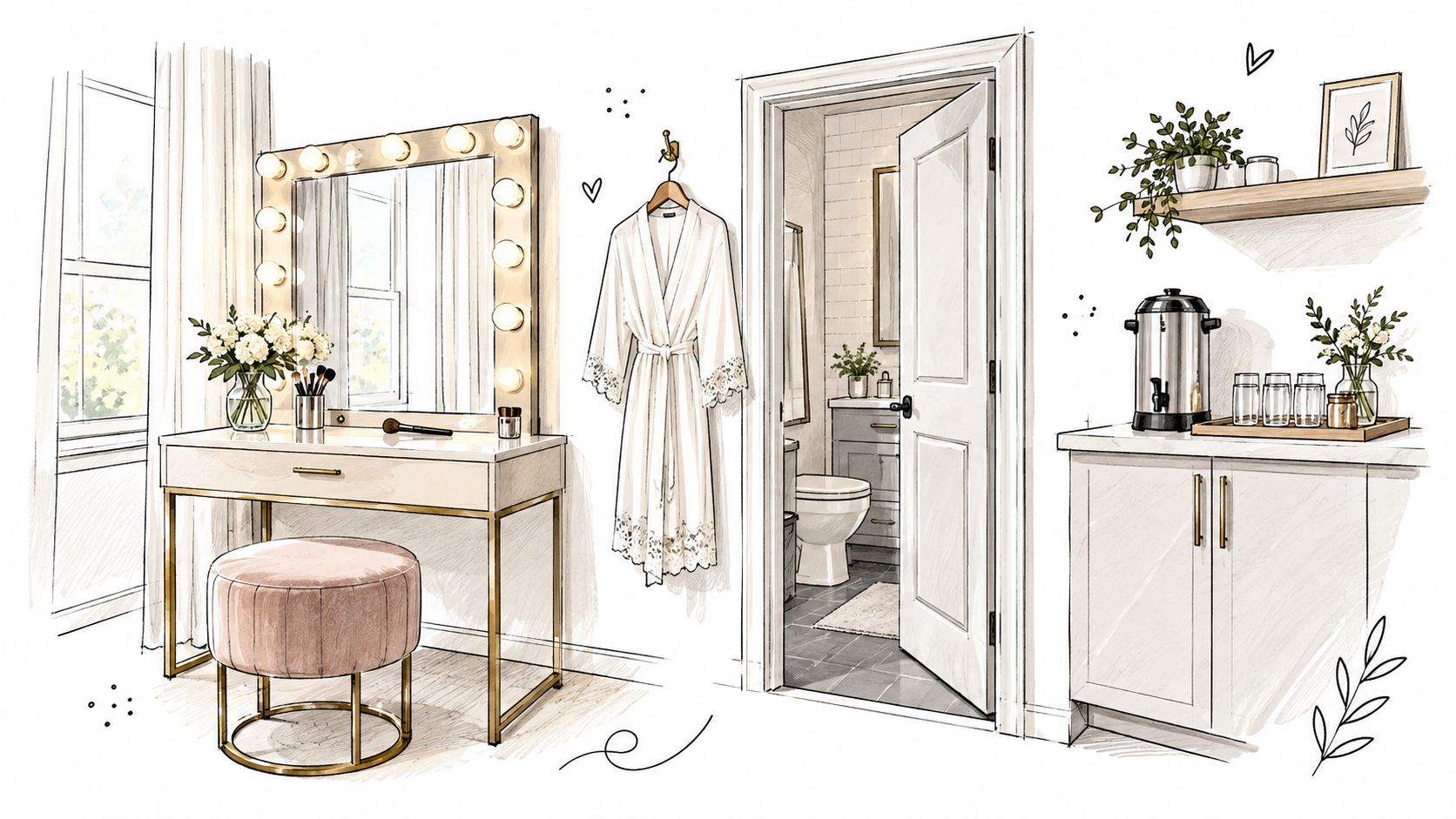
The catering setup deserves the same inspection. A prep kitchen with a separate service entry gives caterers a clearer route than hauling supplies through guest areas. Ask to see where deliveries arrive, what equipment is available, and whether your chosen caterer can work within the venue's requirements.
Make responsibilities explicit
A built-in bar doesn't automatically include bartending, beverages, setup, or cleanup. Ask who provides each part, whether an approved bartending company is required, and who handles the area after service. Confirm furniture counts in writing and find out who sets tables, manages breakdown, and resets the room if the layout changes.
A venue that treats vendors as working partners will explain access, rules, and responsibilities clearly. A venue that makes each answer conditional without documenting it can leave you coordinating the gaps.
On-site management and included cleanup can take major tasks off your family's hands, but define the scope. Ask what the manager oversees during the event, who vendors contact on arrival, and what cleanup covers. Texas Old Town's published amenities include dressing suites, a prep kitchen with separate service entry, a built-in beverage bar, an on-site venue manager, and cleanup and furniture breakdown. Confirm the specific terms for your event before relying on them.
Accessibility as a Guest Journey
“Is the venue accessible?” is too broad to be useful. A venue can have an accessible entrance and still create a difficult day if guests can't reach the ceremony lawn, restroom, dining area, or dance floor comfortably. Accessibility is a route question, from arrival through departure.
Start at the parking area, then follow the path a guest would take. Look for accessible parking near the entrance, a continuous step-free route, stable surfaces, clear wayfinding, and restroom access. In an outdoor Hill Country setting, grass, gravel, slopes, distance, and heat can matter as much as a ramp at the main hall.
Walk the whole route
Ask to see how guests move between ceremony and reception areas, not just the main building. Check whether there's a suitable route if the preferred path becomes muddy or hard to use. Find out whether reserved seating can offer clear sightlines without isolating guests from their group, and whether staff can assist with mobility needs.
The venue's accessibility features can help you prepare specific questions, but verify each route on site. Ask about accessible parking and drop-off, pathway surfaces, restroom placement, ceremony alternatives, dance-floor entry, and how guests can request assistance.
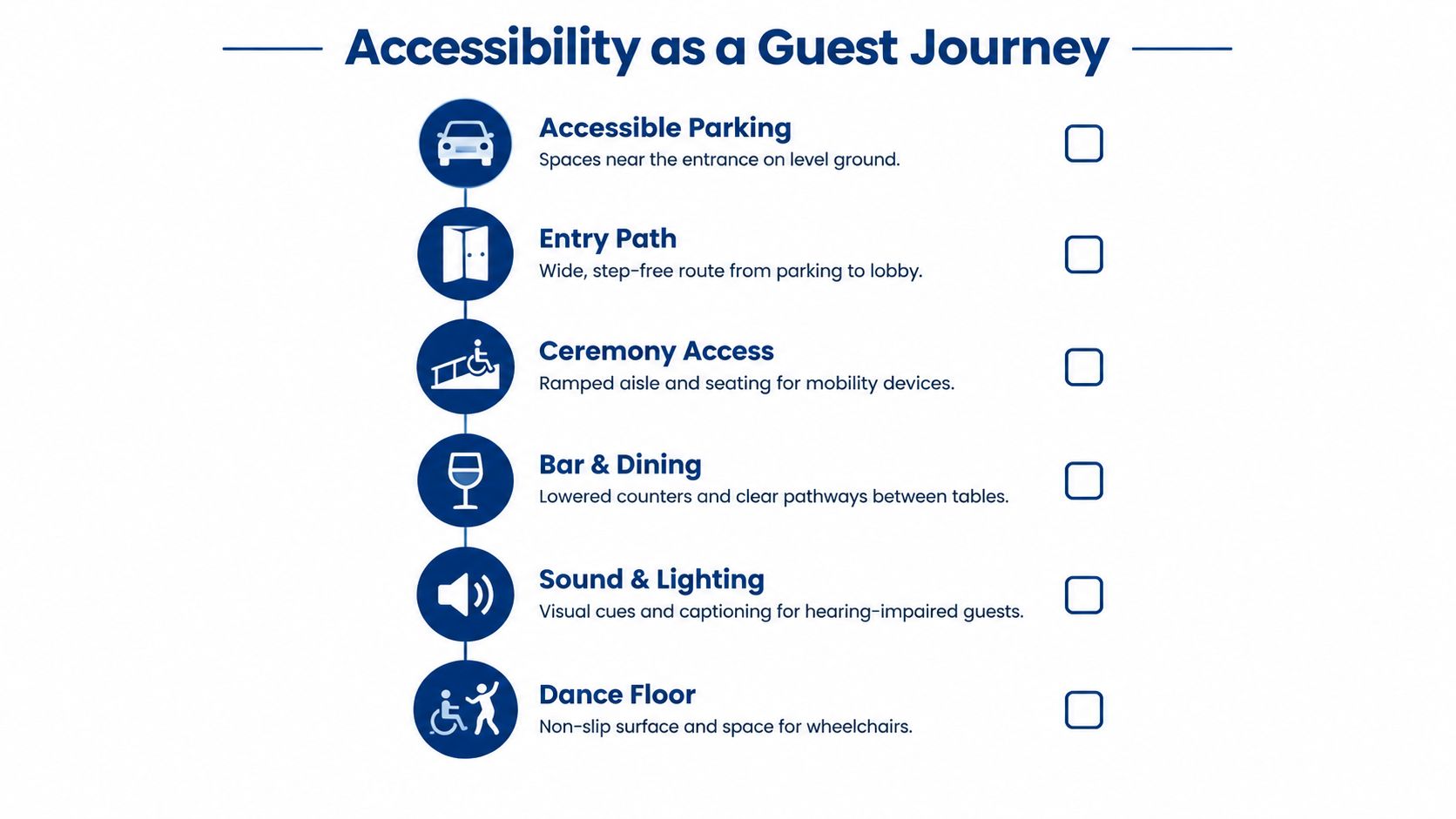
Accessibility also includes communication. Seattle's accessible-events guidance identifies accessible parking, routes, and restrooms as core requirements, and amplification as an important accommodation for guests who have difficulty hearing (Seattle accessible-events guidance). Ask the venue to test the microphone from guest seating, identify areas where speech becomes hard to hear, and explain what visual or seating accommodations are available.
Check how the details connect
A guest who can reach the ceremony but can't comfortably get to dinner or join the reception hasn't been fully accommodated. Look for clear signs, adequate maneuvering space, and paths that remain usable as the event moves from one space to another. If you're exploring broader planning principles, Waymap's discussion of how accessibility drives venue growth offers useful context for treating access as part of the guest experience, not a box to tick.
Matching Amenities to Your Venue Style
Venue format changes how much you'll need to bring, rent, or coordinate. A single-hall property may offer a focused setting with fewer built-in choices. A multi-hall campus can provide different styles or backup options on the same grounds. A full-service estate may handle more vendors and services in-house, though couples should still confirm what the package includes.
Use the table as a starting point, not a guarantee. Policies differ, so ask every venue to mark each item as included, extra cost, or unconfirmed.
| Amenity | Single-Hall Venue | Multi-Hall Campus | Full-Service Estate |
|---|---|---|---|
| Ceremony and reception spaces | Often centered on one main room, outdoor space may vary | More than one setting may be available on the property | Usually designed as a coordinated event experience |
| Furniture and setup | Confirm rentals, counts, setup, and breakdown | Confirm what's provided for each hall | May be bundled, but verify the exact package |
| Weather alternative | Depends on indoor or covered options | Another hall may offer a practical alternative | Often planned as part of the venue's event operations |
| Catering and bar | Outside vendors may handle much of the service | Policies can vary by hall and package | In-house service may be available, check restrictions |
| Preparation space | May be limited or require separate arrangements | Can vary between venues on the campus | Often includes dedicated getting-ready areas |
| Management and cleanup | Confirm who handles vendor timing and post-event work | Ask whether staff support is shared or dedicated | May include coordinated management, verify scope |
| Access and rental period | Confirm access hours and exclusivity | Confirm whether the full property or selected space is exclusive | Confirm access, event overlap, and overtime terms |
Choose the format that removes the right work
A venue with several halls can give you more choice of style and capacity without changing the property. Texas Old Town, for example, has four distinct halls and outdoor ceremony sites on one property, with published hall capacities ranging from 150 to 320 guests. That's a useful model to compare against a single-room venue if you want choices without adding another location.
Rental access matters just as much as room count. Ask when vendors can arrive, when the wedding party can enter, whether you have exclusive use, and when everyone must leave. A longer rental window can create more room for setup and transitions, but only if the contract spells out access and responsibilities.
Compare the total plan: Put the venue fee beside required rentals, staffing, setup, cleanup, and any added access charges. A short list of clear inclusions beats an impressive amenity list with unanswered conditions.
Your Venue Tour Checklist
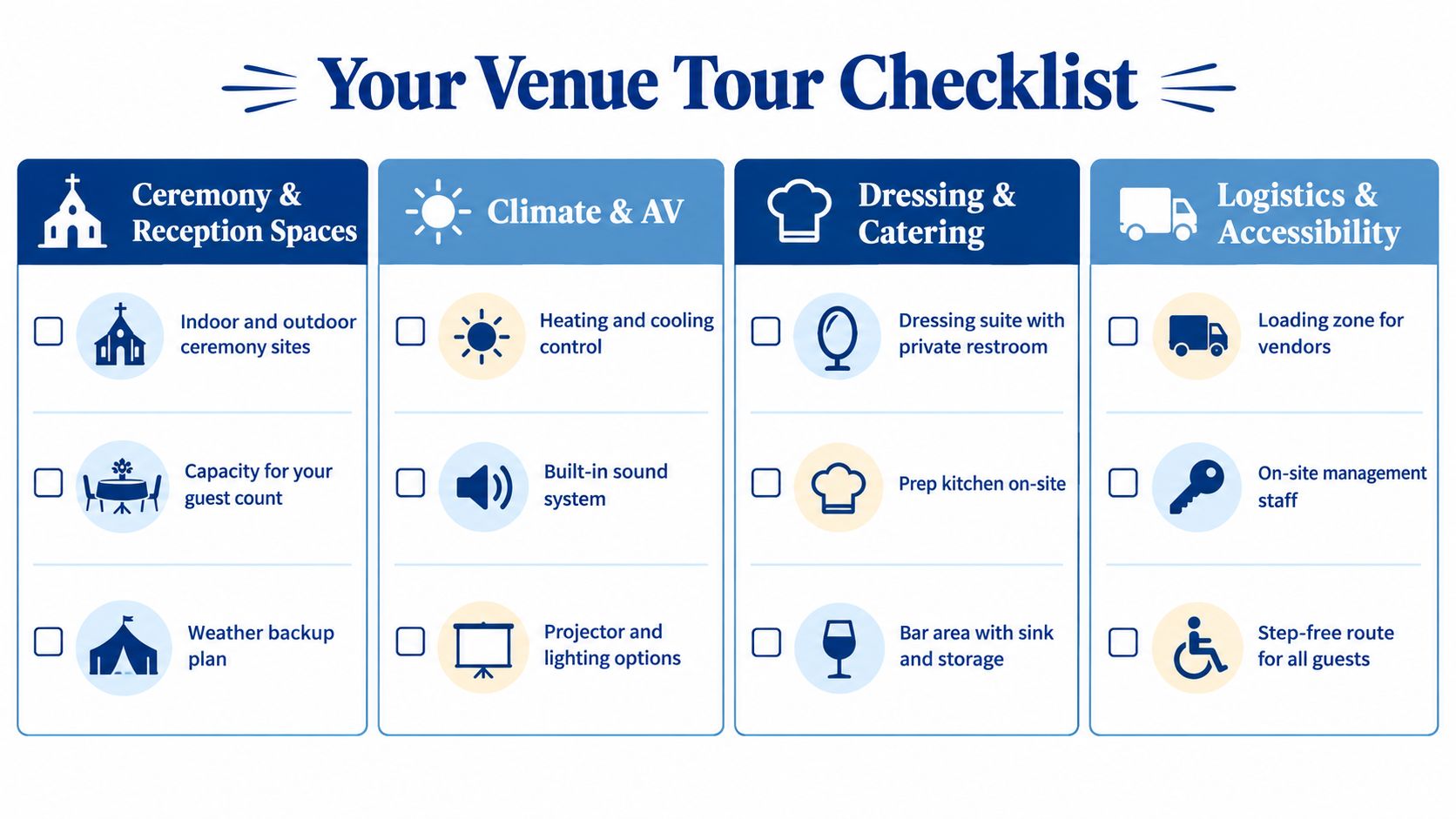
A polished tour can hide expensive gaps. Use the same checklist at every venue, and record each answer, who gave it, and whether it appears in the proposal or contract. That keeps comparisons fair and puts the focus on what the venue will provide.
Walk the spaces and test the systems
- Ceremony and reception: Visit every space in your plan. Ask whether an indoor room can hold the ceremony if weather changes, and whether it fits your guest count.
- Weather contingency: Have staff show you the backup space. Confirm how the move affects seating, sound, and the schedule.
- Climate control: Ask how heating, cooling, and ventilation work with a full room, and who can adjust the settings during the event.
- Audio and AV: Test a microphone from guest seating. Check sound coverage in ceremony and reception areas, and identify who handles setup and troubleshooting.
- Dressing and catering: Inspect suites, restrooms, and the prep kitchen. Confirm delivery routes, kitchen access, and vendor requirements.
- Bar and furniture: Clarify who supplies beverages and bartending. Get furniture counts and setup responsibilities in writing.
Verify guest access and the written price
- Accessible route: Start at accessible parking and walk to the ceremony, reception, restrooms, and dressing areas. Check surfaces, slopes, distances, and shade. Outdoor Hill Country properties can involve long walks or uneven ground, so assess the whole route your guests will travel.
- Seating and communication: Ask how reserved seating can provide clear sightlines, and how staff will support guests who need amplified speech or another accommodation.
- Parking and arrival: Confirm guest parking, vendor unloading, and the route from the lot to the event spaces.
- Management and cleanup: Establish who directs vendors, handles room transitions, manages breakdown, and completes cleanup.
- Written pricing: Request an itemized quote for your event plan. Separate included amenities from add-ons and unresolved costs.
- Access and timing: Confirm vendor and wedding-party arrival times, the event end time, and whether another event will share the property.
A virtual tour for event venues can help you review the layout before traveling. Still, walk the actual routes, room transitions, and outdoor surfaces in person. A screen cannot show how the ground feels underfoot or how far guests must travel between spaces.
After each tour, enter your notes in the same comparison sheet. Mark each item as confirmed, extra cost, or unresolved, then get answers before comparing quotes. Amenities control costs when they replace rentals, staffing, or extra setup. Choose the venue that clearly shows how its spaces, staff, and policies support your plan, not the one with the longest list.
Texas Old Town has outdoor ceremony sites, four distinct halls, on-site management, dressing suites, a prep kitchen, and indoor and outdoor sound. If you're planning a Central Texas celebration, visit Texas Old Town to see how its spaces fit your guest journey, vendor plan, and budget.