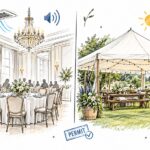
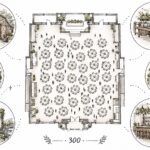
Most advice about the difference between indoor and outdoor events starts with the wrong question: “Which one is more reliable?” After hundreds of weddings and milestone events, I'd ask something more useful: Which parts of this event belong outside, and which parts should stay inside?
A ceremony may deserve the scenery and openness of a lawn. Dinner may work better in a climate-controlled hall. Cocktails can go either way, depending on shade, air quality, and the distance guests must travel. Dancing usually benefits from a stable floor, controlled acoustics, and predictable temperature. Treating the entire event as one indoor-or-outdoor decision creates avoidable problems.
The right comparison uses five lenses: climate control, weather exposure, acoustics, logistics, and guest comfort. Those lenses reveal the core trade-offs behind the visual choice. Outdoor space offers natural air movement, scenery, and room to spread out, while indoor space offers control over temperature, sound, lighting, and transitions.
Table of Contents
- Why the Indoor Versus Outdoor Question Is Bigger Than It Looks
- Climate Control, Air Quality, and Indoor Comfort
- Weather Exposure, Heat, and Seasonal Reliability
- Acoustics and Sound in Halls Versus Open Lawns
- Decorating, Lighting, and Vendor Logistics by Setting
- Guest Comfort, Accessibility, and Inclusion
- Choosing Element by Element and Planning for a Hybrid Event
- Bringing It All Together for Your Event
Why the Indoor Versus Outdoor Question Is Bigger Than It Looks
A venue decision affects every part of the guest experience, but not every part needs the same environment. Couples often choose an outdoor ceremony because it feels memorable, then move dinner and dancing indoors because guests need dependable comfort. That isn't a compromise. It's usually the more deliberate plan.
An experienced coordinator separates the event into ceremony, cocktail hour, dinner, dancing, and late-night activities. Each element has different needs. A ceremony can tolerate a shorter period of exposure if seating is shaded and the schedule avoids the harshest sun. Dinner demands stable temperature, food-service access, comfortable seating, and reliable lighting. Dancing depends on flooring, sound coverage, and enough climate control to keep guests on the floor.
Practical rule: Don't ask which setting wins. Ask which setting creates the fewest problems for each activity.
Central Texas makes this distinction especially important. A beautiful afternoon can become uncomfortable quickly when guests sit in direct sun, while an indoor hall can feel crowded if the HVAC system isn't prepared for full occupancy. Outdoor space also introduces pollen, smoke, wind, and changing ground conditions. Indoor space removes some of those variables, but it doesn't eliminate responsibility for ventilation, air exchange, or emergency access.
The strongest hybrid plans make the indoor move part of the original design. Guests should know where they go next, vendors should know when equipment moves, and the entertainment plan should work in both locations. A backup isn't a second-rate version of the event. It's a pre-approved version that can be activated without confusion.
Climate Control, Air Quality, and Indoor Comfort
Indoor comfort depends on more than air conditioning. It depends on whether the building can replace indoor air, manage heat generated by people and equipment, and keep doors from undermining the system. The U.S. Environmental Protection Agency identifies air exchange as a key factor in indoor pollutant concentration, with infiltration, natural ventilation, and mechanical ventilation all contributing to replacement of indoor air. EPA guidance on indoor air quality explains why ventilation deserves the same attention as temperature.
The indoor environment is also where pollutants can accumulate. The EPA reports that Americans spend approximately 90% of their time indoors, and concentrations of some indoor pollutants are commonly 2 to 5 times higher than typical outdoor concentrations. Many volatile organic compounds can reach indoor levels up to 10 times outdoor levels, while painting or paint stripping can temporarily raise levels to 1,000 times typical outdoor background concentrations. These figures come from the EPA's indoor air quality overview.
What planners should verify indoors
A packed reception isn't automatically comfortable because it happens inside. Before signing off on the room, ask direct operational questions:
- HVAC performance: Will the system run during setup, dinner, and dancing, not just before guests arrive?
- Peak occupancy: Can the hall maintain comfort when every seat is filled and the dance floor is active?
- Door policy: Will exterior doors remain open for catering, smoking areas, deliveries, or guest circulation?
- Ventilation: Does the building bring in outdoor air and maintain effective filtration?
- Cooking and cleaning: Are food preparation, candles, cleaning products, or décor materials likely to affect the room?
- Fallback capacity: Can guests move to another climate-controlled area if conditions change?
Outdoor air usually disperses emissions into a much larger volume, so it avoids the same buildup mechanism. That doesn't make it automatically healthier or more comfortable. Guests remain directly exposed to pollen, wildfire smoke, heat, humidity, and ambient particulate matter. The WHO estimates that ambient outdoor air pollution caused 4.2 million premature deaths worldwide in 2019, while household air pollution from polluting fuels affects roughly 2.4 billion people and causes about 3.2 million premature deaths annually. These are global public-health figures, not event predictions, but they show why indoor and outdoor air require different controls. See the WHO overview of ambient outdoor air pollution-air-quality-and-health).
For venue planning, check local air-quality alerts and smoke conditions before committing to an outdoor cocktail period. If the property has an indoor hall near the ceremony site, that fallback is practical. At Texas Old Town, the indoor reception halls and outdoor ceremony areas are on the same 55-acre property, so a change can be planned as a short operational transition rather than a completely different booking.
For a deeper look at heating-system considerations that affect indoor comfort, insights from Pinnacle Property Media can help planners understand why equipment selection and building conditions matter.
Weather Exposure, Heat, and Seasonal Reliability
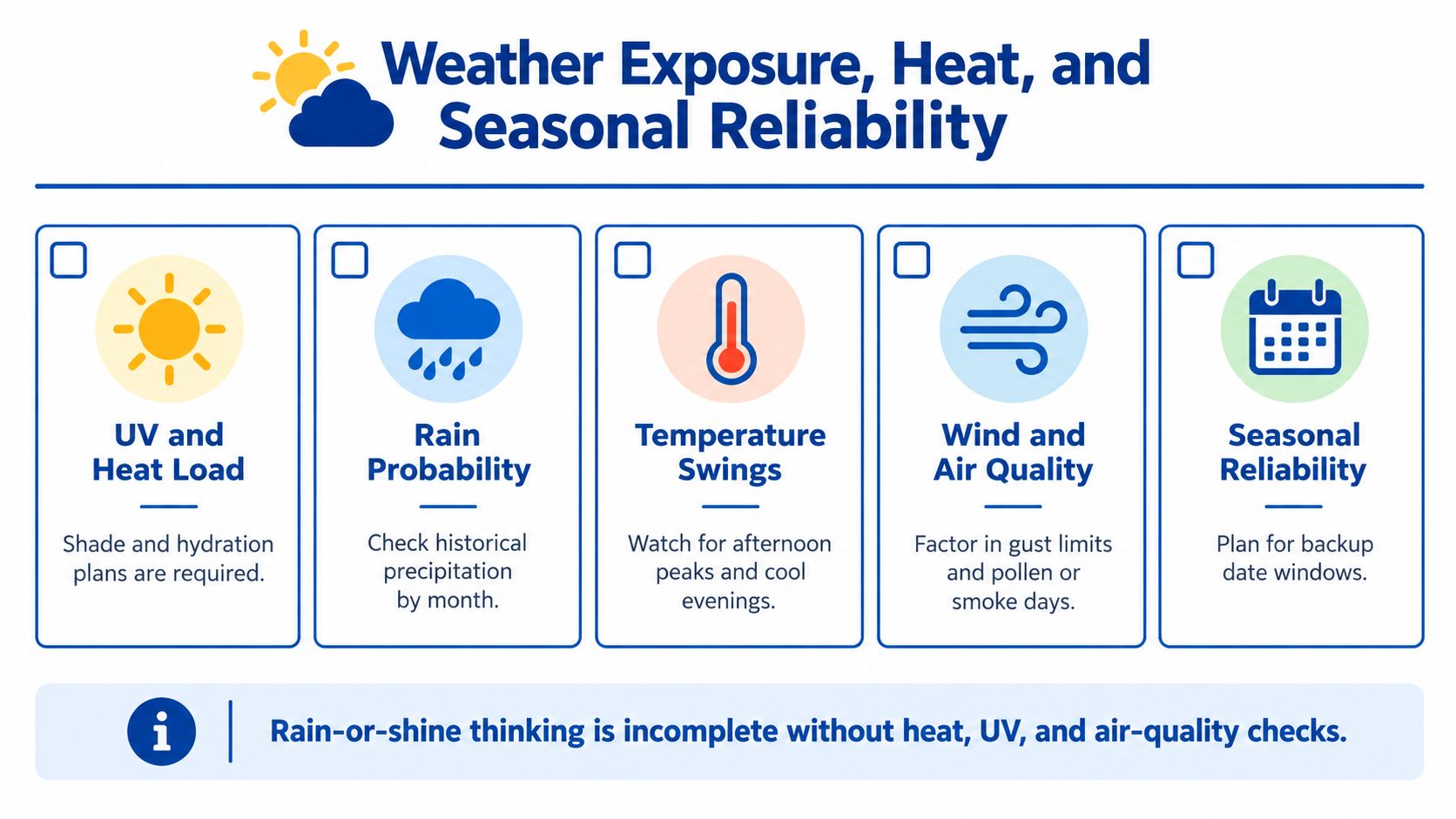
Outdoor reliability is decided element by element, not by asking whether the whole event is “inside” or “outside.” A sunny ceremony can work beautifully while an exposed cocktail hour becomes miserable. A covered dinner can stay on schedule while an open lawn setup for speeches fails because of heat, wind, or smoke. Treat weather as an operational checklist, not a yes-or-no forecast.
Indoor halls give you a predictable envelope. Outdoor spaces give you atmosphere, but they also expose guests, vendors, power, florals, food service, and timing to conditions that shift fast. Judge the risk by exposure length, surface conditions, sun angle, and walking distance to shelter.
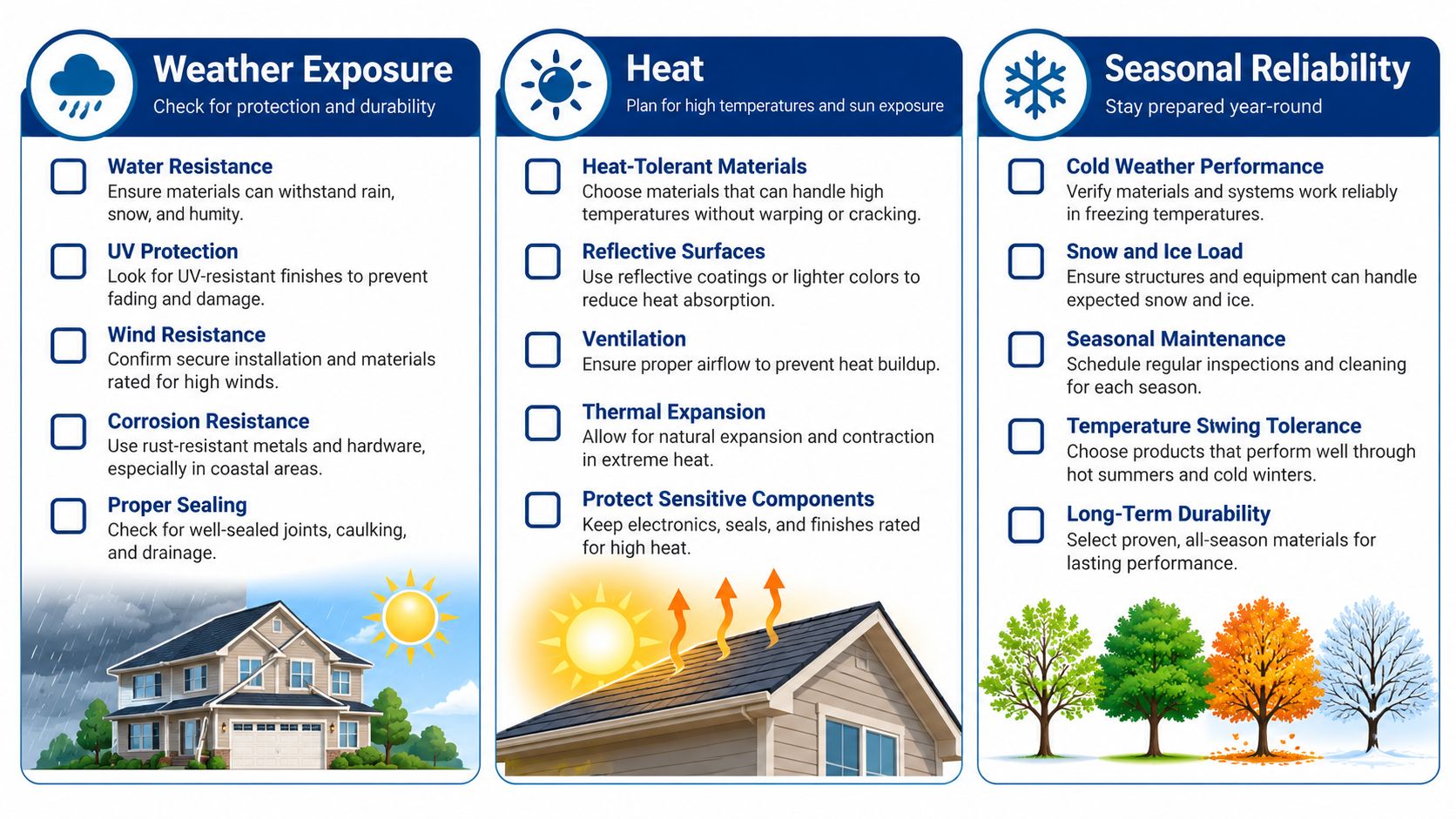
Skip the vague “backup plan.” Set trigger points before the wedding day.
WHO's heat guidance for event participants makes the standard clear. Outdoor event participants face heat and related environmental hazards, so planners should prepare specific protective measures for gatherings rather than assuming a tent solves the problem. That should change how you plan a wedding. Heat management belongs in the same decision framework as rain, lightning, wind, and poor air conditions.
A usable trigger answers four practical questions. What exact condition moves each event element indoors or under cover. Who has authority to make that call. How much lead time each vendor needs to relocate chairs, sound, signage, and décor. How guests will be redirected without confusion.
That structure works better than a generic rain plan because weather rarely disrupts everything equally. Keep the ceremony outside if the site has shade and the exposure window is short. Move cocktail hour inside if guests would otherwise stand in direct sun. Keep dinner and dancing in the hall if the season is unreliable. Hybrid planning usually protects the guest experience better than forcing every part of the day into one setting.
For Central Texas, that often means using the outdoor area for the shortest, most scenic portion of the event and keeping the longest guest dwell time indoors. Schedule exposed moments for lower-sun periods when possible, provide water before guests ask for it, and make the route to the indoor hall obvious and quick. If conditions are trending the wrong way, move early. Guests remember a smooth pivot far more kindly than they remember sitting through visible discomfort.
Texas Old Town's advice on what to do if it rains on your wedding day is useful for exactly that reason. The plan has to cover the program, guest movement, and venue operations together. The best weather backup is the one everyone already understands before the first problem shows up.
Acoustics and Sound in Halls Versus Open Lawns
Sound problems are often discovered when the first toast begins. The ceremony may look perfect, but guests in the back can't hear the vows. Or the reception room may be loud enough for dancing but harsh enough to make conversation unpleasant.
Enclosed rooms allow a sound system to cover a defined audience area, but hard floors, glass, wood, and other reflective surfaces can increase reverberation and reduce speech intelligibility. Outdoor sound disperses with distance and can be masked by wind, traffic, aircraft, generators, and guest movement. Wind and temperature gradients can also bend sound paths, so a lawn may not deliver uniform coverage from one end to the other.
Outdoor ceremony sound
Place the outdoor microphone close to the speaker. Protect it from wind, test the wireless connection at the ceremony position, and use distributed speakers when guests sit across a broad lawn. A single speaker at the front may sound clear in the first rows and disappear for everyone else.
Don't assume a calm setup remains calm during the ceremony. Wind can arrive after the soundcheck, and the officiant may turn away from the microphone while speaking. Give the officiant and speakers a short, practical rehearsal that covers microphone distance, handoffs, and what to do if the wireless signal drops.
Indoor reception sound
Inside, aim speakers toward the audience instead of hard reflective surfaces. Add absorption where possible, control volume, and test speech from the actual toast position. A room that feels lively during music can become difficult for announcements when reflected sound builds up.
Run one test sequence in both environments:
- Test the wireless microphone at the ceremony position.
- Play the planned music through the Bluetooth system.
- Walk to the farthest guest seat.
- Check speech clarity, not just loudness.
- Test the reception microphone from the toast and dance-floor positions.
- Confirm who controls volume and playback during the event.
Texas Old Town publishes information about its sound system for events, including indoor and outdoor PA systems with Bluetooth hookup and a wireless microphone. That makes comparative testing possible before the event instead of forcing the DJ or coordinator to improvise on arrival.
Decorating, Lighting, and Vendor Logistics by Setting
Stop treating décor as a style decision first. In practice, this part of the indoor versus outdoor choice is about infrastructure. Choose each element on its own merits. Keep what benefits from an open setting outside, and move anything fragile, power-hungry, heat-sensitive, or labor-intensive under cover.
Outdoor décor asks more from the setup crew than couples expect. A lawn often needs protected power, added lighting, tenting, weighted pieces, flooring, wayfinding, and a delivery path that works for rentals, florals, and catering. An indoor hall usually starts with the shell already solved. You have built-in lighting, furniture, electrical access, and a defined layout, which means fewer moving parts before guests arrive.
That changes the workday for every vendor. Indoors, the florist and décor team can build against stable walls, level floors, and predictable timelines. Outdoors, they lose time to sun, wind, damp ground, shifting temperatures, and the simple problem of carrying pieces farther than expected. If you are planning a ceremony outside and a reception inside, map the handoff for every item before the event day. Do not leave that decision to whoever happens to be free after photos.
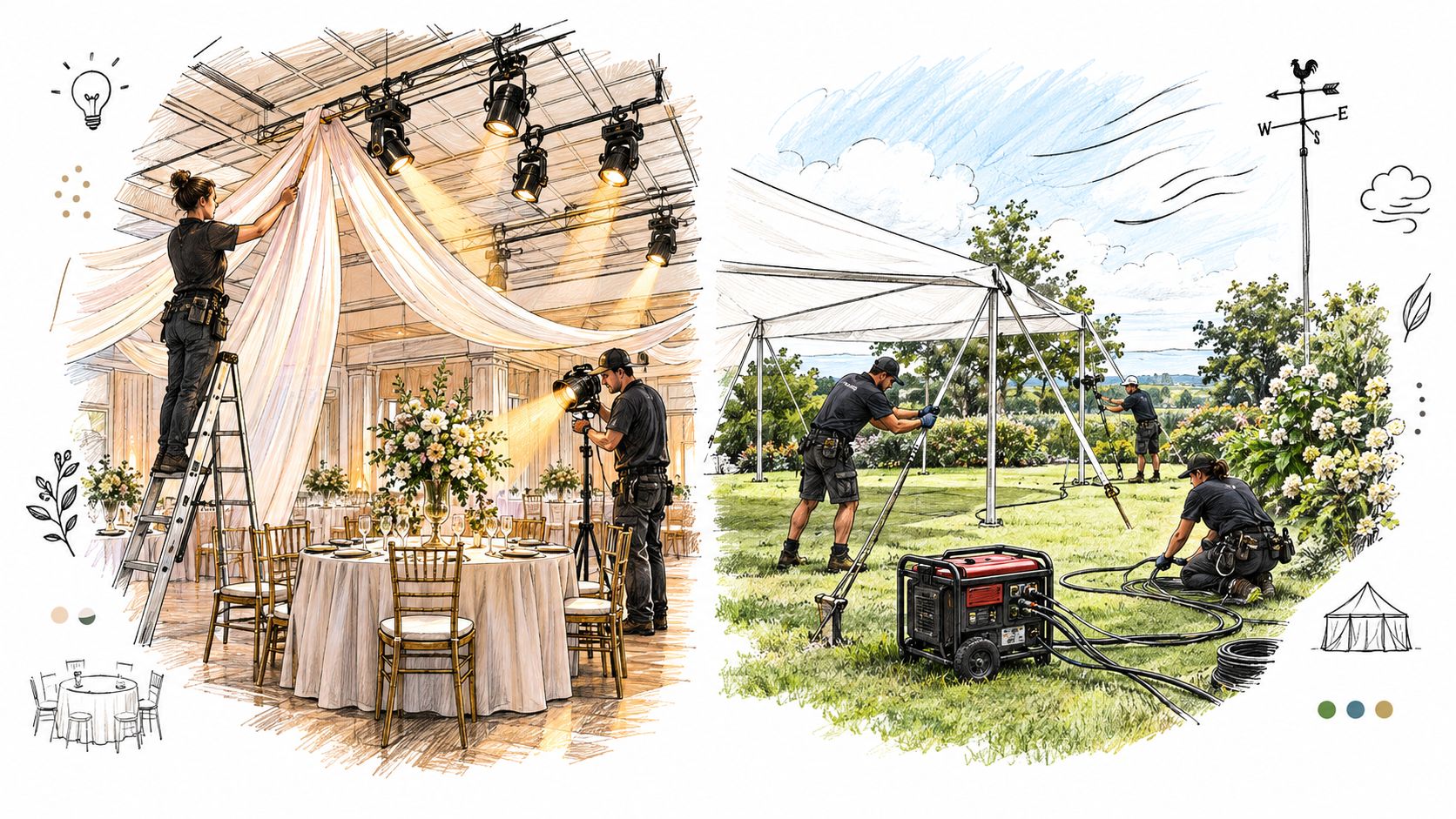
Indoor setups usually cut the error rate. One room can handle ceremony and reception, which simplifies rehearsal, seating, lighting cues, and décor placement. Candlelight is easier to shield. Florals hold their shape better. Tables are not being pushed across soft ground while guests wait for the room reset.
For outdoor areas, build a checklist by element, not by theme. Confirm who supplies, installs, tests, protects, and removes each of the following: lighting, power, furniture, weather protection, ground access, and floral durability. That single conversation prevents half the mistakes I see at outdoor weddings.
Venue inclusions can narrow the gap between the two settings. Texas Old Town publishes what it includes, such as furniture counts, client caterer choice, an on-site manager, cleanup, and furniture breakdown. That does not erase outdoor setup demands, but it does make staffing, delivery timing, and vendor handoffs easier to assign.
If you want to test layout ideas before committing, an AI generated backyard design can help you visualize zones and flow. Use it for concepts only. A coordinator still has to verify power, drainage, shade, access routes, seating placement, and who is responsible for every install.
Guest Comfort, Accessibility, and Inclusion
Guest comfort is where indoor versus outdoor stops being a style question and becomes a hosting decision. A pretty lawn means nothing if part of your guest list is managing heat, fatigue, mobility limits, sensory overload, formal shoes on uneven ground, or a long walk to the restroom. The right answer is rarely “all inside” or “all outside.” It is deciding which parts of the event each guest can enjoy.
I tell couples to start with the people who will feel friction first. Older relatives, small children, pregnant guests, people with disabilities, guests sensitive to heat, and anyone taking medication affected by dehydration will notice the weak points long before everyone else does. Design for them first. Everyone benefits.
For an outdoor plan, skip the generic rain-plan mindset and check the guest experience step by step:
- Shade and refuge: Give guests shaded seating and a cooled indoor backup space.
- Restrooms: Keep accessible restrooms close to the event area and on the main route.
- Seating: Place chairs along circulation paths, not just at tables.
- Surfaces: Walk the full route and inspect grass, gravel, slopes, thresholds, and transitions.
- Timing: Schedule exposed portions of the event for milder parts of the day when possible.
- Quiet space: Set aside a low-noise area for guests who need a break from sound or crowding.
- Hydration: Make water visible, easy to reach, and available in more than one spot.
- Move trigger: Set a clear threshold for moving indoors, then tell vendors who calls it and how guests will be informed.
That last point matters more than couples think. A hybrid event only works if the transition is simple. If ceremony chairs are outside, cocktails are under shade, dinner is inside, and the indoor room is already accessible and set, you have options. If every comfort measure depends on a last-minute scramble, you do not have a plan.
Indoor events need the same level of scrutiny. A crowded hall with weak cooling, poor ventilation, blocked routes, or hard-to-reach restrooms can exclude guests just as quickly as heat and uneven ground. Ask the venue team to walk the entire guest path with you, from parking to ceremony seating to restrooms to the reception room. Problems usually show up in the transitions.
Texas Old Town outlines its accessibility features, including accessible layouts, private parking, dressing suites with private restrooms, and both indoor and outdoor event areas. That is the right way to judge a venue. Accessibility is not one ramp at the entrance. It is the full route, the backup option, and the ease of moving every guest through the day with dignity.
Choosing Element by Element and Planning for a Hybrid Event
Stop treating indoor versus outdoor as one choice. Good event design splits the day by function, then gives each piece the setting that supports it best.
The ceremony often earns the outdoor slot because scenery and natural light change the feel of the moment. Dinner usually benefits from walls, power, stable flooring, and tighter service control. Dancing is a judgment call. If you want a long, high-energy dance floor, indoor conditions usually hold up better. Late night almost always works better inside, where restrooms, lighting, and vendor access are already in place.
Cocktail hour sits in the middle. It can thrive outside, but only if the basics are already solved: shade, water, enough seats, and a fast path to cover. If guests need to hunt for relief, the setting is wrong.
A simple comparison helps:
| Event Element | Indoor Hall | Outdoor Setting | Recommended Approach |
|---|---|---|---|
| Ceremony | Stable temperature, controlled sound, dependable seating | Scenery, natural light, open atmosphere, weather exposure | Use outdoors when shade, sound, access, and conditions are ready. Keep the indoor layout staged. |
| Cocktail hour | Easy service access and predictable comfort | Fresh air, views, informal movement, stronger sense of place | Choose outdoors only with shade, water, seating, and an indoor refuge nearby. |
| Dinner | Reliable food service, lighting, flooring, and temperature | Memorable atmosphere but more equipment and weather dependence | Favor indoors when heat, wind, or service complexity is a concern. |
| Dancing | Controlled acoustics, stable floor, climate control | More space and energy, but sound and flooring are less predictable | Favor indoors for a long dance program or unstable weather. |
| Late night | Restrooms, lighting, security, and easy vendor access | Open-air atmosphere, but exposure and noise logistics continue | Move indoors unless conditions remain comfortable and the route is simple. |
Then build the shift before guests ever arrive. Do not rely on a last-minute scramble. Map the actual guest movement from ceremony to cocktails, then from cocktails to dinner. A short walk can still fail if it lacks shade, clear signs, accessible surfaces, lighting, or enough time for older guests and anyone carrying personal items.
Your vendors need the same level of clarity. Test audio in both locations. Confirm where furniture waits if the program moves. Name one person who makes the call, one person who announces it, and one person who directs guest flow. If those jobs are vague, the transition will be messy.
Use this as a working checklist, not a formality:
- Assign every element: Decide where the ceremony, cocktails, dinner, dancing, and late night will happen.
- Stage the indoor option: Arrange the room so it can accept the program without a frantic reset.
- Set the trigger: Identify the heat, wind, smoke, rain, or lightning condition that activates the move.
- Tell the team: Give the decision-maker and timing to the venue, planner, caterer, DJ, florist, and transportation team.
- Test the route: Walk it with the couple, an older guest, and anyone using mobility support.
- Rehearse the announcement: Guests should hear one clear instruction, not scattered updates.
The PSW Events hybrid guide is useful for operational thinking. The same logic applies even without a virtual audience. Treat the event like one coordinated system, with each element placed where it performs best and a backup that is already ready.
Bringing It All Together for Your Event
The difference between indoor and outdoor events is a stack of decisions about climate control, weather exposure, acoustics, logistics, and guest comfort. Make those decisions by element instead of forcing the entire event into one category.
Choose the two elements that gain the most from outdoor scenery and openness. Choose the two that gain the most from indoor temperature, sound, and service control. Then confirm that the venue can move the program indoors quickly when a trigger is crossed.
A property with both settings on one campus reduces the risk because the fallback is operationally close, not theoretical. For Central Texas events, that flexibility can preserve the outdoor moment without making every guest tolerate outdoor conditions all day.
Texas Old Town offers four private halls, outdoor ceremony sites, indoor and outdoor sound systems, flexible catering, on-site management, and a 16-hour access window in Kyle, Texas. Visit Texas Old Town to compare indoor and outdoor options and build an event plan that can change settings without losing its rhythm.