You arrive at the venue on event morning expecting a controlled handoff. Instead, the chairs are still stacked, the florist is waiting for access, the microphone hasn't been tested, and three vendors are asking you where to unload. Guests haven't arrived, but the day already feels late.
That's the difference between an event with a logistics plan and an event that merely has a schedule. Event logistics services are the operational backbone of the day, covering the people, equipment, access windows, vehicle movement, setup sequence, live coordination, and breakdown that turn a booked venue into a functioning event.
The broader market reflects how central this work has become. One industry estimate valued the global event logistics market at USD 68.0 billion in 2023 and projected it to reach USD 123.8 billion by 2033, with a 6.5% compound annual growth rate from 2024 to 2033. The estimate covers the movement, storage, handling, and coordination required for weddings, corporate meetings, trade shows, festivals, and other live events. (Allied Market Research's event logistics market estimate)
The practical lesson is simple. If logistics gets treated as an afterthought, every creative decision becomes harder to deliver. If someone owns the operational chain from load-in to final reset, the planner gets room to manage the guest experience instead of chasing missing rentals.
Table of Contents
- What Event Logistics Services Actually Cover
- The Core Components Every Planner Should Expect
- How a Typical Event Day Timeline Works
- Matching Logistics to Different Venue Styles and Capacities
- Smart Questions to Ask Any Logistics Provider
- 1. How much exclusive access do we have, and what are the exact load-in and breakdown deadlines?
- 2. Which vendors can work here, and who approves them?
- 3. What staffing is included, and what triggers additional charges?
- 4. What AV equipment is actually available?
- 5. How will parking and overflow arrivals work?
- 6. What happens if weather changes the outdoor plan?
- 7. What is the breakdown sequence, and when does overtime begin?
- Why Full-Service Venues Save Planners Time and Money
- Choosing the Right Logistics Setup for Your Event
What Event Logistics Services Actually Cover
A well-run event morning has a recognizable rhythm. You arrive and find the chairs staged according to the floor plan, signage in place, audio levels tested, parking staff briefed, and a current run-of-show posted where the wedding party and vendors can see it. Nobody is asking you to solve a basic access problem because the team already knows who is arriving, when they're arriving, and where each handoff belongs.
That work is event logistics services. It's the full operational chain that converts a booked date into a usable event environment. Planning defines the purpose, audience, design, and program. Logistics handles the how, when, where, and with what resources.
Decor, catering, and entertainment produce visible or experiential deliverables. Logistics makes those deliverables possible. A florist can create the centerpiece, but someone must confirm the delivery route, protect the setup window, clear the installation area, and coordinate removal. A band can perform, but someone must verify power, stage placement, sound checks, guest flow, and teardown access.
The three phases of operational control
Every credible service covers three connected phases:
- Pre-event setup: Confirm vendor arrivals, load-in routes, furniture placement, power distribution, floor plans, signage, weather contingencies, and access rules.
- Live event management: Monitor transitions, coordinate staff, respond to equipment or timing issues, and keep vendors working from the same current schedule.
- Post-event breakdown: Direct rental pickup, trash removal, furniture breakdown, equipment load-out, venue restoration, and any required inspection.
A decision made weeks earlier can determine whether the event breathes or compresses. A short load-in window forces vendors to overlap. An unclear power plan can delay AV testing. An unassigned breakdown lead can leave the planner negotiating with rental crews after the last guest has left.
Practical rule: Treat every handoff as a potential failure point. Assign an owner, a time, a location, and a backup before event day.
For visual planning, Waymap's guide to show mapping offers a useful way to think about movement through a venue, especially when deliveries, staff routes, guest paths, and production areas compete for space. For day-of oversight, a venue's day-of event coordination should clarify who owns setup, vendor communication, transitions, and closeout.
Historically, this discipline grew from large exhibitions and mass gatherings into a specialized operational function. The Great Exhibition of 1851 in London, held at the Crystal Palace in Hyde Park, is widely treated as a landmark in industrial-scale event management. More recently, the United Kingdom's events sector was reported to have lost an estimated £57 billion of value from a pre-pandemic base of £70 billion, highlighting how much the wider ecosystem depends on staffing, transport, venue operations, and dependable execution. (Global Market Insights' event logistics overview)
The Core Components Every Planner Should Expect
The strongest event logistics services don't hide behind broad labels such as “coordination.” Ask what the provider owns. A useful scope should account for six operational components, each tied to a predictable risk.
Setup
Setup starts before the room looks event-ready. It includes furniture placement, table configurations, signage, ceremony seating, decor access, service areas, and weather contingencies for outdoor elements.
A written setup plan prevents layout surprises. It also gives every vendor a shared reference point, instead of leaving each crew to interpret the room independently.
AV
AV includes microphones, speakers, projectors, lighting, music playback, wireless connections, and sound checks. A reception can have excellent food and beautiful design, yet still feel broken when the officiant's microphone cuts out or the speaker system can't cover the ceremony area.
Confirm who supplies the equipment, who tests it, and who stays available during the program. “The DJ brings sound” isn't enough. You need clarity on coverage, power, backups, placement, and control.
Staffing
Staffing is the human layer of logistics. Coordinators, parking attendants, bar staff, security personnel, setup crews, and cleanup teams each need defined responsibilities and shift timing.
A provider should explain how it will manage shift coverage across arrival, ceremony, meal service, transitions, and breakdown. Understaffing rarely announces itself in advance. It appears as a locked door, an unattended parking entrance, a delayed room flip, or a coordinator pulled away from a critical cue.
Parking and guest arrival
Guests form their first impression before they reach the ceremony or reception room. Parking direction, accessible routes, signage, drop-off space, and greeting staff prevent vehicle bottlenecks and reduce late arrivals.
The plan should address ordinary traffic and exceptions. Ask where vendors park, how deliveries avoid guest routes, and who responds if an accessible entrance or drop-off area becomes blocked.
Timelines
A timeline coordinates vendor arrivals, ceremony cues, meal service, speeches, dances, room flips, and photography. It prevents idle vendors because each crew knows when it can work and what must happen first.
Build the schedule around dependencies. AV testing must happen before guests arrive. Catering setup must align with kitchen access. A ceremony flip must have a defined start, finish, and responsible team.
Clean-up
Clean-up covers trash removal, rental pickup, furniture breakdown, equipment return, and venue restoration. It's often the most underestimated line item because planners focus on the guest-facing program.
A complete closeout plan prevents disputes over damage, missing inventory, or overtime. It should identify who checks the room, who signs off on rentals, and what condition the venue must be in before the access window ends.
How a Typical Event Day Timeline Works
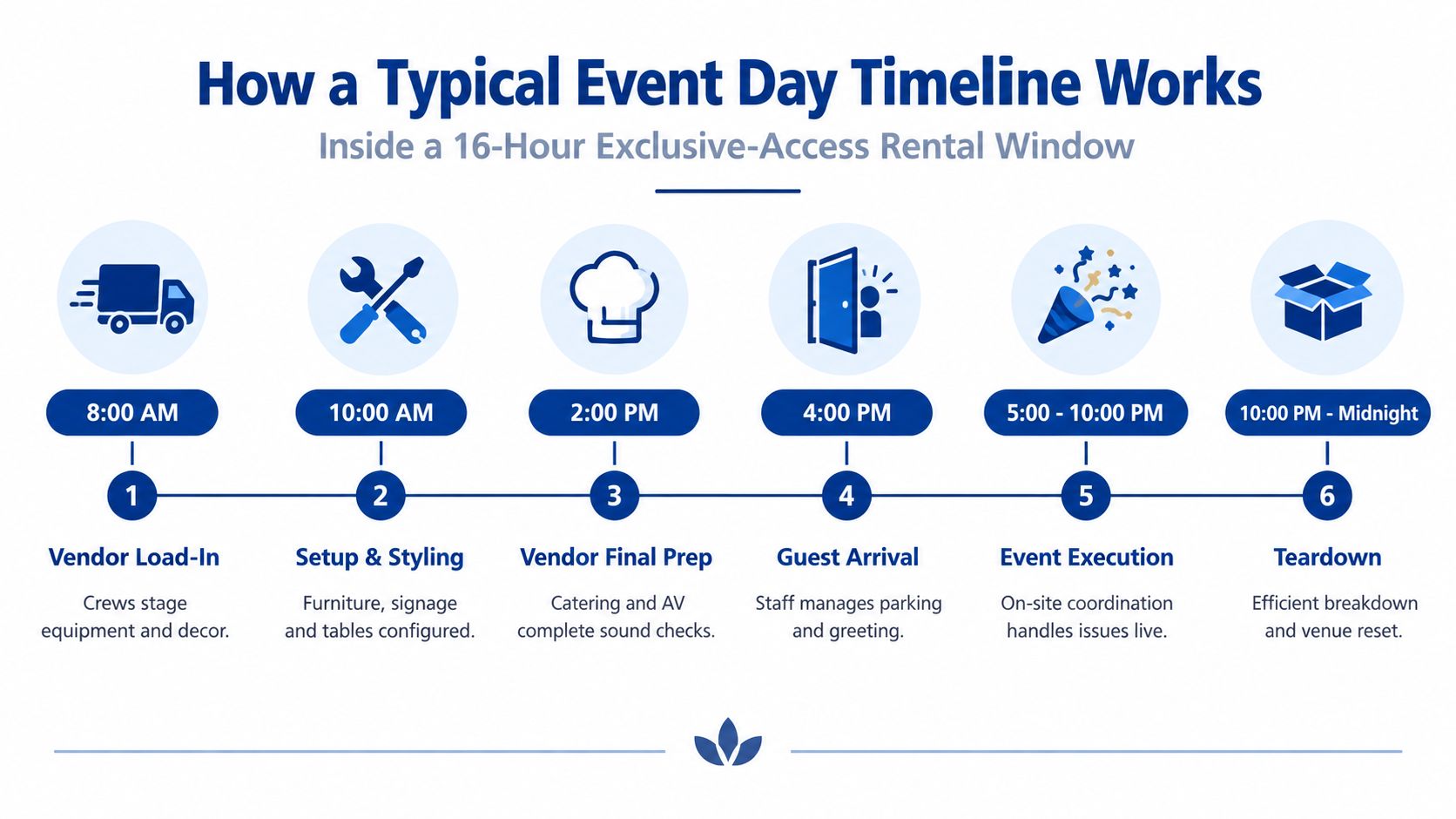
A 16-hour exclusive-access window gives the operations team enough room to sequence work instead of forcing every vendor through the same narrow door. The schedule below uses an 8 a.m. to midnight rental period as a practical operating model.
At 8 a.m., vendor load-in begins. Furniture crews stage tables and chairs, decor teams organize materials, and AV staff identify power sources and equipment positions. The early arrival matters because crews need space to work without guests moving through the same paths.
By 10 a.m., florists and decorators are active. The coordinator compares the room against the floor plan, checks sightlines, confirms signage, and resolves layout conflicts while there's still time to move furniture. A small adjustment at this point is routine. The same adjustment during guest arrival becomes a disruption.
Midday preparation
Around noon, the catering team sets up the kitchen and service areas. The coordinator reviews the meal timeline, confirms where staff will stage, and checks that the catering route won't interfere with ceremony traffic.
At 2 p.m., the couple and wedding party can use the dressing suites for hair, makeup, and photography while production teams finish the operational details elsewhere. Separating private preparation from vendor movement keeps the wedding party from becoming the messenger between crews.
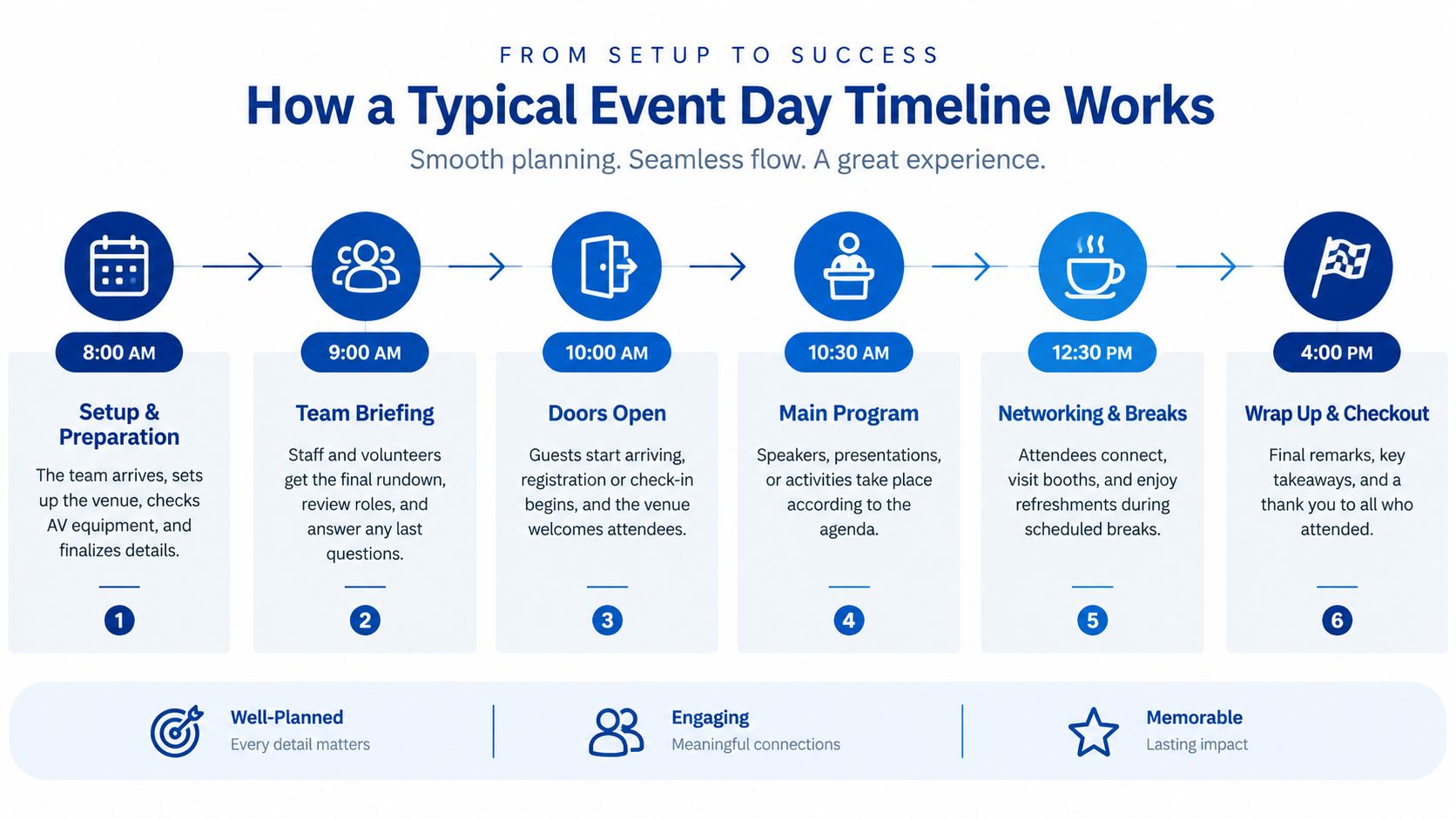
Between 4 and 5 p.m., the team runs final AV checks, confirms ceremony seating, briefs parking staff, and verifies guest-facing signage. These tasks happen in parallel, but one person must maintain the master view. Otherwise, each department can finish its own task while the overall event remains unready.
Evening handoffs
The ceremony begins around 5:30 p.m. Afterward, guests move to cocktail hour while staff reset the ceremony space for the reception. That room flip is a logistics handoff, not a vague instruction to “turn the room.” The team needs a removal sequence, a furniture map, a waste plan, and a clear completion check.
Dinner service runs from 7 to 8 p.m., with toasts and dances sequenced through the later program. The coordinator watches the relationship between kitchen timing, photography, speeches, music, and guest attention. If dinner runs long, the team can adjust the order before the delay spreads across the rest of the evening.
The last song and send-off close the guest-facing portion around 11 p.m. Breakdown then continues through midnight, with rental items packed, furniture restored, trash removed, and vendors loaded out in an agreed order. A practical event day schedule template helps planners document these handoffs rather than relying on memory or group texts.
Matching Logistics to Different Venue Styles and Capacities
A logistics plan should fit the room, not just the guest list. A rustic barn may need a carefully protected decor route and controlled sound coverage, while a ballroom may need more complex staging, lighting, registration, and service circulation. An outdoor pavilion adds weather exposure and ground conditions. A bridal suite or intimate room requires fewer resources but still needs disciplined access and reset procedures.
The following comparison uses planning categories rather than invented operating promises. Exact windows, staffing, and AV requirements should be confirmed with the venue and vendors.
| Venue Type | Typical Capacity | Load-In Window | Staffing Ratio | AV Setup |
|---|---|---|---|---|
| Rustic barn | Up to 150 guests | Staged delivery window coordinated around decor and catering | Coordinator, setup crew, parking support, and service staff sized to the floor plan | Wireless microphone, speakers, music playback, and ceremony coverage |
| Chandelier-lit ballroom | Up to 400 guests | Sequenced load-in for staging, furniture, lighting, and catering | Expanded coordination and guest-flow coverage for larger rooms | Speech microphones, presentation playback, lighting, and distributed sound |
| Outdoor garden pavilion | Variable by layout | Weather-aware access plan with protected routes | Arrival, ceremony, parking, and contingency coverage | Outdoor PA, wireless microphone, and backup ceremony plan |
| Intimate bridal suite or small event room | Smaller gathering | Compact delivery plan with limited staging footprint | Lean coordinator and service team | Focused audio coverage for speeches or background music |
For a rustic barn, the team should preserve the character of the space while managing practical constraints such as narrow access routes, furniture sequencing, and sound reflection. A ballroom usually allows more production equipment but can punish poor zoning. If registration, catering, guest seating, and AV all share the same approach, congestion arrives quickly.
An outdoor garden pavilion requires a decision about wind, heat, rain, cable protection, guest shade, and the transition to an indoor backup space. The right question isn't whether the outdoor setting is attractive. It's whether the team can switch plans without rebuilding the entire event.
Smaller rooms need fewer hands, but they don't eliminate coordination. In an intimate space, every misplaced table and exposed cable is more visible. Parking and accessibility still deserve a written plan, and the venue's parking lot size should be evaluated alongside guest count, vendor vehicles, rideshare activity, and accessible arrival needs.
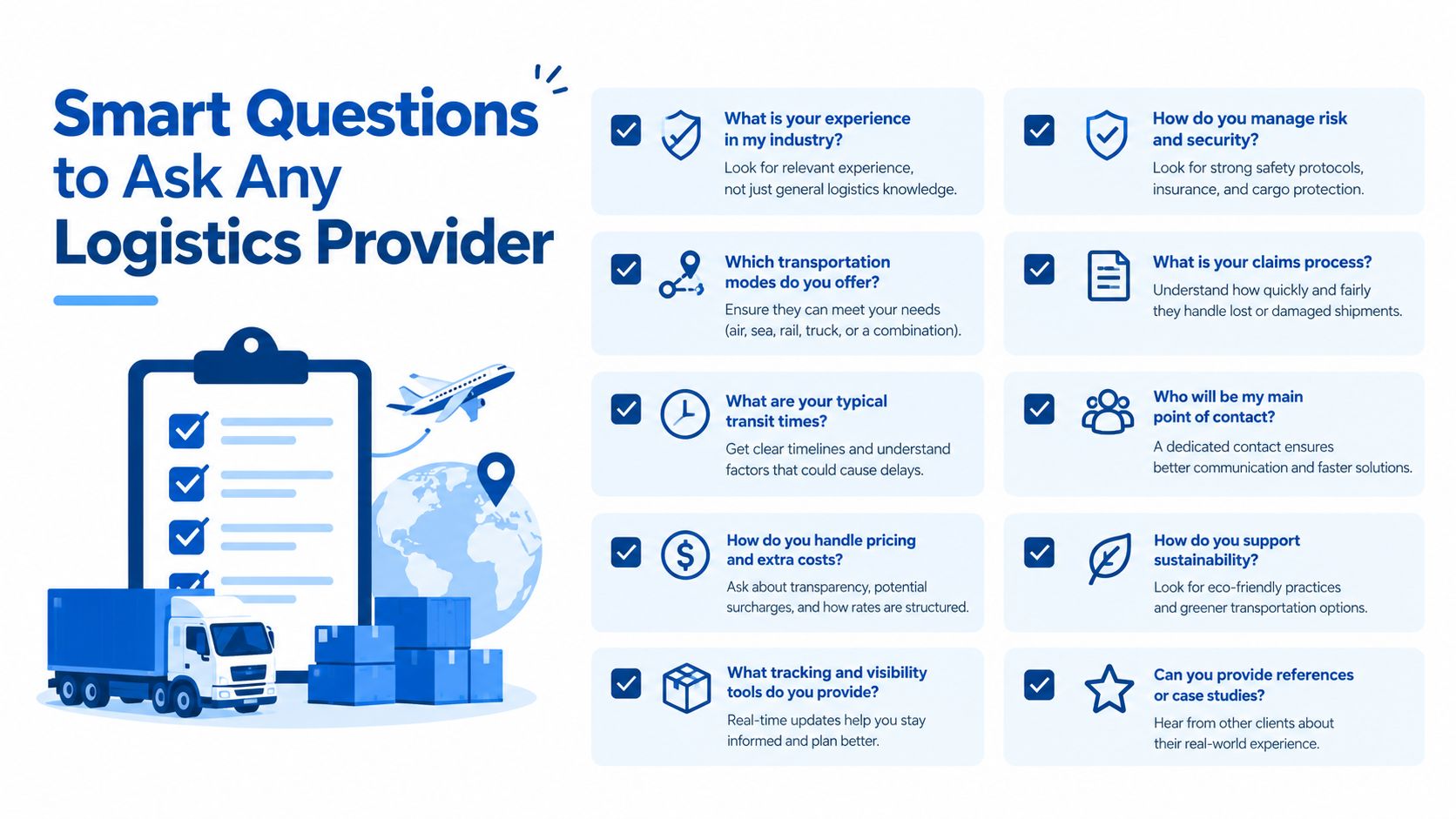
Smart Questions to Ask Any Logistics Provider
Most logistics problems begin as assumptions. A provider says “we'll handle it,” and the planner moves on without defining what “it” includes. Ask these questions before signing.
1. How much exclusive access do we have, and what are the exact load-in and breakdown deadlines?
A strong answer identifies the access window, vendor arrival rules, room availability, and overtime threshold in writing. A weak answer relies on “standard timing” without showing the schedule. The access period controls how much pressure the team can remove from event day.
2. Which vendors can work here, and who approves them?
Ask whether you can choose your caterer, AV company, florist, rental provider, and bartending team. A good provider explains the approval process and venue requirements. A vague answer may leave you discovering restrictions after contracts are signed.
3. What staffing is included, and what triggers additional charges?
Request role descriptions, arrival times, shift coverage, and the person with day-of authority. “An event manager is included” doesn't tell you whether that person handles parking, vendor check-in, room flips, AV escalation, or cleanup.
4. What AV equipment is actually available?
Ask for an inventory, not a category. Confirm microphones, speakers, projectors, lighting, cables, power access, outdoor coverage, testing responsibility, and backup procedures. The provider should distinguish venue-owned equipment from subcontracted equipment.
5. How will parking and overflow arrivals work?
A strong response includes traffic direction, vendor parking, accessible routes, drop-off handling, signage, and an overflow plan. If the answer is just "there's plenty of parking," you haven't received an operational plan.
6. What happens if weather changes the outdoor plan?
Ask who makes the call, when the decision is made, what equipment moves, and how guests are redirected. The contingency should cover sound, seating, decor, photography, power, signage, and staff positions.
7. What is the breakdown sequence, and when does overtime begin?
Get the final guest departure, vendor load-out order, rental pickup requirements, trash responsibility, inspection process, and fee triggers. A strong provider walks through the final hour in detail. A weak one treats cleanup as whatever remains after everyone leaves.
Ask for ownership, not reassurance. The provider should be able to name the person responsible for every major handoff.
Finally, determine whether the provider operates the work directly or subcontracts every function. Subcontracting isn't automatically a problem, but accountability must remain clear. If AV, parking, furniture, and cleanup each report to different companies, ask who resolves a conflict when their schedules collide.
Why Full-Service Venues Save Planners Time and Money
Separate vendors can look cheaper when viewed one quote at a time. The problem appears in the coordination layer. Four or five contracts can mean four or five arrival schedules, communication threads, insurance requirements, payment terms, equipment inventories, and people who assume someone else owns the handoff.
A full-service venue can consolidate more of that responsibility. When the venue supplies an in-house logistics team, owned AV inventory, dedicated setup crews, on-site management, or included cleanup, the planner has fewer operational gaps to close.
The financial advantage is predictability
Bundled labor and equipment make the final cost easier to understand. Instead of discovering separate setup, delivery, overtime, furniture breakdown, and venue restoration charges across multiple agreements, the planner can compare a clearer scope of work.
That doesn't mean a full-service venue always has the lowest initial quote. It means the planner can evaluate the complete operating cost, including personal coordination time, emergency rentals, extra labor, and the consequences of a delayed load-out.
One owner tightens the timeline
A single operations lead can sequence vendor arrivals, confirm room readiness, manage transitions, and coordinate breakdown. That authority matters during a ceremony flip or an AV issue because the team doesn't need to negotiate responsibility before acting.
The trade-off is real. Full-service venues may require earlier booking and may limit some vendor choices. For many planners, that restriction is useful. A defined vendor policy and a team that knows the site can reduce the number of unknowns that reach event day.
The strongest choice is the venue that documents what's included. Look for furniture counts, access rules, sound equipment, staffing responsibilities, cleanup scope, parking information, and overtime terms. A low headline price with an unclear operational scope isn't a savings plan.
Choosing the Right Logistics Setup for Your Event
Choose the logistics model by comparing guest count, event complexity, and your own bandwidth. Guest count matters, but it isn't the only trigger. A small event with several vendors, outdoor production, a tight schedule, and a demanding breakdown can require more coordination than a larger gathering with a simple format.
A DIY model can work for a small guest list and a straightforward timeline when the planner has time to manage deliveries, vendor questions, setup, guest arrival, and closeout. It stops making sense when the planner becomes the unofficial venue manager.
Use this decision path
- Count the moving parts. List the caterer, florist, rental company, DJ or band, photographer, transportation provider, bar team, security, and cleanup responsibilities.
- Map the access demands. Identify who needs early entry, where vehicles unload, which areas need power, and whether guests and vendors share a route.
- Price your attention. Estimate the hours you'll spend on calls, confirmations, setup supervision, troubleshooting, and breakdown. Your time has a cost even if no invoice shows it.
- Test the failure points. Ask what happens if a vendor is late, weather changes the ceremony, a microphone fails, or a rental pickup misses its window.
- Compare the complete scope. Put venue coordination, equipment, labor, access, cleanup, and overtime terms beside the separate-vendor alternative.
If the calculation shows you'll hire a coordinator anyway, choose a venue that already provides operational authority. If the event has multiple rooms, outdoor elements, guest transportation, or a long setup and breakdown cycle, centralized logistics usually offers the cleaner path.
Technology can support this decision. The underserved opportunity in event logistics is real-time visibility combined with single-provider coordination, rather than another disconnected tool. Industry coverage identifies growing interest in end-to-end outsourcing and shipment visibility, and reports that more than 60% of newly adopted event logistics platforms include AI or IoT capabilities, while around 90% of new solutions integrate real-time tracking, IoT, or automation tools. (Mordor Intelligence's global event logistics market coverage) The useful question isn't whether a platform has a modern feature. It's whether your team can see the right handoffs and act on them.
For broader planning references, WipesBlog.com's event planner resources for 2026 can supplement your checklist. For Central Texas events, Texas Old Town offers four private venues, indoor and outdoor ceremony options, a 16-hour exclusive-access window, venue furniture, indoor and outdoor PA systems, a prep kitchen, flexible caterer selection, on-site management, private parking, and included cleanup and furniture breakdown. Review those inclusions against your own vendor list before deciding whether separate logistics contracts add value.
Visit Texas Old Town to compare four Central Texas venues, review layouts and included operational amenities, and see how a 16-hour exclusive-access window can give setup, guest arrival, celebration, and breakdown the room they need. Schedule a tour or contact the venue team to build your event logistics plan around the actual space, vendors, and timeline.