Forty-five minutes before the ceremony, the bride is still in the dressing room, but the questions have already started. The florist can't find the loading dock. The caterer needs to know where the warming ovens can draw power. Her mother is asking where the guest book table belongs, while a musician wants confirmation on the ceremony cue. None of these problems is dramatic by itself. Together, they pull the couple away from the reason everyone gathered.
That's the hidden operational layer of day of event coordination. A wedding, quinceañera, milestone birthday, or corporate gathering can be carefully planned and still become difficult to execute once vendors, guests, weather, transportation, food service, entertainment, and venue rules converge. The coordinator's job is to absorb those decisions, protect the timeline, and keep the hosts present.
Table of Contents
- Why Your Event Day Needs a Dedicated Coordinator
- What Day of Event Coordination Actually Includes
- Benefits for Weddings and Milestone Celebrations
- A 16-Hour Event Day Timeline That Works
- Managing Vendors and Venue Logistics Behind the Scenes
- Do You Need a Day-of Coordinator or Can You DIY
- How to Prepare for a Smooth Handoff to Your Coordinator
Why Your Event Day Needs a Dedicated Coordinator
A well-meaning relative can answer a phone call. A bridesmaid can carry an emergency kit. A venue manager can explain where vendors should park. None of those people should be expected to manage every operational decision while also celebrating, protecting the property, or overseeing another responsibility.
A dedicated coordinator becomes the single point of contact for the event. The florist calls that person, not the bride. The DJ receives the approved cue from that person, not three different family members. If a guest-flow problem appears at the ceremony entrance, the coordinator makes the adjustment without turning it into a family meeting.
Practical rule: The host should be the last person vendors call when something changes.
The need becomes obvious during the final hours of a venue rental. At a Hill Country property, a coordinator may be tracking outdoor ceremony readiness, indoor reception setup, vendor access, parking, power, photography timing, and the transition between spaces at the same time. Even with a generous 16-hour rental window, the day contains dependencies. A delayed delivery can compress setup, which can delay photographs, which can shorten the buffer before guests arrive.

This is why day-of coordination isn't just “someone who shows up on the wedding day.” The work commonly starts weeks ahead with timeline confirmation, vendor communication, site familiarity, and responsibility assignments. On the event day, the coordinator watches the schedule, checks deliverables, manages transitions, and makes quiet corrections before guests notice them.
For couples comparing services, Texas Old Town's event manager responsibilities offer useful context for distinguishing venue oversight from broader event execution. The important question isn't whether someone will be on-site. It's whether one person has clear authority to coordinate all the moving parts that affect the experience.
What Day of Event Coordination Actually Includes
Day-of coordination is the execution phase of an event. In practice, a coordinator often becomes involved during the final four to eight weeks, confirms the existing plan, and manages the event day from vendor arrival through final breakdown. The exact scope varies, so the agreement should state what the coordinator owns and what remains with the client.
The work included in the service
A capable coordinator typically takes over the operational details that become urgent near the event:
- Vendor confirmations: Verify arrival windows, setup requirements, contact details, parking instructions, and breakdown responsibilities.
- Load-in scheduling: Sequence vendors so caterers, florists, rental teams, entertainment, and photographers don't compete for the same access route.
- Timeline control: Build the ceremony, reception, meal, speeches, special dances, transitions, and exit into one working document.
- Rehearsal direction: Explain entrances, processional order, cues, and positioning to the wedding party or event participants.
- Point-of-contact duties: Answer vendor questions and route decisions to the appropriate client representative.
- Emergency readiness: Carry or organize practical supplies such as tape, stain remover, safety pins, and backup décor materials.
- Live adjustments: Move tasks or cues when traffic, weather, setup delays, or guest behavior changes the original sequence.
At a Hill Country venue, site knowledge matters. The coordinator needs to understand the service entrance, power access, indoor and outdoor sound options, parking flow, dressing suites, prep-kitchen access, and any noise cutoff that affects entertainment. A generic timeline can't account for those details.
What it doesn't include
Day-of coordination generally doesn't mean the coordinator will source every vendor, negotiate contracts, develop the design concept, or track the complete planning budget. Those responsibilities belong to full-service planning unless the contract says otherwise.
| Service Element | Day-of Coordination | Full-Service Planning |
|---|---|---|
| Vendor selection | Client books vendors | Planner researches and recommends vendors |
| Contract negotiation | Reviews existing details for execution | Negotiates terms and manages agreements |
| Design concept | Executes approved décor and layout | Develops the creative direction |
| Budget tracking | Works within the approved plan | Builds and manages the planning budget |
| Event-day logistics | Core responsibility | Included, often alongside broader planning |
| Timeline and handoff | Refines and operates the schedule | Creates the plan from the beginning |
“Month-of coordination” is often a different name for a similar handoff model. Read the scope instead of relying on the label. Couples looking for a practical planning reference can also review stress-free event coordination to see how detailed task ownership supports a cleaner transition.
Benefits for Weddings and Milestone Celebrations
The value of a coordinator changes slightly by event type, but the operating principle stays consistent: one person protects the flow while everyone else participates in the experience.
At a wedding, the couple can't walk down the aisle, cue the musician, seat late arrivals, check the caterer's plating progress, and answer vendor calls at the same time. A coordinator handles those parallel tasks and keeps the couple out of the troubleshooting loop. That emotional separation matters. Guests remember whether the hosts were present, not whether the couple personally solved a delivery question.
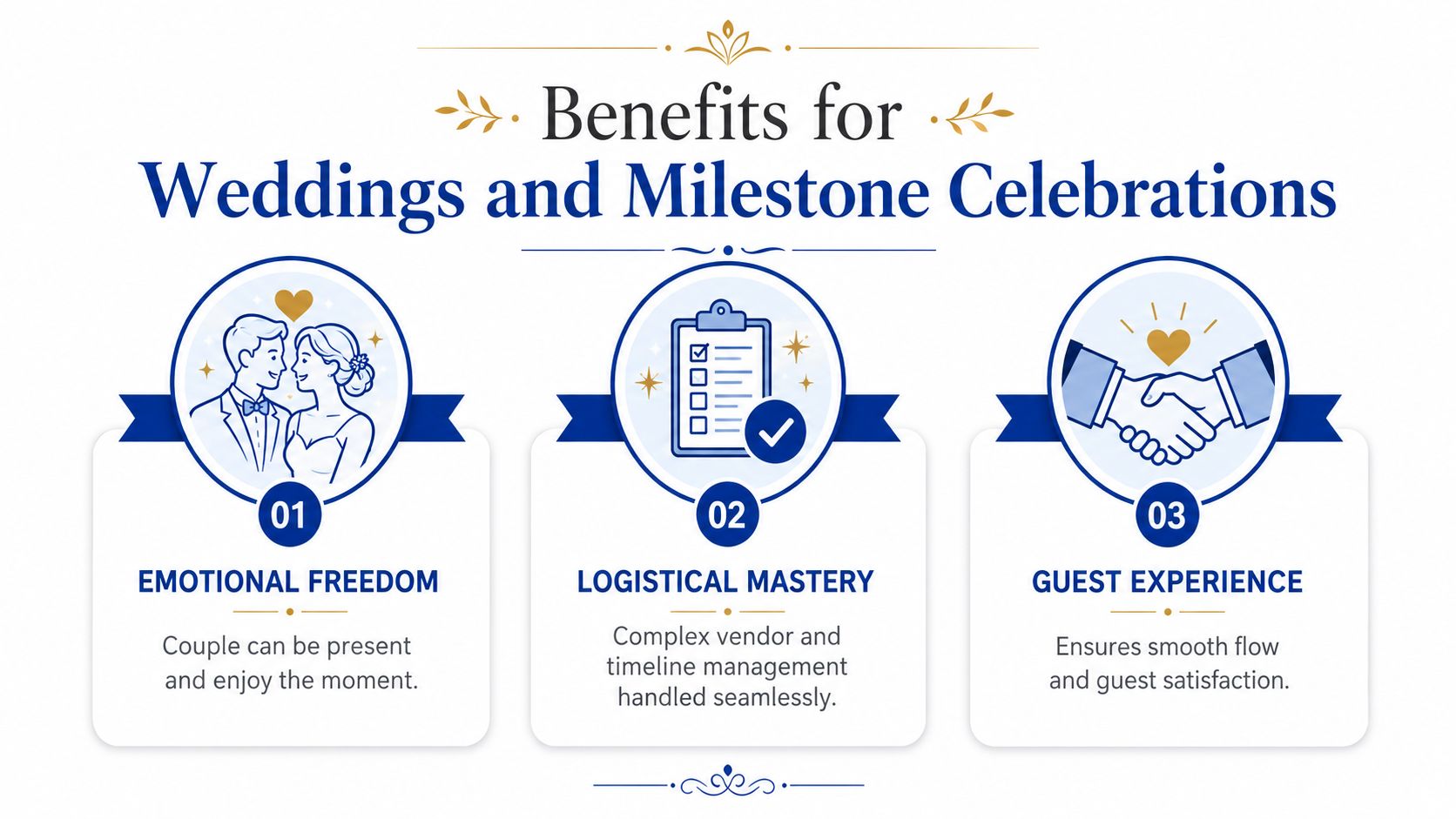
Weddings and quinceañeras
Quinceañeras and milestone birthdays create a different kind of complexity. The coordinator may need to manage a choreographed entrance, surprise elements, family traditions, changing music cues, and guests spanning several generations. A late participant can affect the entire sequence, so the coordinator needs both a written order of events and the authority to make a discreet adjustment.
The same applies to retirement parties, anniversaries, and other milestone celebrations. A tribute video might require an AV check, a speaker may need a revised introduction, and a family member may add an unexpected presentation. The coordinator protects the emotional moments by managing the practical ones around them.
Corporate events and galas
Corporate gatherings and nonprofit galas depend on polished transitions. Speaker handoffs, microphone changes, presentation cues, auction pacing, meal service, and guest movement all need owners. A coordinator helps preserve the intended brand experience by ensuring that the audience doesn't see the backstage uncertainty.
Hill Country venues add practical variables. Outdoor ceremony spaces may require a weather pivot, remote parking may require shuttle planning, and rural vendor travel can make late arrivals harder to correct. Indoor reception space, outdoor audio, and separate service access can solve some issues, but only if someone coordinates the sequence.
A coordinator doesn't eliminate variables. They make sure each variable has an owner, a response, and a place in the timeline.
A 16-Hour Event Day Timeline That Works
A 16-hour rental window gives the coordinator room to separate setup, celebration, and strike, but the schedule still needs structure. The following example uses an 8:00 a.m. to midnight Hill Country rental window. The exact times will change by event, but the sequencing principle remains useful.
Morning setup and vendor access
At 8:00 a.m., the coordinator begins venue access, checks the spaces, reviews the floor plan, and confirms that the first work areas are ready. Florists should arrive early enough to build installations before rental furniture and guest-facing details crowd the space. Rental deliveries follow a planned access window, while catering uses the service entry and prep areas without blocking décor installation.
By late morning, entertainment and AV teams need access for speakers, microphones, lighting, and sound checks. Hair and makeup should have a schedule that includes room for delays, especially when the same group must be ready for portraits before the ceremony. A coordinator doesn't just write these appointments down. They watch the dependencies between them.
The timeline should include 15-minute contingency buffers at key transitions, rather than assuming every task will finish at its ideal time. Expert guidance also recommends 10 to 15 minutes between major transitions and a 30-minute cushion before the ceremony for risk absorption, as outlined in event logistics best practices.
Guest arrival through reception
A practical sequence might look like this:
- 8:00 a.m.: Coordinator load-in and venue inspection.
- 10:00 a.m.: Staggered vendor arrivals and setup.
- 2:00 p.m.: Guest arrival preparation, parking, and shuttle checks.
- 30 minutes before the ceremony: Ceremony space locks, guest flow transfers to the coordinator, and vendors stop making visible setup changes.
- 6:00 p.m.: Ceremony begins, with weather-hold decisions already assigned.
- After the ceremony: Guests move to cocktails while the coordinator manages the room transition and photography priorities.
- 7:00 p.m.: Reception begins, followed by synchronized meal, speech, entertainment, and special-event cues.
- 11:00 p.m.: Last dance or closing moment.
- Midnight: Final strike and venue handoff.
The plated dinner cue often requires the kitchen, emcee, DJ, and coordinator to agree on one signal. If the kitchen isn't ready, the coordinator adjusts the introduction or music sequence instead of allowing guests to wait without explanation. Sunset portraits and outdoor ceremony holds also need active monitoring because seasonal light and weather can change the best timing.
For a more detailed planning reference, use the event planning timeline as a starting point, then adapt it to the selected venue, vendor contracts, guest movement, and breakdown obligations.
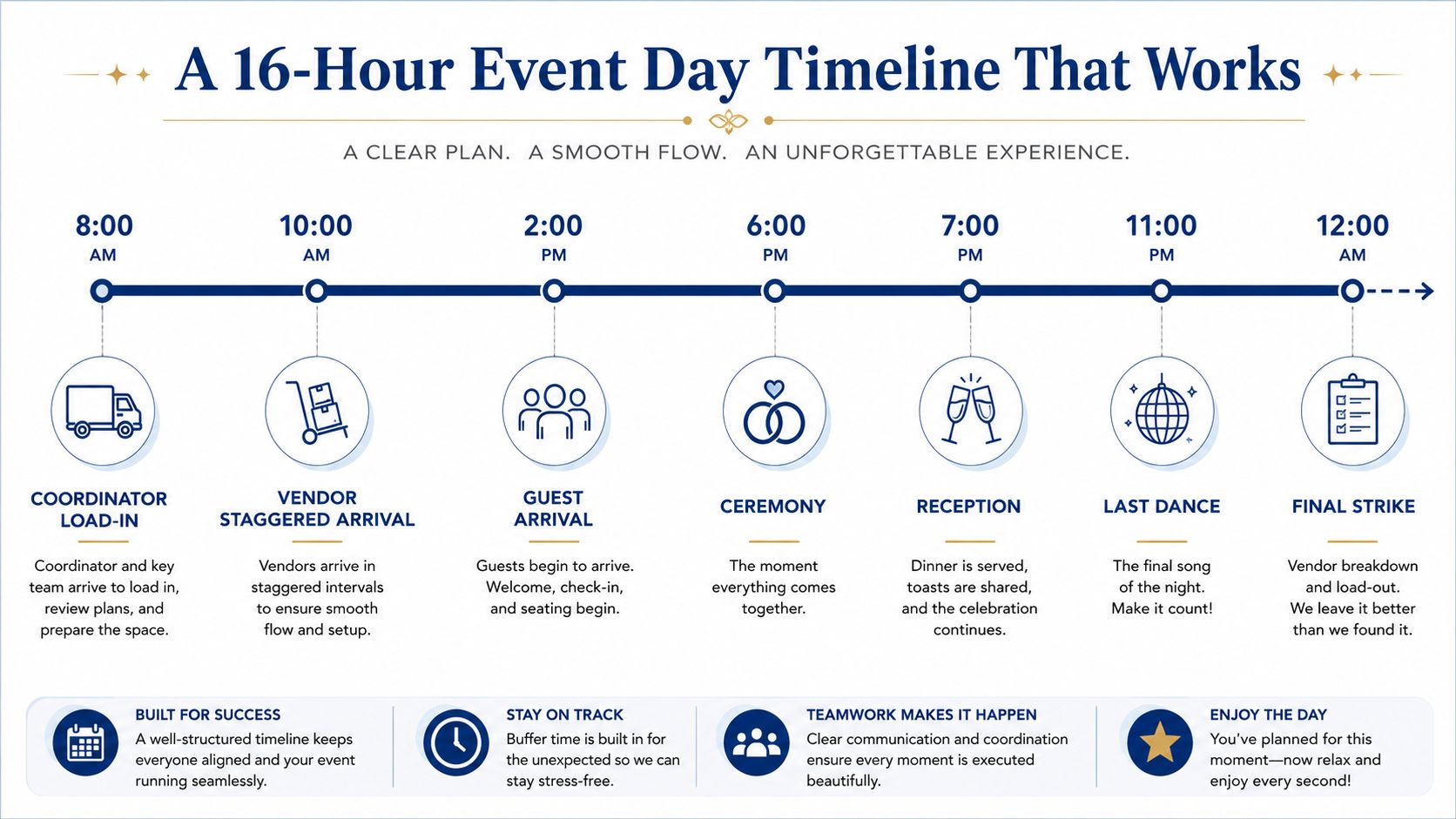
The timeline is a living control document. A private vendor group text can distribute approved changes quickly, but the coordinator should make the decision first. Unstructured group messaging creates noise. Clear authority creates movement.
Managing Vendors and Venue Logistics Behind the Scenes
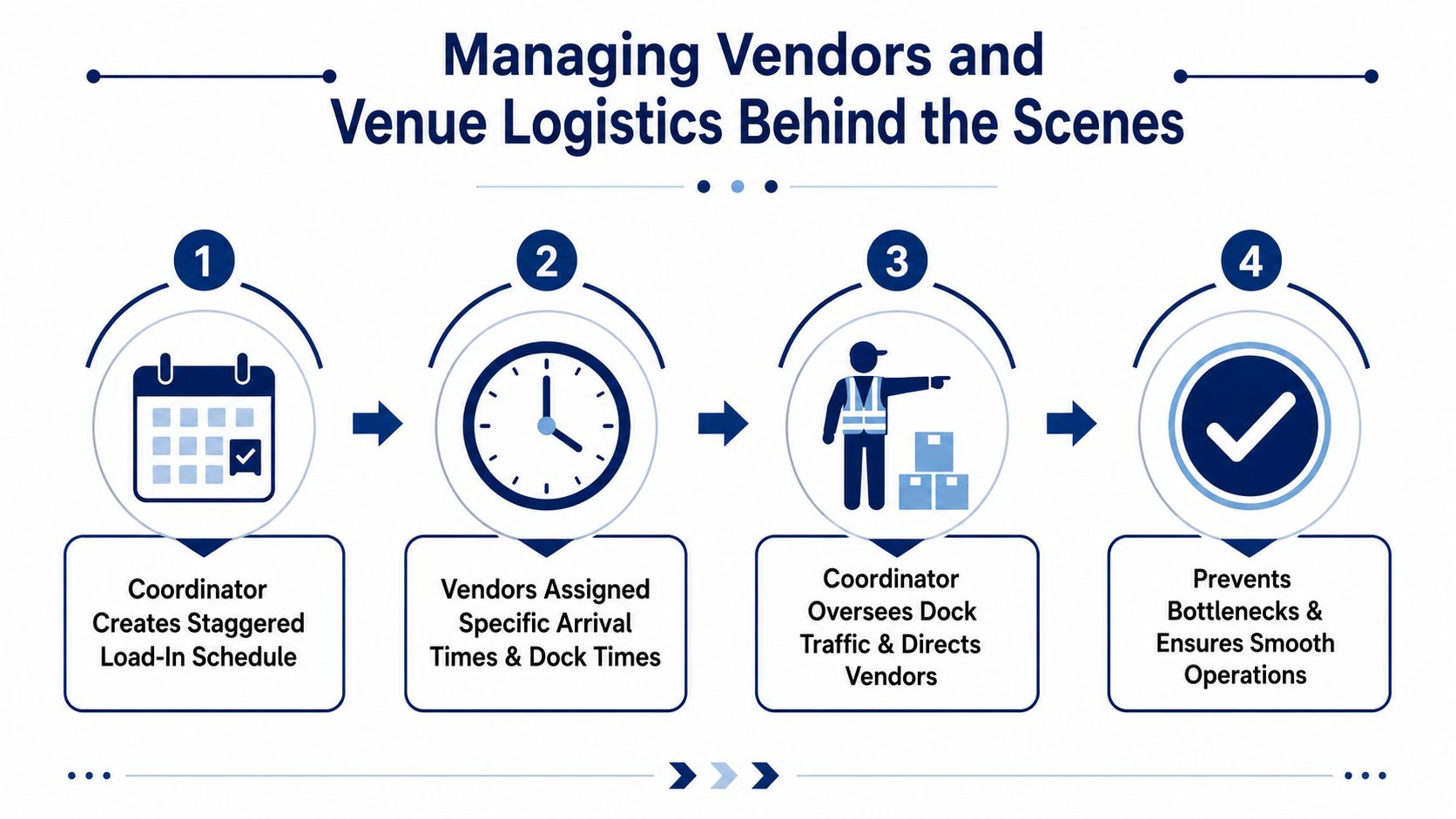
Vendor management starts before anyone reaches the property. At a Hill Country venue with a single-access road or limited loading area, an unplanned arrival pattern can create a bottleneck that affects every subsequent task. Florists, rental crews, caterers, AV technicians, photographers, and entertainers need assigned windows, not a general instruction to arrive “in the morning.”
Sequencing the load-in
A written, vendor-specific staggered load-in schedule should go out one to two weeks before the event, with final written confirmations from each vendor. Expert guidance commonly uses separate windows for florists, catering, AV or DJ teams, photographers, and officiants so each group can work without competing for the same prep space. The precise order depends on the venue, but the logic is stable: upstream tasks must finish before dependent tasks can begin.
At the 48-hour confirmation, the coordinator verifies arrival time, vehicle details, parking assignment, access route, power requirements, and the person responsible for checking in. A site map should identify the service entrance, guest entrance, ceremony area, reception hall, dressing spaces, and any generator location. This prevents a lost caterer from calling the couple while guests are already arriving.
The communication system
The most useful system is simple and redundant:
- Master vendor sheet: Names, phone numbers, responsibilities, arrival windows, contract notes, and emergency contacts.
- Private vendor group text: Short, approved updates for live timing changes.
- Printed run-of-show: One copy in the bridal suite, one in the kitchen or service area, and one with the coordinator.
- Decision hierarchy: A named lead who can approve timeline, layout, weather, and service changes.
The coordinator may also check generator placement for outdoor sound, keep trash from accumulating near photo backdrops, confirm that catering access remains clear, and activate backup contacts when a vendor doesn't appear. A preferred-vendor list can support the sourcing stage, but the coordinator still has to confirm the actual event-day responsibilities. Texas Old Town's preferred vendor lists are one example of venue-provided planning information that can help clients begin that process.
Guest-facing details also benefit from clear ownership. If the couple wants guests to collect guest photos, the coordinator can place the instructions where guests will see them and assign someone to monitor the display or sign. The coordinator's best work is often invisible. Guests don't see the blocked service lane that was cleared, the late delivery that was absorbed, or the room reset completed before the next transition.
Do You Need a Day-of Coordinator or Can You DIY
The right execution model depends on the event's complexity, not just the couple's confidence. A small gathering with a simple layout may be manageable with family help. A multi-vendor celebration with outdoor elements needs a person whose only responsibility is operational control.
| Criteria | DIY / Family Help | Venue In-House Manager | Independent Day-Of Coordinator |
|---|---|---|---|
| Timeline complexity | Family member tracks the schedule | Supports venue-related timing | Owns the complete event run-of-show |
| Vendor count | One person fields every call | Usually handles venue operations | Coordinates all participating vendors |
| Couple stress tolerance | Hosts remain available for problems | Hosts may still receive vendor questions | Hosts are shielded from logistics |
| Budget | Lowest direct service cost | Included or venue-dependent | Separate coordination investment |
| Venue familiarity | Must learn the property | Strong property knowledge | Learns the venue and coordinates the broader plan |
| Event-day authority | Informal and personal | Protects venue rules and operations | Executes the approved plan across vendors |
A venue manager's priorities are important but specific. That person protects the property, enforces venue policies, supports access, and may oversee included setup or cleanup. They generally aren't responsible for cueing the DJ, managing the bridal party, solving a late florist's placement issue, or keeping family members aligned during a surprise entrance.
Family coordination has a different cost. A bridesmaid or parent may save a service fee, but they'll spend the celebration answering calls, carrying supplies, directing vendors, and making decisions without a formal handoff. That arrangement can work, but it transfers pressure to someone who was supposed to be a guest.
Use this decision screen:
- More than six vendors: Independent coordination is usually operationally necessary.
- An outdoor component: Add weather, sound, lighting, parking, and transition decisions.
- More than 100 guests: Guest flow and service timing become harder to manage informally.
- High emotional stakes: A family member shouldn't be the default problem desk.
- Tight budget: Consider a partial package covering the final four hours, ceremony, reception transition, and key vendor handoffs.
A coordinator isn't the only workable choice. It's the clearest choice when one person can't realistically monitor every active workstream.
How to Prepare for a Smooth Handoff to Your Coordinator
A coordinator can execute a strong plan only when the plan is documented. Start with a complete vendor contact sheet at least 30 days before the event, including arrival instructions, delivery addresses, emergency numbers, and each vendor's responsibilities.
Provide the floor plan, seating chart, ceremony layout, and décor placement no later than two weeks before the event. Share contracts as well, because the coordinator needs to know what each vendor promised, what the venue includes, and who handles setup, service, and breakdown.
The handoff checklist
- Timeline draft: Include ceremony, reception, meals, speeches, entertainment, photographs, transportation, and strike.
- Vendor confirmations: Record arrival windows, access needs, power requirements, and contact names.
- Guest details: Confirm final headcount, dietary needs, accessibility needs, parking instructions, and shuttle plans with the relevant teams.
- Emergency kit: Prepare safety pins, stain remover, tape, scissors, batteries, and backup décor materials.
- Venue walkthrough: Schedule a final walkthrough one to two weeks before the event and review indoor, outdoor, weather, and service routes.
- Decision list: Identify who can approve changes if the couple is unavailable.
A three-wave confirmation process at 30 days, seven days, and 48 hours can keep changes from disappearing across email threads, according to wedding vendor coordination guidance. For weather-sensitive events, a formal site walkthrough six to eight weeks out, a full timeline review four to six weeks out, and a final vendor call one to two weeks out create earlier opportunities to resolve access and contingency issues, as described in this vendor timeline template.
The cleaner the handoff, the less the coordinator has to improvise. That protects your time, your vendors, and the experience you've spent months arranging.
Texas Old Town provides four private venues, indoor and outdoor ceremony options, a 16-hour rental window, on-site management, flexible catering access, and venue layouts that support detailed coordination. Visit Texas Old Town to tour the Hill Country property, review the available spaces, and discuss how its venue operations can fit your event-day plan.