Are preferred vendor lists designed to protect couples from bad hires, or to protect a venue's revenue streams? That's the question most couples skip, even though the answer can affect their budget, creative choices, contracts, and wedding-day logistics.
A preferred vendor list can be useful. It can also function as a quiet sales channel, steering couples toward providers who maintain a financial relationship with the venue or penalizing anyone who wants to hire independently. In Central Texas, where weddings often involve outdoor ceremonies, Hill Country weather, travel between Austin and San Antonio, complex load-ins, and many specialized vendors, the label alone isn't enough.
You need to understand who controls the list, how vendors earn a place, what freedom your contract preserves, and what happens when you choose someone outside it.
Table of Contents
- What Preferred Vendor Lists Really Are
- Pros and Cons for Couples and Planners
- The Hidden Economics Behind Curated Lists
- How to Evaluate Vendors on Any List
- Flexible Vendor Policies as a Smarter Alternative
- Central Texas Wedding Planner Checklist and FAQ
What Preferred Vendor Lists Really Are
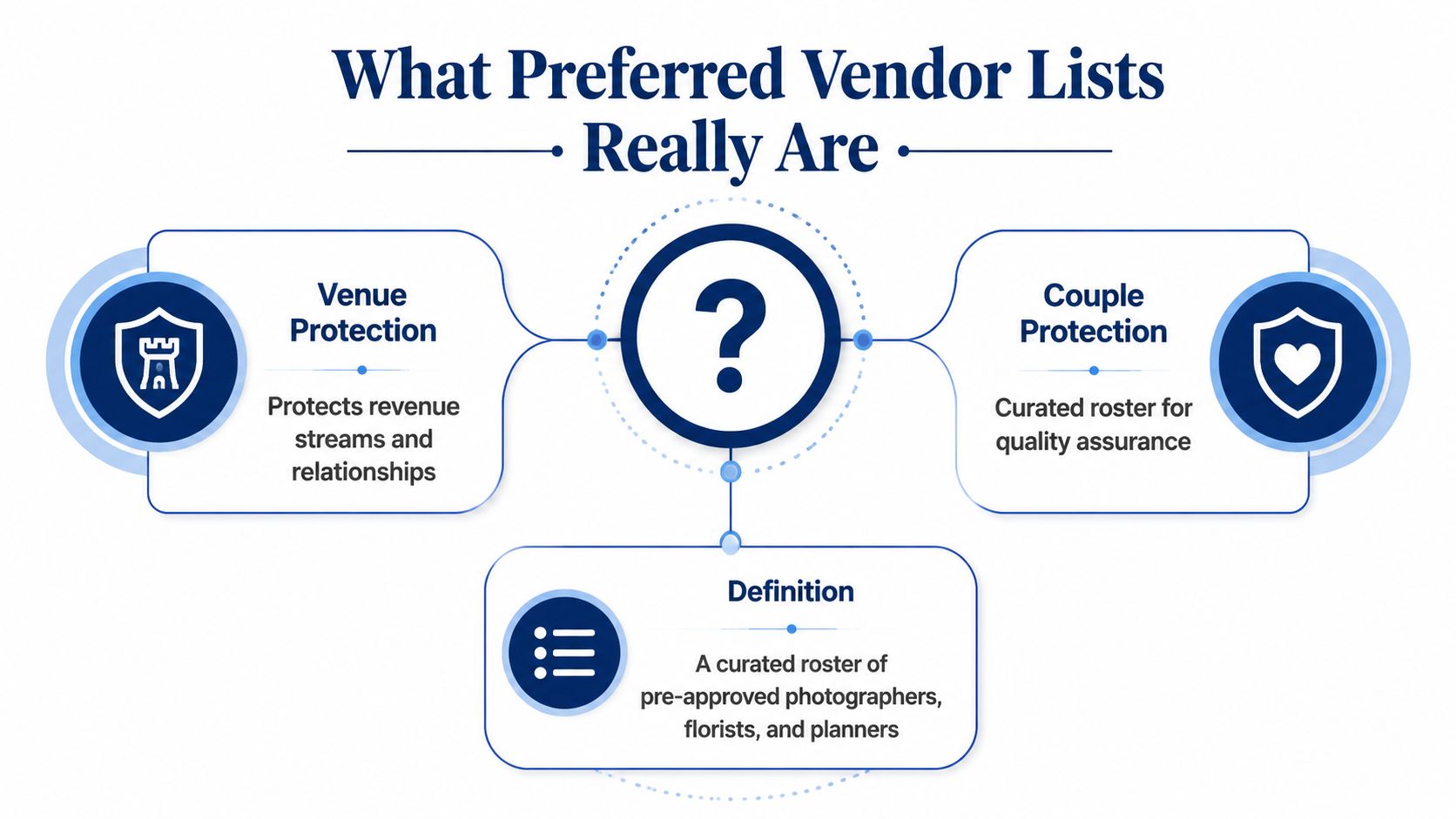
What does “preferred” require from you? A preferred vendor list is a roster of photographers, caterers, florists, DJs, planners, bartenders, rental companies, and other event professionals a venue recommends, approves, or requires. WeddingWire's explanation of approved vendor lists explains that these lists can cover categories from photography and cake design to florals, catering, and music. The contract determines how much control the venue has.
That control varies. One venue may require its roster. Another may recommend listed providers while allowing outside vendors who meet insurance and operating standards. A third may offer names only as a courtesy, without charging or penalizing you for choosing someone else.
Three labels that carry different weight
Preferred usually means recommended, not mandatory. The venue has worked with those providers and considers them a workable fit, but your agreement may allow outside choices.
Approved means the vendor has met stated venue criteria. Those requirements might include insurance, application materials, property training, operational capacity, or previous event experience. Approval does not guarantee the lowest price or the right style for your wedding.
Required means the contract controls the choice. You may have to use the venue's caterer, bartender, rental company, or another named provider, with only limited exceptions.
Read the vendor policy before comparing portfolios or paying deposits. Texas Old Town's advice on choosing a wedding venue can help you identify policy questions early, but the signed agreement determines your obligations.
Why venues create these lists
Venues build lists for operational and financial reasons. Familiar vendors know the property's entrances, power access, floor plans, noise rules, parking patterns, setup windows, and cleanup expectations. That knowledge can reduce confusion and help staff manage the timeline.
A list can also limit liability and prevent avoidable disruptions. Guidance on venue preferred supplier list management recommends checking insurance, documenting selection criteria, and separating preferred, approved, and mandatory categories.
Quality control is only part of the story. Some venues receive referral fees, commissions, or other benefits when couples book listed providers. Others charge outside-vendor fees or impose stricter requirements, turning the list into a revenue channel. Ask directly whether vendors pay for placement, whether the venue receives compensation, and what an outside vendor will cost you.
Treat the roster as a starting filter, not proof that every provider suits your priorities. The Knot's 2025 Real Weddings Study coverage reported that 82% of couples secure their venue first and 26% booked vendors from a preferred or approved list in the prior year. The coverage also says couples spend nearly 20 minutes researching each vendor, with about six vendors on these lists. The list shapes discovery, even when the contract does not require it.
Pros and Cons for Couples and Planners
Could a preferred list save planning time while limiting your choices? Yes. The answer depends on whether the venue uses it to manage quality and logistics, or to steer bookings toward commercial relationships.
For couples, the clearest benefit is less decision fatigue. Instead of researching every photographer, caterer, florist, DJ, and rental company serving Central Texas, start with providers who have worked at the property. A photographer who knows the ceremony-site light, a caterer familiar with the prep kitchen, or a DJ who understands the venue's sound limits may prevent avoidable problems.
Familiar venue-vendor relationships can also improve coordination. Teams may communicate more efficiently about load-in, setup, teardown, parking, bar service, and timeline changes. That experience matters at outdoor Hill Country weddings, where heat, wind, rain, and changing ceremony plans demand quick, clear decisions.
Practical rule: Use the list to narrow your search, then evaluate every vendor as if you found them independently.
The couple's trade-off
| For couples | What it can mean |
|---|---|
| Less searching | You get a manageable starting pool instead of a blank page. |
| Venue familiarity | Listed vendors may understand access, rules, and timing. |
| Simpler communication | The venue may already know how each provider works. |
| Reduced choice | A narrow roster can exclude the specialist who fits your vision. |
| Possible price pressure | Limited competition can make comparisons harder. |
| Potential steering | Placement may reflect venue relationships as well as performance. |
Couples typically hire many different wedding vendors. The Knot's 2025 vendor report says the average couple works with 14 vendors. WeddingWire's 2019 discussion also reported an average of 14 vendors, but that source is the same page used earlier for its approved-list explanation, so it should not be treated as a separate supporting reference. The practical point remains: a preferred list can influence a substantial share of an event's logistics and spending.
The planner's trade-off
Planners benefit from established working relationships. They often resolve questions faster because they know which providers respond promptly, follow venue procedures, and need extra timeline supervision. A familiar team can reduce variables during a crowded production schedule.
Creative fit can suffer. A planner may know that a bilingual officiant, cultural caterer, content creator, or live band outside the roster better suits the couple, yet encounter resistance from the venue. That conflict puts the planner's duty to advocate for the couple against the venue's preferred relationships.
Ask for the complete policy before recommending a venue. Confirm whether outside vendors face extra review, insurance requirements, or fees, and give the couple those details before they sign. Texas Old Town's flexible vendor policy offers a useful counter-example: couples can weigh venue familiarity against personal fit without treating a roster as the only practical path.
Convenience helps, but it should not override transparency, budget, or the couple's stated priorities.
The Hidden Economics Behind Curated Lists
Not every vendor earns a preferred-list position through the same process. Some venues select providers based on performance, compliance, and operational fit. Others may maintain financial relationships that couples never see clearly in the booking conversation.
Possible arrangements include annual listing fees, per-booking commissions, referral payments, or other placement agreements. The precise arrangement varies by venue and vendor, so don't assume a listed provider pays for placement, but don't assume the opposite either. Independent wedding-industry coverage notes that many preferred lists are fee-based, while venue policies can also impose outside-vendor fees that make independent selection more expensive. The White Wood Ranch's discussion of preferred vendor lists addresses this unresolved buyer concern directly.
Three common selection models
| Selection Model | How It Works | Typical Cost to Vendor | Impact on Couple Pricing |
|---|---|---|---|
| Performance-based curation | The venue evaluates experience, compliance, references, event execution, and ongoing feedback. | May involve no placement payment, or ordinary business costs that aren't tied to ranking. | Pricing is more likely to reflect the vendor's services and operating costs, though couples still need comparisons. |
| Paid placement | A vendor pays for inclusion, visibility, or continued listing access. | A listing fee or other arrangement may apply, but the amount isn't automatically disclosed to couples. | The vendor may build marketing or referral expenses into package pricing. |
| Per-booking relationship | The venue receives compensation when a listed vendor is booked. | A referral payment or commission may apply to completed bookings. | The couple may pay indirectly through the vendor's pricing, even if the contract doesn't show a separate line item. |
Outside-vendor penalties create a second economic pressure. A venue may permit you to bring your own caterer, florist, DJ, or rental company, but attach an additional charge or stricter requirements. The fee can make the preferred list appear less expensive without proving that the listed vendors offer better value.
That's why you should ask these questions before signing:
- Selection criteria: What must a vendor demonstrate to join the list?
- Performance review: Does the venue review complaints, damage incidents, missed timelines, and client feedback?
- Financial relationships: Does the venue receive fees, commissions, rebates, or other compensation?
- Outside vendors: Are outside providers permitted, and what charges or requirements apply?
- List maintenance: When did the venue last add, remove, or re-evaluate vendors?
A static list with no visible review process deserves scrutiny. Guidance on building and maintaining a preferred vendor list recommends recurring reviews, removal after serious complaints or incidents, current insurance documentation, and real-event performance before adding new providers. That's the standard couples should expect, even if the venue doesn't use formal scorecards.
For couples comparing venues, a bring-your-own-beverage or flexible-catering policy can change the economics substantially. Texas Old Town's flexible BYOB venue approach offers a useful example of why the complete vendor policy matters more than the preferred-list label alone.
How to Evaluate Vendors on Any List
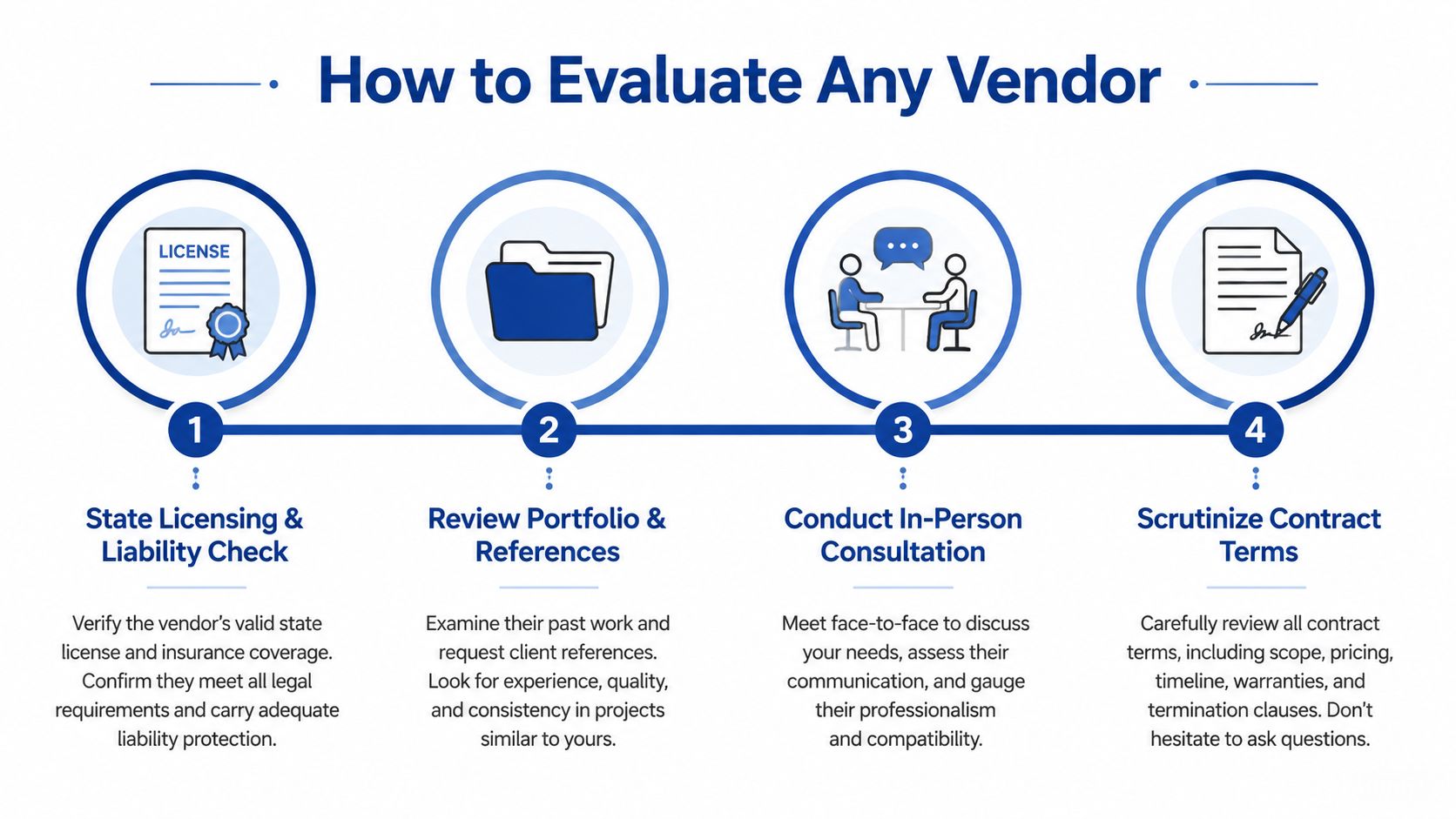
A listed vendor still needs to earn your booking. Start with documentation, then examine the work, interview the team, and read the contract line by line.
Start with compliance
Ask the venue or vendor for proof of current general liability insurance. For a Texas wedding, confirm whether alcohol service requires TABC certification and whether the venue must be named as an additional insured. Don't accept “we've worked there before” as a substitute for documentation.
You should also clarify who carries responsibility for assistants, subcontractors, delivery crews, bartenders, and rental installation teams. A vendor may be well known while the people arriving on your wedding day are contractors you've never met.
Review work and references
A portfolio should show the type of event you're planning, not just the vendor's most polished images. For a photographer, review complete galleries and ask how the team handles difficult light, indoor ceremonies, family formals, and unpredictable weather. For a florist, ask to see examples involving your scale, color palette, floral mechanics, and installation environment.
Use these interview questions:
- Venue experience: How many weddings have you worked at this property, and when was your most recent one?
- Backup planning: What equipment, personnel, or replacement materials are available if something fails?
- Communication: Who will be your point of contact before the wedding and on the event day?
- Cancellation terms: What happens if the vendor cancels, becomes unavailable, or cannot perform?
- References: Can you provide recent clients whose events resembled ours?
Scrutinize the agreement
Your contract should state the exact arrival time, setup responsibilities, departure time, overtime rate, payment schedule, cancellation terms, force-majeure language, and replacement obligations. Ask whether vendor meals are required, who pays for them, and when the crew needs access to the property.
For Central Texas events, delivery contingencies deserve special attention. Confirm what happens if rain, heat, wind, or an access problem delays flowers, rentals, transportation, or entertainment. If guests need group transportation between hotels, venues, and after-party locations, compare practical BusAustin fleet options alongside the vendor's own transportation plan, then confirm pickup timing and responsibility in writing.
Book according to the work, not the badge
Top-tier Central Texas photographers and florists often fill calendars 12 to 14 months out, so couples with a specific team in mind should inquire early. That timeline is practical guidance, not a guarantee, and availability changes by season, date, service category, and vendor workload.
A preferred listing narrows the starting pool. It doesn't replace references, insurance verification, a consultation, or a signed agreement. Disqualify any vendor who refuses references, won't provide written terms, or can't show current proof of insurance, regardless of how prominently the venue recommends them.
Flexible Vendor Policies as a Smarter Alternative
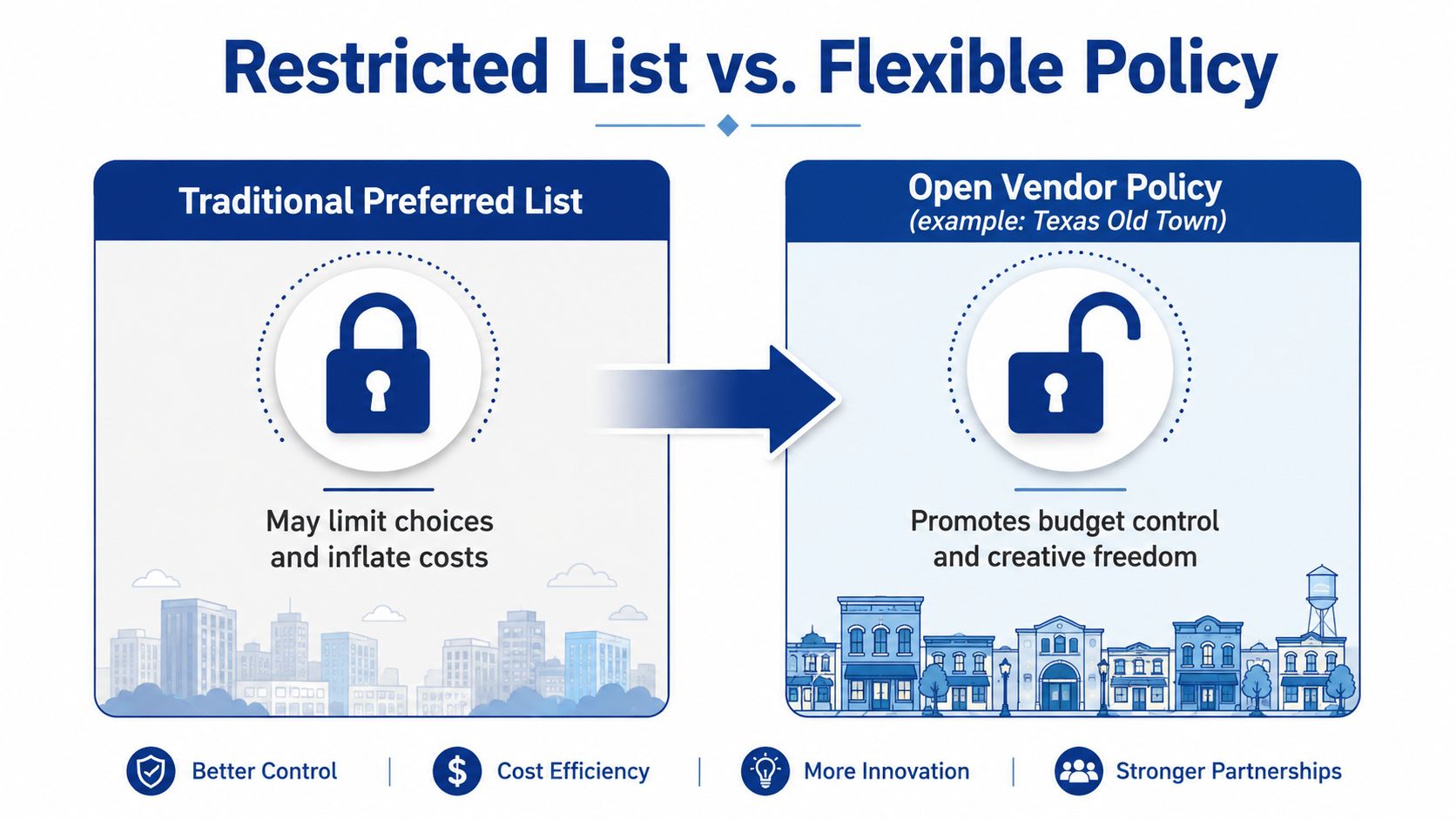
A flexible vendor policy gives couples more control over fit and price. Instead of treating a preferred roster as the only credible path, an open venue can maintain recommendations while allowing couples to hire qualified outside professionals.
That distinction matters for specialized weddings. You may need a bilingual officiant, a caterer experienced with dietary restrictions, a cultural food team, a particular live band, a content creator, or a Hill Country vendor who understands outdoor production. A rigid list can make those choices difficult. An open policy lets the couple start with the venue's recommendations, then look beyond them when the event requires something more specific.
Amenities can reduce vendor dependence
Venue amenities also affect the economics. If the property includes ceremony structures, tables, chairs, a climate-controlled reception hall, sound equipment, dressing areas, a prep kitchen, parking, an on-site manager, and cleanup support, the couple may need fewer outside rentals or coordination services.
Texas Old Town provides an example of this flexible approach, with multiple halls and indoor and outdoor event settings, included venue furnishings, on-site management, cleanup and furniture breakdown, and the ability to choose a caterer. Its Western venue in Austin-area planning option illustrates how a venue's physical setup can support different event styles without forcing every creative decision through one vendor roster.
The savings aren't automatic. Couples still need to compare package pricing, staffing, bar requirements, insurance, and vendor-specific charges. But fewer mandatory selections and no outside-vendor penalty can make the comparison more honest because you're evaluating providers on service and price rather than avoiding a restriction.
Use flexibility as negotiating leverage
Planners should show couples the difference between a curated list and a mandatory roster. Ask each venue to provide the full outside-vendor policy, all applicable fees, insurance requirements, and approval procedures before the couple compares packages.
An open policy also gives planners room to build a stronger creative team. When sourcing décor, signage, lighting, guest transportation, or event-day supplies, a planner can use specialized resources such as event planning supplies for 2026 as part of a broader planning process, without assuming the venue's list covers every emerging service.
The smart standard is not “always avoid preferred lists.” It's choose a venue where the list helps you without controlling you.
Central Texas Wedding Planner Checklist and FAQ
Give couples this checklist during the first venue consultation. It catches the expensive surprises before deposits become difficult to recover.
Printable planning checklist
Initial list review
- Get the policy in writing: Ask whether the list is preferred, approved, or required.
- Request the fee schedule: Confirm outside-vendor charges, bartender rules, rental requirements, and review fees.
- Ask about selection: Find out how vendors are evaluated, added, removed, and reviewed.
Vendor outreach
- Compare fit: Contact listed vendors and at least any permitted alternatives that match the couple's priorities.
- Check venue experience: Ask how recently each provider worked at the property and which team members will attend.
- Request references: Seek recent clients with a similar guest count, service style, or cultural requirements.
Contract negotiation
- Clarify timing: Put arrival, setup, teardown, delivery, and departure windows in the agreement.
- Price the extras: Confirm overtime, vendor meals, travel, rentals, weather contingencies, and replacement costs.
- Protect the deposit: Read cancellation, rescheduling, substitution, and force-majeure provisions before signing.
Insurance verification
- Request the certificate: Confirm current general liability coverage and whether the venue must be named as an additional insured.
- Check alcohol compliance: Verify TABC requirements for any vendor serving alcohol in Texas.
- Track expiration dates: Keep certificates and approvals in the planning file, then recheck them before the event.
Final confirmation two weeks before
- Confirm load-in: Get the venue coordinator's written approval for arrival routes, parking, access times, and equipment placement.
- Reconfirm the team: Verify names, phone numbers, arrival times, meal arrangements, and backup contacts.
- Review the weather plan: Confirm indoor ceremony options, rain procedures, delivery protection, and timeline changes.
Frequently asked questions
Can a venue require only its vendors?
A venue can make vendor restrictions part of its contract, subject to applicable law and the agreement's wording. Don't rely on a salesperson's verbal assurance. Ask whether the requirement applies to every category, whether exceptions exist, and what happens if a listed vendor is unavailable.
What happens if a preferred vendor cancels?
Your contract should address replacement and refund responsibilities. If it doesn't, ask for written language before paying a deposit. The venue may help identify a substitute, but that doesn't automatically mean the replacement will match the original vendor's style or price.
Are outside-vendor fees negotiable?
Sometimes, but never assume. Ask whether the fee can be waived for vendors who provide insurance, meet load-in rules, or pass the venue's approval process. Compare the total cost, including the outside fee, before deciding that an independent vendor is cheaper.
How should we handle a family friend who wants to cater?
Ask the venue for its catering requirements first. The friend may need commercial licensing, insurance, health compliance, food-service documentation, kitchen rules, and an approved service plan. If the venue won't permit the arrangement, choose a flexible-policy venue rather than building the wedding around an exception the contract doesn't support.
Texas Old Town offers couples a flexible vendor policy, included venue amenities, on-site management, indoor and outdoor ceremony options, and a 16-hour exclusive rental window across its Central Texas property. Review the policy details, compare your vendor options, and visit Texas Old Town to see whether its approach fits the wedding you're planning.