You have the ceremony time locked, hotels booked along the Austin to San Antonio corridor, and a group that still has to get from the walkthrough to the table. The hard part is not the menu. It is the minutes between the last processional and the first plate.
A rehearsal dinner timeline is a time budget, not a pretty sequence on a wedding website. Travel, a late grandparent, a wardrobe change, and a toast that runs long all spend from the same account. If the plan only says "rehearsal, then dinner," the meal starts late and the wedding morning starts tired.
I would build the evening backward from tomorrow's call time, then protect the gaps the way you protect the ceremony start. The blocks below are the ones that hold when the night before has to do two jobs: practice the ceremony, and get people to bed.
Table of Contents
- Rehearsal Dinner Timeline at a Glance
- Countdown from Venue Booking to Final Timeline
- How to Move the Group Between Rehearsal and Dinner
- Keeping the Program on Time and Fixing Slips
- Lock Your Timeline Before the Venue Call
Rehearsal Dinner Timeline at a Glance
Copy this schedule when the evening runs about four and a half hours from the rehearsal start. Martha Stewart's rehearsal dinner etiquette starts with a 30 to 60 minute ceremony run-through, then about 30 minutes for travel, wardrobe changes, and arrival, a 60 to 90 minute meal, and a 10 to 20 minute block for speeches, gifts, and reminders. The clock below adds a welcome and a close so late cars still fit. From dinner through closing, the formal program stays near 2.5 hours, inside a 2.5 to 3 hour target after the rehearsal begins.
| Time | Block | Length | What Happens |
|---|---|---|---|
| 3:30–4:30 p.m. | Ceremony rehearsal | 60 min | Officiant walks every processional, reading, and music cue |
| 4:30–5:00 p.m. | Transition | 30 min | Wardrobe changes, travel, and guest arrival |
| 5:00–5:30 p.m. | Welcome and appetizers | 30 min | Guests mingle and family introductions happen |
| 5:30–7:00 p.m. | Dinner | 90 min | Meal service with no speeches yet |
| 7:00–7:30 p.m. | Toasts and gifts | 30 min | Capped speeches and gift presentation |
| 7:30–8:00 p.m. | Closing details | 30 min | Final wedding-day reminders and departure |
What each block is for
Ceremony rehearsal. The officiant walks every processional, recessional, reading, and music cue. Confirm positions, pacing, and who owns each handoff. One clean pass beats three loose ones.
Transition. The wedding party changes clothes or drives. Dinner-only relatives should already be heading to the hall.
Welcome and appetizers. Families meet without a microphone. Put a welcome drink here, not on top of the plated course.
Dinner. Plates only. If toasts start at the salad, the entrée lands cold and the end time slips.
Toasts and gifts. Thank the wedding party, hand the small gifts, and sit down.
Closing details. Call times, parking, and who has the rings. Then send people home.
Build that clock backward from the wedding-day call time. Keep the night-before format as the default so the couple, wedding party, and immediate family share one evening. If travel, a religious observance, or a packed weekend makes that night impractical, shift the same blocks two days earlier or into a morning slot. Lengthen the transition when hotels sit farther from the hall. Shorten the welcome when the group is small.
Practical rule: Finish dinner early enough that everyone can rest before the ceremony.
Countdown from Venue Booking to Final Timeline
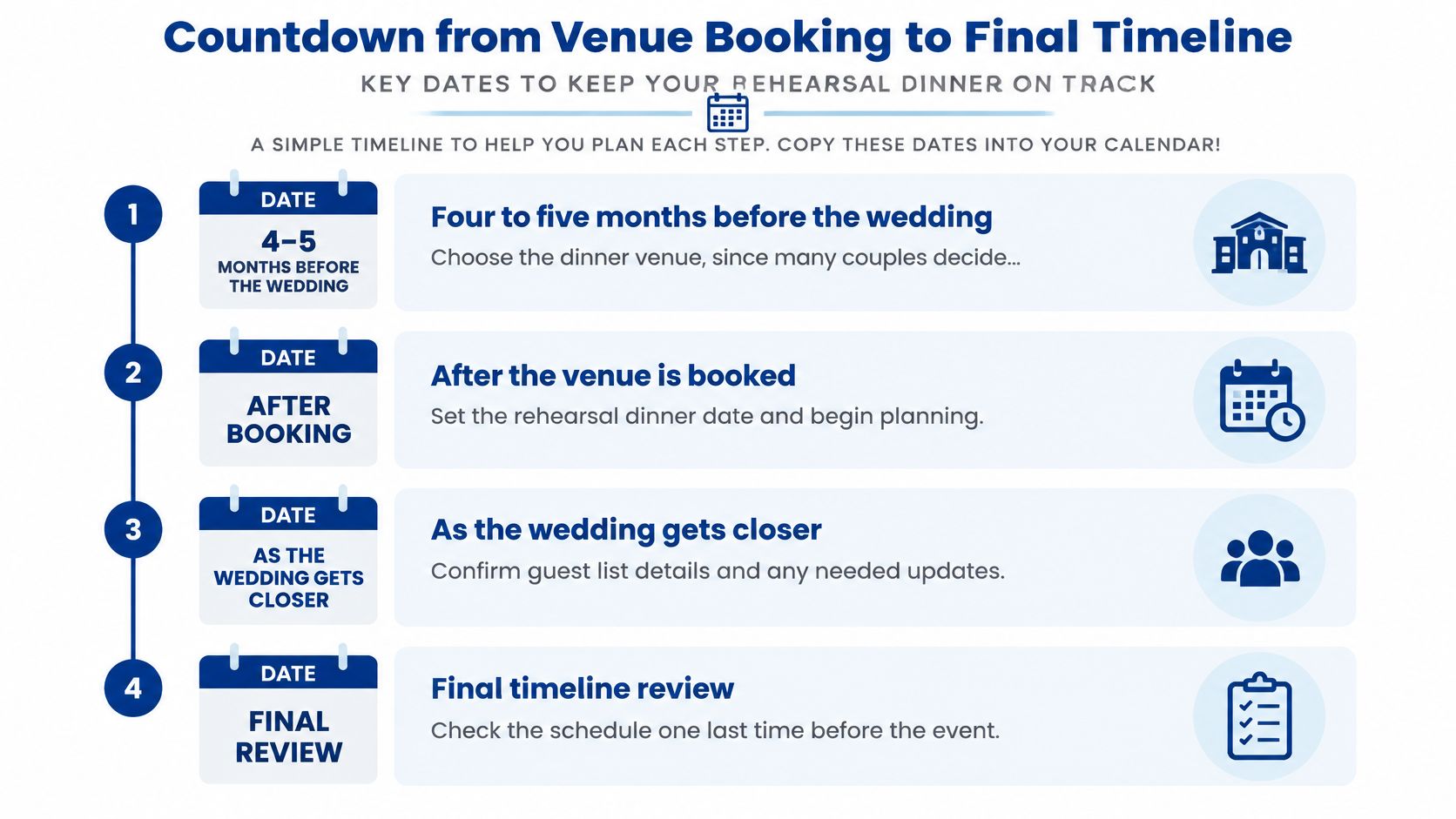
The evening only works if the date, the headcount, and the caterer are settled before anyone argues about speeches. Los Angeles Times planning guidance notes that many couples start choosing the dinner place about four to five months before the wedding, which is enough time for headcount, menu, invitations, transportation, and speeches. The usual guest group is the couple, the wedding party, immediate family, ceremony participants, and often out-of-town guests. Widen that list when travel or family ties make leaving someone out feel wrong.
If you are still sorting who hosts and who pays, read who plans the rehearsal dinner before you book a room in someone else's name.
Copy this countdown into the calendar
- Four to five months out, choose the dinner venue. A long access window lets you separate setup, rehearsal, meal, toasts, and cleanup. The slip is waiting until the good dates are gone.
- Right after that, settle a realistic headcount, menu style, and budget, then book the caterer or restaurant. Booking first and hoping the count shrinks is how you pay for empty seats.
- Send invitations 6 to 8 weeks out, after save-the-dates, and early enough that out-of-town guests can still book travel.
- Close RSVPs 4 to 6 weeks before the event. A cutoff only works if the invitations went out first.
- Confirm the final headcount with the venue or caterer as soon as RSVPs close. A change after the caterer's deadline is the most common slip, because it hits seating, staffing, and food quantities.
- Send the final timeline to every participant one month out. If two versions are floating around, people will follow the old one.
| Task | Target date | Common slip |
|---|---|---|
| Choose dinner venue | 4 to 5 months out | Decision delayed until dates are gone |
| Settle headcount, menu, and budget, then book caterer | After venue is chosen | Booking before the headcount is realistic |
| Send invitations | 6 to 8 weeks out | Out-of-town guests invited too late to book travel |
| Close RSVPs | 4 to 6 weeks out | Late RSVPs with no cutoff |
| Confirm final headcount with venue or caterer | After RSVP close | Changes after the caterer deadline affect seating and food |
| Send final timeline to all participants | One month out | Participants work from an old version |
Put every date in one shared calendar with one named owner. A busy wedding month will drop a task that lives only in someone's head. If you want a simple way to organize event deadlines and dependencies, map each row above to the person who has to act, not to a group chat.
How to Move the Group Between Rehearsal and Dinner
A ceremony rehearsal commonly runs 30 to 60 minutes, then a 2 to 3 hour dinner that often starts around 6 to 7 p.m., and that conventional start is hard on guests coming from different hotels, families with children, older relatives, and a wedding party still getting dressed. The Perfect Wedding etiquette guide also notes that 69% of couples name guests' comfort and enjoyment as a leading planning concern. Comfort here is mostly logistics.
Say a grandparent is leaving a hotel in Austin while the wedding party is still on the ceremony lawn in Kyle. If both groups share one "be there at 5" text, somebody waits in a hot parking lot and somebody else misses the first course.
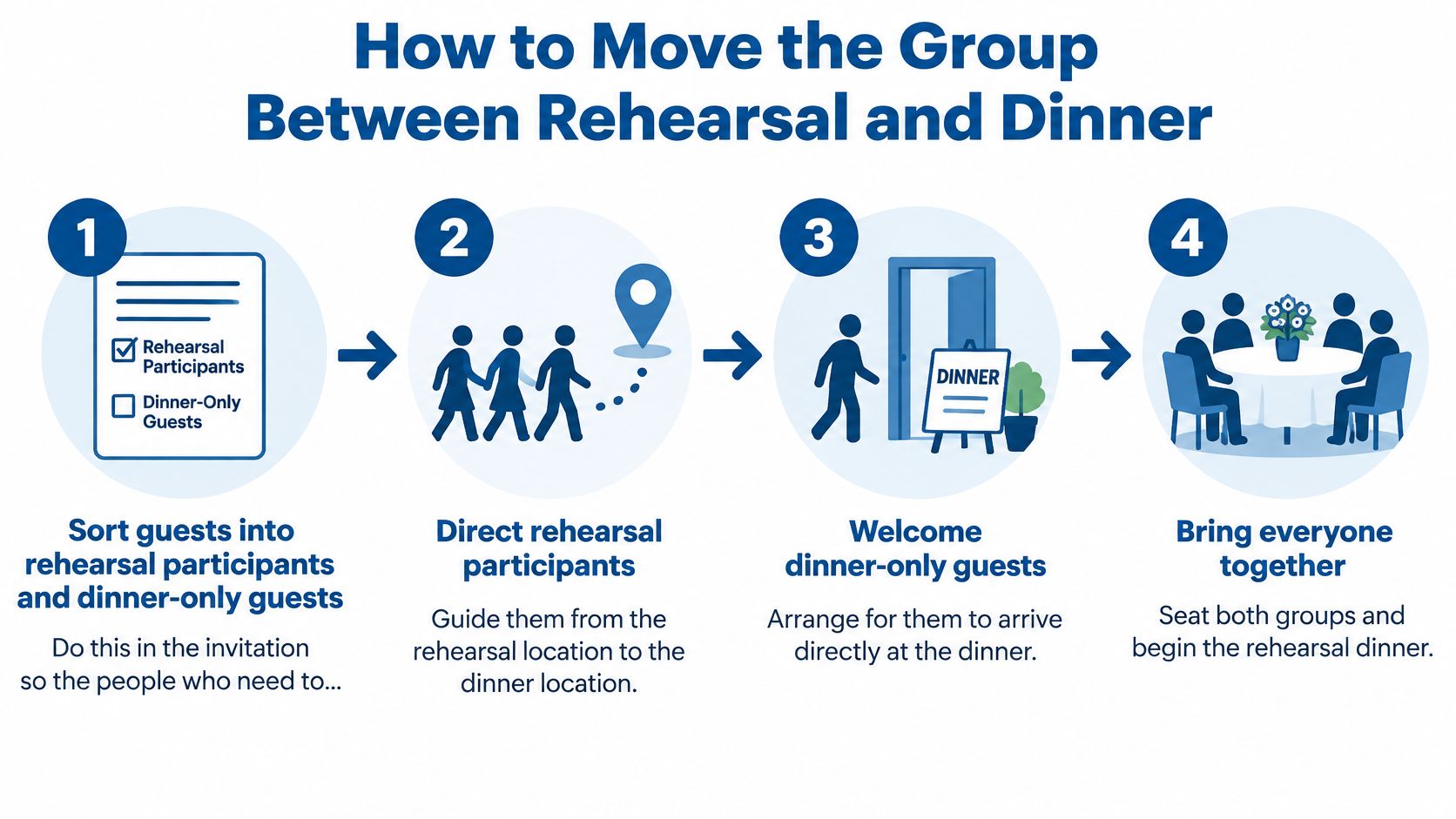
Move them as separate groups
- Sort rehearsal participants from dinner-only guests in the invitation. The people who must walk the aisle should not wait on the people who only need a table. Parents of children in the processional belong with the rehearsal group.
- Set a firm arrival time and a 15 to 30 minute buffer for anyone coming from another hotel. Tell dinner-only guests to arrive at the hall, not at the ceremony site.
- Write the transportation and parking note. Name the lot the hall assigns. If the walk from that lot is long, say where hotel guests can get a ride.
- Lock the meal start and the end time. Older relatives and families with children need to know when they can leave without missing the thanks.
- Name who greets late arrivals. One wedding-party member at the entry, with a seating card, beats a host who abandons the head table.
- Test the drive if traffic backs up on the Austin to San Antonio corridor. If the buffer dies in a slowdown, move the rehearsal earlier. Do not slide the meal.
A shorter, tightly managed dinner usually beats an elaborate meal that ends late. Guests remember being seated on time. They do not remember a fourth course that stole their sleep.
Can a guest leaving another hotel make the rehearsal and sit down on time without rushing? If the answer is no, the timeline is still a wish.
Keeping the Program on Time and Fixing Slips
Overruns share one cause. Meal service, speeches, gifts, introductions, and announcements all want the same finite hour. Peerspace's rehearsal dinner planning notes treat that overload as the main scheduling risk, and the control is a run-of-show with a named owner, hard start times, and a 15 to 20 minute buffer.
Cap the formal program before anyone stands up
Write the toast line the way a stage manager would. 7:00 p.m., best man, toast, three-minute cap, starts on time. Do the same for each speaker. Decide in advance whether remarks sit between courses or only after dinner. Between courses works when you have two short thanks. After dinner works when you have more than that, because plates can clear while people shift chairs.
Give the venue manager and the caterer one synchronized version. Staff need to know when to bring plates, when to clear, and when to pause. Two timelines in two inboxes is how the salad arrives during a speech.
Before you assign the rehearsal start, confirm the weather fallback, the microphone location, the parking-to-hall route, the catering service entry, beverage setup, and a clear path for older guests. On a Central Texas property with indoor and outdoor ceremony space, heat and a fast storm are scheduling problems, not surprises. For day-of handoffs once the wedding itself starts, day-of event coordination is the same habit: one owner, one clock.
Treat 10 p.m. as the latest finish when the ceremony is the next day. Aim to end formalities by about 9:30 p.m. so rides and hallway conversations do not eat the sleep you saved.
Fix the slip in front of you
| Symptom | Likely cause | Fix |
|---|---|---|
| Rehearsal runs past 60 minutes | Walkthrough turned into a full practice | Run each processional once, then move to cues and transitions |
| Dinner starts late | Toasts or introductions were not capped | Set a hard start time and move toasts after dinner |
| Guests arrive after the rehearsal starts | No arrival buffer or parking instructions | Add a 15 to 30 minute buffer and send a map with parking |
| Headcount changes after the final count | Late RSVPs and no caterer cutoff | Set a final count 4 to 6 weeks out and agree on a cutoff for late additions |
| Outdoor rehearsal hit by heat or rain | No fallback space | Reserve an indoor hall or confirm a covered backup area in writing |
| Wedding party reaches dinner late | Last-minute dressing and prep | Stagger dressing times and assign a timekeeper |
Guests notice a late dinner more than a shorter rehearsal. When the walkthrough runs over, cut it back to cues and hold the meal start. Do not "make up the time" by shrinking the transition. That is the block that absorbs a wrong turn and a stuck zipper.
A hard start with a shorter speech list beats a flexible evening that ends at midnight.
Lock Your Timeline Before the Venue Call
A dinner start time that works on paper can still fail once you add travel, parking, and late arrivals. Set the full time budget before calling the venue, then confirm that its access window covers each block.
Put five details in writing: the call time, rehearsal end time, dinner start and end, caterer's service entry time, and final headcount. Keep setup, travel, the meal, and cleanup distinct so a delay in one block does not consume the time reserved for guests.
Run this list, then send it
- Date and call time, matched to the wedding-morning report time.
- Guest split, with separate counts for rehearsal participants and dinner-only guests.
- Transport and parking plan, including the venue's designated lot.
- Run-of-show owner, with authority to shorten the toast list.
- Weather backup, confirmed in writing rather than left as a verbal possibility.
Send the final timeline to everyone involved a month before the event. Confirm the venue is available before promising the date to family. Each Texas Old Town venue rental includes 16 hours, from 8 a.m. to midnight. The venue also offers a $750 rehearsal-dinner option that allows early decorating if the space remains available 90 days before the event. Check rehearsal dinner venue availability and details before committing to travel or hotel plans.
Leave the venue call with the access window, meal start, and weather backup confirmed in the same email. Those details protect the transition time; a late car should not push setup into dinner or cut into the time guests have to eat.
Texas Old Town is in Kyle, between Austin and San Antonio, with indoor halls and outdoor ceremony spaces on one Hill Country property. Keeping the walkthrough and dinner at one site avoids a second drive, though guests still need clear arrival and parking instructions. Visit Texas Old Town to ask which hall is available for the rehearsal dinner date.