You're probably juggling a venue search, a guest list, and a calendar that's already filling up faster than you expected. That's normal in Austin. This market rewards people who move early, stay organized, and make decisions with the full logistics picture in mind, because the city's event economy is big, busy, and used to serious scale, from SXSW 2023's 425,000 attendees and $485 million economic impact to the 2023 Austin City Limits Festival's 350,000 attendees and $345 million impact (Austin events industry statistics).
If you're trying to pull together a wedding, corporate offsite, quinceañera, or milestone party, the pressure usually isn't about one big decision. It's about a dozen small ones that all affect each other, like timing, guest flow, parking, vendor access, and how much control you have once the day starts. For a helpful parallel on managing a fast-moving launch-style event, the effective flash sale event guide is a useful reminder that tight timelines work best when the plan is simple, measurable, and locked down early.
Table of Contents
- Your Austin Event Planning Journey Begins Here
- The Austin Event Planning Timeline From 18 Months to Day-Of
- Building a Realistic Budget for Your Central Texas Event
- Choosing Your Venue and Assembling Your Austin Vendor Team
- Navigating Austin Permits and Planning for Contingencies
- Final Rehearsals and Flawless Day-Of Coordination
Your Austin Event Planning Journey Begins Here
Successful event planning Austin TX work starts with operations. The creative pieces matter, but the primary task is to match guest flow, vendor timing, weather backup plans, and site rules to the way Austin events typically unfold. In a market with busy calendars and high guest movement, the details around access, load-in, parking, and teardown are what protect the experience.
Start with the event's real objective
The cleanest plans begin with a single question, what does success look like for this event? A wedding may prioritize flow, food, and photos. A corporate event may care more about timing, breakout space, and sound. A quinceañera may need a strong ceremony-to-reception transition and room for family traditions to land without feeling rushed.
Practical rule: if you can't explain the event's purpose in one sentence, you're not ready to book vendors yet.
That clarity also helps you make better choices in Austin, where a polished venue can still create problems if it does not fit the headcount, setup schedule, or service style. A room that looks right in a gallery may be tight once catering stations, photo areas, and guest circulation are all in place. The same is true for outdoor space, because shade, wind, and heat can change how long people stay in one area and how smoothly the event moves.
Think like a planner, not a browser
Good planning starts by sizing the event accurately, then building decisions from there. A venue that looks perfect online can fail you if it can't support the guest count, caterer workflow, or parking pattern you need. A solid checklist makes those trade-offs visible before contracts are signed, which saves stress later.
If you want a local benchmark for how structured planning should look, UT Austin's event checklist is a smart model, and Texas Old Town's event planning timeline shows how a venue can turn that logic into a practical sequence for real-world use. Some venues also create breathing room through extended rental windows, which helps spread out setup, vendor arrival, and cleanup instead of forcing everything into a rushed block. That matters in Austin, where a late vendor arrival or a parking delay can ripple through the entire day.
The same planning mindset applies to alcohol service. If your event includes BYOB, the policy has to be handled with care, because guest safety, staff supervision, and clear check-in procedures all matter. A loose approach creates risk fast, especially when the schedule is already tight.
A good example is an effective flash sale event guide, which shows how tight timing and clean execution shape the result. The setting is different, but the lesson is the same, the plan has to account for pressure points before the day begins.
That mindset keeps an Austin event from feeling improvised. The earlier you define the goal, the easier every later decision becomes.
The Austin Event Planning Timeline From 18 Months to Day-Of
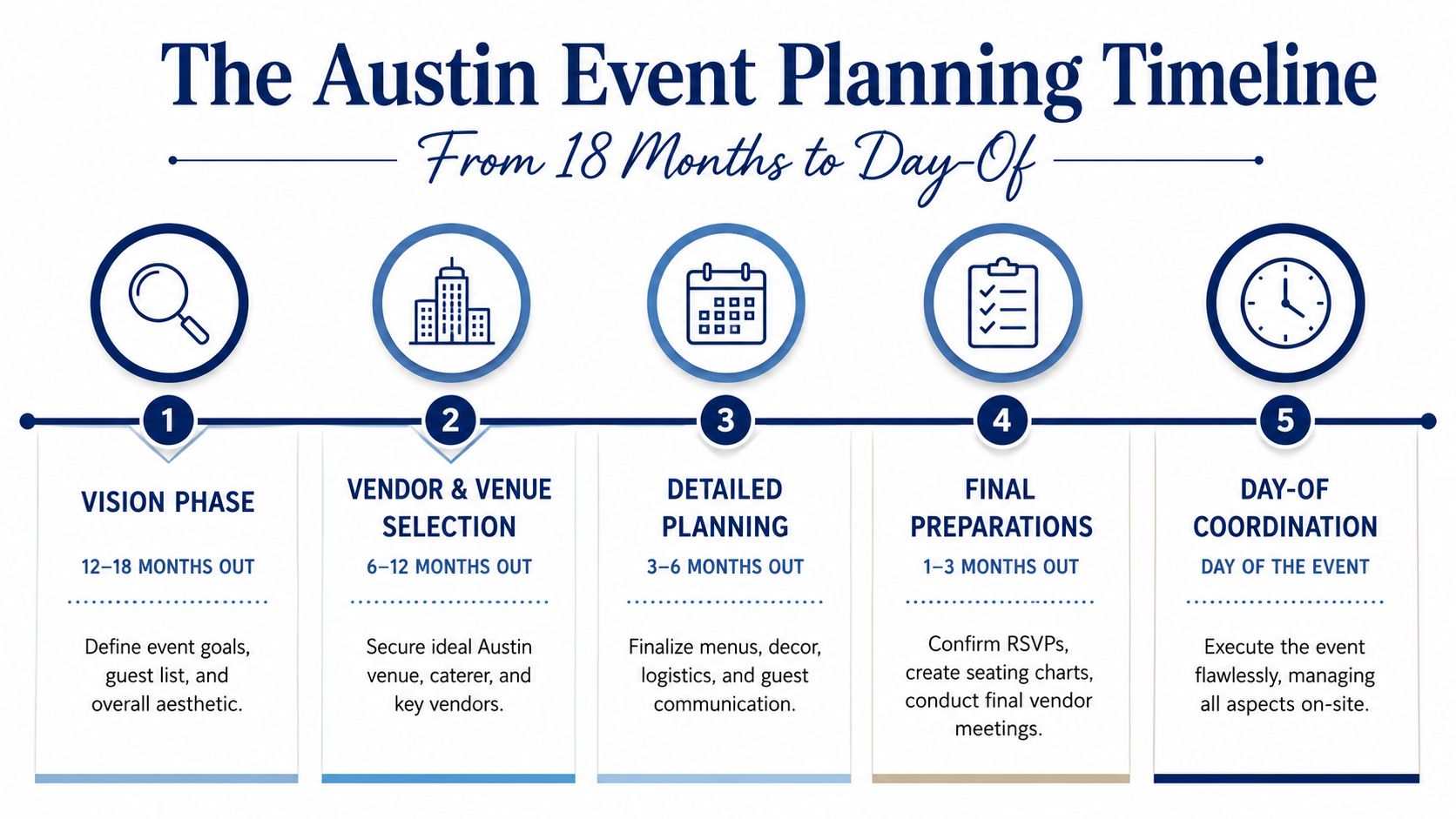
Vision phase, 12 to 18 months out
This is the time to define the event's purpose, guest count, and feel. That sounds basic, but it's the step people skip when they're excited about venues and décor. The result is usually a mismatched space or a budget that doesn't fit the actual event.
UT Austin's planning checklist recommends estimating attendance early so you can reserve an adequate facility and project all expenses before the rest of the planning starts (UT Austin planning checklist). That's not bureaucratic advice, it's the foundation of a workable plan. If the headcount is vague, everything else stays vague too.
Foundation phase, 6 to 9 months out
This is the booking window for the pieces that are hardest to replace. Secure the venue, anchor vendors, and any service providers tied to the event's timing or format. In Austin, delays become costly as popular dates disappear quickly and shortlists shrink fast.
A good planner also checks the vendor policy at this stage. Some events need a fully coordinated package, while others work better with more flexibility. For a wedding preparation reference that emphasizes sequencing, this wedding preparation timeline is a useful comparison point even if the event itself is different.
Details phase, 3 to 6 months out
Menus, layout, transportation, rentals, entertainment, and guest communication all belong here. Here, the event stops being an idea and starts becoming a production. The more complicated the guest experience, the more valuable a clean timeline becomes.
Finalization phase, 30 to 90 days out
This is when the moving parts need to stop moving. Confirm RSVPs, build the seating chart, review arrival windows, and reconfirm what each vendor is bringing. If a venue is offering furniture counts, indoor-outdoor ceremony options, or on-site coordination, use those facts now, not the week of the event.
Execution phase, week-of
The week-of is about confirming what's already been planned. Final walkthroughs, vendor check-ins, and day-of assignments should all be written down. That's the only way to keep the event from turning into a series of verbal assumptions that no one can prove later.
Building a Realistic Budget for Your Central Texas Event
The Austin wedding market was valued at over $5,746,470 in 2025, based on 186 weddings and an average spend of $30,895 per wedding (Wedding Report Austin market data). That doesn't mean every event should cost that amount. It does mean Central Texas celebrations live in a serious spend category, where pricing clarity matters as much as aesthetics.
Build the budget from the venue outward
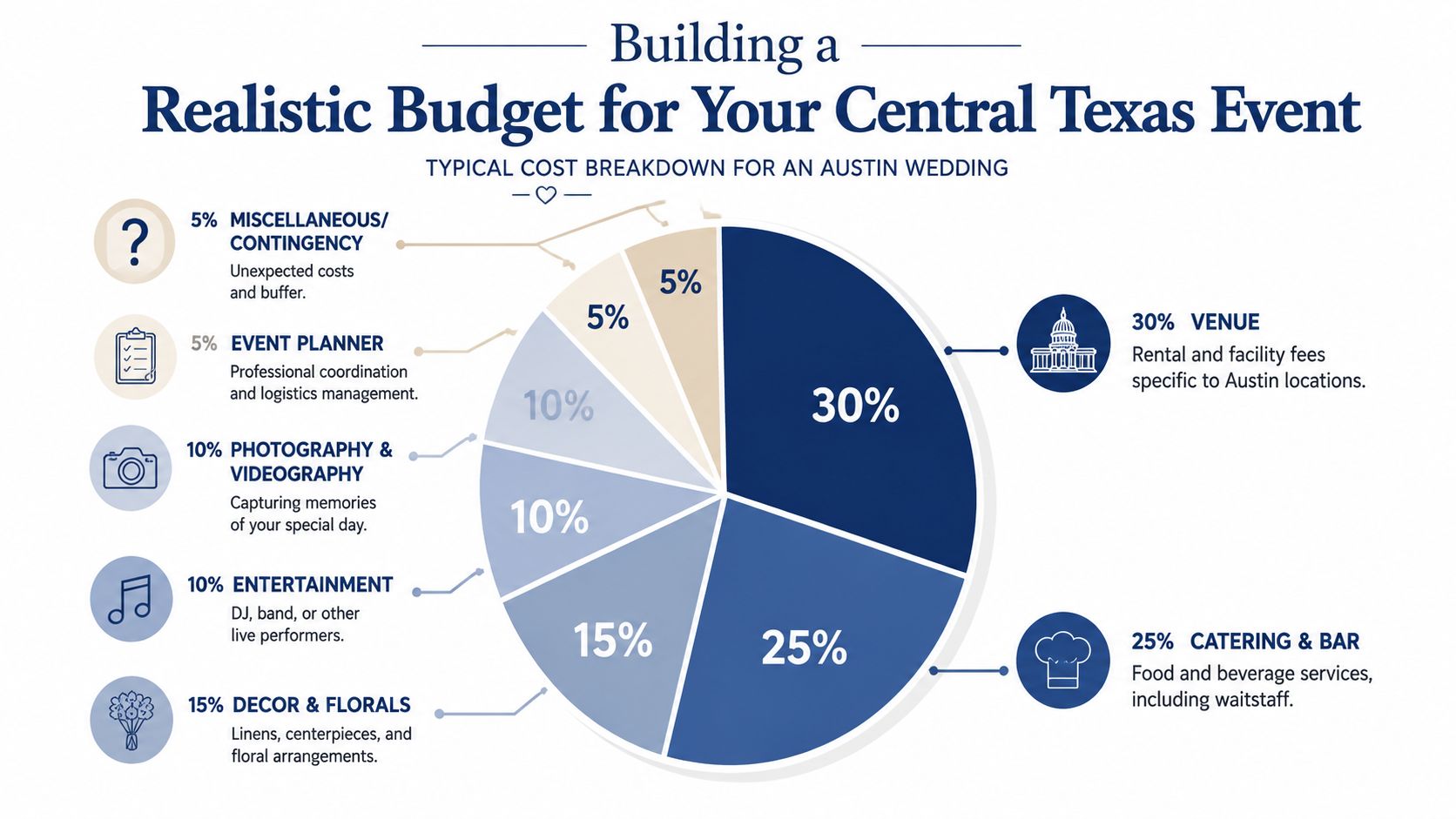
Venue, catering, bar service, décor, entertainment, and photography tend to drive most of the pressure on a wedding or milestone-event budget. In Austin, the smartest approach is to start with the venue and work outward, because the venue determines what else you'll need. If the space already includes tables, chairs, parking, and an indoor backup, you've reduced several line items before the rest of the budget gets built.
A practical budget breakdown for a 150-guest event often needs room for contingency, because local labor and transportation can move faster than casual planners expect. If you want a fill-in-the-numbers framework, Texas Old Town's event planning budget template is a useful planning tool.
| Sample Austin Event Budget Breakdown (150 Guests) | Estimated Cost | Percentage of Budget |
|---|---|---|
| Venue | Varies by venue | 30% |
| Catering & Bar | Varies by menu and service level | 25% |
| Decor & Florals | Varies by design scope | 15% |
| Entertainment | Varies by performer or DJ | 10% |
| Photography & Videography | Varies by package | 10% |
| Event Planner | Varies by coordination scope | 5% |
| Miscellaneous / Contingency | Varies by event complexity | 5% |
Know where flexibility saves money
Flexible vendor policies help when you're comparing quotes. So does a venue that's transparent about what's included, because hidden add-ons make budgets harder to control. One common cost trap is treating alcohol as a simple bring-your-own line item, then forgetting that service, compliance, and staffing still matter.
A BYOB policy isn't a free pass to improvise. It still needs structure, staffing, and clear rules for service.
That's why couples and planners should ask what the bar setup includes, not just whether beverages can be supplied by the host. The same principle applies to quinceañeras and corporate events. If the venue helps reduce furniture, cleanup, or logistics costs, that flexibility can matter more than a lower base rental that comes with more separate charges.
Choosing Your Venue and Assembling Your Austin Vendor Team

The biggest venue mistake is choosing by appearance before checking operations. Beautiful spaces can still create ugly problems if the load-in path is awkward, the ceremony flow is cramped, or the vendor policy forces too many compromises. For event planning Austin TX, the right venue is the one that supports the event's timing and crew, not just the one that photographs well.
What to ask on a venue walkthrough
Capacity comes first, but it shouldn't be the only question. Ask where guests arrive, where vendors load in, where the ceremony transitions to the reception, and whether the venue supports indoor and outdoor options if weather shifts. Ask about tables, chairs, parking, climate control, restrooms, accessibility, and whether setup and teardown are part of the rental window or squeezed into a narrower span.
For a venue like Texas Old Town, the planning advantage is operational, not decorative. Its event center in Austin represents the kind of layout that planners often need when they're trying to keep a full event inside one controlled window. The 16-hour exclusive-use window also reduces schedule compression, which is a real problem in this part of the state (Great Event planner checklist guide).
Build a vendor team that can actually work together
A strong vendor team isn't just a list of talented people. It's a group that can coordinate without stepping on each other's timing. Caterers need access to prep areas. DJs need to know where sound testing happens. Photographers need to understand the lighting and the moment the event will move from formal to social.
For visual coverage, especially corporate functions and branded gatherings, mastering corporate event photography is a useful perspective because it reinforces how much timing and access matter for getting usable images. Photographers don't just capture moments, they need predictable moments to capture.
Watch the contract language
Red flags usually hide in vague phrases. “Access as available,” “standard setup,” and “vendor-friendly” can mean very different things depending on the venue. The clearer the contract, the fewer arguments on the day of the event.
A clean vendor team understands the event's flow before it arrives on site. That means the caterer knows service timing, the DJ knows announcements, and the coordinator knows who owns each transition. Once those roles are clear, the event starts behaving like a process instead of a scramble.
Navigating Austin Permits and Planning for Contingencies
Austin's official guidance makes one point very clear, events in parks, streets, sidewalks, and other public right-of-way areas may require permits, traffic control, and insurance (Austin Event Planning Guide). That's the detail a lot of consumer guides skip, and it's one of the fastest ways for a planning timeline to break. If you're using a public space, assume the city review process is part of the plan until proven otherwise.
Check permissions before you lock the date
A public-space event can look affordable right up until permit timing changes the calendar. That's why location choice should happen after you understand whether the site is usable for your event type. If a planner doesn't verify the permit path early, they may end up rebuilding the event around a venue or date that can't support the original idea.
Private venues reduce that uncertainty because the use case is already defined. That doesn't eliminate planning work, but it does simplify the chain of approvals.
Build a weather and access backup plan
Central Texas weather is reason enough to demand indoor flexibility, covered transitions, or a fast rain plan. Even when the forecast looks cooperative, the event should still have a version that works if guests arrive wet, early, or in a different parking pattern than expected. That means checking where umbrellas go, how guests move between ceremony and reception, and whether the seating can shift without a complete reset.
Parking and accessibility deserve the same level of attention. Guests should be able to arrive without guessing where to go, and people with mobility needs shouldn't be forced into a separate or awkward route. If the venue offers one campus with multiple indoor and outdoor settings, use that to reduce friction instead of treating it as a design afterthought.
Backup plans work best when they're written for real people, not ideal weather.
That also applies to transportation. If ride-share pickup, vendor parking, or guest loading needs coordination, spell it out before event day. The more predictable the arrival pattern, the smoother the first hour feels for everyone.
Final Rehearsals and Flawless Day-Of Coordination
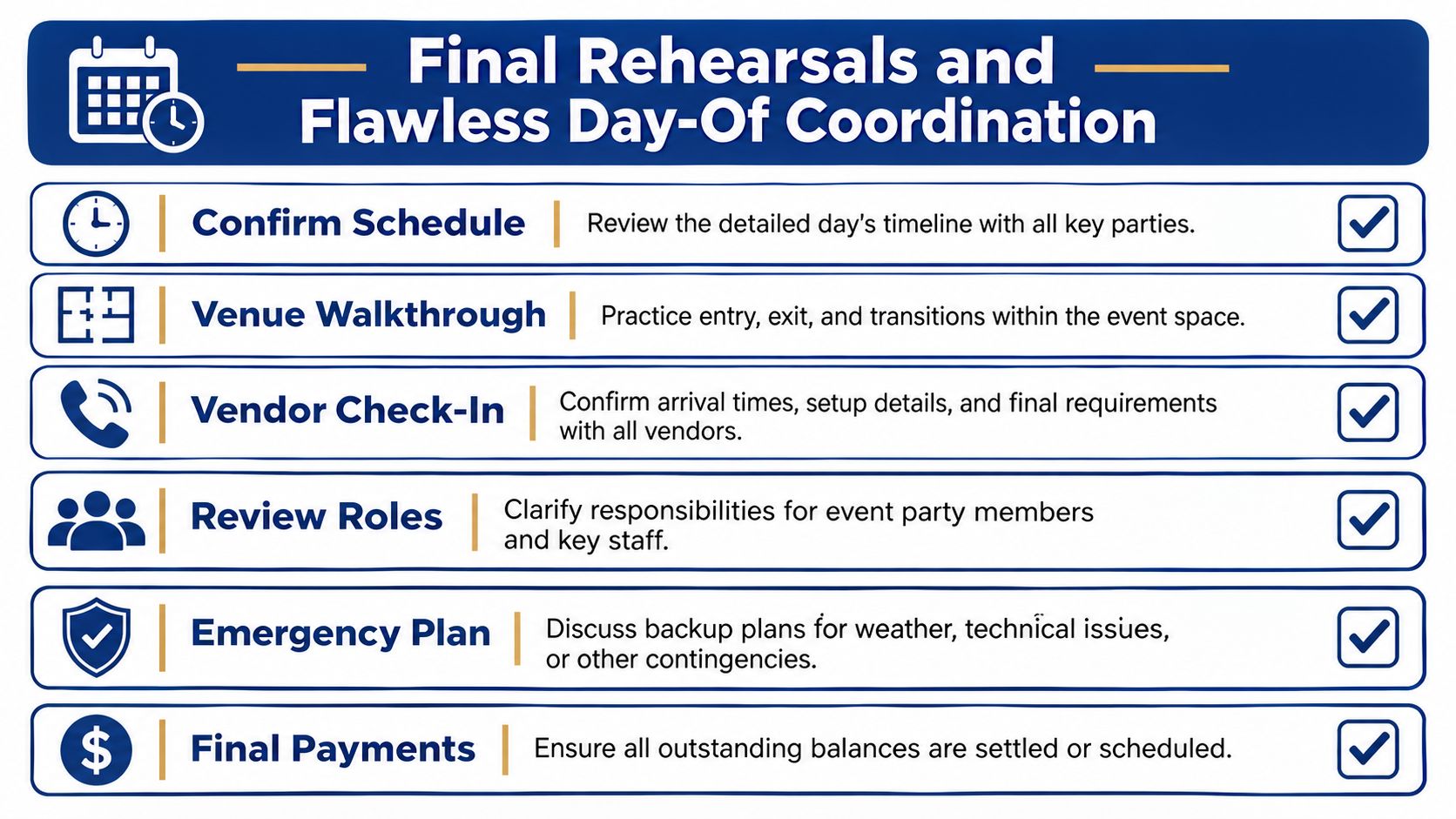
A rehearsal is where the event stops being theoretical. People learn where to stand, when to move, and who speaks first. Vendors get the final confirmation they need, and the coordinator gets a chance to catch the small problems that don't show up in planning software.
What to confirm before guests arrive
Rehearse the processional, the transitions, and the moments when the room changes from one use to another. Confirm who has the emergency contact list, who handles final payments, and who owns the timeline if the event starts slipping. The on-site venue manager and the day-of coordinator should not be guessing about who does what.
The day-of checklist that keeps events calm
- Confirm schedule. Recheck the run-of-show with vendors and key participants so no one is relying on memory.
- Walk the venue. Test the path from arrival through ceremony, reception, and teardown.
- Check vendor arrivals. Make sure setup times, delivery points, and final service needs are confirmed.
- Review roles. Assign family members, staff, or coordinators to specific tasks instead of vague “help out” instructions.
- Prepare for disruptions. Keep the weather plan, power plan, and contact list in one place.
- Close out cleanly. Confirm what needs to be packed, what stays, and who signs off before the final exit.
Protect the last hour before the event starts
The last hour should not be used for problem-solving unless there's no other option. That time is for sound checks, lighting checks, guest-flow checks, and making sure the timeline still matches the room. If the venue includes cleanup and furniture breakdown, the team still needs to know when teardown begins and how vendors should exit.
A well-run event feels easy because the hard choices were made earlier. That's the ultimate benefit of strong planning, the room looks relaxed because the structure underneath it is tight.
If you're planning a wedding, quinceañera, corporate gathering, or milestone celebration near Austin, Texas Old Town gives you four distinct venues, a 16-hour rental window, indoor and outdoor ceremony options, and on-site management that supports the logistics this kind of event needs. Visit the venue, review the layouts, and use those details to build a plan that feels controlled from setup through teardown.