You can tell when a timeline is too abstract. The spreadsheet looks clean, the vendor list is complete, and the calendar has no obvious gaps, but the week of the event still feels crowded. The florist is waiting on final counts, the DJ needs sound check time, the ceremony site needs to flip to reception, and the whole day has to fit inside one rental window that doesn't care how beautiful the plan looked on paper.
That's where most event planning timeline templates fail. They stop at booking and approval, then act surprised when the actual event day needs setup, transitions, weather backup, vendor handoffs, and breakdown all squeezed into the same afternoon and night. A timeline only works when it's built backward from what happens on site, not forward from a checklist.
Table of Contents
- Why Most Event Planning Timelines Fall Apart on Event Day
- The 12-Month and 9-Month Anchor Decisions
- The 6-Month and 3-Month Build Phase
- The 8-Week to 1-Week Final Countdown
- Anatomy of a Real 16-Hour Event Day
- What Actually Causes Timelines to Slip
- Your Final Checklist and Quick Answers
Why Most Event Planning Timelines Fall Apart on Event Day
The breakdown usually starts earlier than event week. Planners often build the timeline as a long to-do list instead of a dependency map, so one late approval pushes the next decision, and the schedule loses its cushion before setup even begins. By the time the event week arrives, there is no room left for a florist who runs behind, a rain plan that has to be activated, or a DJ who needs extra time for sound check.
A strong event planning timeline starts with fixed milestones and review points, not just due dates. Industry guides place the first major planning window at 6 to 12 months before the event for setting goals, locking the venue, and confirming format, followed by 3 to 6 months out for deeper schedule development, registration launch, speaker and vendor coordination, and logistics planning source. That phased structure matters because later tasks depend on earlier decisions. Registration cannot launch until the copy, pricing, and landing page are approved, and the master schedule needs to stay separate from the day-of run sheet so operational details can move without throwing the entire plan off balance.
Practical rule: a task due on Friday often needs a decision by Tuesday.
That is why strong planners set review points early. A due date tells you when something must be finished, but a review point tells you when the decision has to be made so the work can happen on time. For major-market weddings, corporate offsites, and private celebrations, that difference separates a controlled event week from a compressed one.
The field has also become more disciplined about how timelines are used. The timeline is no longer treated as a calendar decoration. It is the coordination system that keeps venue commitments, vendor contracts, and guest communications from colliding at the finish line source. A venue coordinator feels that pressure most on a 16-hour rental day, because every missed handoff shortens setup, squeezes transitions, and eats into breakdown time. If the venue choice is still unsettled, how to choose a wedding venue becomes part of the timeline, not a separate decision.
The 12-Month and 9-Month Anchor Decisions
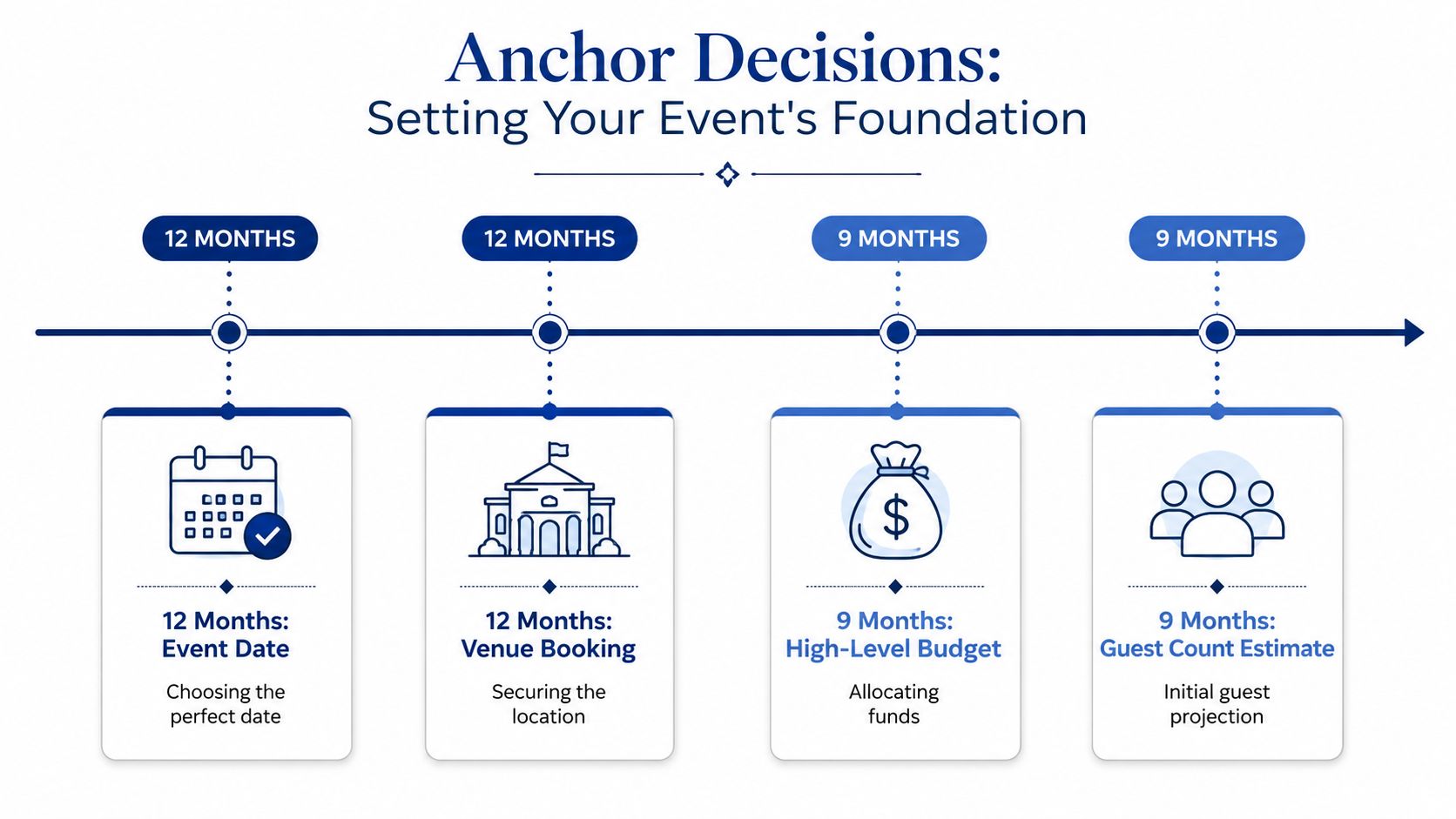
The earliest decisions set the limits for everything that follows. If the date changes late, the venue list changes with it. If the venue changes, the layout, catering access, vendor arrival times, and guest flow can all change too. That is why the date and venue sit at the center of the timeline, not at the edge of it.
Start with what cannot move
Lock the event date first, then secure the venue. Practitioners build the timeline backward from the event date and treat the longest lead-time dependency as the anchor point source. Start with the experience the event needs to support, then choose the space that can handle it. An exclusive rental window, for example, changes how early vendors can arrive, how much setup fits into the morning, and how much time remains for transitions later in the day.
Venue confirmation also sets the budget frame. Venue and catering often take about 40 to 50 percent of the budget, and a 10 to 15 percent contingency fund is recommended to cover schedule slippage and last-minute changes source. That is not a line to leave open until later. It shapes every other decision that follows.
A strong venue decision also keeps the rest of the plan from drifting. If you are still comparing spaces, how to choose a wedding venue can help you test whether the property matches the pace and sequence you need on event day.
Build the one-page anchor sheet
A useful anchor sheet only needs four items:
- Event date: the date you are holding, plus any blackout dates or travel conflicts.
- Venue selection: the site, rental window, and whether the ceremony and reception share the same property.
- High-level budget: the major buckets, including a contingency line.
- Guest count estimate: the realistic range, not the hopeful number.
Once those four decisions are fixed, the rest of the timeline stops floating. Vendor options narrow, design choices become more realistic, and the schedule starts reflecting the actual shape of the day instead of a generic checklist.
At a venue like Texas Old Town, this is the point where the rental window starts to matter as much as the room itself. A 16-hour day has to absorb setup, the ceremony, the reception, and breakdown, so every anchor decision has to respect the time available on site.
The 6-Month and 3-Month Build Phase
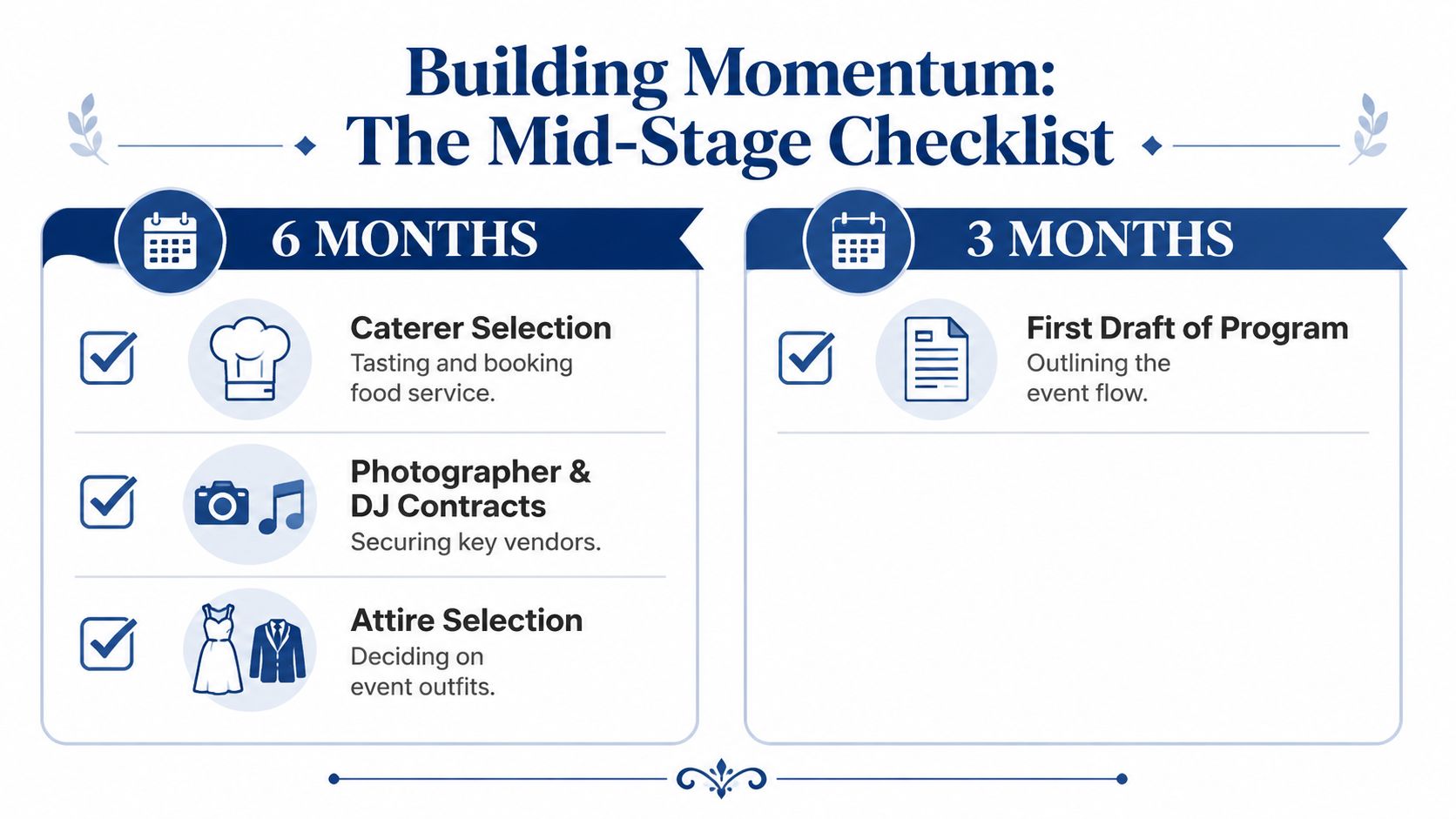
Once the anchors are locked, the timeline becomes operational. Planners stop talking in broad ideas and start making decisions that affect the floor plan, vendor orders, and guest flow. It's also the point where a lot of timelines drift, because the work feels productive even when it isn't fully coordinated.
The 6-month mark is for lock-in
At six months out, the big move is commitment. Venue confirmation should already be done, and the remaining work is about booking the vendors that shape the actual experience. Caterer selection, photographer and DJ or band contracts, attire decisions, and the first draft of the layout all belong here.
This is also the moment to test the systems that will handle invitations, RSVPs, or registration. If a digital form or tracking sheet hasn't been checked by a real person, don't assume it works. Use a short test cycle and confirm that responses land where they should. If you're coordinating a flexible venue like Texas Old Town, this is also the time to verify whether outside caterers are approved and what they need to submit before they can be scheduled.
A timeline gets risky when a planner books the fun pieces before the dependency pieces. The room, the caterer, and the invitation flow have to agree with each other.
The 3-month mark is for coordination
Three months out, the work turns from booking to sequencing. Invitations should be out, RSVPs should be tracking, décor should be confirmed, rehearsal logistics should be defined, and the first draft of the day-of program should exist in writing. This is also the point where the master schedule and the day-of run sheet need to split into separate documents.
That separation matters. The master schedule tracks major milestones across the planning period. The run sheet tracks who is doing what inside the event day, in what order, and where the handoffs happen. When both live in one document, changes become hard to manage. When they're separate, the operational details can shift without undoing the whole timeline.
One more practical move belongs here. Confirm the ceremony-to-reception transition in plain language. Who moves the chairs, who clears the aisle, who cues music, and who gives the signal to open the next space? If nobody owns the flip, it'll get handled late and every vendor downstream will feel the squeeze.
The 8-Week to 1-Week Final Countdown
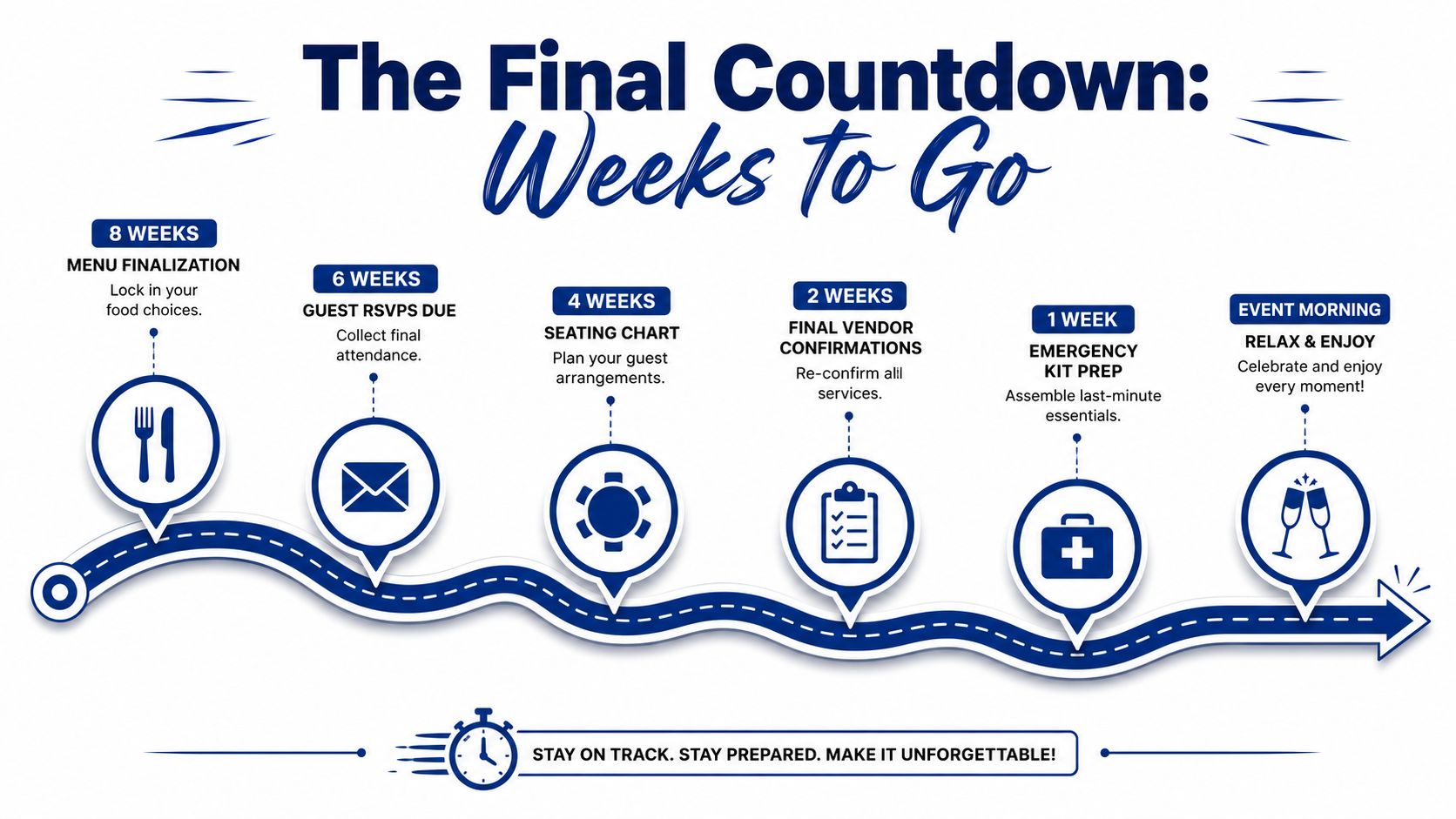
The final stretch is where timelines usually break down, because every decision starts touching the next one right away. At this stage, the work is less about adding ideas and more about cutting uncertainty. You want fewer open questions, fewer approvals still hanging, and fewer vendors waiting on each other.
Work backward from the hard stops
Use the last few weeks as a chain of decisions, not a pile of reminders.
- 8 weeks: finalize the menu and the seating draft.
- 4 weeks: lock the guest count and review the vendor timeline.
- 2 weeks: make final payments and distribute the run sheet.
- 1 week: watch the weather, confirm vendors, and prepare emergency contacts.
That order matters because a Friday deadline often needs a Tuesday decision, especially when vendors need time to adjust staffing or truck schedules. Planners get into trouble when they treat the deadline itself as the important date. The pressure point is the day before it, when there is still time to change the rest of the chain.
A seating draft also needs real-world testing before it feels final. If you have vendor-specific timing, a reception schedule template helps you line up arrivals, meal service, speeches, and cleanup without guessing at the handoffs.
Keep the last week quiet
The last week is for confirmation, not redesign. Final communications are often sent 1 week in advance, and confirmed guest counts may be required at least 3 business days before the event source. That timing exists for a reason. Catering, seating, staffing, and room setup all depend on it.
A rehearsal walk-through should also be on the calendar, along with dressing suite timing and any vendor arrival notes that affect the morning. On a long rental day, a 30-minute buffer between ceremony and reception gives you room for the normal drag that comes from moving people, furniture, and equipment through the same property. The goal is not to make the schedule loose. It is to keep one delay from taking over the evening.
Anatomy of a Real 16-Hour Event Day
A 16-hour rental day gives you something shorter venues don't. It gives you space to breathe, as long as you use it deliberately. At a venue with morning access and midnight breakdown, the whole event can be built as a sequence instead of a sprint.
A sample day on site
Here's what a practical run sheet can look like inside that window:
| Time | Block | Key Tasks |
|---|---|---|
| 8:00 a.m. | Access and unload | Venue opens, vendors arrive, décor and rental teams begin setup |
| 9:00 a.m. | Hair and makeup | Wedding party uses dressing suites, personal items stay off the main floor |
| 10:30 a.m. | Florals and layout | Ceremony pieces, table settings, and signage are placed |
| 11:30 a.m. | Catering prep | Caterer uses prep kitchen and separate service entry |
| 12:30 p.m. | Sound check | PA system, wireless mic, and music cues are tested |
| 1:30 p.m. | Photos and staging | First look photos, portraits, and final room adjustments |
| 3:30 p.m. | Guest arrival | Parking, welcome table, and ceremony seating are active |
| 4:00 p.m. | Ceremony | Processional, vows, recessional |
| 4:30 p.m. | Transition buffer | Chairs move, aisle clears, reception reset begins |
| 5:00 p.m. | Reception opens | Dinner, toasts, dancing, and vendor service flow |
| 11:00 p.m. | Final call and wrap | Guest exits begin, gifts and personal items are secured |
| 12:00 a.m. | Breakdown | Venue clean-up and furniture breakdown complete |
That structure works because each block has a purpose. There's no fake padding, but there is enough room for human movement. If the ceremony runs late, the buffer absorbs some of it. If hair and makeup take longer, the photo block can shift without collapsing the reception.
What the venue team should own
The site team should handle the parts of the day that need venue authority, including access coordination, on-site direction, and the cleanup sequence. In a venue with a prep kitchen, separate service entry, dressing suites, indoor and outdoor ceremony options, and included clean-up, those features matter because they reduce the number of outside pieces the planner has to manage at once. The cleaner the handoff, the better the day flows.
For planners who want a more detailed framework, a reception schedule template is a practical reference for turning the day into a workable sequence. I've seen that kind of structure help both intimate halls and larger dance halls, because the underlying need is the same. People need to know where they belong, when they move, and who has the next cue.
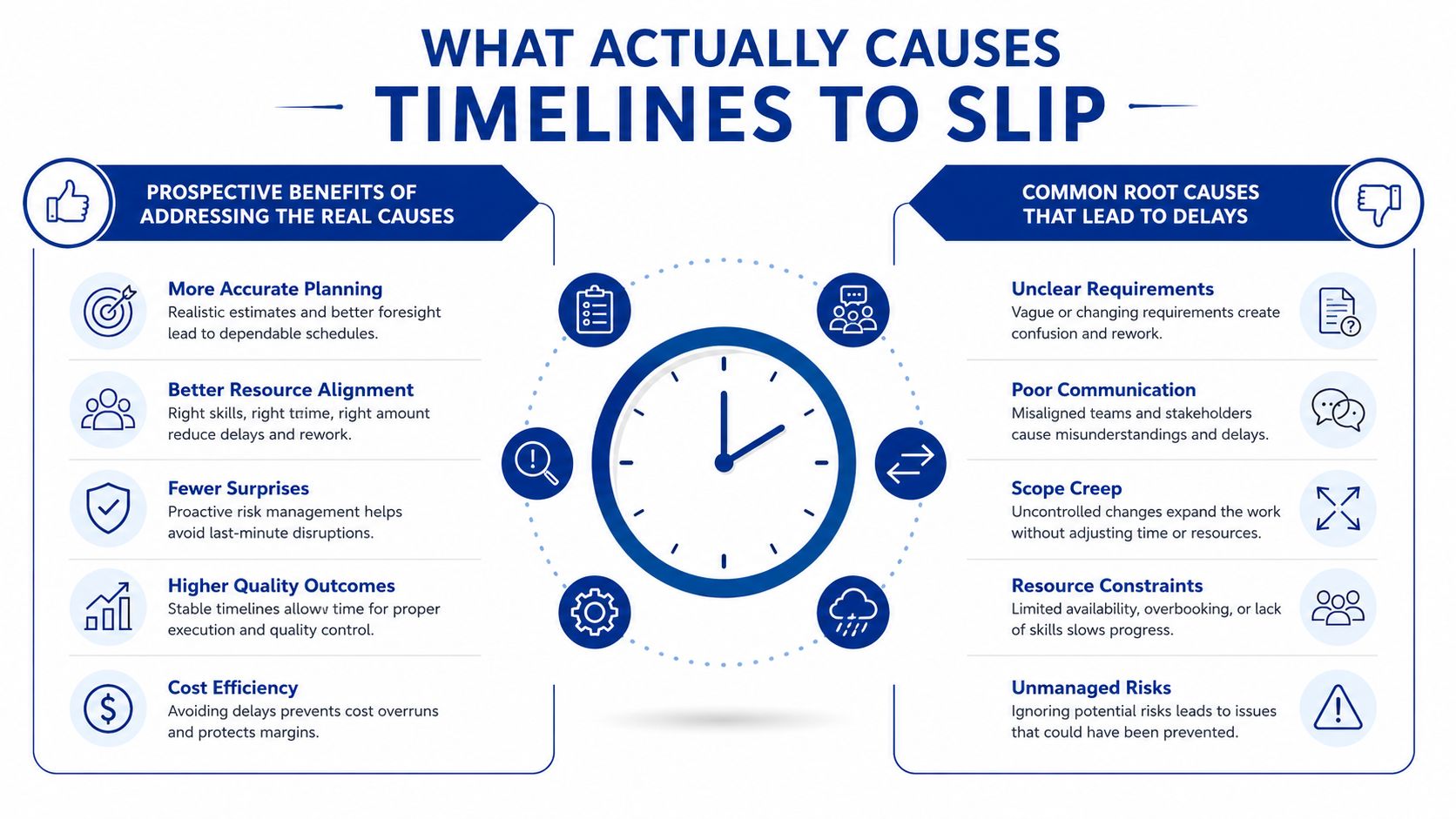
What Actually Causes Timelines to Slip
A timeline usually slips in the week of the event, not at the start of planning. By then, the vendor chain is already set, the rental window is fixed, and small delays have nowhere to hide. That is why the pressure points are predictable.
The usual pressure points
A planner usually runs into the same four problems.
- Vendor dependency chains: One contract waits on another, then the whole sequence slows.
- Decision-versus-due-date gaps: The team misses the review point even though the deadline still looks intact.
- Weather and outdoor risk: A ceremony plan fails because there was no real backup.
- Budget drift: Small upgrades pile up until the timeline and the budget stop matching.
Vendor chains are easiest to control when the earliest dependencies are locked first, then the later pieces are released in order. Decision gaps need review points that land before the due date, because that leaves room to adjust without forcing last-minute approvals. Weather risk changes fast on a Texas property, so the indoor and outdoor ceremony plan has to be settled early, not treated as a backup only after clouds roll in. For that trade-off, should I do an indoor or outdoor wedding in Texas is the question to answer before the layout gets too far along.
Budget drift needs a hard line. Once the venue, catering, and core services take their share, every add-on should be checked against the contingency line before it is approved. The 1021 Events planning template helps teams keep those decisions visible, which matters when the schedule is already tight and the budget starts drifting toward extras that the day cannot absorb.
Your Final Checklist and Quick Answers
The last 30 days are where weak timelines usually show themselves. Guest counts still move, vendors still wait on final arrival times, and the run sheet still needs one clean version that everyone can follow. At a venue day that runs on a fixed rental window, those details matter more than any polished planning spreadsheet.
Keep the list short and practical. Confirm the guest count, lock vendor arrival times, send the run sheet, and tell the venue manager which issues belong to the site team and which belong to the planner. If a request does not change the guest experience or protect the order of the day, leave it off the list.
A useful shortcut is the 1021 Events planning template. It helps you separate anchor decisions, build tasks, and day-of operations so the team can track what is due, instead of treating every task like it has the same weight.
Quick answers
- When should the final guest count be locked? Late enough to reflect real attendance, but early enough to support catering and seating. Many guides place that cutoff at least 3 business days before the event source.
- How early should the run sheet go out? Send it early enough for vendors to review before the event week, then send it again in the final stretch after all confirmations are in. A run sheet that lands too late usually creates more questions than answers.
- What should you ask the venue about weather backup? Ask where the indoor ceremony option is, how fast the flip can happen, and who makes the call. On a property with outdoor space, the backup plan has to be ready before the forecast turns.
- How do you avoid a rushed breakdown? Use the full rental window, keep the last hour for exit and cleanup, and do not stack unnecessary late-night tasks onto the end of the day.
A good event planning timeline leaves less room for avoidable mistakes. It does not promise nothing will change. It gives you enough room to handle the change without losing the sequence.
Texas Old Town is set up for planners who need the day to work in real time, not just on paper. With 16-hour exclusive access, indoor and outdoor ceremony options, on-site management, and clean-up included, it gives you a structure that fits a backward-built timeline. If you are planning a wedding, quinceañera, or corporate event in Central Texas, visit Texas Old Town and compare your plan against a venue built around the full day, not just the ceremony hour.