You've chosen the Hill Country setting, booked the caterer, and planned the ceremony. Then someone asks the question that sounds simple but isn't: “Will the hall be comfortable all day?” In Central Texas, the answer depends on far more than whether the thermostat displays a pleasant number.
A venue has to manage heat, moisture, air movement, and fresh-air supply as guests move from setup to ceremony, dinner, speeches, and dancing. The right indoor climate control plan starts early, because a room that feels fine at breakfast can feel warm, damp, or stuffy after hours of activity.
Table of Contents
- Why Indoor Climate Control Matters at Your Event
- The Four Pillars of Indoor Climate Control
- How Central Texas Seasons Shape Venue Comfort
- HVAC Features Worth Asking Any Venue About
- Comparing Climate-Ready Venues Side by Side
- Common Misconceptions About Venue Cooling
- A Venue Tour Checklist for Indoor Comfort
Why Indoor Climate Control Matters at Your Event
At an event venue in Kyle, the day may begin with a quiet bridal suite, a lightly occupied reception hall, and doors opening to a cool morning. Later, vendors bring in food, lighting, décor, and sound equipment. Guests arrive from an outdoor ceremony or parking area, doors open repeatedly, and the room fills with people who are seated, eating, moving, and dancing at different times.
That changing pattern is why indoor climate control isn't just a thermostat setting. It combines temperature, humidity, airflow, and ventilation. The U.S. General Services Administration identifies HVAC as an average of 39% of a facility's energy use, which makes the system important not only for comfort but also for operating efficiency and building management. The GSA's HVAC guidance explains why these systems are among a facility's largest opportunities for controlling energy waste.
Comfort starts before guests arrive
A venue manager shouldn't wait until the ceremony begins to discover that the main hall has a hot corner near the windows or a draft beside an entrance. The team should review the event timeline, expected occupancy, outdoor conditions, catering schedule, and high-activity periods before guests arrive.
That preparation also supports indoor air quality. Ventilation, filtration, moisture control, and sensible occupancy planning all contribute to a more comfortable room, so planners can use this practical resource on improving indoor air quality when discussing broader building conditions with a venue or contractor.
The transition between an outdoor ceremony and an indoor reception deserves special attention. A couple may feel comfortable beneath open skies, then enter a hall carrying heat, humidity, or cool evening air on clothing and skin. The reception room needs time to recover, especially when doors remain open for photographs, late arrivals, catering service, or guests moving between spaces.
For planners comparing ceremony and reception layouts, an indoor and outdoor event space offers a useful way to think about that transition. Ask how the venue manages both settings, not just whether the reception hall has air conditioning.
Practical rule: A comfortable event is planned as a continuous day, not switched on at ceremony time.
The Four Pillars of Indoor Climate Control
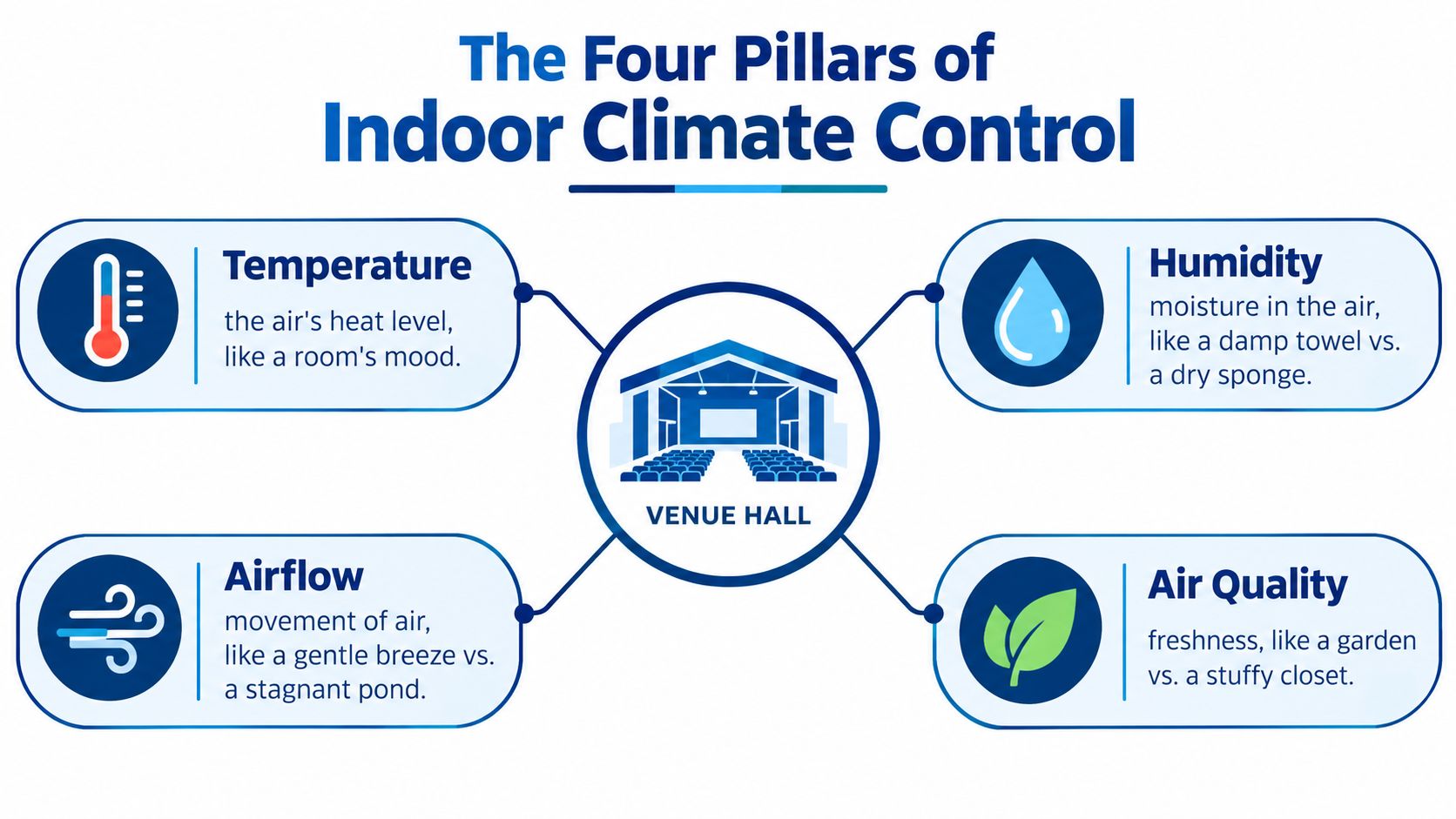
A hall can have a reasonable thermostat reading and still feel unpleasant. Guests experience a combination of environmental conditions, so it helps to think of indoor climate control as a four-legged table. If one leg is weak, the whole experience becomes unstable.
Temperature is only the starting point
Temperature describes the heat level of the air. It is the number many notice first, but it doesn't tell you whether guests near a sunny window feel warmer than guests in the center of the room. Radiant heat from glass, walls, lighting, and equipment can change how a space feels even when the air temperature appears steady.
Humidity is the amount of moisture in the air relative to its capacity to hold moisture. Think of the difference between a damp towel and a dry sponge. In warm, humid Central Texas conditions, a room can feel sticky even when the thermostat looks comfortable. EPA guidance explains that high relative humidity can encourage mold and mildew, while ASHRAE-related guidance uses below 60% relative humidity as a useful upper-control target for limiting mold growth. EPA's HVAC and indoor-air-quality guidance provides useful context for this relationship.
Airflow is the movement of air through the room. Gentle circulation can prevent stagnant pockets, but a strong stream aimed at a dinner table or ceremony aisle creates a draft. Fans, supply diffusers, return-air locations, ceiling height, and furniture arrangement all affect this experience.
Ventilation and air quality concern freshness and dilution. Fresh outdoor air helps manage pollutants and occupant-generated carbon dioxide, but outdoor air also brings heat and moisture into a Texas building. The system must introduce enough air for the occupied space while conditioning it properly.
Comfort isn't one number. It's the interaction of heat, moisture, movement, and freshness.
How Central Texas Seasons Shape Venue Comfort
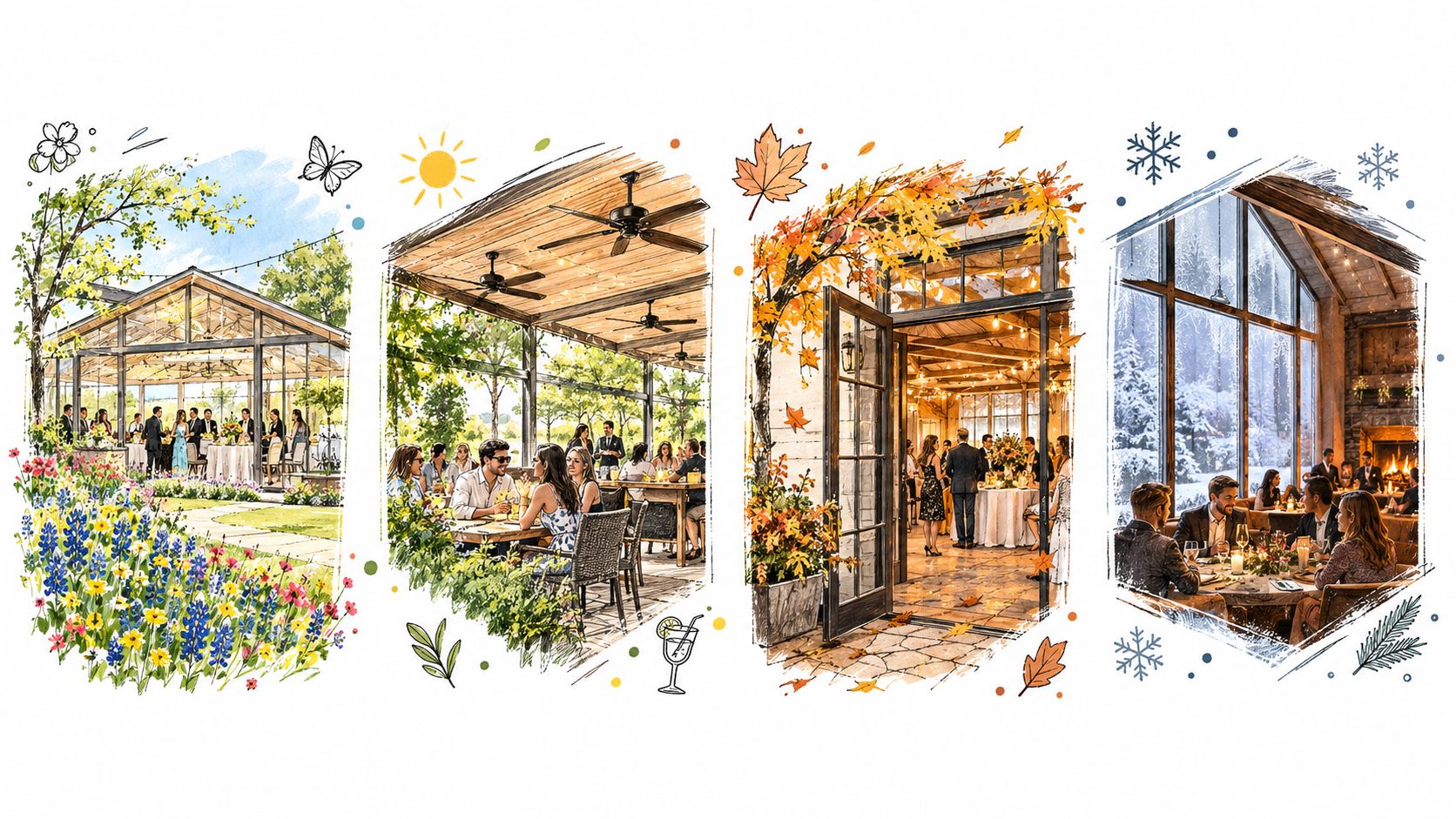
Central Texas gives venue operators four different comfort problems across the year. A spring ceremony may begin pleasantly and turn warm by afternoon. A summer reception can challenge dehumidification as guests arrive from the heat. A mild fall evening may need little intervention early, while a winter cold snap can make guests near doors or windows feel chilly even when the center of the hall is comfortable.
A 16-hour event day shows why scheduling matters. During morning setup, the hall may need gradual pre-conditioning while vendors move in and doors open. Before an outdoor ceremony, the reception space may remain lightly occupied. During dinner, people sit close together and catering activity adds heat and moisture. Dancing creates a different load again, because active guests generate more heat and may perceive the room as warmer than they did while seated.
Match the plan to the season
- Spring: Monitor outdoor temperature, pollen, and door-opening patterns. An outdoor ceremony can make the indoor transition feel warmer than expected later in the day.
- Summer: Prioritize moisture removal as well as cooling. A system that reaches its temperature target too quickly may not run long enough to dehumidify effectively.
- Fall: Avoid assuming that mild weather eliminates planning. Afternoon sun, evening temperature changes, and changing guest activity can still create uneven conditions.
- Winter: Check entrances, windows, and seating near exterior walls. Older guests and lightly active guests may notice drafts before dancers do.
Portable equipment can help with localized comfort during setup or outdoor-adjacent activities, provided it doesn't obstruct paths or blow directly across dining tables. Planners can see MODERN LYFE battery fans for an example of the type of flexible equipment people sometimes consider for temporary airflow support.
A venue's summer procedures should also answer practical questions about ceremony timing, shaded waiting areas, indoor backup space, and guest movement. These summer wedding tips for beating the Texas heat can help couples build those decisions into the schedule rather than treating heat as a last-minute problem.
HVAC Features Worth Asking Any Venue About
A venue tour should include more than a glance at the décor. Ask the coordinator to translate the HVAC system into event-day decisions. You don't need to understand every mechanical component, but you do need to know what the system can adjust, what it can monitor, and who will respond when conditions change.
Questions for the venue tour
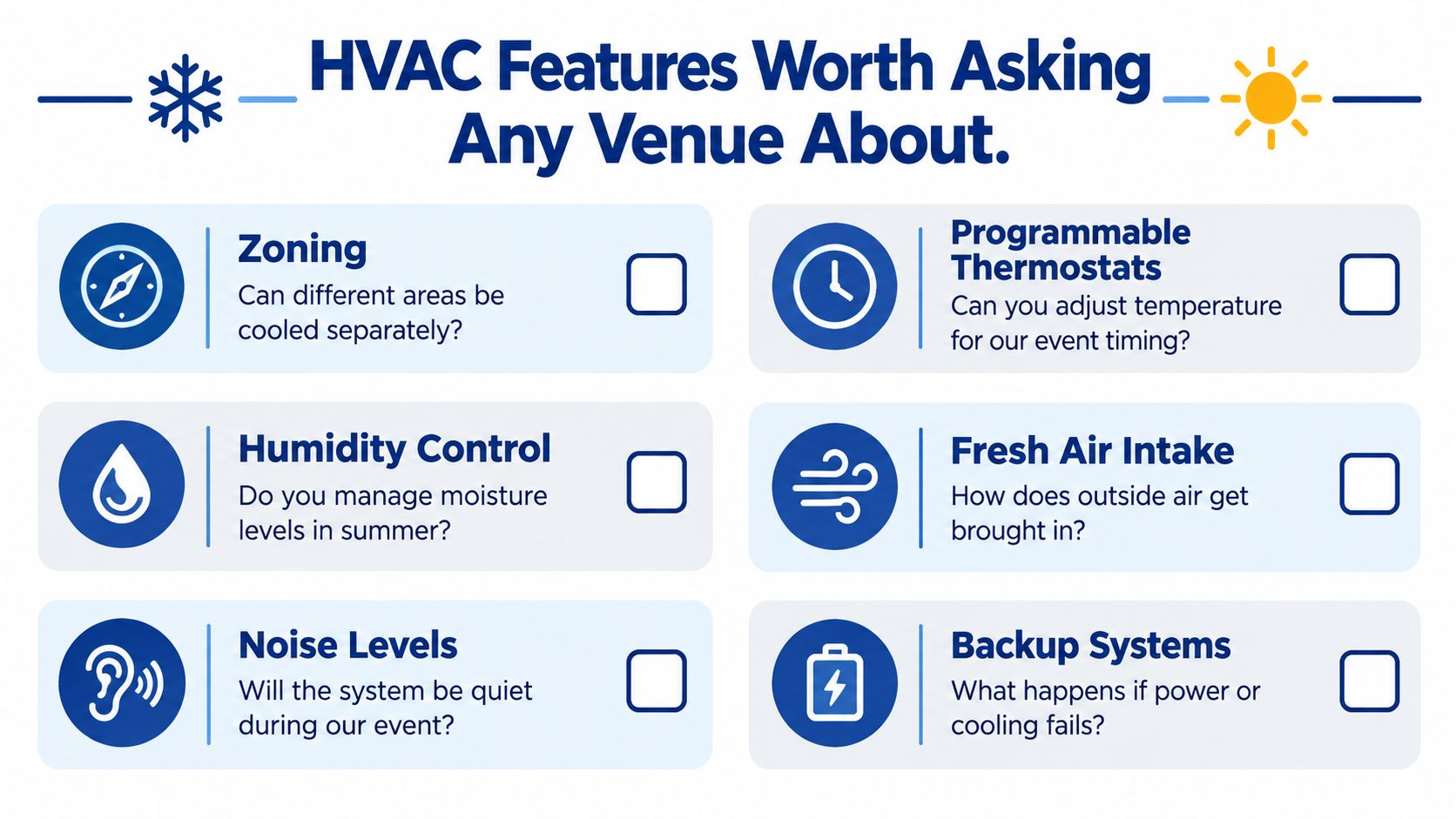
Can different areas be cooled separately? Zoning matters when a bridal suite, dining area, dance floor, and entrance experience different loads. Separate zones can reduce the need to make one area too cold to compensate for another.
Can the team adjust the schedule? Ask whether the system can start conditioning before vendors arrive, respond to the ceremony-to-reception transition, and continue operating through breakdown. Programmable controls are useful only when staff understand how to use them.
How is summer humidity managed? Ask whether the venue monitors relative humidity, maintains condensate drainage, and can handle the moisture created by open doors, catering, and high occupancy. Temperature alone won't answer that question.
Where does outdoor air enter? The ASHRAE 62.1 Ventilation Rate Procedure calculates breathing-zone outdoor airflow with (V_{bz}=R_pP_z+R_aA_z). The people component rises with occupancy, while the area component accounts for building-related pollutants. For example, a design assumption of 5 cfm per person for 300 occupants produces 1,500 cfm for the people component alone, before area requirements and other system factors are added. ASHRAE's Standard 62.1 information explains the standard's application to occupied enclosed spaces.
Will the system be quiet? Ask whether supply diffusers, rooftop equipment, fans, or emergency adjustments could interfere with vows, speeches, live music, or recorded audio. A comfortable room shouldn't require guests to compete with mechanical noise.
What happens if equipment or power fails? A responsible answer includes the response process, escalation contact, backup procedures, and the person managing the room during the event. On-site oversight can matter as much as the equipment itself.
For a facility manager evaluating larger properties, commercial cooling services offer a useful reference point for the maintenance and response expectations associated with commercial HVAC. Couples should still ask the venue who performs routine maintenance and who makes event-day adjustments.
Comparing Climate-Ready Venues Side by Side
A venue comparison should connect design choices to the sensations guests notice. Capacity alone doesn't tell you whether a hall will feel balanced. Look at occupancy, room size, indoor and outdoor options, schedule flexibility, and the staff available to manage the conditions.
The following comparison uses the published characteristics of four Texas Old Town halls as a planning example. It isn't a ranking. A smaller hall may suit an intimate celebration, while a larger hall may offer the right layout for a high-energy reception.
| Hall | Published capacity | Climate-planning implication | Useful comfort question |
|---|---|---|---|
| Redbud | Up to 150 guests | Intimate scale may support a more focused room plan, depending on layout and event activity | Where are the warmest and coolest seating areas? |
| Sage | Up to 300 guests | A larger guest count makes occupancy, ventilation, and door management more important | How does the system respond as the room fills? |
| Stone | Up to 300 guests | Upscale finishes and a full reception layout still need an activity-based comfort plan | Can staff adjust conditions for dinner and dancing separately? |
| Tejas | Up to 320 guests | The largest listed capacity calls for clear peak-occupancy and airflow planning | What happens during a full dance floor and frequent entrance traffic? |
The capacities above come from Texas Old Town's published venue information. They should be treated as planning limits, not as proof that every arrangement will feel identical. Seating orientation, dance-floor size, stage equipment, catering stations, windows, doors, and guest distribution can all change the room's behavior.
Compare the whole operating model
Ask whether the venue offers an indoor backup for the ceremony, how vendors access the building, and whether the rental schedule leaves time for conditioning before guests arrive. A compressed setup can force staff to work around an already occupied room, while longer access gives the team more opportunity to prepare.
Also compare operational support. An on-site manager can track doors, coordinate vendors, respond to guest feedback, and contact maintenance personnel if conditions shift. A venue with flexible catering and clear service access may reduce unnecessary door traffic, which helps the mechanical system maintain the planned conditions.
The right choice depends on the event. A 150-person milestone gathering may benefit from the scale of Redbud. A large wedding with active dancing may need the capacity and circulation of Tejas. The climate question is not “Which hall has the strongest air conditioning?” It is “Which hall, schedule, layout, and management plan fit the way our guests will use the space?”
Common Misconceptions About Venue Cooling
Cooling problems often start with a reasonable assumption. A couple feels warm during a tour, asks for a lower setting, and expects the entire room to improve. In practice, comfort depends on more than the thermostat, particularly when humidity, radiant heat, air speed, and occupancy change together.
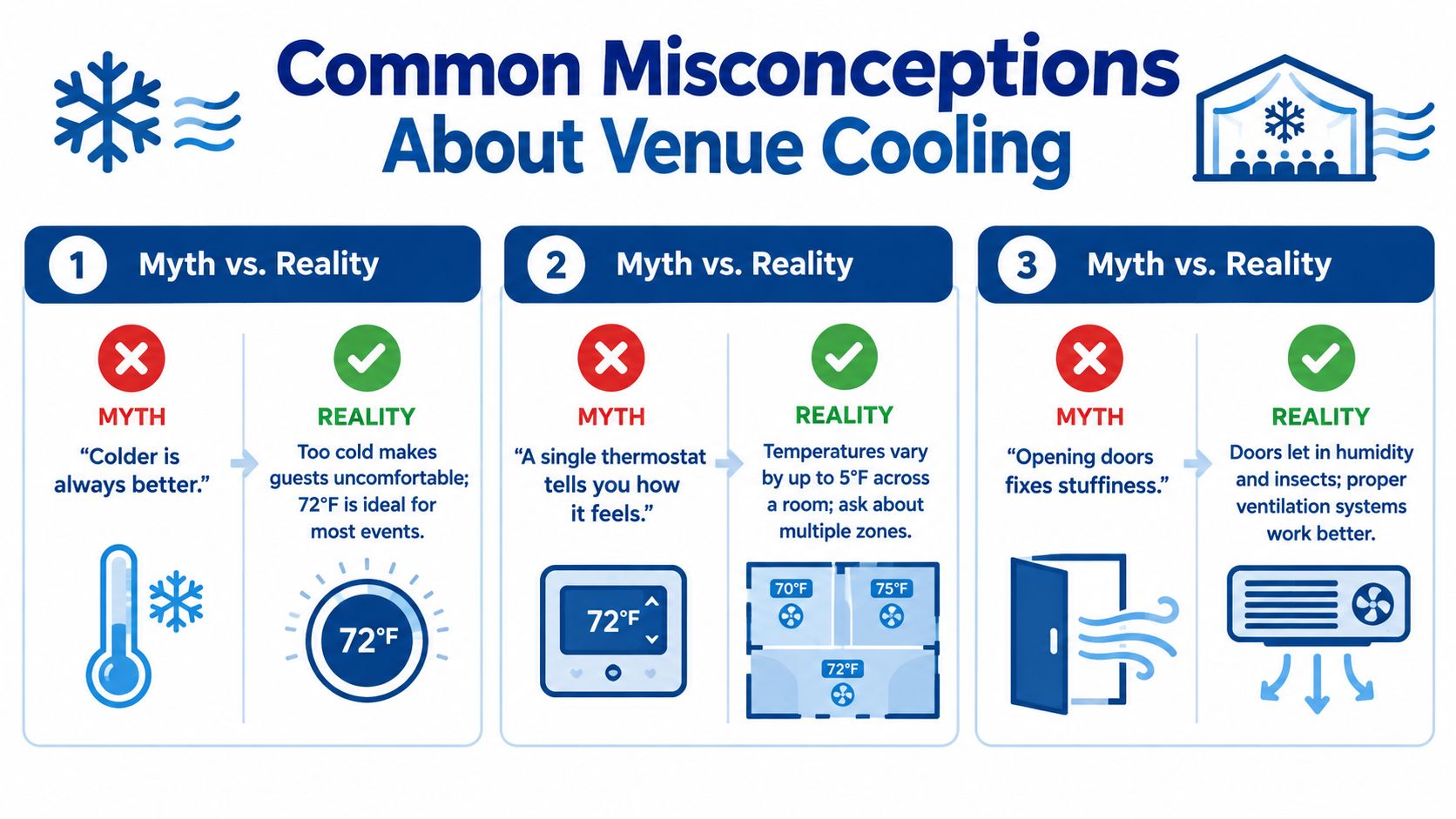
Myth one, colder is always better
A colder setpoint may make one part of the room feel better while creating drafts elsewhere. Lightly active guests, older relatives, and people seated near supply diffusers may become uncomfortable even as dancers appreciate the lower temperature. Aggressive cooling also consumes energy without necessarily solving humidity, radiant heat, or uneven airflow.
ASHRAE Standard 55-2023 treats thermal comfort as an interaction between environmental and personal factors. Its commonly referenced comfort conditions may fall around 67 to 82°F, but the acceptable range depends on season, humidity, clothing, and activity. The ANSI listing for ASHRAE Standard 55-2023 provides the relevant standard context.
Myth two, one thermostat tells the whole story
A thermostat measures conditions at its sensor location. It doesn't automatically reveal how the room feels near windows, doors, corners, the stage, or a crowded dance floor. Ask whether the venue uses multiple zones or sensors, and whether staff can check conditions in the areas guests will occupy.
A room can also feel damp despite a comfortable dry-bulb temperature. EPA guidance links high relative humidity with mold and mildew risk, while ASHRAE-related guidance identifies humidity management as part of healthy occupied-space control. The practical question is whether the venue tracks moisture, not just whether it can lower the temperature.
Myth three, opening doors fixes stuffiness
Opening a door may provide a temporary feeling of movement, but it can also bring in outdoor heat, moisture, dust, insects, and noise. It doesn't replace a ventilation strategy designed for occupied spaces.
ASHRAE 62.1 accounts for both the number of people and the area of the occupied zone. Demand-controlled ventilation and carbon-dioxide sensors can help a system respond to changing occupancy, but the venue must coordinate outdoor-air supply with heating, cooling, and dehumidification. More outdoor air isn't automatically better if the system cannot condition that air effectively.
The better question is not “Can you make it colder?” Ask, “How will you keep temperature, humidity, airflow, and fresh air balanced during our busiest periods?”
A Venue Tour Checklist for Indoor Comfort
Bring this checklist to a venue tour and ask for specific answers. A coordinator who can explain the operating plan clearly gives you more useful information than a tour that focuses only on finishes and furniture.
- Temperature zones: Ask where the sensors and thermostats are located, and whether the hall has areas that can be adjusted independently.
- Humidity management: Ask how the venue monitors moisture during humid weather, open-door periods, catering, and crowded dancing.
- Ventilation approach: Ask how outdoor air enters the building and how the system responds when occupancy rises.
- Event schedule: Confirm when conditioning begins, how the system handles setup, and whether it remains available through breakdown.
- Activity changes: Discuss the difference between a seated ceremony, dinner service, speeches, and dancing.
- Outdoor transition: Ask how guests move between outdoor ceremony areas and the indoor reception without leaving the hall overheated or damp.
- Door strategy: Identify which doors vendors and guests will use, and how staff limit unnecessary openings.
- Localized comfort: Stand near windows, entrances, corners, and supply diffusers during the tour. Ask which areas typically feel different.
- Noise control: Listen during quiet moments and ask how HVAC sound affects vows, speeches, and music.
- Event-day responsibility: Confirm who monitors conditions, who can adjust controls, and who handles a mechanical problem.
- Backup planning: Ask what happens if cooling, heating, or power becomes unavailable.
- Venue fit: Match the hall's capacity and layout to your guest count, furniture plan, dance floor, catering stations, and equipment.
A scheduled wedding venue tour is the right time to test these questions in person. Don't just stand in the middle of an empty hall. Walk through the entrance, sit near the windows, inspect the ceremony backup space, and ask how the room will operate at the busiest point of your day.
For Central Texas events, Texas Old Town offers four indoor halls, Redbud, Sage, Stone, and Tejas, alongside outdoor ceremony settings and on-site event management. Couples can ask how the selected hall, event timeline, and indoor backup plan work together before choosing a layout.
Visit Texas Old Town to tour its indoor halls and outdoor ceremony settings in Kyle, then discuss how your 16-hour event schedule, guest movement, and reception plans will be managed for year-round comfort. Bring the checklist, walk through the spaces, and ask the venue team to show you how the room will perform from setup through the last dance.