Guests are seated, the lights soften, and the DJ waits for the signal. Then the first notes begin, the doors open, and every person in the room sees the quinceañera for the first time in her gown. That entrance immediately tells guests whether the celebration will feel elegant, energetic, intimate, dramatic, or completely personal.
The strongest quinceañera grand entrance ideas balance spectacle with practical details. The route must be comfortable, photographers need clear sightlines, the music cue has to be reliable, and the venue must support the staging, lighting, movement, and weather plan. At Texas Old Town, that may mean using an indoor hall, an outdoor garden path, or a transition between the two.
The eight concepts below organize the decision around what the entrance is designed to accomplish, from an architectural reveal and coordinated court choreography to family emotion, technology, and themed self-expression.
Table of Contents
- 1. Classic Staircase or Ramp Entrance With Spotlight
- 2. Choreographed Dance Entrance With Court
- 3. Outdoor Garden or Scenic Path Entrance
- 4. Surprise or Reveal Entrance Behind a Curtain or Doors
- 5. Processional Entrance With Escorted Court Presentations
- 6. Modern Interactive or Tech-Enhanced Entrance
- 7. Father-Daughter Entrance as a Special Escort Moment
- 8. Themed or Costume Entrance for Self-Expression
- 8-Point Comparison: Quinceañera Grand Entrance Ideas
- Choose the Entrance That Fits Her Story
1. Classic Staircase or Ramp Entrance With Spotlight
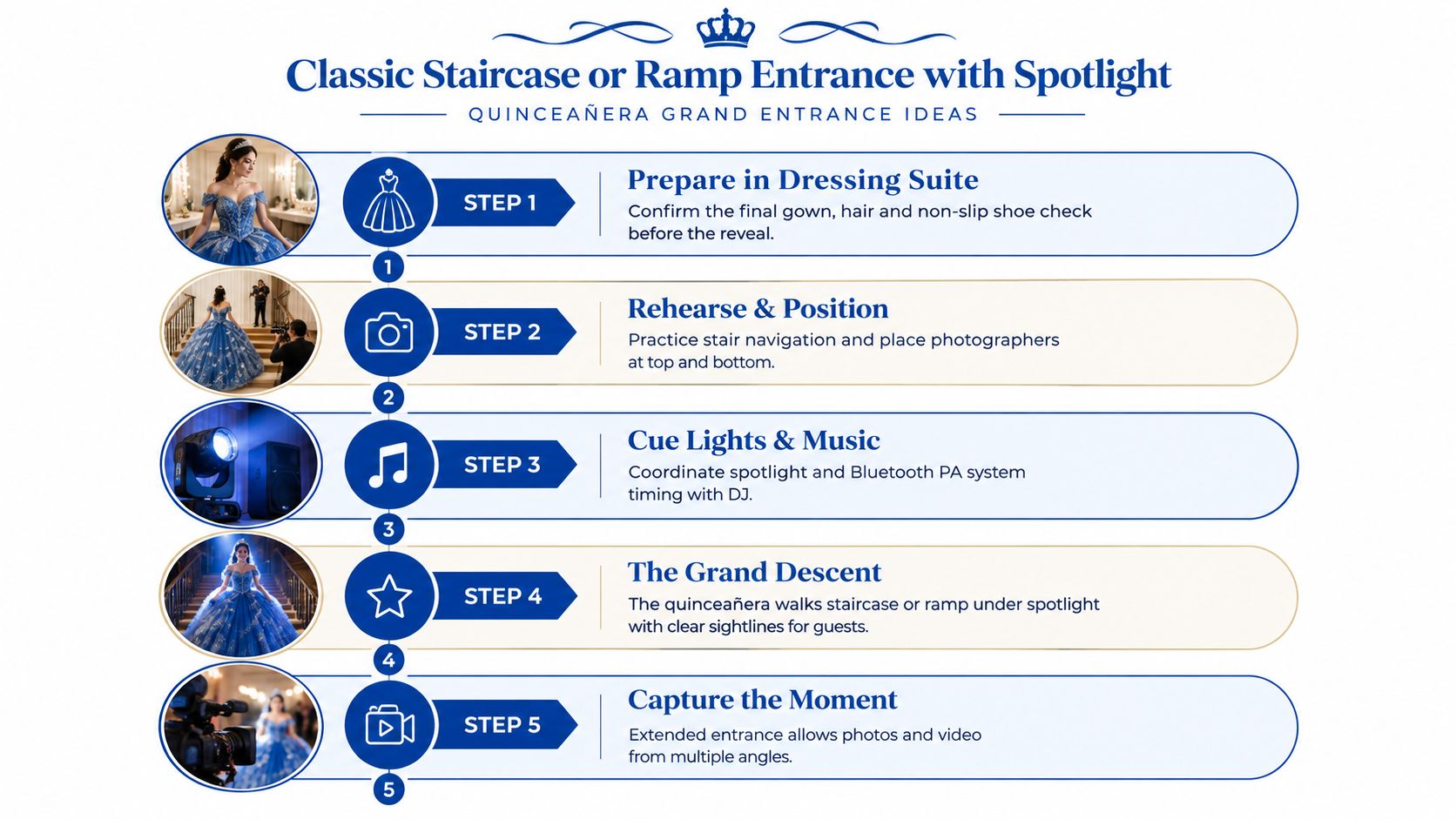
A staircase entrance gives the quinceañera time to be seen. She descends slowly while a spotlight follows her gown, or she walks up a ramp toward a raised focal point as the music builds. Unlike a quick doorway reveal, this format gives guests an extended view of her dress, posture, expression, and accessories.
The architectural setting does much of the visual work. Texas Old Town's Sage, Stone, and Tejas halls can support a formal concept built around a defined approach, dramatic lighting, and a clear background. Families comparing layouts can use the Texas Old Town venue floor plans to discuss the route, guest seating, photographer positions, and any space required for the court.
Make the route comfortable
A beautiful staircase can become a liability if the gown catches, the shoes slip, or the quinceañera can't see the steps. Rehearse the walk several times during Texas Old Town's 16-hour rental window, first in comfortable clothing and later in the actual shoes and gown or a similar rehearsal skirt. A ramp may be the better choice for mobility, balance, or a full skirt with a long train.
Coordinate the DJ or music coordinator with the lighting technician. Texas Old Town's Bluetooth-compatible PA system can handle the music connection, but the team still needs a clear cue sequence for the opening track, spotlight, pause, applause, and final position.
Practical rule: The entrance should be paced for her comfort, not for the effect. A steady, confident walk photographs better than a rushed descent.
Place one photographer at the top and another at the bottom when possible. The dressing suites, with private restrooms and vanity areas, also give the quinceañera a controlled place for final hair, makeup, and gown adjustments before the reveal. Choose a meaningful family-selected song, especially if the entrance will flow directly into a father-daughter dance or another formal moment.
2. Choreographed Dance Entrance With Court
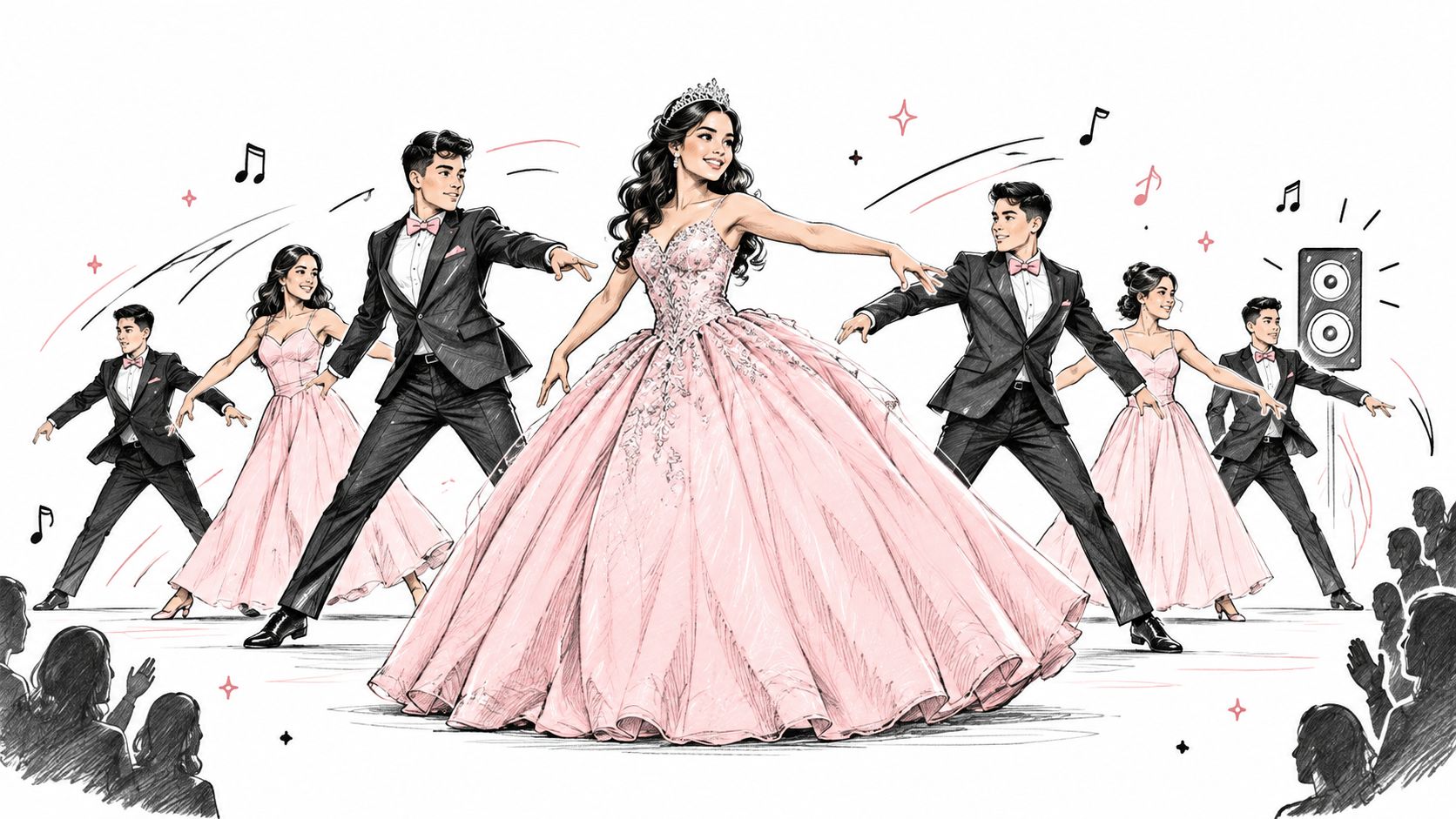
A court entrance turns the first appearance into a shared performance. Damas and chambelanes may enter in pairs, create moving formations, and then bring the quinceañera into the center for a final flourish. The result feels more energetic than a solo walk and gives friends an active role in the celebration.
The traditional court of honor can be adapted to the family's preferred size and style. A modern Austin-area celebration might combine a formal waltz with cumbia, salsa, reggaeton, or contemporary choreography. A court can also begin with a polished processional before shifting into a surprise dance, but the transition must be simple enough for every participant to remember.
Build choreography around reliability
Hire a professional choreographer early enough for participants to learn the sequence without turning the preparation into a source of stress. The music should have a steady beat and clearly marked transitions. Complicated footwork often looks impressive in rehearsal but breaks down when the floor is crowded, dresses restrict movement, or one participant misses a cue.
Create a formation map and written notes. Mark where the quinceañera enters, where each pair stops, and where the final formation faces. Rehearse at a dance studio or during an available venue session, then use Texas Old Town's 16-hour access period for a full dress rehearsal with sound and lighting. The Texas Old Town reception schedule template can help place the entrance alongside introductions, the waltz, dinner, and later formalities.
A backup music track should be ready on a second device. Test the wireless microphone and Bluetooth audio connection during setup, not only during the final minutes before guests arrive.
The best court routine makes the quinceañera the focal point. If every dancer receives equal visual emphasis, the audience may lose track of who the celebration honors.
3. Outdoor Garden or Scenic Path Entrance
A scenic entrance uses the property itself as part of the presentation. The quinceañera may walk through a landscaped garden, follow a decorated path, or approach the ceremony or reception area through the Hill Country setting. This format feels intimate and cinematic because guests see her arrival unfold through a real background instead of a controlled stage.
Texas Old Town's property covers 55 acres and includes water features, streams, and maintained gardens, creating several possible outdoor approaches. Families should treat the route as a production path, not a pretty place to walk. A trail that looks attractive during a daytime tour may have uneven ground, changing shadows, or limited visibility at the preferred event time.
Scout the route before decorating
Walk the property with the venue team and photographer at the same time of day planned for the entrance. Note the direction of the sun, the position of guests, camera access, sound coverage, and any natural obstacles. If the entrance happens near sunset, coordinate the timing carefully so the light supports the reveal without leaving the quinceañera backlit in every image.
Use potted plants, ribbon, fairy lights, or restrained floral details to frame the path. Heavy décor can compete with the surroundings and make the approach feel cluttered. The outdoor ceremony planning guidance from Texas Old Town is useful when reviewing guest comfort, sound, seating, and weather contingencies.
The outdoor route should have an indoor twin. If wind, rain, heat, or an unsafe surface changes the plan, the celebration shouldn't lose its entrance.
Connect the route to the outdoor PA system so the music and announcement remain audible. Place the videographer at a point where the entrance can be followed continuously, while still leaving room for the quinceañera to walk safely. For a long approach, include a pause point or transportation option, such as a golf cart, especially when the gown or terrain makes extended walking uncomfortable.
Brief guests to remain on designated paths and avoid blocking the camera positions. A climate-controlled indoor hall should remain ready as the backup route, with the same music, lighting palette, and announcement wording.
4. Surprise or Reveal Entrance Behind a Curtain or Doors
A reveal entrance hides the quinceañera until the exact moment the audience is ready. Curtains open, double doors swing back, or a decorative screen moves aside, exposing her in full view while the music reaches its strongest point. The effect depends less on expensive equipment than on controlled sightlines and precise timing.
The enclosed Tejas, Stone, Sage, and Redbud halls are well suited to this concept because the staging area can be separated from the reception space. The quinceañera may wait in a dressing suite or another controlled area while guests settle, but the hidden route must protect her gown from crowd traffic, food service, and accidental early discovery.
Rehearse every moving part
The DJ, lighting operator, venue manager, photographer, and reveal coordinator should share one written cue sheet. It should state when guests are asked to face the entrance, when the music begins, when lights dim, when the curtain or doors move, and where the quinceañera stops after the reveal.
Test the doors or curtain mechanism repeatedly before guests arrive. A family member or trusted coordinator should stand near the staging area and communicate with the DJ if the quinceañera needs extra time. The entrance should never depend on a performer guessing whether the music is starting or the mechanism is ready.
A hidden staging area also needs enough room for the dress. A tight corner can crease a train, flatten a bustle, or make the quinceañera feel trapped before a highly emotional moment. Keep water, a small repair kit, and a person available to adjust the gown.
Photographers should remain on the guest side so they capture both the quinceañera and the audience's reaction. If transportation is needed for vendors or family members moving around the property, review practical options such as minibus rental fleet options, but don't allow vehicles or equipment to obstruct the reveal sightline.
The reveal works best when the pause is short and intentional. Too much silence creates uncertainty, while too many effects can distract from the person guests came to see.
5. Processional Entrance With Escorted Court Presentations
A formal processional gives each member of the court a moment of recognition before the quinceañera enters last. Damas and chambelanes walk in an established order, often with escorts, while the announcer introduces them by name. The guest of honor then completes the procession, making the entrance feel ceremonial rather than performance-driven.
This approach suits families who want the celebration to communicate tradition, gratitude, and community. It honors the people who have supported the quinceañañera and gives grandparents, relatives, and close friends a clear role in the opening program. It also establishes a natural transition into the waltz, parent introductions, toasts, or dinner.
Protect the ceremony from confusion
Prepare the processional order well before the event and give it to the DJ, announcer, venue manager, photographer, and court coordinator. Confirm every pronunciation with the relevant family. An incorrect name can interrupt the emotional tone and embarrass a participant who has spent months preparing.
Use the wireless microphone so announcements remain clear, but keep the wording warm and concise. Classical guitar, a traditional vals, or another family-selected piece can support the formal mood without competing with the introductions.
Assign one coordinator to line up participants and release them in order. Each person needs to know where to enter, where to stop, which direction to face, and where to sit or stand afterward. A simple printed diagram is more useful than a last-minute verbal explanation.
A processional succeeds when guests understand who is being honored and why each person belongs in the story.
Rehearse the complete sequence during the 16-hour rental window. Walk the actual aisle or route, test the microphone, confirm the lighting, and let photographers identify positions at the beginning, middle, and end. Build enough space between names for the announcement, movement, applause, and the next entrance. The exact interval should be agreed upon during rehearsal rather than improvised during the reception.
This concept has a slower rhythm than a dance entrance. That's its strength, but it also means the family should make sure the audience is comfortable and attentive before the first name is announced.
6. Modern Interactive or Tech-Enhanced Entrance
Technology can turn a plain entrance wall into a visual environment. Projection mapping, LED effects, controlled lasers, digital backgrounds, live-streaming, drone photography, and AI-powered photo booths are now among the effects families request for quinceañera celebrations, according to industry coverage of modern quinceañera production. These tools can make the entrance feel contemporary, but they're only effective when the technical design supports the quinceañera instead of overpowering her.
Projection works best when the surface is large, unobstructed, and dark enough for the image to remain visible. Stone or Tejas may be appropriate options for a production that requires a substantial visual backdrop, subject to the venue's approval and the equipment plan. An outdoor screen or LED installation requires a different conversation about sunlight, wind, power, and weather.
Treat technology as a cue stack
Create a single sequence for music, lighting, projection, haze, camera movement, and the quinceañera's first step. A technical producer should lead this sequence, while the DJ handles the audio and the venue team confirms that the equipment fits the space and complies with operating rules.
Test every effect in both darkness and ambient light. A projection that looks strong during a dark rehearsal may disappear when doors open or guests move around the room. Lasers, haze, sparks, and similar effects also require advance approval and qualified operators. Never assume an effect is acceptable indoors because a vendor has used it elsewhere.
Keep a non-technical version ready. If the projector fails, the music should still introduce the quinceañera. If an LED wall loses power, the lighting design should still provide a clear reveal. The backup shouldn't feel like an emergency improvisation. It should be a simpler version of the same concept.
Use professional photo and video coverage with agreed camera positions. A screen can expose camera sensors, haze can flatten faces, and moving lights can create inconsistent skin tones. The technical team should brief every operator, including a backup person for critical cues.
7. Father-Daughter Entrance as a Special Escort Moment
A father-daughter entrance places relationship before spectacle. The father meets the quinceañera at the doorway, offers his arm, and escorts her along the aisle or path. The entrance may lead directly into a waltz, making the first public appearance an intimate statement about family, transition, and support.
The format can also honor another important parent or guardian. A single mother, grandparent, older sibling, or chosen family member may share the escort role when that better reflects the quinceañañera's life. The meaning comes from the relationship, not from following a rigid arrangement.
Let the music carry real meaning
Choose a song that matters to both people. It may connect to family history, a cultural tradition, or a private memory. The DJ should have the full track and a clearly marked entrance point, especially if the dance follows immediately.
Rehearse the walk at the venue during the 16-hour rental window. The father needs to know the pace, where to pause, where to face the photographers, and where to stand after presenting his daughter. A gentle cue from a family member or coordinator can prevent awkward uncertainty without taking away from the emotion.
The dressing suites give father and daughter a quiet place to meet before the formal entrance. That private moment can help them settle nerves and check the gown, boutonniere, shoes, and final details. Coordinate the photographer's position so the camera captures the approach, the handoff, the first look at the guests, and the opening movement of the dance.
The most moving escort entrance usually has a clear plan, but it doesn't feel over-rehearsed.
Check the PA system during rehearsal. Music that sounds warm in an empty room may feel too loud once guests arrive, while a soft song can lose its emotional impact if the lyrics aren't understandable. Keep the path free of chairs, cables, floral stands, and other trip hazards. If the gown has a long train, designate someone to manage it discreetly until the dance begins.
8. Themed or Costume Entrance for Self-Expression
A themed entrance gives the quinceañera permission to enter as herself, interpreted through a world she loves. The concept might draw from a fairy tale, a historical era, vintage Hollywood, Mexican folklórico tradition, a favorite book, music, art, sports, or another personal interest. The strongest themes don't merely decorate the room. They explain something about the celebrant.
A princess-inspired entrance can use a formal doorway and orchestral music. An Art Deco concept can emphasize geometric lighting and a controlled processional. A folklórico-inspired entrance may incorporate movement, color, music, and family heritage with care. The theme should guide the visual language while leaving the quinceañera clearly at the center.
Keep the concept wearable and respectful
Choose a theme that feels authentic rather than selected only because it photographs well. Cultural references deserve particular care. Work with family members who understand the tradition, and avoid costumes or symbols that reduce a culture to a decorative stereotype.
A seamstress or costume designer experienced with formalwear can adapt the idea into a gown, removable overskirt, cape, headpiece, or other wearable detail. Rehearse in the actual costume or a complete approximation. A dramatic sleeve, mask, train, crown, or structured accessory can alter balance, visibility, and arm movement.
Integrate the court subtly. Their colors, bouquets, accessories, or entrance music can reference the theme without making the court compete with the quinceañera. Tejas, Stone, or Sage may provide room for immersive décor, but the route still needs to stay clear for guests, cameras, and service staff.
Plan a backup accessory or outfit component. A damaged shoe, uncomfortable headpiece, or heavy fabric can change the quinceañera's confidence quickly. Use the venue access window for décor setup, a full costume rehearsal, and technical testing.
Photographers should know the concept in advance so they can prepare backgrounds, angles, and lighting that support it. The entrance should feel like an introduction to her personality, not a costume interruption before celebration begins.
8-Point Comparison: Quinceañera Grand Entrance Ideas
| Entrance Type | Implementation complexity | Resource requirements | Expected outcomes | Ideal use cases | Key advantages |
|---|---|---|---|---|---|
| Classic Staircase or Ramp Entrance with Spotlight | Low–Medium, uses existing architecture and lighting cues | Venue stairs/ramp, spotlights, photographer, rehearsal time | Elegant, timeless visuals; extended photo/video coverage | Formal indoor halls (Sage, Stone, Tejas); large guest counts | Classic, safe, highly photogenic |
| Choreographed Dance Entrance with Court | High, complex choreography and timing for many participants | Professional choreographer, lengthy rehearsals, sound & lighting coordination, ample floor space | High-energy, memorable performance; viral-ready video content | Large receptions (Tejas, Sage); youth-focused, entertainment-driven events | Engaging, community-building, great social content |
| Outdoor Garden or Scenic Path Entrance | Medium, route planning and weather contingencies needed | Outdoor PA, path décor, lighting, transport/rest options, contingency indoor route | Intimate, natural photos; picturesque transitions | Garden/ceremony sites on 55-acre property; golden hour sessions | Leverages natural setting, lower decor cost, scenic backdrops |
| Surprise or Reveal Entrance (Hidden Behind Curtain or Doors) | Medium, precise timing and theatrical control required | Curtains/doors/dividers, staging area, synced lighting/music, technical rehearsal | Dramatic, emotional reveal moments captured on video | Enclosed halls with controllable sightlines (Stone, Tejas, Sage, Redbud) | High emotional impact, focused attention, private pre-reveal prep |
| Processional Entrance with Escorted Court Presentations | Medium, long duration and coordinated announcements | Announcer/MC, wireless mic, aisle setup, rehearsals, processional order | Formal, ceremonial recognition; extended photo opportunities | Traditional cultural celebrations, formal venues (Stone, Tejas) | Honors court/families, culturally authentic, ceremonial gravitas |
| Modern Interactive or Tech-Enhanced Entrance | Very High, advanced AV integration and testing | AV/tech company, projection/LED/lasers, power/infrastructure, multiple tech rehearsals, backups | Visually striking, highly shareable social-media content | Indoor venues with infrastructure (Stone, Tejas); tech-forward events | Unique, customizable visuals; strong social media appeal |
| Father-Daughter Entrance (Special Escort Moment) | Low, simple escort with optional brief choreography | Meaningful music, minimal rehearsal, PA/microphone | Emotionally resonant, intimate photos and moments | Family-focused, traditional or modern celebrations across all venues | Deep emotional significance, easy to execute |
| Themed or Costume Entrance (Character, Era, or Cultural Inspiration) | High, creative design and coordination across elements | Costume designer, themed décor, rehearsal in full costume, larger venue space | Highly distinctive, immersive visuals; standout social content | Personalized, creative quinceañeras; immersive themed events (Tejas, Stone) | Strong personal expression, memorable and unique aesthetics |
Choose the Entrance That Fits Her Story
Start with the quinceañera, not the effect. A young woman who loves formal tradition may feel most comfortable with an escorted processional or staircase entrance. Someone who enjoys performing may prefer a court choreography. A family-centered celebration may gain more meaning from a father-daughter escort, while a creative celebrant may want a themed reveal that reflects her interests.
Then match the concept to the practical conditions:
- Personality and comfort: Choose an entrance she can perform with confidence. A technically ambitious concept isn't successful if she feels rushed, hidden behind effects, or uncomfortable in the costume.
- Tradition level: Decide how prominently the court, parents, formal introductions, waltz, and other symbolic moments should appear. The grand entrance is traditionally the official introduction of the quinceañera, and the court is often introduced before the guest of honor, as described in this quinceañera timeline guide.
- Court size and ability: A large court needs more staging space, clearer formations, and stronger coordination. A smaller group may work better for a processional, duet, or intimate reveal.
- Mobility and clothing: Check stairs, ramps, terrain, train length, shoes, lighting levels, and stopping points. Build the route around safe movement rather than forcing the gown into an unsuitable setting.
- Music style: Select the song before finalizing choreography or cue design. A vals, classical piece, cumbia, salsa, reggaeton remix, or family song changes the entrance's pace and mood.
- Rehearsal capacity: Effects, doors, lighting, microphones, choreography, and outdoor routes all need rehearsal. The more moving parts an entrance has, the more valuable a timed technical run becomes.
- Weather plan: Outdoor entrances should have a ready indoor alternative. Confirm whether the backup route preserves the same guest view, music cue, photo positions, and emotional sequence.
Texas Old Town's four private halls range from intimate to larger event spaces, and the property offers both outdoor settings and climate-controlled indoor reception halls. Families should ask the on-site manager to review the exact route, guest sightlines, sound coverage, lighting locations, staging area, power needs, décor boundaries, and the weather backup before booking vendors.
Use the venue's 16-hour access window for more than setup. Walk the route in the gown, test the PA system and wireless microphone, run the lighting cues, place the photographers, rehearse the court, and time the transition into the waltz, toast, or dinner. A reliable plan gives the DJ and venue team clear responsibilities, while the quinceañera can focus on the people waiting to see her.
For families comparing planning tools, a ShortGenius AI ad generator may help create promotional copy for invitations or event-related announcements, but the entrance itself still depends on human coordination, rehearsal, and a venue-specific plan.
The most effective entrance isn't necessarily the loudest or most expensive. It's the one that lets the quinceañera feel secure, gives guests an unobstructed first view, honors the family's expectations, and moves naturally into the next part of the celebration. When the music, movement, lighting, safety, and emotion all point toward her, the first moment becomes memorable for the right reason.
Texas Old Town offers four private halls, outdoor ceremony settings, a 55-acre Hill Country property, indoor and outdoor PA systems, dressing suites, exclusive 16-hour access, and on-site event management for quinceañera planning. Visit Texas Old Town to tour the available settings, discuss your grand entrance route, and build an indoor and outdoor plan that fits her celebration.