Central Texas venues

Event Venue Amenities: A Practical Buyer’s Guide

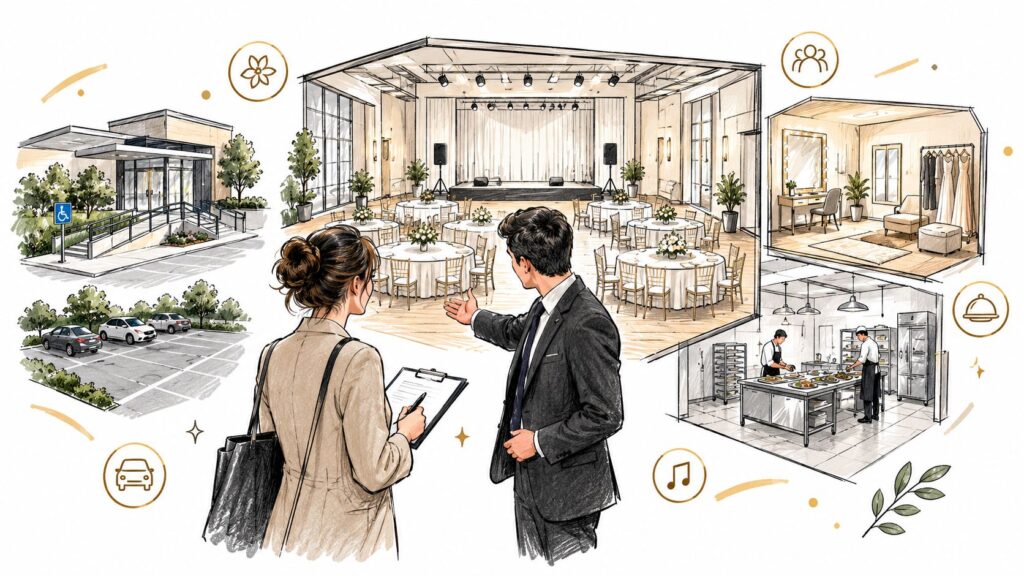
Prioritize event venue amenities that keep guests comfortable and vendors working: dependable audiovisual equipment, power, climate control, accessible routes, and clearly assigned staffing. With audiovisual needs identified as a major expense by 66% of planners, technical inclusions deserve scrutiny before decorative extras. You're comparing beautiful properties, trying to understand what the rental price covers, and wondering whether a longer inclusion list means an easier event. The useful question isn't how many amenities a venue advertises. It's which problems those amenities solve, who operates them, and what happens when the original plan changes. Table of Contents Why Amenities Decide How the Day Actually Feels Translate the brochure into tasks Defining Event Venue Amenities in Functional Terms Give each amenity a job Distinguish availability from usability How Amenities Differ Across Venue Types Amenity Coverage by Venue Type Match the property to your compromises The Production Stack Audio Visual Power and Climate Follow the signal and the electricity Check comfort under event conditions Service and Staffing Amenities Behind the Scenes Price the work, not just the room Examine the rules that affect your suppliers Accessibility as an End-to-End Guest Experience Walk the route guests will actually use Ask for documentation without making assumptions The Buyer's Amenity Checklist Before You Tour Initial research and site visit Contract review and final preparations Putting It All Together Before You Book Why Amenities Decide How the Day Actually Feels On the morning of an event, vendors arrive while a coordinator searches for an extension cord. The catering van stops across the parking lot because nobody identified a service entrance, and the wedding party asks where they're supposed to get dressed. That's an illustrative scenario, not an inevitable disaster. But it exposes the difference between a property that photographs well and a property your team can operate without improvising. Event venue amenities are working infrastructure. A dressing suite protects preparation time. A service entrance keeps equipment carts out of guest traffic. A usable indoor alternative gives the coordinator somewhere to move the ceremony when outdoor conditions become unsuitable. Translate the brochure into tasks Start with the language venues use, then ask what your team can do. Complimentary parking: Where do guests park, where do vendors unload, and who directs arrivals? Climate-controlled hall: Can staff adjust conditions during setup, dinner, and dancing? Full bar: Does that mean a built-in counter, beverage service, staffing, glassware, or some combination? On-site support: Who is present, what decisions can they make, and when does their responsibility end? Don't accept an adjective where you need an operating answer. Spacious, flexible, and convenient aren't specifications. Practical rule: If an amenity matters to your timeline, ask someone to demonstrate how it works. The economic context reinforces why these details deserve serious attention. U.S. meetings generated approximately $325 billion in direct spending in 2016, according to the meetings industry economic-impact analysis published by ICCA. That historical figure isn't a forecast for your event, but it puts venue infrastructure in perspective: these spaces support substantial work across hospitality, transportation, catering, and production. Put amenity questions into your initial shortlist, not your post-deposit planning session. If an essential capability is missing, you need time to price the workaround, find the right vendor, or choose another property. Discovering the gap after committing limits your options. Defining Event Venue Amenities in Functional Terms A useful definition is simple: event venue amenities are the spaces, equipment, permissions, and services that let people deliver the event. Treat them as a toolbelt, not a collection of perks. I organize that toolbelt into production infrastructure, guest experience, logistics, and service. Accessibility belongs across every family, because a feature isn't useful if a guest or vendor can't reach or use it. Give each amenity a job Production infrastructure includes electricity, sound, lighting, climate systems, and connectivity. Its job is to support what people need to hear, see, operate, and communicate. A microphone belongs here, but so does the power supply serving the presentation equipment. Guest experience covers dressing areas, restrooms, comfortable seating, arrival spaces, and movement between activities. Evaluate these features from a guest's position rather than from the doorway during an empty-room tour. Logistics includes delivery access, preparation areas, furniture inventory, storage, and usable layouts. A beautiful room can still be awkward to operate if caterers have nowhere to stage trays or rental crews can't store empty cases. Service determines who turns those physical resources into a functioning event. Management, cleanup, vendor permissions, operating hours, and escalation procedures belong in this family. Distinguish availability from usability Use a simple test when reviewing an inclusion: Present: Does the feature exist in the specific space you're renting? Usable: Does it suit your event format, equipment, and guest needs? Supported: Who prepares it, operates it, and resolves problems? Included: Is its use covered by the quoted agreement? A prep kitchen illustrates the distinction. The room may exist, yet your caterer still needs to confirm appliances, refrigeration, permitted activities, and access arrangements. Don't translate “kitchen” into “full cooking capability” without checking. The same applies to furniture. Included tables are useful only when their dimensions, condition, quantities, and layout suit your meal service. Name the job first, then judge whether the amenity performs it. How Amenities Differ Across Venue Types Choose the venue model before getting attached to a particular package. A hotel, standalone ballroom, multi-hall property, and rural estate can all accommodate a celebration, but you shouldn't evaluate them with identical assumptions. The comparison below is a touring framework, not a promise about every property. Each cell identifies what to investigate rather than declaring that a venue category automatically includes it. Amenity Coverage by Venue Type Amenity Category Ballroom Hotel Venue Multi-Hall Property Outdoor / Estate Parking Check dedicated allocation Clarify guest and overnight use Separate hall-specific and shared areas Inspect surfaces and arrival routes Dressing suites Confirm private preparation space Separate guestrooms from event inclusions Verify suites assigned to your hall Confirm indoor preparation facilities A/V inventory Request room-specific equipment Clarify equipment and technician charges Identify systems
7 Venues for 300 Guests in Central Texas

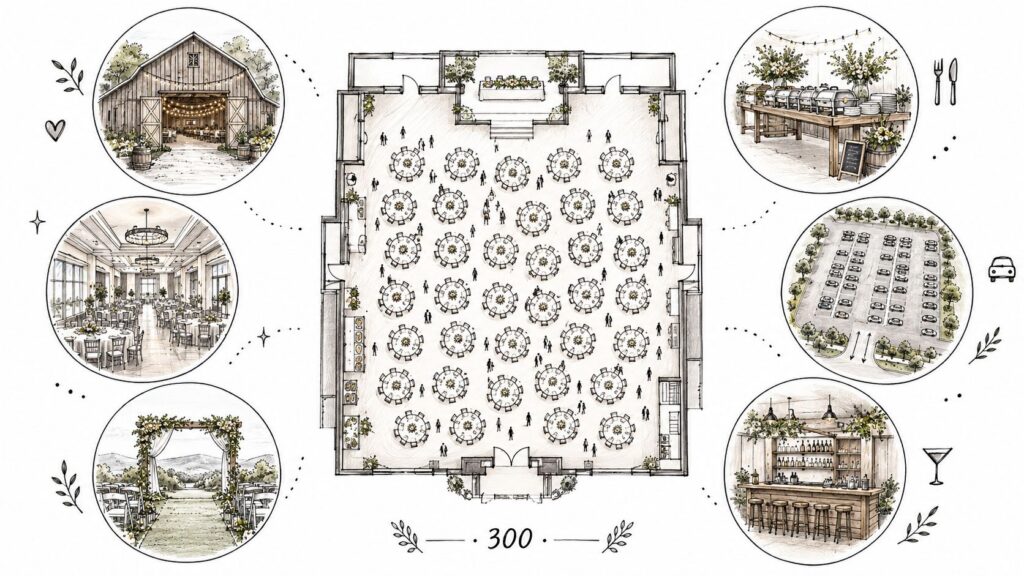
A venue may advertise space for 300 guests, yet the room can feel crowded once you add the ceremony setup, dance floor, buffet, bar, band, accessibility routes, photographer access, and vendor staging. The useful question isn't merely whether 300 people can enter the building. It's whether 300 guests can dine, move, celebrate, and leave safely without forcing every service area into the seating plan. This roundup compares seven venues for 300 guests in Central Texas, with options across the Austin to San Antonio corridor. The comparison focuses on stated capacity, indoor and outdoor ceremony choices, rental windows, included services, parking, accessibility, vendor restrictions, weather contingencies, and pricing transparency. Texas Old Town in Kyle receives dedicated attention because its four halls range from 150 to 320 guests, with Tejas accommodating up to 320 and Sage and Stone accommodating up to 300, according to the venue's event information. Table of Contents 1. Texas Old Town The logistics package 2. The Addison Grove What to verify before signing 3. The Arlo Where the budget comparison is clearer 4. Pecan Springs Ranch The outdoor-space trade-off 5. Canyonwood Ridge A venue for transition control 6. The Milestone | Georgetown Transparent pricing with less vendor freedom 7. The Witte Museum Experience and policy considerations 7-Venue Comparison for 300 Guests Build a 300-Guest Venue Shortlist Compare the quote, not the headline rate 1. Texas Old Town Texas Old Town is the strongest flexibility play for a host who wants a large guest list without committing to a single oversized room. Its Hill Country campus in Kyle includes four private halls, Tejas for up to 320 guests, Sage and Stone for up to 300, and Redbud for up to 150, as described on the Texas Old Town venue page for 300 guests. That range matters because a 300-person wedding, quinceañera, corporate banquet, or milestone event may not need the same room configuration as a smaller celebration. The campus also combines curated grounds, streams, water features, and indoor reception spaces. Hosts can plan an outdoor ceremony and move into a climate-controlled hall, or keep the ceremony indoors if heat or rain makes the original plan unsuitable. The four-hall model creates a less obvious advantage: the largest hall isn't automatically the best hall. Tejas may provide more breathing room for entertainment and circulation, while Sage or Stone may feel more proportionate when the guest count is close to 300 but the program is simpler. The logistics package Texas Old Town provides exclusive access from 8:00 a.m. to midnight, an on-site venue manager, clean-up, furniture breakdown, dressing suites, a prep kitchen, and a separate service entry. The venue also documents furniture counts and provides indoor and outdoor PA systems with Bluetooth connectivity and a wireless microphone. Those details help planners build a realistic floor plan instead of treating the advertised capacity as usable seating capacity. Other practical provisions include a built-in beverage bar, large private parking, and an accessible layout. Hosts can bring any caterer, while the bring-your-own-beverage policy requires an approved bartending company. That arrangement offers menu and beverage flexibility, but it also means the host must coordinate drinks, bartending, insurance or approval requirements, and service timing. Practical rule: Ask for the furniture inventory and a diagram showing the exact banquet layout, dance floor, bar, buffet, staging area, and accessible circulation before treating a 300-person capacity as confirmed. Pricing is not published as a flat online rate, so you'll need to request availability and a proposal. The venue states that quoted pricing includes sales tax and gratuity and offers personalized payment plans. Its preferred-vendor list and multiple industry awards, including Hall of Fame recognition from 2013 through 2022, provide additional planning signals, though they don't replace a written quote. Pros Capacity flexibility: Four private halls cover events from 150 to 320 guests on one campus. Weather resilience: Outdoor ceremony grounds can be paired with indoor, climate-controlled reception and ceremony spaces. Long access window: Exclusive access from morning through midnight allows more room for setup and breakdown. Vendor choice: Hosts can select their caterer and supply beverages under the venue's bartending requirements. Included operations: An on-site manager, clean-up, furniture breakdown, documented counts, parking, and sound equipment reduce coordination gaps. Cons Inquiry-based pricing: Exact rental rates aren't posted publicly, so budget comparison starts with a request. Beverage coordination: Bring-your-own beverages still requires an approved bartending company and host-supplied drinks. 2. The Addison Grove The Addison Grove suits planners who want a modern-rustic setting near Austin while keeping the room's capacity closely aligned with a 300-person reception. Its pecan-lined property is approximately 20 minutes from downtown Austin, and the barn seats up to 300 guests, according to The Addison Grove. That location can reduce the perceived distance for guests staying in Austin, although the final transportation plan still depends on lodging patterns and event timing. The venue's indoor and outdoor flow is a central strength. Multiple ceremony sites provide visual choice, while an indoor ceremony backup protects the schedule when outdoor conditions change. A venue with a fallback inside the same property can prevent a last-minute room search, but planners should still ask whether the backup arrangement uses the reception room and creates a flip between ceremony and dinner. What to verify before signing The Addison Grove offers a 14-hour access window from 10:00 a.m. to midnight, along with tables and chairs, documented furniture counts, on-site parking, shuttle accommodation, an Event Safety Officer, and venue management support. Those inclusions make it easier to establish a timeline and check whether a proposed layout can hold dining, entertainment, and guest circulation. The website doesn't publish a flat rate. Request a brochure or proposal that separates the rental charge from catering, staffing, rentals, security, taxes, gratuity, and overtime. The venue allows outside vendors, but house rules and restrictions should be confirmed in writing. A BYO-friendly policy may sound flexible until a caterer, bar team, décor company, or production vendor discovers a restriction that affects the schedule. For a reception that uses the full barn capacity,

How Much Does It Cost to Rent a Banquet Hall in 2026

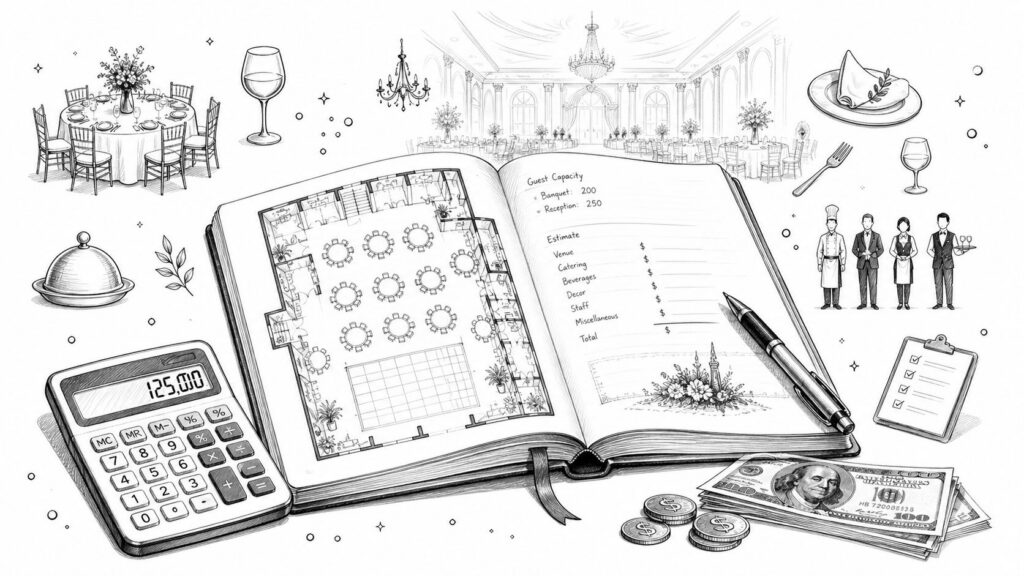
A banquet hall rental in 2026 can cost anywhere from $45 to $500 per hour, while banquet halls in some markets average about $1,200 per hour. That base fee is only one slice of the final bill, because catering, bar service, staffing, taxes, gratuity, equipment, and required minimums can change the economics completely. You're probably asking because a venue quote is sitting in your inbox and the number feels both specific and incomplete. The rental line may look manageable until you add the hours needed for setup, the guest count, food and beverage commitments, and every service the venue doesn't include. For a Central Texas wedding, corporate banquet, quinceañera, or milestone celebration, the right question isn't “How much does it cost to rent a banquet hall?” Ask instead: What will this event cost after the venue delivers everything I need? Table of Contents What Banquet Hall Rentals Actually Cost in 2026 Build the budget in layers What's Included in a Banquet Hall Quote The venue and access lines Staffing, food, and beverage Inventory and add-ons The Biggest Factors That Drive the Price Capacity changes more than the room Date and day of week create demand pressure Location affects the same square footage Amenities decide whether the quote is honest How Central Texas Halls Compare on Cost Three Sample Budgets for Real Events Wedding scenario Corporate banquet scenario Quinceañera scenario Why Transparent Pricing Beats the Lowest Headline Audit the contract, not the brochure Smart Ways to Lower Your Total Cost Planning Your Next Step With Confidence What Banquet Hall Rentals Actually Cost in 2026 Start with the rental model, not the advertised package name. Neutral pricing guidance places banquet hall rentals across a broad $45–$500-per-hour range, with mid-sized properties often clustering around $150–$500 per hour. A national 2026 pricing guide reports that banquet halls average about $1,200 per hour, with rates ranging from $200 to $3,800 per hour depending on location, amenities, guest count, and included services. See the national 2026 event-space pricing guide for that market-wide comparison. For a first-time planner mapping a 150-guest Central Texas wedding, a $1,500–$7,500 rental quote can be a practical working band for the site fee, depending on the day, hall size, access window, and what the contract bundles. That figure is not a verified statewide average. It's a budgeting framework for comparing local proposals without mistaking the room fee for the event total. Build the budget in layers Treat the quote as a stack: Venue access: The room, grounds, rental period, and exclusive use. Operational delivery: Tables, chairs, linens, setup, breakdown, manager, security, and cleaning. Guest experience: Catering, bar service, cake service, entertainment, and décor. Financial obligations: Taxes, gratuity, service charges, deposits, insurance, and minimum spends. All-in event spending can commonly land between $8,000 and $45,000 once catering, bar service, staffing, taxes, and gratuity are included. That range is a practical planning band rather than a national statistical average, and it reflects how dramatically a simple room rental differs from a full-service wedding or banquet package. Practical rule: Compare the final contracted total, not the first number in the brochure. A wedding venue benchmark places the average U.S. venue cost at $8,573 in 2025, while another industry guide puts the broader 2026 national average at $13,200. The contrast itself is useful. Wedding venue cost data shows why geography, capacity, and bundled services matter more than a single national average. For Central Texas buyers, use the rental quote as the starting checkpoint. Then ask what it takes to host guests comfortably, serve them efficiently, and leave the property without a second invoice. A useful local reference is the reception hall rental information from Texas Old Town, especially when you're comparing access time, included inventory, and venue operations. What's Included in a Banquet Hall Quote A transparent quote should let you identify the price of the room, the price of serving guests, and the price of operating the event. If those categories are blended into a single “package” without an itemized explanation, you can't compare it fairly with a venue that separates each cost. The venue and access lines The base rental fee covers the physical space and the right to use it for a defined period. Confirm the exact start and end times, because setup and teardown can consume a significant portion of the booking window. Ask whether vendor loading, décor installation, rehearsal access, and furniture breakdown happen inside the paid period or trigger additional hours. A refundable damage deposit protects the venue against damage, missing inventory, or rule violations. It isn't the same as a nonrefundable booking payment. Your contract should state the amount, refund conditions, inspection process, and expected return timing. The quote should also identify: Service charges: An administrative or operational percentage applied to selected services. Sales tax: Central Texas planners should ask the venue to show the applicable Texas sales tax line. The plan for this article references 8.25% in Central Texas counties, but the venue should confirm the exact tax treatment for your contract. Gratuity: Determine whether gratuity is included, separately calculated, or expected on top of a service charge. Overtime: Get the hourly rate for late departures, extended bars, and delayed vendor pickup before signing. The wedding package pricing details from Texas Old Town provide a useful example of the kind of inclusions and pricing structure buyers should look for when auditing a proposal. Staffing, food, and beverage Staffing minimums often include an event captain, servers, bartenders, security, and cleanup personnel. The venue may calculate staffing against guest count, service style, alcohol service, or event complexity. A plated dinner usually requires more coordinated service than a buffet, while a hosted bar can require bartenders for the full reception period. Bar pricing usually follows one of two structures. Per-consumption billing charges for what guests drink. A hosted minimum requires the event to reach a predetermined beverage spend whether or not guests consume that amount. Ask whether the minimum includes bartender labor, mixers, glassware, ice, and nonalcoholic drinks. Catering minimums

Reception Hall Rental Guide for Central Texas Events

You've shortlisted a few reception halls between Austin and San Antonio, but the numbers still don't line up. One venue advertises a low site fee, another includes tables and chairs, and a third offers more time in the building but explains its vendor rules only after the tour. Meanwhile, your guest count keeps changing, the ceremony location depends on the weather, and every quote seems to answer a different version of the question, “What will this event really cost?” That confusion is common because reception hall rental isn't just about square footage or a pretty room. The useful comparison includes capacity, usable floor area, setup access, ceremony options, furniture, catering rules, beverage requirements, cleanup, staffing, and the flexibility to change plans. This guide walks through those details in plain language, so you can compare halls by the experience and total cost they deliver. Table of Contents Introduction to Reception Hall Rental in Central Texas What a Reception Hall Rental Really Includes Start with exclusive use and access Look beyond tables and chairs Comparing Four Hill Country Halls by Capacity and Style Match the room to the event's rhythm Layouts Rental Windows and Space Planning Essentials Use the floor area as a working calculation Treat the rental window as an operating schedule Understanding Pricing Transparency and Total Cost Normalize every proposal Must Ask Questions and Planning Checklist Before You Book Confirm flexibility before discussing décor Verify vendor and service rules Walk the operational route Read the contract as an operating document Planning Your Next Steps With Confidence Introduction to Reception Hall Rental in Central Texas A first-time planner often starts with three details: the date, the guest list, and the budget. Those details matter, but they don't tell you whether a hall will work smoothly on event day. A room may hold your guest count on paper and still feel cramped once you add a dance floor, buffet stations, a DJ, a cake table, a bar, gift tables, and the walking space guests need to move comfortably. The broader market helps explain why venue comparisons can feel so varied. The global event venue rental market was valued at USD 116.17 billion in 2024 and is projected to reach USD 168.14 billion by 2034, a 6.2% compound annual growth rate, according to Business Research Insights' event rental market analysis. The same source estimates the market at USD 123.85 billion in 2026, pointing to continued demand for bookable spaces for weddings, corporate gatherings, and private celebrations. That demand gives planners plenty of choices, but it also makes apples-to-apples comparison more important. A venue-only quote may exclude rentals, catering, bartending, service charges, or the labor required to reset the room. Another hall may bundle those services, making its first quote look higher even though the final invoice is easier to predict. The practical question isn't “Which hall has the lowest rental fee?” It's “Which hall gives my event enough time, space, support, and cost clarity to run without unnecessary pressure?” As you tour Central Texas venues, use four filters: capacity fit, operational flexibility, included services, and normalized total cost. Those filters work for a wedding, a quinceañera, a corporate banquet, a birthday celebration, or a retirement party. They also help you recognize when a venue's attractive online presentation doesn't answer the logistical questions that will shape your actual event. What a Reception Hall Rental Really Includes A modern reception hall rental often works more like renting a furnished home than borrowing an empty shell. You're not only paying for four walls. You're evaluating the furniture, utilities, preparation areas, sound coverage, guest access, management, and cleanup that allow people to use the space comfortably. Industry packaging data reflects that shift. In the United States, 73% of wedding venues include rentals such as tables and chairs, while only 16% offer space-only rental, according to MMCginvest's 2026 wedding venue market analysis. The same analysis reports that 41% include catering and 37% include alcohol, which means a venue's package structure can matter as much as its room design. Start with exclusive use and access Exclusive use means your event has a defined relationship with the selected hall rather than sharing the room with another group. Ask whether that exclusivity applies only to the reception room or also to ceremony areas, dressing suites, outdoor grounds, parking, and service entrances. Time matters just as much. A compressed rental may require decorators, caterers, musicians, and family members to work over one another. A longer window gives each team a clearer handoff for setup, celebration, and breakdown. Look beyond tables and chairs Furniture should be documented, not described vaguely. Ask for the published counts and types of tables and chairs, then confirm whether those items are included in the quoted rental or treated as add-ons. Also identify the infrastructure behind the room: Ceremony flexibility: Can the ceremony happen outdoors, indoors, or in the same hall as the reception if weather changes? Sound coverage: Does the venue provide indoor and outdoor PA equipment, Bluetooth connectivity, and a wireless microphone? Preparation space: Are dressing suites private, and do they include restrooms and vanity areas? Catering support: Does the prep kitchen have a separate service entry, and can your caterer use it? Guest convenience: Are parking, accessible routes, restrooms, and transitions between spaces easy to manage? Event supervision: Will an on-site manager coordinate venue operations during the event? A built-in beverage bar may still come with rules. For example, a bring-your-own-beverages policy can require an approved bartending company, so the beverage policy belongs in your cost worksheet rather than in a footnote. Comparing Four Hill Country Halls by Capacity and Style A hall should fit both your guest count and the personality of the event. On one 55-acre Hill Country campus, Texas Old Town offers four distinct halls, so planners can compare atmosphere without changing the property, general setting, or access to the broader grounds. The first step is to separate maximum capacity from comfortable event fit. A maximum tells you how many guests

Scroll to Top