You've shortlisted a few reception halls between Austin and San Antonio, but the numbers still don't line up. One venue advertises a low site fee, another includes tables and chairs, and a third offers more time in the building but explains its vendor rules only after the tour. Meanwhile, your guest count keeps changing, the ceremony location depends on the weather, and every quote seems to answer a different version of the question, “What will this event really cost?”
That confusion is common because reception hall rental isn't just about square footage or a pretty room. The useful comparison includes capacity, usable floor area, setup access, ceremony options, furniture, catering rules, beverage requirements, cleanup, staffing, and the flexibility to change plans. This guide walks through those details in plain language, so you can compare halls by the experience and total cost they deliver.
Table of Contents
- Introduction to Reception Hall Rental in Central Texas
- What a Reception Hall Rental Really Includes
- Comparing Four Hill Country Halls by Capacity and Style
- Layouts Rental Windows and Space Planning Essentials
- Understanding Pricing Transparency and Total Cost
- Must Ask Questions and Planning Checklist Before You Book
- Planning Your Next Steps With Confidence
Introduction to Reception Hall Rental in Central Texas
A first-time planner often starts with three details: the date, the guest list, and the budget. Those details matter, but they don't tell you whether a hall will work smoothly on event day. A room may hold your guest count on paper and still feel cramped once you add a dance floor, buffet stations, a DJ, a cake table, a bar, gift tables, and the walking space guests need to move comfortably.
The broader market helps explain why venue comparisons can feel so varied. The global event venue rental market was valued at USD 116.17 billion in 2024 and is projected to reach USD 168.14 billion by 2034, a 6.2% compound annual growth rate, according to Business Research Insights' event rental market analysis. The same source estimates the market at USD 123.85 billion in 2026, pointing to continued demand for bookable spaces for weddings, corporate gatherings, and private celebrations.
That demand gives planners plenty of choices, but it also makes apples-to-apples comparison more important. A venue-only quote may exclude rentals, catering, bartending, service charges, or the labor required to reset the room. Another hall may bundle those services, making its first quote look higher even though the final invoice is easier to predict.
The practical question isn't “Which hall has the lowest rental fee?” It's “Which hall gives my event enough time, space, support, and cost clarity to run without unnecessary pressure?”
As you tour Central Texas venues, use four filters: capacity fit, operational flexibility, included services, and normalized total cost. Those filters work for a wedding, a quinceañera, a corporate banquet, a birthday celebration, or a retirement party. They also help you recognize when a venue's attractive online presentation doesn't answer the logistical questions that will shape your actual event.
What a Reception Hall Rental Really Includes
A modern reception hall rental often works more like renting a furnished home than borrowing an empty shell. You're not only paying for four walls. You're evaluating the furniture, utilities, preparation areas, sound coverage, guest access, management, and cleanup that allow people to use the space comfortably.
Industry packaging data reflects that shift. In the United States, 73% of wedding venues include rentals such as tables and chairs, while only 16% offer space-only rental, according to MMCginvest's 2026 wedding venue market analysis. The same analysis reports that 41% include catering and 37% include alcohol, which means a venue's package structure can matter as much as its room design.
Start with exclusive use and access
Exclusive use means your event has a defined relationship with the selected hall rather than sharing the room with another group. Ask whether that exclusivity applies only to the reception room or also to ceremony areas, dressing suites, outdoor grounds, parking, and service entrances.
Time matters just as much. A compressed rental may require decorators, caterers, musicians, and family members to work over one another. A longer window gives each team a clearer handoff for setup, celebration, and breakdown.
Look beyond tables and chairs
Furniture should be documented, not described vaguely. Ask for the published counts and types of tables and chairs, then confirm whether those items are included in the quoted rental or treated as add-ons.
Also identify the infrastructure behind the room:
- Ceremony flexibility: Can the ceremony happen outdoors, indoors, or in the same hall as the reception if weather changes?
- Sound coverage: Does the venue provide indoor and outdoor PA equipment, Bluetooth connectivity, and a wireless microphone?
- Preparation space: Are dressing suites private, and do they include restrooms and vanity areas?
- Catering support: Does the prep kitchen have a separate service entry, and can your caterer use it?
- Guest convenience: Are parking, accessible routes, restrooms, and transitions between spaces easy to manage?
- Event supervision: Will an on-site manager coordinate venue operations during the event?
A built-in beverage bar may still come with rules. For example, a bring-your-own-beverages policy can require an approved bartending company, so the beverage policy belongs in your cost worksheet rather than in a footnote.
Comparing Four Hill Country Halls by Capacity and Style
A hall should fit both your guest count and the personality of the event. On one 55-acre Hill Country campus, Texas Old Town offers four distinct halls, so planners can compare atmosphere without changing the property, general setting, or access to the broader grounds.
The first step is to separate maximum capacity from comfortable event fit. A maximum tells you how many guests a room may accommodate under a particular layout. Your actual plan may need room for dining, dancing, a stage, buffet service, a photo area, or a ceremonial focal point.
| Venue | Capacity | Style Character | Ideal For |
|---|---|---|---|
| Tejas | Up to 320 guests | Authentic Texas country dance hall with handcrafted pine tables | Large weddings, quinceañeras, corporate banquets, and energetic celebrations |
| Sage | Up to 300 guests | Secluded setting near the grand entrance | Weddings, milestone events, and gatherings where privacy shapes the mood |
| Stone | Up to 300 guests | Upscale finishes with a polished reception feel | Formal weddings, corporate dinners, galas, and refined social events |
| Redbud | Up to 150 guests | Intimate rustic hall | Smaller weddings, birthdays, rehearsal dinners, and close-family celebrations |
Match the room to the event's rhythm
Tejas makes sense when the guest list is large and the dance-hall character is part of the experience. Handcrafted pine tables support a distinctly Texas setting, while the room's capacity gives planners more room to consider a full reception program.
Sage and Stone serve similar upper capacity needs, but they create different impressions. Sage's secluded personality can suit a private wedding or family celebration. Stone's upscale finishes may feel more natural for a formal dinner, awards program, or evening reception where the room itself carries a polished tone.
Redbud changes the planning equation. A smaller hall can make an intimate guest list feel intentional rather than underfilled. It may also simplify sight lines and transitions for a birthday, rehearsal dinner, or smaller corporate gathering.
Choose the hall that leaves room for the event you're actually planning, not only the number of people on the invitation list.
For a quinceañera, consider where the court, DJ, dance floor, food service, and photography will operate. For a corporate banquet, think about presentation sight lines, registration, networking, and meal service. For a wedding, account for the ceremony, cocktail transition, dinner, dancing, gifts, and personal items. The right shortlist usually includes one room that fits the count and one that fits the event's movement.
Layouts Rental Windows and Space Planning Essentials
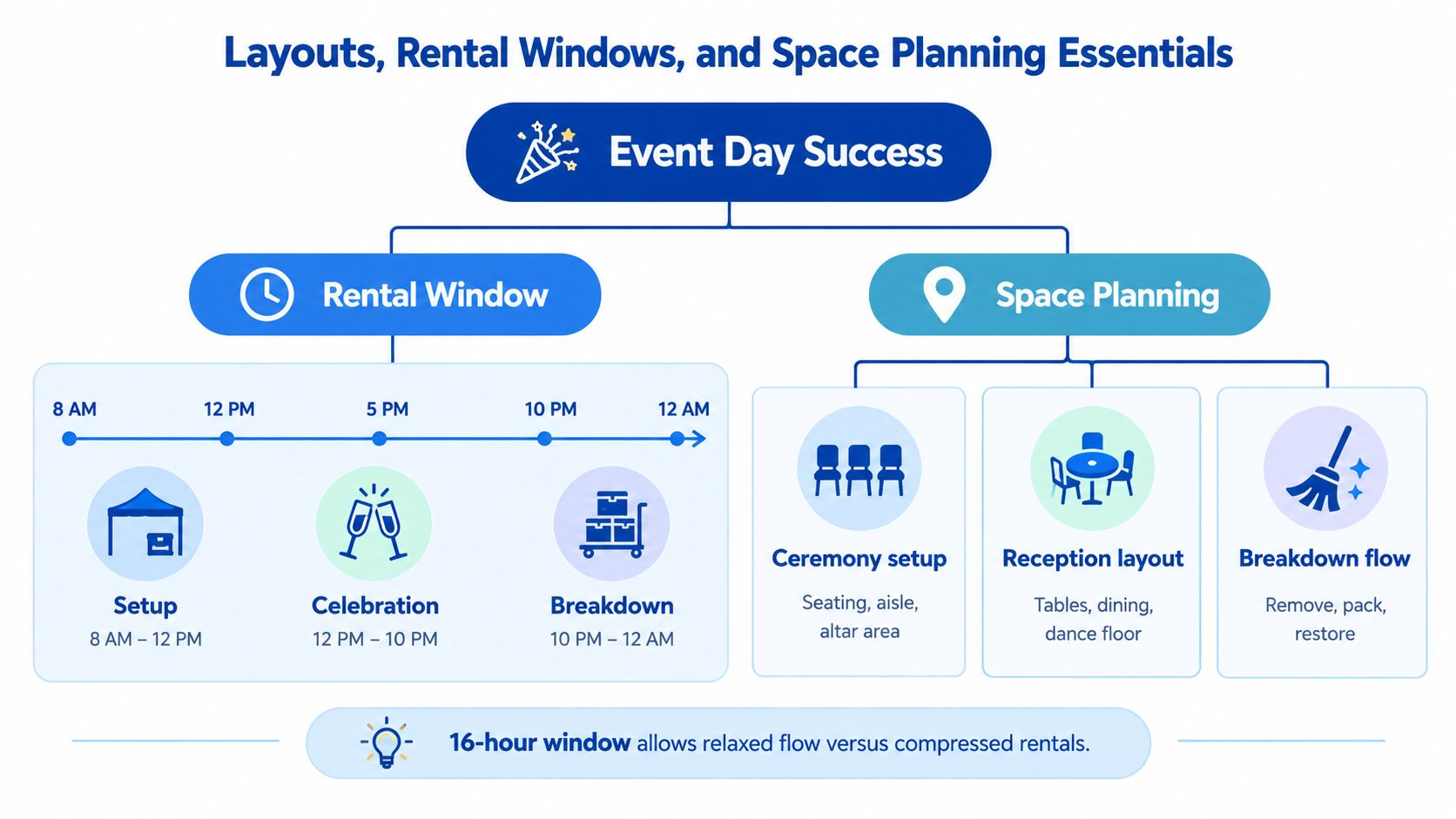
A successful layout starts with usable space, not gross building size. For seated banquet rounds, a common planning benchmark is 10 to 12 square feet per guest, and a more conservative approach protects roughly 20% of gross floor area for circulation, staging, buffet lines, and service lanes, as explained in Mississauga Convention Centre's event capacity guide.
That circulation allowance is where many first-time plans go wrong. A room can technically contain enough chairs and tables, yet guests may struggle to reach the buffet, servers may have no clean route between tables, and the dance floor may become a passageway instead of a destination.
Use the floor area as a working calculation
The planning example is straightforward. A 4,250-square-foot hall may provide closer to 3,400 square feet of usable event area after circulation is protected, according to the same capacity guide. That difference can determine whether a buffet queue moves smoothly or blocks the bar, whether a stage has safe clearance, and whether guests can circulate without brushing against chairs.
When reviewing a floor plan, mark these zones before placing guest tables:
- Ceremony setup: Reserve sight lines to the altar, arch, stage, or speaker. Leave a clear aisle and consider where the wedding party or honored guests will enter.
- Reception layout: Place banquet rounds, the head table or sweetheart table, dance floor, DJ or band area, cake, gifts, bar, and buffet stations.
- Breakdown flow: Identify the route for caterers, rental staff, trash removal, and furniture movement after guests leave.
An indoor, climate-controlled hall can provide a dependable reception environment, while an outdoor ceremony site adds open-air character. Ask whether the sound system covers both areas, whether the wireless microphone works where vows or announcements will occur, and how the plan changes if weather moves the ceremony indoors.
Treat the rental window as an operating schedule
A 16-hour rental window from 8:00 a.m. to midnight creates a different rhythm from a short booking. It can accommodate setup, vendor arrival, guest celebration, and breakdown without forcing every task into the same narrow period.
Use the extra time deliberately. Confirm when the caterer can enter, when décor can be installed, when the ceremony space must be ready, and when cleanup begins. A prep kitchen with a separate service entry can reduce conflicts because catering staff don't have to move through the guest entrance with food, equipment, or waste.
For more detailed layout considerations, review the wedding venue floor plans before your tour and compare the drawing with the furniture list, service access, and ceremony backup plan.
Understanding Pricing Transparency and Total Cost
The advertised site fee is only one line in a reception budget. A useful quote answers what the venue includes, what it requires, and what outside vendors or service providers you'll still need to hire.
Industry analysis cited for 2026 places the U.S. wedding services market at roughly USD 65 billion to USD 100 billion in 2025, with venues capturing about 24% to 40% of total wedding spend, according to MMCginvest's wedding venue investment analysis. With about 2 million weddings annually and average total wedding costs of USD 34,000 to USD 36,000, that analysis estimates venue rental alone can represent roughly USD 8,500 to USD 14,300 per event. These figures are market context, not a quote for your event.
Normalize every proposal
A low venue fee can become less attractive after required rentals, catering minimums, alcohol restrictions, bartending, service charges, taxes, gratuity, security, and cleanup are added. A higher initial price may include more of those items and provide a clearer final total.
Some 2025 and 2026 estimates show why online comparisons vary so widely. One estimate places venue rentals around USD 881 to USD 1,077 in some budgets, while broader guides put U.S. site fees in the USD 3,000 to USD 11,000 range or around USD 7,900 on average, as summarized by Wedding Report's venue cost estimate. The difference usually reflects market, event type, package design, and inclusions.
Build a comparison sheet with these columns:
- Base rental: What does the advertised fee cover?
- Furniture: Which tables and chairs are included, and in what counts?
- Food: Is catering included, required, or entirely separate?
- Beverages: Can you provide your own, and is approved bartending required?
- Labor: Who handles setup, reset, cleanup, and furniture breakdown?
- Taxes and gratuity: Are they included in the quote or added later?
- Payment terms: Are payment plans available, and when are balances due?
Texas Old Town states that its quoted price includes sales tax and gratuity, with no hidden fees, and offers documented furniture counts and personalized payment plans. You can review the venue's wedding package pricing while building your own normalized comparison.
A transparent quote should let you estimate the event total before you commit to vendors.
Must Ask Questions and Planning Checklist Before You Book
A tour should answer more than “Do we like the room?” Bring your guest estimate, preferred date, event type, and rough program. Then ask questions in the order they affect your ability to plan.
Confirm flexibility before discussing décor
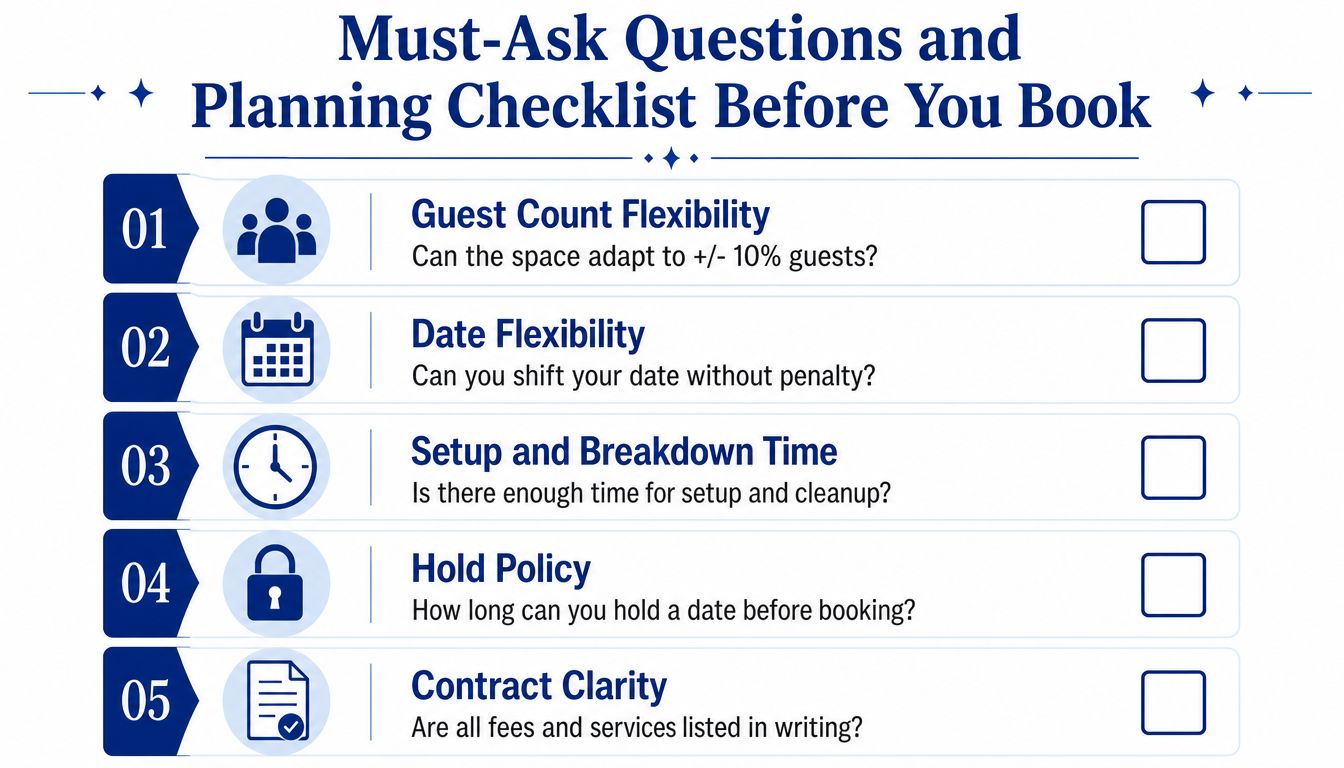
Guest counts change. Ask when the final count is due, whether the hall can absorb a modest increase or decrease, and whether a changed count affects the room assignment, catering, furniture, or price.
Date flexibility deserves equal attention. Ask how long the venue can hold a date, whether the hold is written, and what happens if a decision-maker needs more time. Also ask what happens if the event date must shift after the contract is signed.
- Hold policy: Get the hold window, expiration time, and release process in writing.
- Change policy: Ask which changes trigger fees, revised terms, or a new agreement.
- Response expectations: Identify the venue contact and how urgent planning questions are handled.
For a broader tour prompt list, EasyRegistry's guide to key questions for wedding venues offers a useful companion resource for contract conversations.
Verify vendor and service rules
A flexible vendor policy can affect both cost and creative control. Ask whether you can choose your caterer, baker, DJ, planner, photographer, and rental provider. If the venue uses a preferred list, find out whether it's optional or mandatory and whether outside vendors need approval or insurance.
Beverage policies deserve their own conversation. Clarify whether beverages are host-provided, whether bartending must come from an approved company, who supplies ice and mixers, and who manages last call and cleanup.
Walk the operational route
During the tour, physically follow the path that vendors and guests will use. Check the parking lot, accessible entrance, restrooms, dressing suites, prep kitchen, service entry, ceremony site, reception room, and waste area.
Ask who will be present during setup and the event. Confirm whether an on-site manager oversees venue operations, whether cleanup is included, and whether furniture breakdown happens after guests leave or during the rental window. A written venue inspection checklist can help you record these answers consistently across tours.
Read the contract as an operating document
The contract should identify the selected hall, access hours, included furniture, ceremony options, vendor requirements, beverage terms, payment schedule, cancellation or date-change rules, cleanup duties, and responsibility for damage. If a salesperson promises something during the tour, ask for it in writing before signing.
Planning Your Next Steps With Confidence
A good reception hall decision should make the event easier to operate, not easier to picture in a photograph. Start with the guest count, then test the room against the full program, including ceremony seating, dinner tables, dancing, food service, sound, photography, gifts, and guest movement.
Next, examine the rental window. A 16-hour access period from 8:00 a.m. to midnight can give vendors room to set up, give guests an unhurried celebration, and leave time for breakdown without forcing the event team into a rushed handoff. That flexibility matters especially when the schedule includes an outdoor ceremony, a large meal service, cultural traditions, speeches, or a packed dance floor.
Finally, compare written totals instead of headline prices. Normalize furniture, catering, beverages, bartending, taxes, gratuity, service charges, cleanup, and payment terms. Then use your checklist to verify guest-count changes, date holds, vendor rules, parking, accessibility, and on-site management.
For a wedding, book a tour that includes both ceremony options and reception layouts. For a quinceañera or milestone party, ask to see the dance floor, buffet route, and sound coverage. For a corporate banquet, review presentation sight lines, registration flow, meal timing, and guest parking. Rehearsal dinners, proposals, engagement photos, and bridal portraits may also be available by appointment, subject to availability.
A calm booking process comes from knowing exactly what you're comparing. When the hall, timeline, inclusions, and contract all support the same event plan, you can make a decision with fewer surprises and a clearer path to event day.
Texas Old Town offers four indoor reception halls, outdoor ceremony sites, documented furniture counts, flexible catering options, on-site management, included cleanup, and exclusive access from 8:00 a.m. to midnight in Kyle, Texas. Visit Texas Old Town to schedule a tour, check availability, and compare the venue options for your Central Texas celebration.