corporate events

10 Event Logistics Examples at Texas Old Town

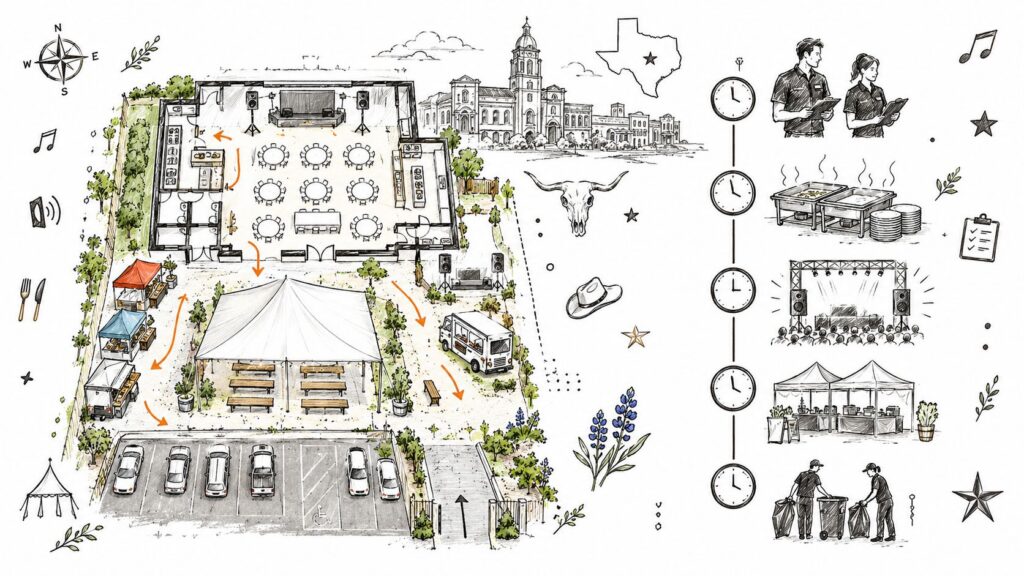
A venue can look finished and still fail the moment guests arrive. The florist may be blocking the caterer's service entry, the ceremony may run late because the microphone wasn't tested outdoors, or guests may circle the property because parking instructions were never assigned to anyone. These problems rarely come from the event concept. They come from unclear ownership, compressed setup windows, and movement paths that only exist on paper. The following event logistics examples use Texas Old Town's documented halls, 16-hour access from 8:00 a.m. to midnight, indoor and outdoor options, parking, PA systems, a prep kitchen, flexible vendor policies, and on-site management to turn common pressure points into working plans. That matters in a fragmented but expanding U.S. party and event planning sector, which had 3,379 businesses in 2026 and reached $2.9 billion in revenue after growing at an annualized rate of 6.6% over the preceding five years, according to IBISWorld's party and event planners industry data. Each example includes a compact timeline, a floorplan or movement description, staffing ownership, equipment placement, a practical insight, and tactics you can adapt. The aim is simple: build the day before guests arrive. A useful overview of the broader planning process is available in this guide to how events work. Table of Contents 1. Venue Capacity Planning and Multi-Hall Configuration Build the room around movement Adaptable tactics 2. Extended Rental Window and Timeline Management Use staggered access A workable sequence 3. Flexible Vendor Policy and Preferred Vendor List Management Separate selection from compliance Vendor controls that prevent collisions 4. Dual Ceremony Options for Indoor and Outdoor Site Selection Plan both routes before the rehearsal 5. Transparent Pricing and All-Inclusive Quotation Model Turn the quote into an operating document 6. On-Site Venue Management and Day-of Oversight Give the manager decision rights Build the manager briefing 7. Parking and Traffic Flow for Multi-Guest Events Separate people from production 8. Prep Kitchen and Catering Logistics Infrastructure Build the service sequence before setup 9. Sound System and Audio-Visual Infrastructure Build the setup around the program 10. Furniture Management and Layout Configuration Build the room around guest movement 10-Point Event Logistics Comparison Turn Venue Features Into a Working Playbook 1. Venue Capacity Planning and Multi-Hall Configuration A 120-person quinceañera shouldn't feel lost in a hall designed for a much larger celebration. Conversely, a corporate gala with 300 guests needs enough room for dining, presentations, circulation, and social time without forcing every function into the same tight footprint. Texas Old Town offers four distinct halls, Tejas, Sage, Stone, and Redbud, with published capacities ranging from 150 to 320 guests. Use the guest count and event behavior to choose the room, not just the room's visual style. Redbud can support an intimate family-style quinceañera, Stone can suit a formal corporate gala, and Tejas can give a country-themed wedding enough room for a prominent dance floor. Build the room around movement Start with a scaled floorplan showing guest tables, the dance floor, bar, buffet or service area, DJ position, gift table, cake table, and accessible routes. A 280-person wedding in Tejas may need a large dance area, while a corporate dinner in Stone may need stronger sightlines to a screen and speaker position. Assign one person to verify the final guest count, one to coordinate catering and bar assumptions, and the venue manager to confirm that the layout fits the selected hall. Request capacity verification from Texas Old Town before finalizing invitations or vendor orders. Practical rule: Capacity is not just a maximum occupancy figure. It determines how comfortably people can enter, eat, dance, socialize, and leave. Adaptable tactics Use the hall as the anchor: Let the selected room determine furniture quantities, service routes, and entertainment placement. Protect open space: Keep the guest entrance, restrooms, and key circulation paths clear of décor and vendor equipment. Walk the room at event time: Visit during the same part of day as the celebration so you can assess light, heat, parking conditions, and outdoor movement. 2. Extended Rental Window and Timeline Management The most useful venue feature is often the one guests never notice. A rental window running from 8:00 a.m. to midnight gives planners time to separate vendor access, setup, guest arrival, programming, and breakdown instead of forcing every task into a compressed period. For a wedding, the morning can be reserved for furniture placement, décor, sound checks, and catering preparation. The ceremony can happen later, followed by the reception, with vendors still having time to remove equipment before the facility closes. A corporate event can use the early window for registration and presentation testing, while a quinceañera can allow the family, DJ, caterer, and court of honor to prepare without competing for the same doorway. Use staggered access Build the timeline backward from the first guest-facing moment. Give each vendor a defined arrival period and access route. The AV team may need the room before the florist, while the caterer needs protected access to the prep kitchen and service entry. Décor installation should not block either route. The venue manager owns building access and room readiness. The event planner owns the master schedule. Each vendor should have one named contact responsible for reporting arrival, setup completion, and departure. A workable sequence Early access: Gain access to the hall, inspect the room, confirm utilities, and establish the staff base. Technical setup: Place speakers, microphones, screens, DJ equipment, and presentation devices before guest-facing décor is completed. Catering preparation: Move food, serviceware, and warming equipment through the service entry rather than guest areas. Show-ready check: Leave a clear buffer before guests arrive for a room inspection and staff briefing. Strike: Confirm vendor departures before the midnight closing requirement, with cleanup and furniture breakdown responsibilities documented. A long rental window only helps when the planner protects it. Unscheduled early arrivals can create the same congestion as a short rental. 3. Flexible Vendor Policy and Preferred Vendor List Management Bringing your own vendor can improve creative control, menu flexibility, and local fit. It can

How to Plan Corporate Events That Deliver Real Results

You've got a sales kick-off confirmed eight weeks out, a leadership offsite booked six weeks ago, and both events have landed on the same team's calendar. The budget hasn't expanded, key speakers are still being confirmed, and the venue shortlist keeps changing because every decision affects the next one. That's the practical reality behind how to plan corporate events. Corporate planning rarely follows the leisurely timeline used in wedding guides or long-lead conferences. One industry compilation reports that the average corporate event took 8 weeks to plan in 2023, while 60% of companies planned within 4 to 6 weeks (Sweap event planning statistics). A successful plan therefore starts with priorities, not decoration. Table of Contents The Shape of a Corporate Event Plan Work backward from the outcome Defining Objectives, Audience, and Budget Decide what the event must achieve Build the budget around control points Building the Timeline and Master Checklist Twelve weeks or more Eight to twelve weeks Four to eight weeks One to four weeks Event week Choosing the Venue, Floorplan, and AV Setup Start with the room, then test the show Catering, Bar, Transportation, and On-Site Staffing Design the attendee journey Staff for ownership, not headcount alone Contingency Planning for Weather, Tech, and Staffing Gaps Write the trigger and response together Post-Event Follow-Up and Measuring ROI Use one post-event report The Shape of a Corporate Event Plan A sales kick-off is eight weeks away, the leadership offsite is six weeks out, and both depend on the same operations team. The budget is fixed, speakers are not final, and one venue decision can force changes to catering, AV, travel, and staffing. Under that pressure, the plan must connect decisions instead of treating each workstream as a separate project. Corporate events can operate at meaningful scale. Industry reporting places average attendance at 475 people, with events of 1,000 or more attendees representing 18% of events and international attendees accounting for 18% of attendance in 2023 (Sweap event planning statistics). The figures do not dictate a large venue for every event. They do require early decisions about capacity, travel, accessibility, communication, and movement between rooms. Work backward from the outcome Write the business result in one sentence. A sales kick-off may need to align the team around a new strategy and increase confidence in executing it. A leadership offsite may need to resolve stalled decisions across departments. A client event may focus on stronger relationships, qualified conversations, or a commercial objective. Then order the plan by decisions that can invalidate later work: Objective: What must attendees understand, decide, do, or change? Audience: Who needs to attend, and how does the role mix affect the format? Budget: Which costs are fixed, which can move, and where is the reserve? Timeline: What must be contracted now because delay makes it expensive or unavailable? Venue and AV: Does the space support the agenda, sightlines, power, sound, and movement? On-site operations: Who owns registration, catering, transport, speakers, vendors, and changes? Contingencies and measurement: What happens when something fails, and how will value be shown? Venue and on-site logistics usually save more time than late creative refinements. A guide on maximise corporate event impact is useful when business outcomes and attendee experience compete for the same budget. The master plan should also assign responsibility for vendor coordination, schedule control, and day-of decisions. A clear outline of event manager responsibilities helps prevent ownership gaps. Practical rule: If a decision does not affect the objective, guest movement, safety, budget, or measurement, it should not outrank those decisions on a compressed timeline. The U.S. events market was estimated at about $302.7 billion in 2025, while the global events industry was valued at roughly $1.4 trillion (BoomPop event management statistics). The scale explains why corporate planning requires disciplined operations. Time is saved by setting priorities early. It is wasted when departments build disconnected versions of the same event. Defining Objectives, Audience, and Budget A budget isn't useful until it reflects the audience and the objective. Treat those three decisions as one design exercise. Suppose a sales kick-off has 120 attendees, runs for three days, and needs to align the team around Q2 strategy while motivating the sales group. A practical outcome measure could be a confidence score collected before and after the event. The number of attendees matters because it affects room size, food service, transportation, seating, and the amount of time required for registration. The audience mix matters too. Executives may need a private working room, while individual contributors may need classroom seating, hands-on sessions, or structured networking. Decide what the event must achieve Write the objective so the producer can make a decision without calling another meeting. “Make the team feel motivated” is too broad to guide a venue or agenda. “Align the sales team around Q2 priorities and measure change in rep confidence before and after the event” gives the content team, facilitator, and measurement owner a shared direction. Use three questions: What should attendees know? This defines content and speaker requirements. What should attendees do? This shapes workshops, commitments, and follow-up. What evidence will show progress? This determines the pre-event and post-event survey design. A larger audience isn't automatically better. Recent industry coverage says planners are shifting toward ROI and engagement metrics rather than simple headcount, with practical attention moving toward attendance quality and post-event follow-through (Conference News corporate event trends for 2026). That supports a selective guest list when a smaller group can make better decisions or have more relevant conversations. Build the budget around control points Separate expenses into fixed and variable categories. Fixed costs usually include the venue, food and beverage minimums, audiovisual scope, transportation commitments, and required staffing. These are the lines that can force a redesign if they exceed the approved budget. Variable costs include giveaways, entertainment, decorative elements, upgraded menus, and optional activations. These are safer places to reduce spend because they can often be simplified without changing the event's core purpose. Keep a 15% to 20% contingency line

Scroll to Top