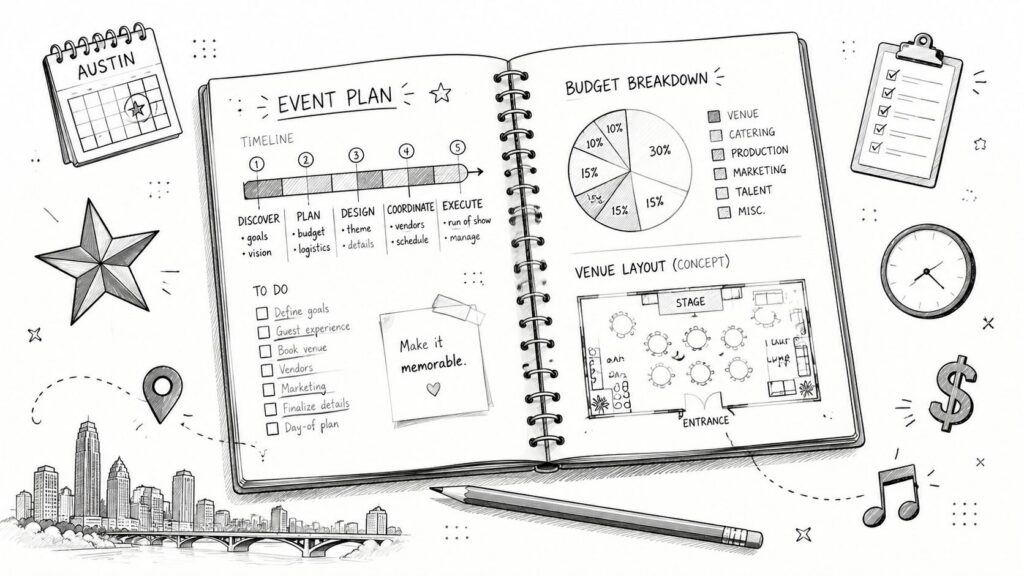
Event Planning Austin TX: Your 2026 Expert Guide
You're probably juggling a venue search, a guest list, and a calendar that's already filling up faster than you expected. That's normal in Austin. This market rewards people who move early, stay organized, and make decisions with the full logistics picture in mind, because the city's event economy is big, busy, and used to serious scale, from SXSW 2023's 425,000 attendees and $485 million economic impact to the 2023 Austin City Limits Festival's 350,000 attendees and $345 million impact (Austin events industry statistics). If you're trying to pull together a wedding, corporate offsite, quinceañera, or milestone party, the pressure usually isn't about one big decision. It's about a dozen small ones that all affect each other, like timing, guest flow, parking, vendor access, and how much control you have once the day starts. For a helpful parallel on managing a fast-moving launch-style event, the effective flash sale event guide is a useful reminder that tight timelines work best when the plan is simple, measurable, and locked down early. Table of Contents Your Austin Event Planning Journey Begins Here Start with the event's real objective Think like a planner, not a browser The Austin Event Planning Timeline From 18 Months to Day-Of Vision phase, 12 to 18 months out Foundation phase, 6 to 9 months out Details phase, 3 to 6 months out Finalization phase, 30 to 90 days out Execution phase, week-of Building a Realistic Budget for Your Central Texas Event Build the budget from the venue outward Know where flexibility saves money Choosing Your Venue and Assembling Your Austin Vendor Team What to ask on a venue walkthrough Build a vendor team that can actually work together Watch the contract language Navigating Austin Permits and Planning for Contingencies Check permissions before you lock the date Build a weather and access backup plan Final Rehearsals and Flawless Day-Of Coordination What to confirm before guests arrive The day-of checklist that keeps events calm Protect the last hour before the event starts Your Austin Event Planning Journey Begins Here Successful event planning Austin TX work starts with operations. The creative pieces matter, but the primary task is to match guest flow, vendor timing, weather backup plans, and site rules to the way Austin events typically unfold. In a market with busy calendars and high guest movement, the details around access, load-in, parking, and teardown are what protect the experience. Start with the event's real objective The cleanest plans begin with a single question, what does success look like for this event? A wedding may prioritize flow, food, and photos. A corporate event may care more about timing, breakout space, and sound. A quinceañera may need a strong ceremony-to-reception transition and room for family traditions to land without feeling rushed. Practical rule: if you can't explain the event's purpose in one sentence, you're not ready to book vendors yet. That clarity also helps you make better choices in Austin, where a polished venue can still create problems if it does not fit the headcount, setup schedule, or service style. A room that looks right in a gallery may be tight once catering stations, photo areas, and guest circulation are all in place. The same is true for outdoor space, because shade, wind, and heat can change how long people stay in one area and how smoothly the event moves. Think like a planner, not a browser Good planning starts by sizing the event accurately, then building decisions from there. A venue that looks perfect online can fail you if it can't support the guest count, caterer workflow, or parking pattern you need. A solid checklist makes those trade-offs visible before contracts are signed, which saves stress later. If you want a local benchmark for how structured planning should look, UT Austin's event checklist is a smart model, and Texas Old Town's event planning timeline shows how a venue can turn that logic into a practical sequence for real-world use. Some venues also create breathing room through extended rental windows, which helps spread out setup, vendor arrival, and cleanup instead of forcing everything into a rushed block. That matters in Austin, where a late vendor arrival or a parking delay can ripple through the entire day. The same planning mindset applies to alcohol service. If your event includes BYOB, the policy has to be handled with care, because guest safety, staff supervision, and clear check-in procedures all matter. A loose approach creates risk fast, especially when the schedule is already tight. A good example is an effective flash sale event guide, which shows how tight timing and clean execution shape the result. The setting is different, but the lesson is the same, the plan has to account for pressure points before the day begins. That mindset keeps an Austin event from feeling improvised. The earlier you define the goal, the easier every later decision becomes. The Austin Event Planning Timeline From 18 Months to Day-Of Vision phase, 12 to 18 months out This is the time to define the event's purpose, guest count, and feel. That sounds basic, but it's the step people skip when they're excited about venues and décor. The result is usually a mismatched space or a budget that doesn't fit the actual event. UT Austin's planning checklist recommends estimating attendance early so you can reserve an adequate facility and project all expenses before the rest of the planning starts (UT Austin planning checklist). That's not bureaucratic advice, it's the foundation of a workable plan. If the headcount is vague, everything else stays vague too. Foundation phase, 6 to 9 months out This is the booking window for the pieces that are hardest to replace. Secure the venue, anchor vendors, and any service providers tied to the event's timing or format. In Austin, delays become costly as popular dates disappear quickly and shortlists shrink fast. A good planner also checks the vendor policy at this stage. Some events need a fully coordinated package, while others work better with more flexibility.