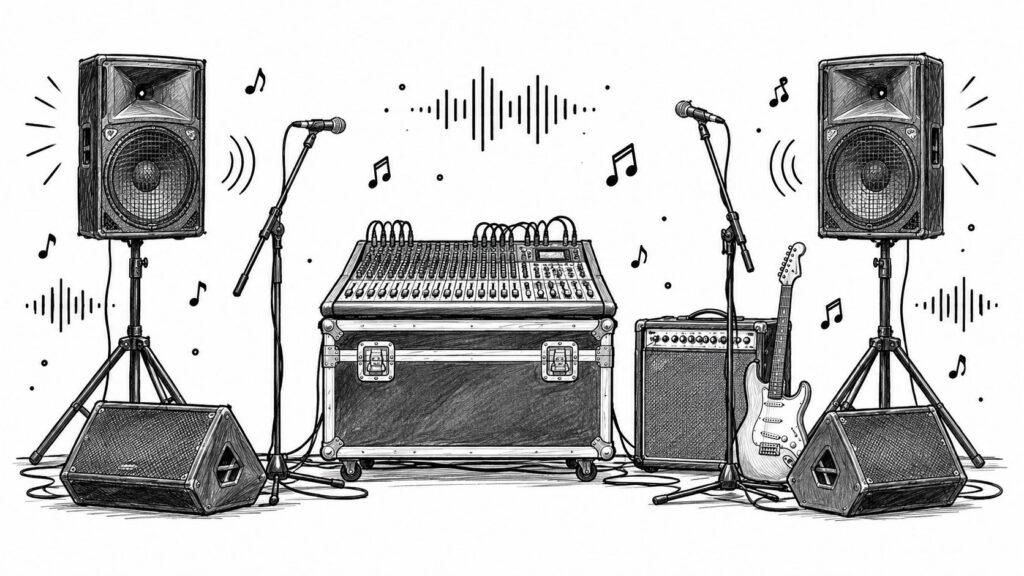
What Sound Equipment Do I Need for a Band: Live Setup Guide
For a 100-person indoor room, plan on roughly 500 to 1,000 watts RMS, using about 5 to 10 watts per person; outdoors, you may need double or triple that power. A band normally needs microphones, a mixer, powered speakers or amplifiers, audience mains, and performer monitors, with the exact package determined by the room and the loudest instrument. The usual problem isn't finding a list of equipment. It's arriving at a wedding venue with a Bluetooth speaker, one vocal microphone, and no workable way for the drummer or guitarist to hear the singer. The room may already have a PA, but its inputs, monitor coverage, speaker placement, and wireless frequencies may not suit a live band. A dependable setup starts with the signal chain, then matches the system to the venue, stage plot, channel count, and monitoring plan. That approach prevents the familiar gig-night failures: feedback during the first dance, vocals buried under guitar amps, and a band that can't hear the count-in. Table of Contents Understanding the Core Parts of a Live Band Sound System Start with sources and inputs Separate the audience mix from the stage mix Choosing the Right Gear by Band Size and Venue Type Indoor and outdoor rooms behave differently Avoid the monitor compensation trap Sizing Your Mix Around the Room and the Performance Build the input list before buying equipment Use the loudest source as the design test Building a Reliable Band Stage Plot and Mic Plan Draw the stage from the audience perspective Match microphones to sources Build monitor mixes deliberately Handling Venue Sound Options and Wireless Mic Planning Treat wireless microphones as a coordination task Final Setup Checklist and Common Band Sound Mistakes Understanding the Core Parts of a Live Band Sound System Every live band PA follows four practical pillars: input transducers, signal processing, amplification, and loudspeakers. In working terms, microphones and direct boxes capture sound, the mixer and processing shape and route it, amplifiers increase the signal, and speakers turn it back into sound for people in the room. This chain is easier to troubleshoot than a pile of disconnected boxes because each failure has a place. Start with sources and inputs The input stage includes vocal microphones, drum microphones, instrument microphones, and DI boxes. A DI box sends a clean, balanced signal from a keyboard, acoustic guitar, bass, or playback device to the console. That matters on a long stage run, where a balanced connection is less vulnerable to noise than an improvised unbalanced cable. The mixing console gives the operator control over channel level, EQ, routing, and monitor sends. You don't need the most elaborate console available, but you do need enough inputs for the actual band, spare capacity for announcements, and enough AUX outputs for the monitor plan. Processing may be built into the console or supplied by separate devices. It can include EQ, compression, reverb, monitor routing, and feedback management. Processing should improve clarity, not disguise a badly placed speaker or an overpowered guitar amplifier. Practical rule: Fix placement and stage volume before reaching for more processing. A mixer can't rescue a microphone aimed at a monitor. Separate the audience mix from the stage mix The main speakers face the audience. Monitors face the performers. These are different jobs, and major live-sound guidance treats them as separate PA roles because musicians need a controlled reference mix while the audience needs coverage and balance. That means a small band usually needs at least two output paths, not one speaker pointed vaguely toward the room. A left and right main arrangement can cover the audience, while wedge monitors or in-ear systems provide the stage feed. If the band uses substantial bass or kick drum, subwoofers may be added below the mains to handle low-frequency reinforcement. Historical live-sound development reflects the same practical progression. Harman's history of live sound describes early-1960s PA systems that were often used mainly for vocals, a 1,000-watt touring PA described by 1967, and larger multi-way systems appearing by the 1970s. Modern equipment grew more complex because full-band sound requires clarity, headroom, coverage, and monitoring. If the band is also producing promotional material, a clean live feed can support rehearsal clips and visual content. Tools such as AI video tools for song releases can help turn those assets into release-ready videos, but they don't replace a properly balanced room mix. For event-specific planning, compare the practical requirements in this band and event sound system guide. Choosing the Right Gear by Band Size and Venue Type The right PA depends on the band, room, and arrangement, not the number of people standing on stage. A quiet acoustic trio may send vocals and a few instruments through a compact powered system. A full rock band with acoustic drums, loud guitar amplifiers, and bass needs more headroom, low-end support, and monitor control. The following ranges provide a starting point from live-sound buying guidance. They aren't a substitute for checking the venue, but they prevent the most common mistake, buying a system that reaches its limit before the band reaches performance volume. Band size and genre Indoor wattage range Outdoor wattage range Typical speaker class Small acoustic act 300 to 800 watts Higher capacity required as sound disperses Powered two-way tops, commonly 8 to 12 inches Medium full rock band 1,000 to 2,000 watts Substantially more power and coverage Larger powered tops with subwoofer support Large band or large room 5,000+ watts System design and coverage become critical High-output mains, subwoofers, or line-array approach These ranges come from the American Musical live-sound buying guide, which also recommends sizing from the loudest unamplified source, then adding vocal and drum requirements before checking clean SPL and distortion. A compact powered PA can work well for an acoustic act, especially when the guitar or keyboard is DI'd and the room is controlled. Indoor and outdoor rooms behave differently For indoor events, a practical planning rule is 5 to 10 watts per person, or approximately 500 to 1,000 watts RMS for 100