Ceremony and Reception Same Venue Made Simple
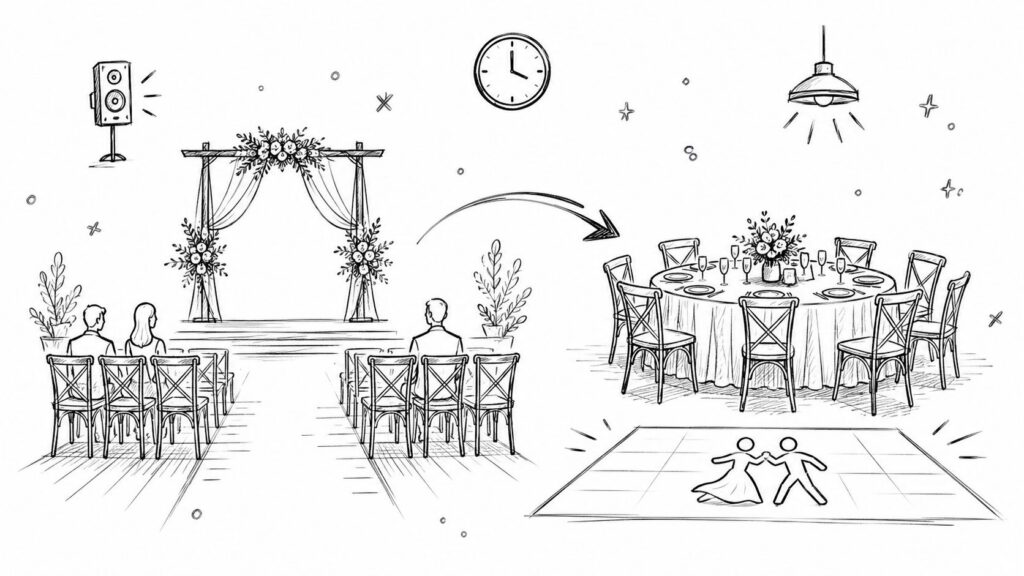
You're probably somewhere between excitement and spreadsheet fatigue right now. You've found a venue you like, or maybe three, and the big question is whether keeping the ceremony and reception in one place will make the day feel smooth or make everyone stand around while the room gets turned over. That's the part couples often miss at first. A ceremony and reception same venue setup isn't only about convenience. It's about what happens in the in-between. The vows end, guests clap, and then one of two things happens. People either flow naturally into the next part of the celebration, or the energy drops while everyone wonders where to go, what to do, and why dinner still isn't starting. The good news is that same-venue weddings can work beautifully when the property, timeline, and transition are planned on purpose. The cocktail hour isn't just a pleasant extra. In many weddings, it's the working bridge that gives staff time to reset the space and gives guests a clear next step. Table of Contents Why Couples Are Choosing One Place for Everything What couples are really buying Where confusion usually starts How a Same Venue Wedding Actually Works Two common ways the format works Why exclusive access matters Benefits and Trade Offs to Weigh Honestly Where same-venue setups shine Where couples should pause Same Venue vs Separate Venues at a Glance Designing Zones That Keep Guests Moving Naturally The four zones that do the heavy lifting What good flow looks like on the ground Questions worth asking on a tour Timeline and Room Flip Without the Stress A realistic transition sequence Where dead time comes from Sound Lighting and Flow Details That Make It Seamless Sound should follow the day Lighting does more than make photos pretty Service flow should stay mostly invisible Deciding If One Venue Is Right for Your Celebration Quick decision checklist Why Couples Are Choosing One Place for Everything A lot of couples start with the obvious benefit. One address is easier than two. Grandparents don't need a second set of directions. The wedding party isn't piling into cars between events. Vendors aren't racing the clock across town. That practical appeal isn't a fringe preference anymore. A major UK wedding-industry summary found that up to 77% of ceremonies in 2023 took place at the same venue as the reception, and that share had been rising steadily since 2018, which points to a longer shift toward all-in-one planning rather than a passing trend (UK wedding industry overview). For couples, that shift makes emotional sense too. Once the ceremony starts, nobody wants the day to feel broken into separate errands. People want the celebration to keep its rhythm. What couples are really buying They're not just buying one location. They're buying: Less travel stress so guests can settle in once Cleaner timing because the day isn't vulnerable to traffic between venues More usable celebration time instead of transition time A simpler guest experience from arrival through the last dance A U.S. wedding analysis from The Knot noted that in 2019 nearly one-third of couples hosted their receptions both indoors and outdoors, and it also observed that couples increasingly preferred to hold the ceremony, cocktail hour, dinner, and dancing within the same venue. That same analysis reported the average U.S. wedding size in 2019 was 131 guests, down from 141 in 2010, which helps explain why flexible one-property layouts became more attractive as couples focused on experience and convenience (The Knot wedding changes analysis). The best same-venue weddings feel like one continuous gathering, not two events stitched together. Where confusion usually starts Couples hear “same venue” and picture an easy day. Sometimes that's true. Sometimes it only looks easy because the hard work is hidden behind a strong floor plan, a realistic cocktail hour, and staff who can flip a room without guests seeing the scramble. That's why the key question isn't just, “Can we do both here?” It's, “What will our guests experience in the 30 to 60 minutes after the ceremony ends?” How a Same Venue Wedding Actually Works Hosting a big dinner party at a house is a good analogy. You wouldn't ask guests to stand in the kitchen while you clear plates, set dessert, dim the lights, and rearrange chairs. You'd move them somewhere else for a bit. Maybe the patio for drinks, then back inside for dinner. A wedding on one property works the same way. The day moves through different phases in different spaces, or through the same space at different times. Two common ways the format works The first version is a multi-zone property. You hold the ceremony in one area, guests move to another space for cocktails, and the reception begins in a hall or separate lawn. This is usually the smoother option because staff and vendors can work in parallel. The second version is a single-room flip. The ceremony and reception both happen in one main room. Guests leave for cocktails while staff reset chairs, tables, decor, lighting, and audio. This can work well, but it puts more pressure on timing. Guidance from venue operators consistently emphasizes that same-venue weddings work best when the site has distinct zones for ceremony seating, cocktail circulation, dressing rooms, and reception dining or dancing because that layout reduces friction and lets vendors reset one area while guests enjoy another (same-venue layout guidance). Why exclusive access matters If your venue gives you full use of the property for the day, the timeline usually feels calmer. Your florist can stage early. Your DJ can sound-check without rushing. Your planner can place signage, rehearse entrances, and solve little issues before guests arrive. That matters just as much as the pretty backdrop. Here's a practical way to evaluate a venue tour: Ask where guests go after the ceremony. If the answer sounds improvised, the transition may feel improvised too. Ask where staff stage tables, linens, and decor. A smooth flip needs a hidden work path. Ask what happens in bad