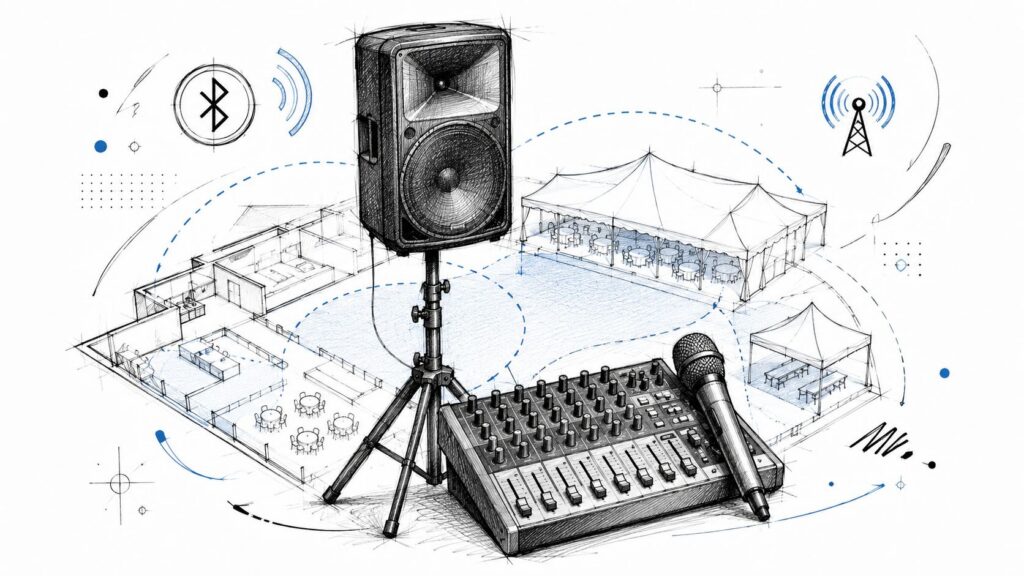
Sound System for Event: Setup and Coverage Guide
You can have a beautiful ceremony site, carefully written vows, and a reception playlist ready to go, yet still lose the most important words to wind, distance, or a sudden Bluetooth dropout. Outdoor ceremonies expose weak audio quickly. A microphone that sounds acceptable during a quiet setup can become muffled once guests settle in, while a speaker aimed at the front row may leave everyone behind it straining to hear. A dependable sound system for an event isn't defined by how loud it can get. It's defined by whether the officiant, couple, speakers, and musicians remain clear across the entire audience area, then transition smoothly into dinner and dancing. The practical approach is to plan coverage, signal paths, microphone placement, and backup control before the first guest arrives. Table of Contents Why Event Sound Fails at the Worst Moments The problems planners should identify early Mapping Coverage for Indoor and Outdoor Spaces A coverage-first calculation Choosing Microphones and Signal Paths Build the channel plan before arrival Bluetooth Hookup and Reception Audio Workflow A controlled connection sequence Plan the reception transitions Working with Venue Systems and Outside AV Vendors Start with the event, not the equipment list When external AV support earns its place Future-Proofing for Accessibility and Hybrid Events Match the upgrade to the audience Why Event Sound Fails at the Worst Moments The failure usually begins without warning. During a ceremony rehearsal, the officiant speaks into a wireless microphone and the sound seems fine. On the actual day, a breeze hits the capsule, the vows pick up popping noise, and guests at the back hear fragments instead of complete sentences. A reception toast can create a different problem. Someone walks in front of a speaker, the microphone gets too close to the PA, and feedback cuts through the room just as the best man starts speaking. Bluetooth introduces another familiar risk. A phone connects successfully during setup, then a notification, incoming call, device switch, or unstable connection interrupts the first-dance song. The equipment may be functioning exactly as designed. The workflow wasn't. The problems planners should identify early Three patterns account for many avoidable complaints: Muffled spoken audio: Wind, clothing friction, poor microphone technique, and incorrect speaker placement reduce intelligibility before anyone considers volume. Uneven audience coverage: Guests near the speakers hear too much while rear rows hear too little. Turning up the main PA rarely fixes that balance. Uncontrolled connections: A shared phone, untested Bluetooth receiver, or last-minute laptop creates a fragile playback chain. The remedy is not automatically a larger amplifier. It's a deliberate plan for who speaks, where each listener sits, how far the signal must travel, and who controls the levels. Ceremony audio deserves its own test because speech has a narrower margin for error than background music. Practical rule: If the person responsible for music can't explain the backup connection and the person responsible for microphones can't identify the audience coverage limits, the system isn't ready. Ask the venue or AV provider specific questions. Where will the speakers stand? Is the microphone signal wired or wireless? Who monitors levels during vows and toasts? Can the system cover both an outdoor ceremony site and an indoor reception room without moving guests or improvising cables? Those answers tell you more than a checklist that only says “PA included.” Mapping Coverage for Indoor and Outdoor Spaces Treat event sound as a geometry problem, not a wattage contest. The relevant measurement is the distance between the loudspeaker and the farthest listener, along with the speaker's coverage pattern and the shape of the audience area. A powerful system aimed in the wrong direction can produce louder front-row sound while leaving the back poorly served. Start by drawing the ceremony or reception footprint. Mark the main speaker positions, the nearest listeners, the farthest listeners, walkways, walls, reflective surfaces, and any change between indoor and outdoor zones. A venue with outdoor grounds and a climate-controlled reception hall requires two related plans, not one generic PA setting. Texas Old Town's indoor and outdoor event space is the kind of mixed layout where that distinction matters. A coverage-first calculation Use this sequence before selecting equipment: Measure the farthest listener distance. Work backward from the rear of the audience, not forward from the stage. Account for distance loss. Sound pressure level drops by about 6 dB every time listener distance doubles, as explained in Live Sound 101 event sound system design. Choose the target by event type. Outdoor or mixed-space guidance places speech roughly at 75 to 85 dB SPL, while background or live-music reception areas sit around 85 to 95 dB SPL, with the same source recommending 10 to 20 dB of headroom for control and clean peaks. Add operating margin. That guidance generally means oversizing amplifier power by 2 to 4 times and operating the system around 70 to 80% capacity, rather than forcing it to run at its limit. Check the overlap. Main speakers and delay fills should meet with only about 3 to 6 dB of level difference so guests don't hear a sudden jump or an obvious phase problem. A long outdoor audience area often needs delay speakers once listeners are more than about 30 to 40 meters from the main PA, according to this outdoor lighting and sound guide. Delays shouldn't be turned up until they sound prominent. They should reinforce the rear zone while blending with the mains. For planners comparing portable options, it can help to browse event equipment hire after the coverage sketch is complete. Equipment should follow the map. Renting a larger speaker without confirming its throw, dispersion, and placement won't solve a dead zone. A final walk test matters more than a specification sheet. Stand at the ceremony entrance, the center aisle, the last row, and the edges of the reception area. Check speech at each point, then listen for level changes as you move between zones. The goal is consistent intelligibility, not maximum loudness at the speakers. Choosing Microphones and Signal