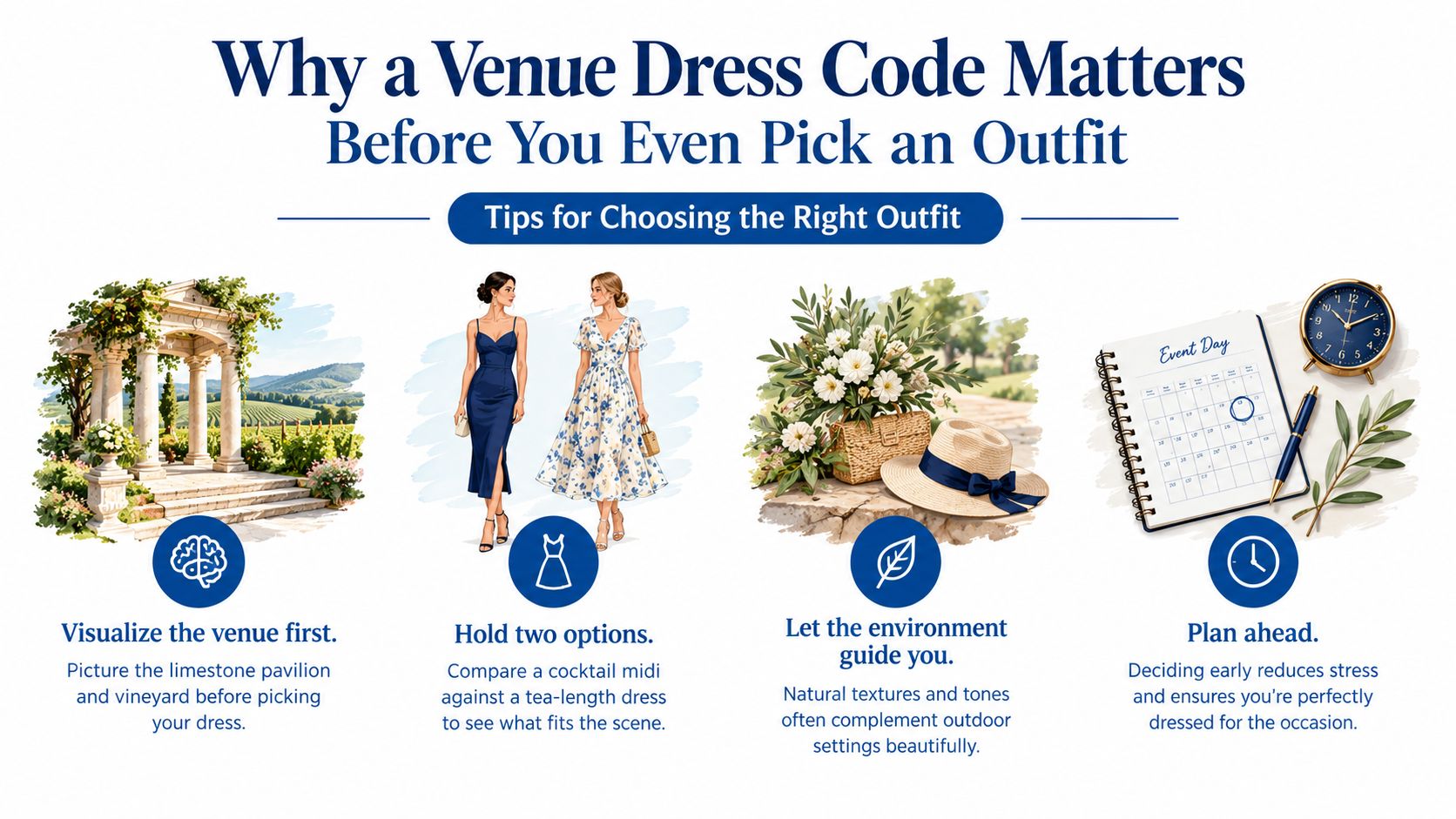
A guest is standing in front of a closet, holding a cocktail midi against a tea-length dress and trying to picture your limestone pavilion, vineyard lawn, or barn reception. The invitation says “formal,” but that still leaves practical questions. Will the ceremony sit on grass or crushed granite? Will guests move from full sun to an air-conditioned hall? Are dress shoes suitable for the paths?
That hesitation is exactly why a venue dress code deserves more attention than a single line at the bottom of an invitation. The right guidance helps guests choose clothing that respects the event, works with the property, and stays comfortable from ceremony through dancing. It also gives hosts and coordinators fewer avoidable problems to solve on event day.
Table of Contents
- Why a Venue Dress Code Matters Before You Even Pick an Outfit
- What a Venue Dress Code Actually Does
- Common Dress Code Categories Explained
- How Venue Features Change What Guests Should Wear
- How Hosts Should Write the Dress Code
- How Guests Can Comply With Confidence
- Bringing It All Together on Event Day
Why a Venue Dress Code Matters Before You Even Pick an Outfit
A venue sets conditions before anyone chooses a color, hemline, or jacket. Gravel paths change footwear decisions. An open-air chapel changes layering. Barnwood floors, lawns, patios, and climate-controlled halls all create different demands, even when the invitation uses the same word, such as “cocktail.”
A guest shouldn't have to search through venue photos, call three relatives, and guess whether a dressy flat looks underdressed. The property should inform the instruction. If the ceremony takes place outdoors and the reception moves inside, the dress code needs to account for both spaces rather than describing only the desired level of polish.
Practical rule: Choose the outfit around the least forgiving part of the property, then make it as formal as the invitation requires.
That means a guest attending a garden ceremony may choose a formal midi with a block heel instead of a floor-length gown with a narrow stiletto. Someone attending a chilly indoor reception may bring a blazer or wrap even if the outdoor weather feels warm. A corporate host planning a banquet should consider whether attendees will walk across manicured grounds before entering the hall.
Start with the property
Hosts should identify the event's physical sequence before writing attire guidance:
- Ceremony setting: Grass, gravel, stone, pavement, or an indoor floor.
- Guest movement: Whether attendees will walk between ceremony, cocktail hour, dinner, and dancing.
- Climate changes: Sun exposure, wind, evening cooling, or a cold reception room.
- Surface rules: Whether heels, cleats, hard soles, or shoes that damage finished floors create a problem.
Guests who want a broader starting point can also review this wedding guest attire guide 2026, then adjust the outfit to the actual venue rather than treating a general style guide as a final answer.
A useful dress code protects three things at once: the host's vision, the guest's comfort, and the venue's operation. It should tell people how to look appropriate without forcing them to sacrifice mobility, cultural expression, religious attire, adaptive clothing, or weather-appropriate layers.
What a Venue Dress Code Actually Does
A venue dress code is a written operating instruction. It aligns the formality of the clothing, the character of the event, and the physical demands of the property.
It performs three jobs. First, it helps guests place themselves on the casual-to-formal scale. Second, it prevents visible mismatches, such as athletic shoes and denim at a formal banquet or fragile footwear on a lawn. Third, it gives coordinators a consistent reference when guests ask about coats, shoes, layers, or accommodations.
Consider a Texas Hill Country event that begins on crushed granite, continues to a covered terrace, and ends on a sealed dance floor. “Cocktail attire” establishes the general formality, but it doesn't answer whether a guest should wear a thin heel, bring a jacket, or choose a dress that allows comfortable walking. A strong policy adds those details.
Three jobs a venue dress code performs
| Audience | What the dress code solves | Example outcome |
|---|---|---|
| Guests | Uncertainty about formality and practical clothing | A guest chooses a polished midi, dress shoes, and a light layer for an outdoor ceremony followed by an indoor reception |
| Hosts | Inconsistent attire that can distract from the event's intended atmosphere | A wedding party communicates one clear standard across invitations, reminders, and the event website |
| Venue staff | Repeated questions about surfaces, jackets, footwear, and exceptions | Coordinators can answer consistently and direct private accommodation requests to the right person |
The guidance also reflects guest behavior. A 2023 YouGov survey of 1,000 U.S. adult citizens found that 59% considered wearing white to a wedding inappropriate, 77% considered an outfit more extravagant than the couple's inappropriate, and 79% considered casual clothing inappropriate when the stated dress code was formal. Those results show why a dress code functions as behavioral guidance, not decorative wording.
Put the instruction where guests will see it
Place the attire block beside the date, time, and location on the invitation or details card. Repeat the same wording on the event webpage, registration page, or guest FAQ. Don't hide the only explanation behind a vague “see website” note.
The policy should answer four questions quickly:
- How formal should the outfit be?
- What garments meet that standard?
- What property conditions affect shoes or layers?
- Whom should guests contact about accessibility, religious, medical, or cultural needs?
Clear wording reduces guesswork without turning the host into an enforcer. Guests need a usable standard, not a lecture on etiquette.
Common Dress Code Categories Explained
A dress-code label must tell guests what to put on and how that clothing will work at the property. “Formal” does not answer enough when a Hill Country venue combines an outdoor ceremony with a climate-controlled hall, gravel paths, lawns, and a long walk between spaces. Use the category as the starting point, then specify garments and practical footwear.
| Dress code | What guests wear | Footwear and surface note |
|---|---|---|
| Casual | Clean jeans, neat trousers, sundresses, polished shirts, and simple skirts | Closed-toe sandals, clean boots, or comfortable flats suit gravel, lawns, and relaxed outdoor settings |
| Smart casual | Collared shirts, pressed trousers, midi dresses, polished jumpsuits, and loafers | Choose shoes that can manage turf or paths without looking like athletic footwear |
| Cocktail or semi-formal | Knee-length or midi dresses, dressy separates, dark trousers, dress shirts, and refined jumpsuits | Block heels, wedges, dress shoes, or elegant flats are safer for movement between ceremony and reception |
| Formal | Floor-length gowns, dressy midi dresses, dark suits, formal separates, and polished accessories | Select stable dress shoes when guests will cross grass, stone, or uneven walkways |
| Black tie | Tuxedos, formal dinner jackets, bow ties, evening gowns, or an equally formal ensemble | Dress shoes suit smooth indoor floors, while outdoor venues should state whether stable formal footwear is preferred |
| Theme or cultural attire | Western wear, garden-inspired clothing, white-tie variations, traditional dress, religious attire, or another stated theme | The theme must not override safety, mobility, climate, or respectful accommodation |
Casual and smart casual
Casual does not mean careless. Clean jeans, a neat sundress, a pressed shirt, or polished boots can suit a relaxed barn celebration or daytime family event. At a property with crushed stone, grass, or maintained grounds, guests still need shoes that provide support and stability.
Smart casual raises the standard without requiring eveningwear. A collared shirt with pressed trousers, a midi dress with simple accessories, or a neat jumpsuit usually meets the expectation. Leave out clothing designed for exercise, errands, or the beach unless the host has specifically requested that look. Hosts should name acceptable garments because “smart casual” can otherwise produce widely different interpretations.
Cocktail, semi-formal, and formal
Cocktail and semi-formal attire sit in the middle. Guests can choose a knee-length or midi dress, dressy separates, dark trousers with a dress shirt, or a polished jumpsuit. Outdoor cocktail events call for footwear that handles the ground, while an indoor ballroom allows more delicate shoes.
Formal attire should look intentional from head to toe. Floor-length gowns, dressy midi dresses, dark suits, formal separates, and dress shoes fit the expectation. The property still affects the final choice. Formal on limestone is still formal without the stiletto.
Black tie and themed events
Black tie has a specific history. Accounts commonly trace the first dinner jacket to 1865, when the Prince of Wales wore a shorter alternative to the traditional tailcoat. The dinner jacket, black waistcoat, and black bow tie later became associated with formal eveningwear, distinct from white tie. The historical account is summarized in black-tie dress standards.
For practical purposes, black tie generally means a tuxedo or dinner jacket with a bow tie. Women may choose a floor-length gown or another comparably formal evening ensemble. Hosts who want flexibility should write “black tie optional” and list acceptable alternatives, such as a dark formal suit. That wording gives guests a clear standard while allowing them to work with what they own.
Guests and hosts who want to decode event dress codes should focus on observable clothing rather than assumptions about gender. Use terms such as “formal wear,” “separates,” or “evening attire.” Traditional or cultural dress should be presented as a valid way to meet the event standard, not as an exception. For Hill Country properties, the final instruction should also tell guests whether the same outfit must work outdoors, indoors, or across both spaces.
How Venue Features Change What Guests Should Wear
The physical property fine-tunes the dress code. A guest can meet the formality standard and still arrive in clothing that fails the terrain, temperature, or event flow.
Read the ground before choosing shoes
Hill Country properties may include live oak roots, crushed granite, soft turf, flagstone, garden paths, and creek-stone crossings. Thin heels can sink or catch. Delicate soles can wear quickly on rough ground. Ankle straps and loose embellishments can become uncomfortable when guests spend the day walking between outdoor and indoor spaces.
For an outdoor ceremony, recommend block heels, wedges, platforms, dressy flats, or stable boots when they suit the event. Hosts should state the reason plainly. “Comfortable dress shoes for grass” sounds more useful and more inclusive than “no heels.”
Plan for changing thermal conditions
A climate-controlled hall and an open lawn can demand different layers on the same day. ASHRAE defines clothing insulation with the clo unit, where 1 clo equals 0.155 m²·°C/W. A typical long-sleeve ensemble with a knee-length skirt and full slip measures approximately 0.67 clo, while heavier formal ensembles can approach 1 clo, as described in its thermal comfort vocabulary.
The practical lesson is simple. A heavy formal outfit may feel uncomfortable during sun exposure, walking, or dancing outdoors, while a lightweight outfit may feel cold inside. Recommend a removable jacket, shawl, breathable dress shirt, formal wrap, or overshirt that works with the chosen level of formality.
| Venue feature | Impact on dress | Recommended adjustment |
|---|---|---|
| Outdoor lawn or garden | Shoes may sink, and guests may walk farther than expected | Choose stable footwear and mention lawn conditions in the invitation |
| Crushed granite or stone paths | Thin soles and delicate heels can create discomfort | Suggest dress shoes, block heels, wedges, or polished flats |
| Open-air ceremony | Sun, wind, and changing temperatures affect comfort | Recommend breathable fabrics, secure accessories, and a removable layer |
| Climate-controlled hall | Guests may feel cooler after outdoor exposure | Add a formal jacket, wrap, blazer, or shawl to the outfit plan |
| Indoor dance floor | Footwear and clothing must support movement | Clarify that guests should choose clean, stable shoes suitable for dancing |
| Ceremony-to-reception transition | One outfit must work across different settings | Write separate guidance for outdoor ceremony attire and indoor reception attire |
A property that combines outdoor grounds with indoor halls should communicate the transition explicitly. Guidance on indoor-outdoor venue flexibility for weddings and events reinforces the planning principle: the venue sequence matters as much as the formality label.
Sustainability also belongs in the conversation. Guests can rent occasional-use formalwear, borrow a garment, tailor something already owned, rewear versatile separates, or choose pieces that work beyond one celebration. Market reporting cited research that rental can reduce per-wear greenhouse-gas emissions by up to 84% when garments receive higher utilization, according to formalwear rental market reporting. Hosts don't need to prescribe rental, but they can normalize practical, lower-waste choices.
How Hosts Should Write the Dress Code
The strongest wording contains three parts: a category, a garment example, and a property-specific constraint. Leave out any one of those and guests still have to infer too much.
“Cocktail attire” gives the formality level. “Midi dress, dressy jumpsuit, or dark suit and tie” gives guests a usable clothing target. “Comfortable shoes recommended for the lawn ceremony” connects the standard to the property.
Use examples guests can see
Write for a guest who has never visited the venue. Avoid relying on insider terms such as “refined,” “chic,” or “Texas formal” unless you define them.
Good examples include:
- Cocktail attire: “Wear a knee-length or midi dress, dressy jumpsuit, separates, or a dark suit with a dress shirt. The ceremony takes place on grass, so choose stable dress shoes, block heels, wedges, or flats.”
- Formal outdoor wedding: “Formal wear is requested. Floor-length gowns, formal midi dresses, dark suits, and formal evening separates are welcome. Select footwear suitable for outdoor paths and bring a layer for the indoor reception.”
- Black tie optional: “A tuxedo or dark formal suit is appropriate. Guests may also wear a floor-length, midi formal, or evening ensemble with dress shoes. No casual denim, athletic shoes, or novelty clothing.”
- Hill Country casual: “Wear polished casual clothing such as clean jeans, a sundress, a collared shirt, boots, loafers, or neat sandals. The event includes outdoor paths and lawn seating.”
Make constraints about the venue
Avoid language that treats a guest's body or gender as the problem. “No heels” is blunt and may exclude guests who rely on a particular shoe. “Choose footwear that stays stable on grass and gravel” explains the operational reason and leaves room for personal needs.
The same approach works for garments:
- “A light wrap is recommended for the climate-controlled reception.”
- “Please avoid long trains on the patio.”
- “Dress shoes must be clean and suitable for the indoor dance floor.”
- “Traditional, religious, modest, adaptive, and culturally specific formalwear is welcome.”
- “Contact the coordinator privately with accessibility or accommodation questions.”
Repeat the exact wording
Place the dress code directly below the event location and time. Repeat it on the event website, details card, registration page, and reminder message. Venue staff should receive the same wording in the planning packet so the coordinator, caterer, and host don't give conflicting answers.
The policy should also separate attire expectations from safety requirements. A guest may wear formal religious clothing, an adaptive garment, or traditional attire while still needing footwear that works on the property. That distinction keeps the event polished without confusing respect with uniformity.
How Guests Can Comply With Confidence
Guests don't need to guess. Before packing, confirm three details with the host or coordinator:
- Formality: Ask whether the event is casual, cocktail, semi-formal, formal, black tie optional, or black tie.
- Terrain: Find out whether the ceremony or cocktail hour includes grass, gravel, stone, stairs, or uneven paths.
- Climate: Ask whether any part of the event takes place in an open-air space, cellar, hall, terrace, or other climate-controlled room.
Choose footwear for the worst surface of the day, not the most attractive one. Break in new shoes before the event, and consider bringing a second pair for dancing if the schedule involves substantial walking or standing.
Pack one adaptable layer regardless of the season. A pashmina, linen blazer, formal jacket, or light shawl can make an outdoor-to-indoor transition much easier without changing the outfit's formality.
Respect the code without ignoring your needs
Dress codes describe the event's expectations. They don't define who belongs at the event. Religious attire, cultural clothing, modest garments, adaptive clothing, medical devices, and accessibility-related footwear should have a clear place in the policy.
Contact the host early if a stated requirement creates a conflict. A short private message gives the coordinator time to offer a practical solution, whether that means approving a different shoe, clarifying a garment, or arranging a smoother route across the property.
Once the outfit is settled, guests can plan the finishing details without losing sight of comfort. If professional preparation is part of the schedule, a makeup specialist near San Antonio can help create a look that suits the event's formality and the demands of a long day.
Bringing It All Together on Event Day
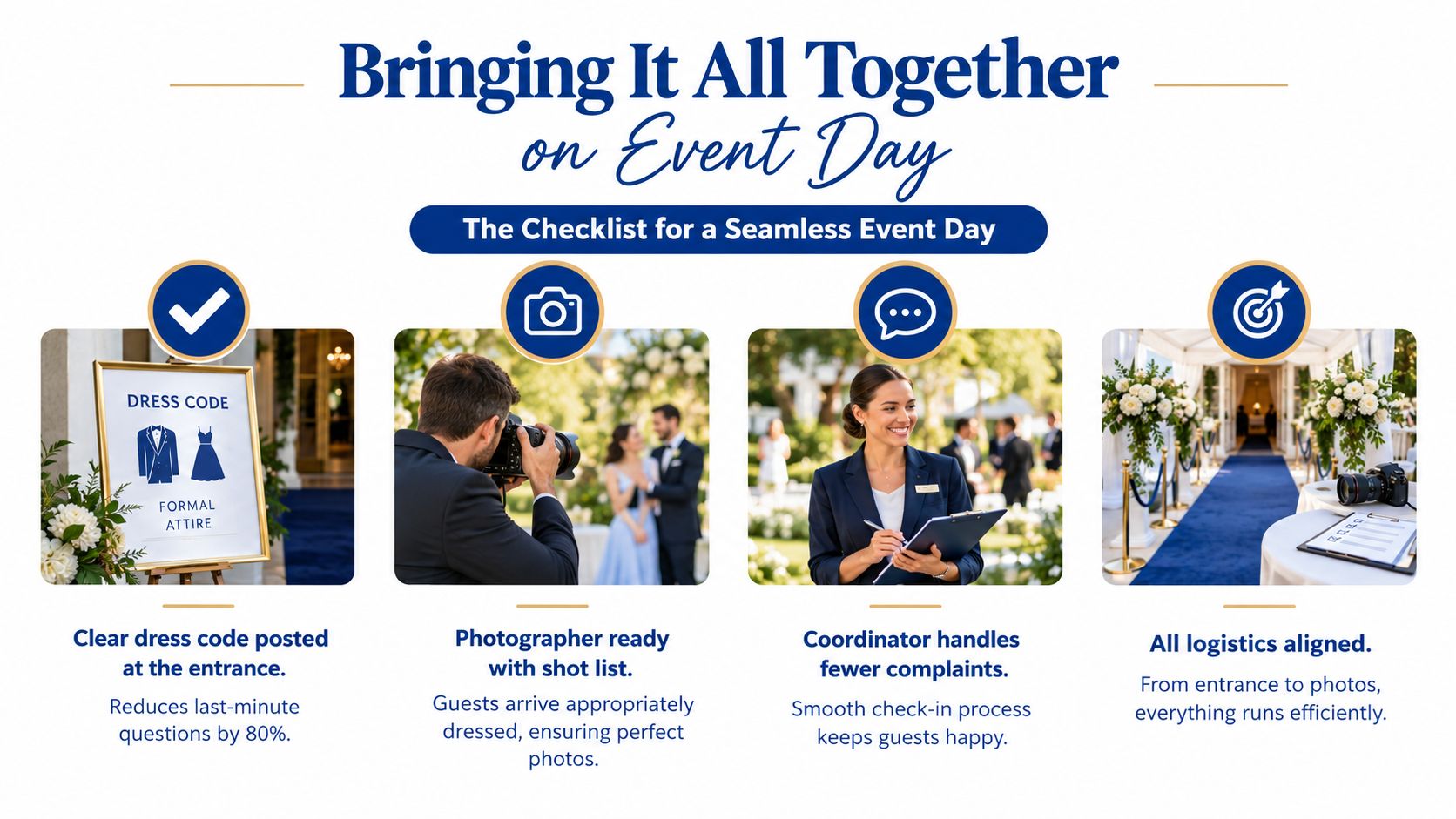
A clear dress code improves the whole event. Guests arrive with fewer questions, coordinators spend less time resolving avoidable misunderstandings, photographers work with a more cohesive visual story, and attendees move more comfortably between outdoor ceremony spaces and indoor receptions.
Use this short checklist:
- Put the dress code beside the time and location on the invitation.
- Repeat the same wording on the venue website or details card.
- Send a one-line reminder in the group chat during the week before the event.
- Name one coordinator for accommodation and accessibility questions.
- Mention layers, stable footwear, and outdoor conditions when they apply.
For Texas properties, guests should plan for outdoor portraits, evening temperature changes, grass, flagstone, and sun exposure. Hosts should treat those details as part of the guest experience, not as fine print. A venue dress code protects the host's vision, the guest's comfort, and the staff's workflow at the same time.
Texas Old Town offers four private halls, outdoor ceremony sites, climate-controlled reception spaces, on-site management, and a 16-hour access window across a 55-acre Hill Country property, as detailed at Texas Old Town. Visit the venue to evaluate the ceremony surfaces, indoor-outdoor flow, and dress-code language before you send invitations.