You've found the Hill Country venue, chosen a date, and received a contract that appears refreshingly simple. The rental price is clear, the ceremony site looks beautiful, and the venue representative says, “You'll have the property all day.” Then your florist arrives early, the gate is locked, your caterer asks where the prep kitchen is, and you discover that “all day” meant something very different from what you assumed.
That confusion is common in Central Texas. Venue rental contracts for barns, ranches, vineyards, and restored halls often divide exclusive access, event time, vendor load-in, teardown, and final departure into separate rules. Sign before you understand those distinctions, and a polished venue can become an expensive logistics problem.
Table of Contents
- Why Venue Rental Contracts Catch Central Texas Clients Off Guard
- The Rental Window Clause and What Access Time Really Means
- Inclusions and Exclusions That Shape the Real Price
- Payment Schedules, Damage Deposits, and Cancellation Terms
- Hidden Fees to Watch For Before You Sign
- Vendor Policies and BYOB Liability in Flexible Texas Venues
- Negotiation Tactics That Actually Work in Central Texas
- Pre-Signing Checklist and Red Flags Worth Walking Away For
Why Venue Rental Contracts Catch Central Texas Clients Off Guard
A Hill Country couple once planned a 6 p.m. ceremony and assumed their florist could arrive whenever necessary. Their florist showed up at 7 a.m. with arrangements, décor, and installation supplies. The gate attendant turned the crew away because the contract's “exclusive access” period didn't begin until later in the day. The couple had read the phrase as full control of the property. The venue treated it as a narrower right tied to a specified rental window.
That disagreement rarely comes from bad intentions. It comes from contract language that uses familiar words without defining the operational details. A hotel ballroom usually has continuous staff, controlled loading areas, and established procedures for vendors. A Central Texas ranch or converted barn may hand over the keys, provide a site manager for the event, and leave the client's planner to coordinate every arrival and departure.
The three blind spots
The first problem is ambiguous access time. “Event time” may describe only guest-facing hours, while setup begins later and teardown ends earlier than the client expects. The second is vendor liability. A flexible venue may allow an outside caterer, bartender, florist, or rental company without taking responsibility for that vendor's employees, equipment, or mistakes.
The third is unmarked overtime. A late ceremony, delayed shuttle, slow teardown, or amplified music extension can trigger charges even when guests barely notice the delay.
Practical rule: If the contract doesn't state when your vendors may arrive, when guests must leave, and when every item must be off the property, you don't have a usable schedule.
The broader market makes this precision important. One 2026 industry summary estimates the global event venue market at $450 billion in 2023, with a projection of $620 billion by 2030, while the U.S. market generated $120 billion in 2022. The same summary places the wedding-venue segment at 35% of total event venue revenue, or about $42 billion, and reports an average U.S. rental cost of about $5,000 for a 50-person event, rising to as much as $15,000 in premium markets such as New York City and Los Angeles. Those figures show why small wording differences can affect a high-value, heavily scheduled asset. (venue market and rental-cost summary)
The rest of your review should focus on what the contract lets you do, when you can do it, and who pays when a person or vendor causes a problem.
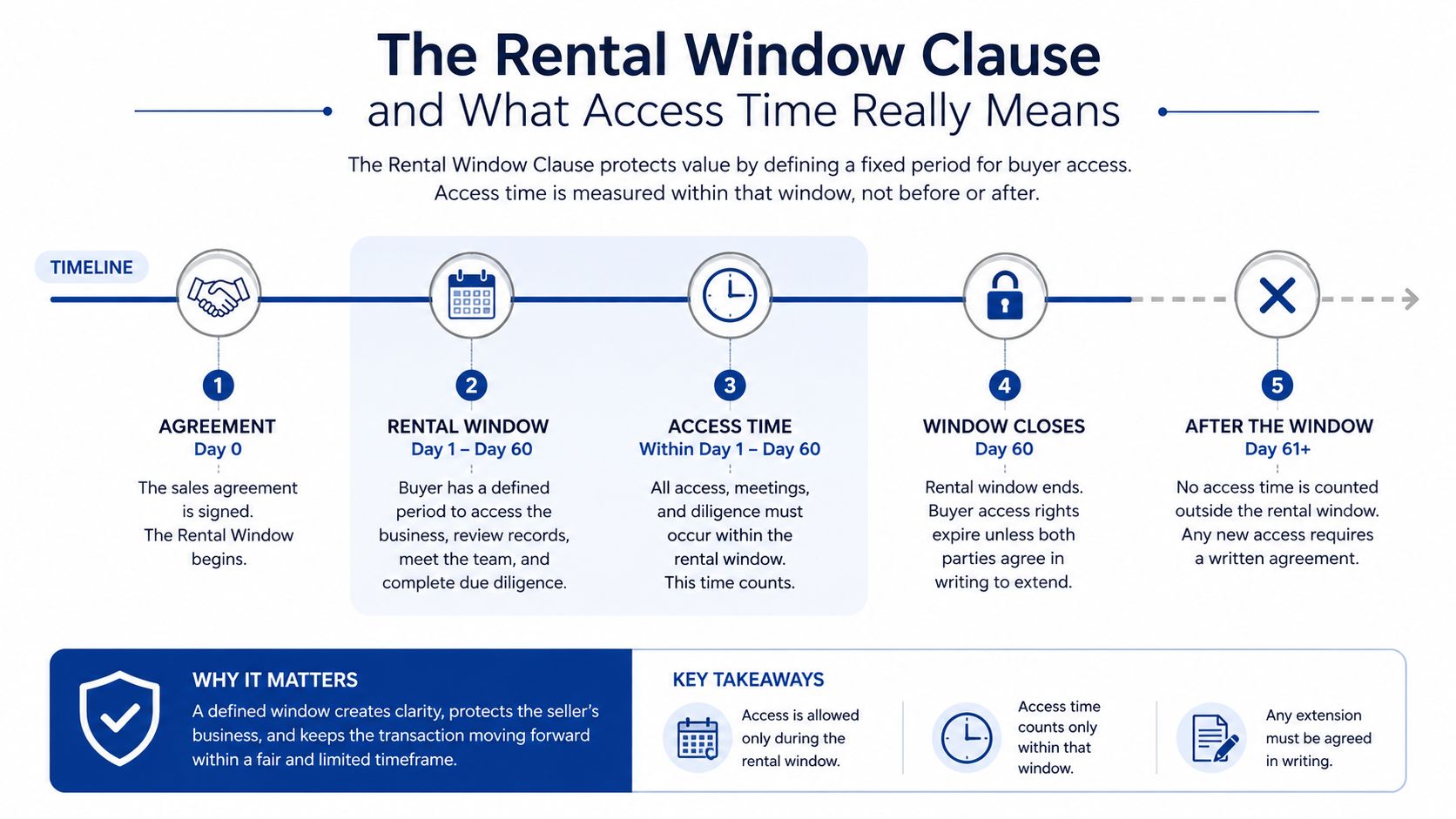
The Rental Window Clause and What Access Time Really Means
The rental window clause defines the period when you control the venue. A common Central Texas structure is a 16-hour block from 8 a.m. to midnight, but that doesn't mean your ceremony, vendors, guests, and teardown can use every minute without restrictions.
Separate the schedule into five parts:
- Access time: When you, your planner, and approved vendors may enter.
- Setup time: When florists, rental crews, caterers, and musicians may unload and install.
- Event time: The guest-facing period, often narrower than the rental window.
- Teardown time: The period for removing décor, food equipment, personal items, and rented goods.
- Hard vacate time: The deadline when people, vehicles, and property must be gone.
A contract may advertise “full-day access” but still say that vendor load-in starts at 10 a.m., the ceremony must begin within a particular window, amplified music ends at a separate cutoff, and everyone must depart shortly after midnight. The phrase sounds generous until you compare the promised access with the actual permitted actions.
Words to find before you initial
Search the agreement for “vendor load-in begins,” “ceremony start window,” “amplified music cutoff,” “final departure,” “cleanup,” “teardown,” and “vacate.” Don't rely on a venue brochure or a sales conversation to fill gaps. The contract controls when there's a dispute.
A performance-venue rental guide describes events as commonly confirmed 2–6 months before the event, showing how closely many venue agreements sit to the event date. It also explains that use days can include move-in, move-out, and “dark days,” when space is reserved and unavailable to another client. (performance venue rental guide)
A six-hour wedding can consume a twelve-hour operational day. Your contract should show every hour, not just the hours your guests see.
Ask the venue to attach a schedule that names the earliest vendor arrival, guest entry, ceremony, reception end, music cutoff, cleanup completion, and final departure. If the venue grants an extension, get the revised times and any fee in writing before signing.
Inclusions and Exclusions That Shape the Real Price
The inclusions page often determines the final cost more than the headline rental price. A contract can say “tables and chairs included” while limiting the quantities, restricting their placement, or charging for every item beyond the stated inventory.
Read the list as an inventory sheet, not a marketing description. Confirm the exact number and type of tables, chairs, bars, microphones, speakers, dressing suites, parking spaces, coordination hours, and kitchen privileges. “Access to a prep kitchen” doesn't necessarily mean the caterer receives refrigeration, cooking equipment, storage, or exclusive use.
What commonly appears in each column
Central Texas venues often include some combination of furniture, a basic PA system, a getting-ready suite, a prep kitchen, parking, and limited on-site coordination. Exclusions frequently include linens, dinnerware, glassware, bar service, signage, ceremony furniture, rehearsal access, shuttle vehicles, and extra coordination.
The quiet upcharge appears when an item is technically included but capped. A venue might include chairs for the contracted guest count, then charge for additional pieces. It might include one coordination meeting and bill for every additional hour. Your job is to identify the threshold before you compare proposals.
| Item | Usually Included | Usually Excluded | Typical Add-On Cost |
|---|---|---|---|
| Guest tables | A stated inventory | Specialty, banquet, or extra tables | Contract-specific |
| Guest chairs | A stated inventory | Additional or upgraded chairs | Contract-specific |
| Sound equipment | Basic PA, microphone, or Bluetooth connection | Technician, advanced lighting, or expanded AV | Contract-specific |
| Getting-ready space | One or more designated suites | Early access or additional rooms | Contract-specific |
| Prep kitchen | Basic access for the approved caterer | Food storage, specialty equipment, or extra cleaning | Contract-specific |
| Bar service | Bar structure or service area | Bartenders, glassware, mixers, permits, or insurance | Contract-specific |
| Cleanup | Standard venue cleanup | Excess waste, vendor cleanup, or damaged items | Contract-specific |
The planning guide's job is to turn every exclusion into a line on your budget. Add catering rentals, linens, glassware, staffing, transportation, décor, ceremony furniture, and rehearsal use. Then ask the venue to produce a worst-case invoice, not a starting quote.
If an item matters to your event, its quantity, condition, location, and price belong in the contract.
Don't accept “we usually include that” as an answer. Have the venue write “150 chairs,” “12 tables,” “two dressing suites,” or whatever applies to your booking. Specific counts prevent arguments when another event uses part of the inventory or a vendor assumes the venue supplies something it doesn't.
Payment Schedules, Damage Deposits, and Cancellation Terms
A contract can look affordable until a missed deadline turns the booking deposit into a forfeited payment. Require the payment section to answer four questions clearly: what reserves the date, when later payments are due, what money is refundable, and what happens if you cancel or postpone.
The booking deposit usually reserves the date. Later installments may follow contract milestones, with the final balance due before the event. A damage deposit serves a different purpose. It is a separate hold for defined losses such as property damage, excess cleaning, missing equipment, or other documented charges. The agreement should state whether the hold is refundable, when the venue will return it, and what evidence supports any deduction.
Read the schedule as a deadline map
| Payment Stage | Typical Amount | Typical Timing | Refundable? |
|---|---|---|---|
| Booking deposit | Contract-specific | When the agreement is signed | Often non-refundable |
| Milestone installment | Contract-specific | A scheduled date before the event | Depends on the cancellation clause |
| Final balance | Contract-specific | Before the event | Usually governed by cancellation terms |
| Damage deposit | Contract-specific | Before or near the event | Usually refundable if no charge applies |
Use the schedule as a working calendar, not background paperwork. A sample event-space agreement makes the balance due 7 days before the event, showing how venues may divide the booking deposit from the final payment. (sample event-space payment agreement)
Look closely at labels such as “administrative,” “processing,” and “date reservation.” A fee under one of those names may be nonrefundable even when the client expects a refund. Postponement creates another common dispute. You may view a date change as preserving the booking, while the venue treats the original reservation as canceled and the new date as a separate contract.
Ask for the consequence, not the label
Cancellation clauses may increase the amount forfeited as the event approaches. Force majeure language may address extraordinary conditions, but it does not automatically cover every weather concern, travel disruption, or venue-access problem. Identify the exact triggers, deadlines, refunds, credits, and rescheduling options.
For a plain-language comparison of refund concepts outside your venue agreement, browse refund terms, then compare them with the binding contract language. Couples building a scheduled wedding budget can also review payment plans for weddings to see how venues may organize installments.
Ask this before signing: “If I cancel, what specifically do I lose, and when is each deadline?” Get the answer in writing. The document should cover deposits, installments, damage holds, postponement rights, and any credit toward a new date.
Hidden Fees to Watch For Before You Sign
A quoted rental fee is not an all-in price unless the contract says what it includes. Flexible Hill Country properties often create modular proposals, which can be useful, but each module gives another line item room to appear after the booking.
Start with overtime. The contract should state the hourly rate, the event-end trigger, the teardown trigger, and whether the fee applies to guests, vendors, music, vehicles, or all of them. A delayed shuttle can keep guests on-site. A caterer breaking down equipment can keep vendors on the property. Either situation may create a charge under a poorly drafted clause.
Fees that deserve a written explanation
- Overtime: Ask whether the charge starts at the scheduled event end, music cutoff, or final vacate time.
- Beverage charges: Confirm whether bartending, mixers, ice, glassware, insurance, and service fees are separate from the beverages.
- Outside-vendor fees: Look for corkage, load-in, kitchen, security, waste, and vendor-access charges.
- Cleaning minimums: Check whether the venue charges more when a non-preferred caterer handles cleanup.
- Ceremony add-ons: Confirm whether a ceremony on the same property creates a separate site or setup fee.
- Service charges: Ask whether a service fee is a gratuity, an administrative charge, or both.
- Sound surcharges: Identify music cutoffs and extra charges tied to amplified sound or local noise restrictions.
The tax treatment of service charges can also create confusion. Don't accuse the venue of miscalculating tax based on a generic rule. Ask for the taxable subtotal, tax line, service charge, and gratuity as separate entries so your accountant or planner can review the calculation.
Ask for the ugly invoice. You want the version that includes late departure, extra cleanup, outside catering, added bartending, ceremony use, sound extension, and every other plausible charge.
Transparent pricing gives you one clear number with its inclusions and exclusions. Modular pricing gives you flexibility but demands more scrutiny. I prefer the second approach only when the venue is willing to disclose every possible add-on before the deposit becomes non-refundable.
Vendor Policies and BYOB Liability in Flexible Texas Venues
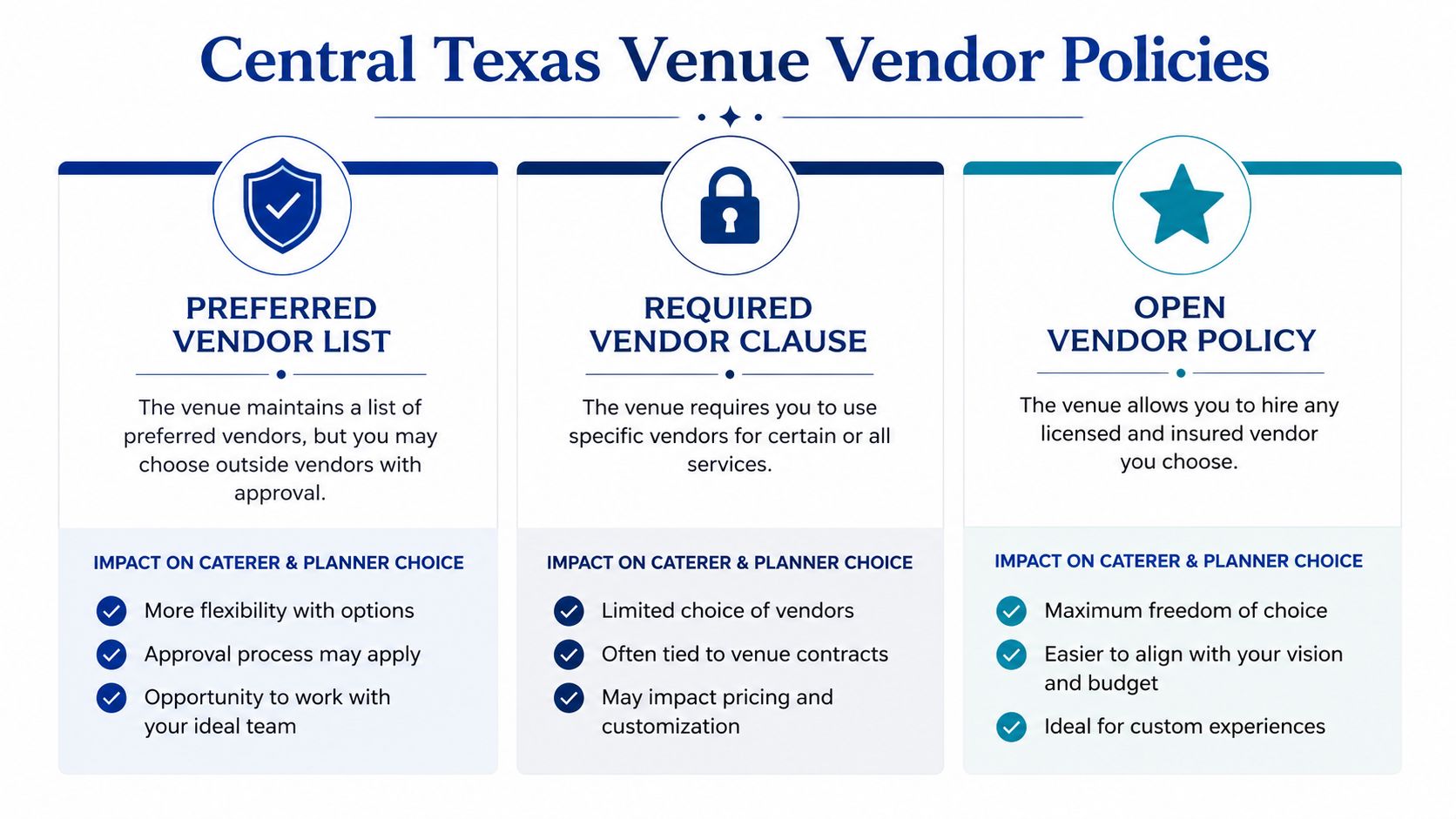
Central Texas venues generally use one of three vendor structures. A preferred-vendor list recommends caterers, planners, bartenders, and rental companies but may allow substitutions. A required-vendor clause limits you to approved providers. An open vendor policy lets you choose outside companies that meet the venue's licensing, insurance, and operating requirements.
Each structure changes your control and your risk. Preferred vendors can reduce coordination friction, but the contract should state whether the list is mandatory. Required vendors can simplify venue oversight, but you need their price sheets before signing. Open policies offer choice, but they place more coordination responsibility on the client and planner.
BYOB changes the liability conversation
A BYOB venue may let the host purchase beverages independently while requiring an approved bartending company. That arrangement doesn't automatically make the venue responsible for service decisions, guest intoxication, vendor conduct, or alcohol-related damage.
Ask for the exact insurance and credential requirements. The contract may require:
- General liability insurance for each outside vendor.
- Liquor liability insurance for bartenders or alcohol-service companies.
- Workers' compensation coverage where required for the vendor's employees.
- Certificates of insurance naming the venue as an additional insured.
- Bartending credentials and service procedures required by the venue or local law.
Contract language alone may not transfer premises or dram-shop exposure. Neutral contract guidance warns that liability allocation depends on insurance, vendor credentials, and applicable state law, not merely on a hold-harmless sentence. (venue rental agreement liability guidance)
Don't ask only, “Can we bring our own alcohol?” Ask, “Who carries each risk, what insurance proves it, and what happens if an outside vendor causes the loss?”
If you're comparing open-vendor properties, review venues that allow outside catering with the same attention to insurance and cleanup terms. Require an indemnity or hold-harmless provision that addresses vendor-caused damage, while understanding that your lawyer should tailor the language to the facts and governing law.
Negotiation Tactics That Actually Work in Central Texas
Most venues won't rewrite their entire agreement, but they may adjust operational details that protect both sides. Your strongest requests solve a concrete scheduling or liability problem instead of just demanding a lower price.
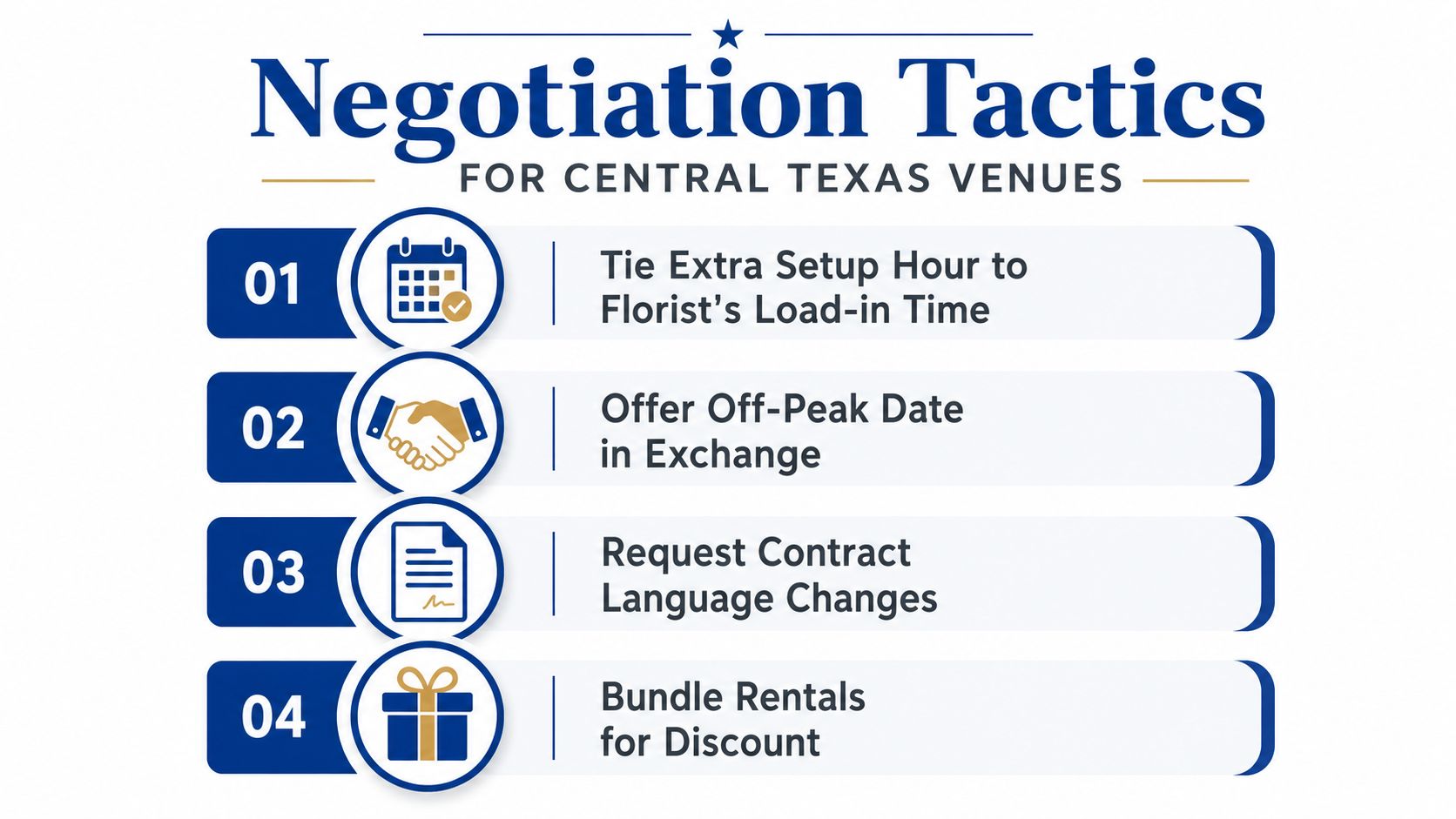
Start with the rental window. Tie an earlier arrival to a named vendor and a documented load-in requirement. “Our florist needs time to install hanging arrangements” is more persuasive than “Can we have more time?” Ask the venue to add the arrival time, permitted access areas, and any supervision requirement to the schedule.
Put practical edits on the table
- Trade flexibility for access: Offer an off-peak date, weekday event, or earlier end time in exchange for an additional setup hour.
- Replace exclusivity with approval: Request mutual approval language that lets you use your photographer, caterer, or planner if the vendor meets the venue's insurance and conduct standards.
- Clarify deposit release: Ask the venue to identify the inspection deadline and the date when the damage deposit must be returned.
- Define weather triggers: For an outdoor Hill Country ceremony, discuss flash-flood warnings affecting low-water crossings, sustained wind concerns, and burn bans during drought conditions.
- Add a rain-plan rider: Require the venue to identify the covered alternative and decision process before the event, rather than leaving the plan to the morning of.
- Cap overtime: Ask for a stated hourly rate and a reasonable multiplier instead of an open-ended penalty.
The venue has legitimate reasons to control sound, vendors, safety, and turnover. Your edits should preserve those protections while eliminating uncertainty. A clear cutoff helps the manager enforce the rule, and a defined vendor insurance requirement protects both parties better than vague language about responsibility.
Have your planner mark proposed edits directly on the agreement. If the venue rejects a request, ask why and whether another clause solves the same concern. You're not trying to remove every venue rule. You're trying to make the rules visible before the event begins.
Pre-Signing Checklist and Red Flags Worth Walking Away For
Take the contract to the site visit. Walk the route your florist, caterer, rental company, guests, and cleanup crew will use, then match that route to the written access rules. A beautiful ceremony lawn doesn't solve a loading problem if the vendor can't reach it during the permitted window.
Confirm the operating details
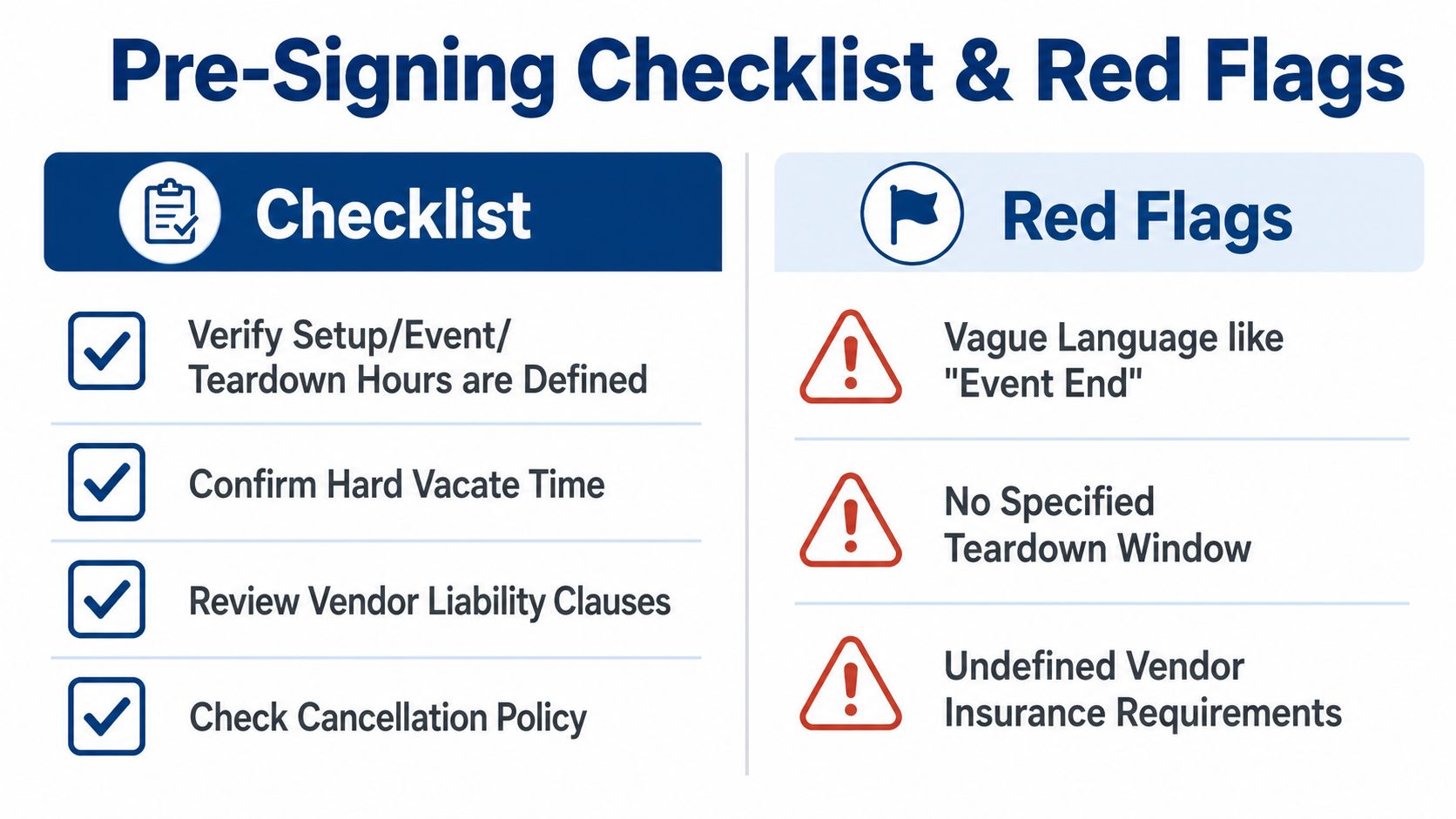
- Rental window: The agreement should separate setup, event, teardown, and final vacate hours.
- Access rights: Identify who may enter, through which gate, and when vendor vehicles may load and unload.
- Furniture inventory: Require exact counts and descriptions rather than broad categories.
- Included equipment: List microphones, speakers, tables, chairs, suites, kitchen access, parking, and cleanup responsibilities.
- Payment deadlines: Mark every deposit, installment, final-balance date, and damage-deposit deadline on your calendar.
- Refund rules: Identify non-refundable amounts, cancellation tiers, postponement treatment, and force majeure remedies.
- Vendor controls: Check preferred and required lists, outside-vendor fees, insurance requirements, and responsibility for damage.
- Fee exposure: Look for overtime multipliers, cleaning minimums, service charges, tax treatment, corkage, ceremony fees, and sound limits.
- Rain plan: Confirm the alternate space, decision authority, and communication process.
For an additional inspection framework, use this venue inspection checklist during your walkthrough. It's easier to challenge a missing detail while you're comparing venues than after your deposit has locked the date.
Five reasons to keep looking
Walk away when the venue refuses to provide a written cancellation policy. Do the same when the agreement gives the venue unlimited liability protection while leaving you responsible for every guest injury, or when the venue won't disclose its certificate of insurance.
Treat required in-house catering without a price sheet as a serious warning. You can't evaluate the rental cost without knowing the required food and beverage structure. A damage deposit exceeding 50% of the rental fee also deserves extreme caution, especially if the agreement doesn't define deductions or set a return deadline.
A contract should make planning calmer, not force you to decode every important obligation through emails and verbal assurances. If the venue can't state when your vendors arrive, what you receive, what you pay, and who carries the risk, keep touring.
Texas Old Town offers four private halls and outdoor ceremony sites across a 55-acre Kyle property, with a 16-hour rental window, documented furniture counts, prep-kitchen access, flexible outside-caterer policies, and on-site management. Visit Texas Old Town to tour the spaces and review a venue rental contract with the access, inclusions, payment, and vendor questions already in hand.