You're probably doing the math in your head already.
You found a venue you love. The photos are beautiful, the ceremony site feels right, and then the proposal lands in your inbox. Suddenly the emotional part of wedding planning turns into a spreadsheet problem. The issue usually isn't just the total price. It's when the money is due, what that price includes, and how exposed you are if something changes.
That's why couples looking for wedding venues with payment plans shouldn't think about the plan as a simple convenience. A payment schedule is a budget tool, a contract clue, and in many cases a risk-management tool. A venue that lets you spread payments out but keeps fees vague can still wreck your budget. A venue with clear inclusions, realistic due dates, and transparent terms gives you something much more useful than flexibility. It gives you predictability.
Table of Contents
- Why Wedding Venue Payment Plans Matter More Than Ever
- Decoding Common Venue Payment Plan Structures
- How to Find and Inquire About Flexible Payment Options
- Negotiating Terms and Spotting Financial Red Flags
- Budgeting with Your Payment Plan A Sample Timeline
- Securing Your Dream Venue Without Financial Stress
Why Wedding Venue Payment Plans Matter More Than Ever
A lot of couples hit the same wall early. They set a rough wedding budget, start touring venues, and realize the venue isn't just one line item. It shapes almost every other decision that follows.

That reaction makes sense. Wedding venues represent the single largest revenue segment within the U.S. wedding services industry, capturing 24% to 40% of total wedding budgets, with the average venue cost reaching $12,200 for couples married in 2024, according to wedding venue market analysis.
When the biggest expense in your wedding comes due in large chunks, everything else gets squeezed. Couples delay booking the photographer they want. They hesitate on florals. They start making rushed decisions because cash flow, not priorities, is driving the timeline.
The real benefit is breathing room
A structured payment plan changes that rhythm. Instead of one large financial hit followed by panic, you get a sequence of known obligations. That lets you match your savings to real dates and make vendor decisions with more confidence.
I usually tell couples to stop asking only, “Can we afford this venue?” and start asking, “Can we carry this venue comfortably through the entire planning period?” Those are different questions.
Practical rule: A venue can fit your total budget and still be a bad financial fit if the payment timing collides with your other major bookings.
Good planning habits matter here. If you want a simple framework for mapping installments against savings goals, these financial mastery tips are useful because they focus on assigning every dollar a job before the due dates arrive.
Why venue structure matters early
Once the venue is booked, the rest of the budget starts taking shape around it. A venue with clear pricing and published inclusions makes that easier than a venue that requires repeated back-and-forth just to understand the total.
That's one reason many Central Texas couples look closely at venues with transparent package details, including options like affordable wedding venues near Austin and San Antonio. They're not only comparing aesthetics. They're trying to avoid budget surprises before they commit.
Decoding Common Venue Payment Plan Structures
Not all wedding venues with payment plans handle timing the same way. Two schedules can have the same total price and feel completely different in real life.
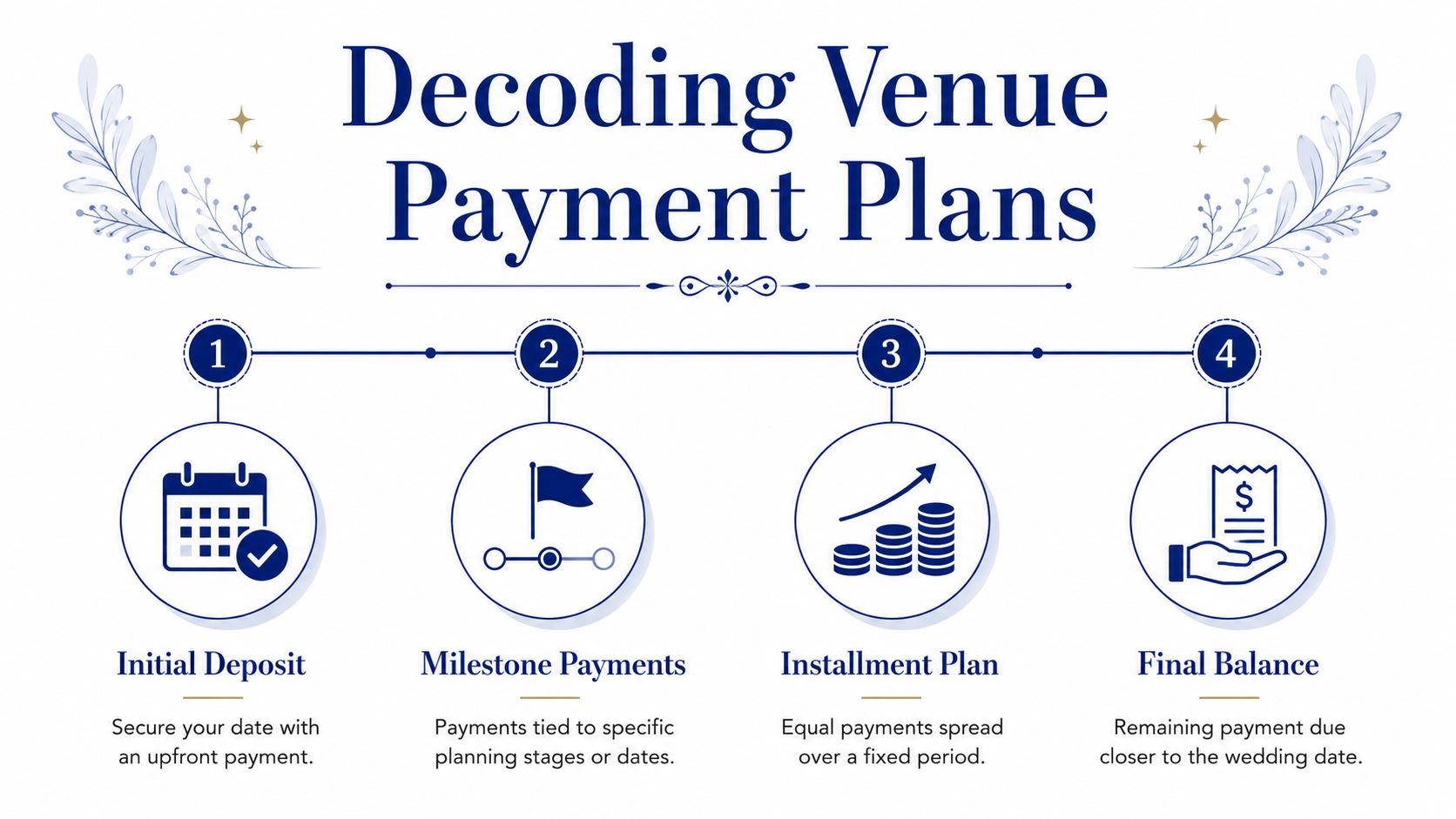
Approximately 68% of full-service wedding venues offer structured payment plans, most commonly a phased structure with a booking deposit of 10–25%, a second installment of 30–40% due 6–9 months before the event, and a final balance due 30 days prior, according to venue payment plan benchmarks.
That headline number is helpful, but the more useful question is what kind of structure you're being offered.
Milestone-based plans
This is the format couples see most often. Payments are tied to planning checkpoints rather than equal monthly amounts. A deposit secures the date, another payment lands months before the event, another comes closer in, and the final balance is due shortly before the wedding.
This structure works well when your savings pattern isn't perfectly monthly. It also matches how venues manage their calendars and staffing. Once they reserve your date, they've likely turned away other inquiries.
Common features include:
- Date reservation first: The initial payment functions as the retainer that takes the date off the market.
- Larger middle installment: The heaviest payment often arrives when planning gets serious and your guest count, vendor list, and design choices start firming up.
- Final payment before event week: Venues usually want the account settled before staff is scheduled and final logistics are locked.
Equal installment plans
Some venues offer a flatter schedule with predictable recurring payments. Couples often prefer this because it feels easier to budget, especially if income arrives on a fixed cycle.
The advantage is simplicity. The downside is that not every venue is set up operationally to manage a long string of smaller payments, so availability varies.
A smooth payment plan isn't just one that spreads money out. It's one you can actually follow without colliding with your other wedding commitments.
What the deposit is really doing
The deposit is often emotionally frustrating because it's usually the least flexible part of the contract. Couples hear “non-refundable” and assume the venue is being difficult. In practice, the deposit is protecting the venue from holding inventory that can't easily be resold once the date is blocked.
That doesn't mean every deposit term is fair. It means you need to read it as a risk allocation clause, not just a first payment.
Here's a simple way to evaluate the schedule:
| Plan feature | Usually works well when | Watch out for |
|---|---|---|
| Milestone schedule | Your savings are uneven or bonus-based | Large due dates bunching up with other vendors |
| Equal installments | You want a fixed monthly budget rhythm | Payment frequency that feels manageable on paper but tight in practice |
| Large retainer | The venue is in high demand and date-based | Limited refund language and vague cancellation terms |
| Final payment close to event | You want time to confirm details first | Final due date that arrives before key questions are answered |
A smart next step is comparing the contract against the venue's published pricing details and inclusions. If the payment schedule looks clear but the package itself is fuzzy, you still don't have enough information.
How to Find and Inquire About Flexible Payment Options
Couples often waste time by asking the wrong first question.
“Do you offer payment plans?” is fine, but it rarely gets you the information you need. A venue can say yes and still offer a rigid, vague, or fee-heavy structure. The better approach is to test how transparent the venue is from the first exchange.
Start with what the website doesn't say
When I review venue websites, I'm less impressed by polished galleries than by what's clearly spelled out. If pricing, rental duration, furniture, staffing, cleanup, bar policy, and ceremony setup are all easy to find, that usually signals an organized operation.
If the site is vague, assume the financial process may be vague too.
Use this kind of screening language in your inquiry:
- Ask for the schedule itself: “Can you send a sample payment schedule with due dates?”
- Ask what triggers changes: “What causes the final amount to increase after booking?”
- Ask about flexibility: “Can payment dates be adjusted if our planning timeline is different?”
- Ask how overages are handled: “When are add-ons or guest-count changes billed?”
- Ask about payment methods: “Do you charge processing fees for cards, and are there lower-fee payment options?”
Watch how they answer
The content of the answer matters, but the style matters too. Clear venues answer directly. Murky venues answer in fragments and ask you to sign first.
Here's what I'd want to hear in an early reply:
- A written breakdown, not just “we can work with you.”
- Specific due dates or timing windows, even if the schedule is customizable.
- A list of inclusions and exclusions, so you can tell whether the plan covers the full venue cost or only the base rental.
- An explanation of refund terms, especially for payments made after the retainer.
- A clear contact person who can explain contract language without sales pressure.
If a venue can't explain how and when you'll pay before the tour, that usually doesn't improve after the contract arrives.
Use the inquiry to test philosophy, not just policy
Some venues treat payment plans as a courtesy. Others treat them as part of the client experience. You can feel the difference quickly.
A practical venue team will usually talk through timing, guest-count changes, and realistic planning pressure points. A less helpful team keeps the conversation at the level of “starting price” and “subject to fees.”
That's why it helps to compare venue responses alongside broader planning criteria, such as the decision framework in this guide on how to choose a wedding venue. The venue's financial communication should support the same level of clarity as its aesthetic and logistical fit.
Negotiating Terms and Spotting Financial Red Flags
A payment plan only protects you if the contract is clear.
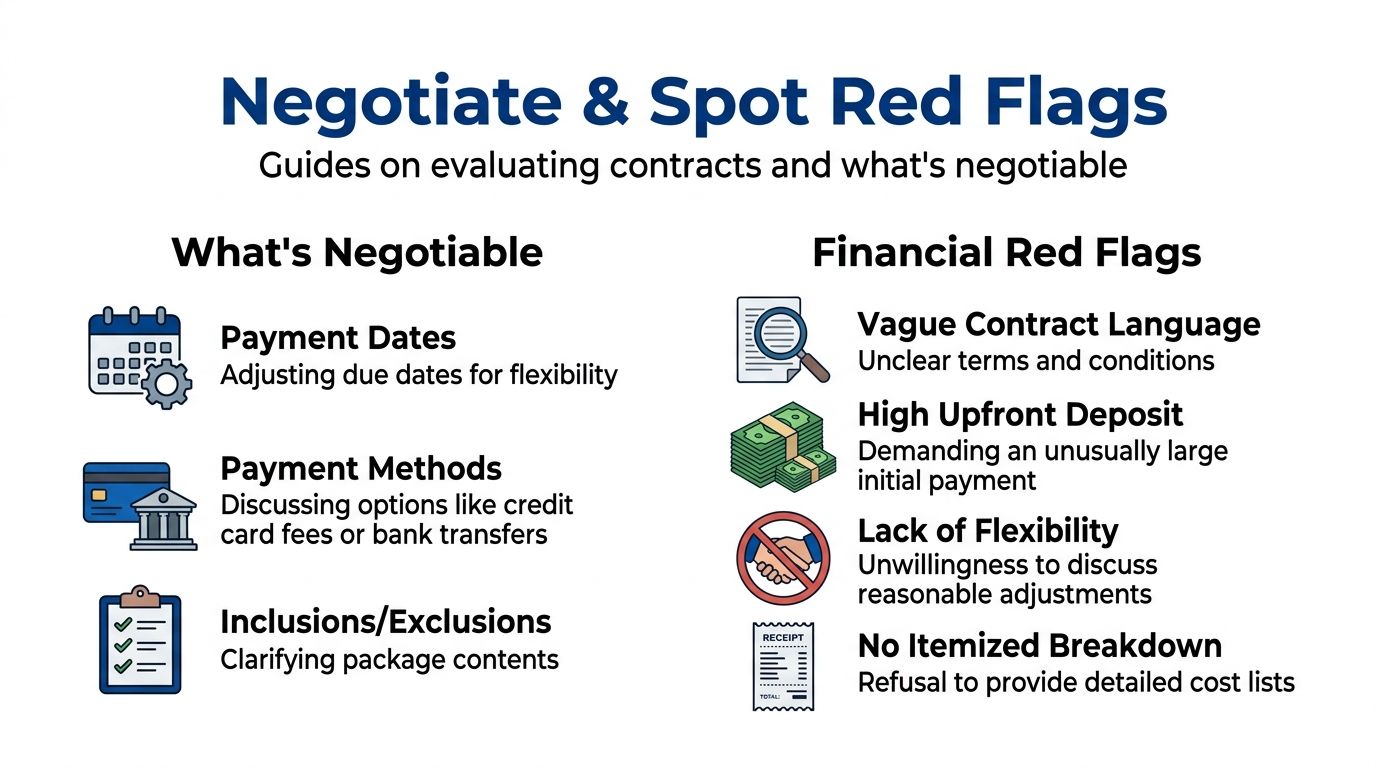
Many couples mistakenly focus on the wrong aspect. They try to negotiate the headline number, but the true advantage often lies in the terms surrounding it. Payment dates may be adjustable. Accepted payment methods may be flexible. Package inclusions can often be clarified in writing. Vague fee language should always be tightened before anyone signs.
The biggest problem isn't always the price
One of the strongest reasons to look past “monthly payments available” is that the market still has a transparency problem. According to venue pricing breakdown research, only 12% of venues provide completely transparent, upfront all-in pricing with no hidden fees, 89% hide pricing on websites, and 67% introduce hidden fees after the initial quote. The same research notes that 72% of venues accept credit cards, but they often charge a 2.5–4% processing fee unless the client uses the venue's preferred platform.
That's why I push couples to view payment plans as a transparency test. If a venue spreads the bill across installments but leaves service charges, gratuity, cleanup, staffing, or processing fees unresolved, the schedule can still feel unstable.
What's usually negotiable
You often won't change the venue's entire business model, but you may be able to improve how the contract fits your timeline.
A reasonable conversation can include:
- Due date adjustments: Ask whether a payment can move earlier or later to avoid colliding with another large vendor bill.
- Payment method clarity: If cards trigger fees, ask whether ACH, check, or another method changes the cost.
- Itemization: Request that every included and excluded item appear in writing.
- Post-booking additions: Ask how guest-count changes, ceremony upgrades, staffing, or extended access are billed.
Red flags that deserve a pause
Some problems show up before you ever open the contract. Others are buried in plain sight.
| Red flag | Why it matters |
|---|---|
| Vague references to service charges or administrative fees | You can't budget accurately if the contract doesn't define them |
| Pressure to sign before receiving a full itemized quote | Speed benefits the venue more than the couple |
| Large non-refundable sums with weak refund language afterward | This increases your downside if plans change |
| Separate fees for basics like cleanup, management, or standard setup | The “affordable” base quote may not reflect the real total |
| Processing fee surprises | Installments can cost more than expected depending on payment method |
Don't negotiate from excitement. Negotiate from the written document in front of you.
Why all-inclusive structure changes the risk
The overlooked issue in many venue contracts is financial risk asymmetry. Couples usually commit real money early through a non-refundable retainer, while the venue preserves far more control over the terms and timing. That imbalance gets worse when the package is fragmented.
A more stable model is the bundled one, where the quote includes the core operating pieces instead of scattering them into later invoices. The same payment schedule best-practices analysis notes that couples bear the burden of non-refundable retainers of 25–50% of total cost, and that 41% of couples now prioritize venues with tiered refund policies for payments beyond the retainer. It also highlights an emerging Central Texas approach in which venues bundle payment flexibility with inclusive services to reduce cost variance.
That's the right lens. The strongest payment plan isn't the one with the most installments. It's the one attached to pricing you can trust.
One example in this category is Texas Old Town, which publishes factual details around inclusions such as 16-hour access, on-site management, cleanup, furniture, and personalized payment plans, with quoted pricing structured to avoid hidden fees. That kind of model reduces the number of moving parts that can turn into invoice surprises later.
If you're also booking room blocks for guests, some of the same negotiation habits apply in hospitality. This guide on how to score deeper hotel discounts is useful because it shows how asking for exact terms often matters more than asking for a generic deal.
Budgeting with Your Payment Plan A Sample Timeline
A venue payment plan works best when you treat it like the backbone of your wedding cash-flow calendar.
I wouldn't use this sample as a pricing benchmark for the market. Use it as a planning model. The point is to see how venue due dates interact with the rest of the wedding, especially when other vendors also need deposits before the final stretch.
A simple planning example
Let's say your venue total is $10,000 and the contract breaks it into four payments across a twelve-month engagement. You'd want to map those due dates against your other commitments immediately, not when the reminders start arriving.
Here's a clean sample schedule:
| Timeline | Venue Payment Due | Amount | Concurrent Budget Item |
|---|---|---|---|
| At booking | Retainer to secure date | $2,500 | Initial planner or photographer deposit |
| 9 months before wedding | Second payment | $2,500 | Engagement photos, attire shopping, save-the-dates |
| 4 months before wedding | Third payment | $2,500 | Florist deposit, rentals, entertainment balances beginning |
| 30 days before wedding | Final venue balance | $2,500 | Final catering count, transportation, beauty trial follow-ups |
The exact timing will vary by venue. What matters is the pattern. If the second or third venue payment lands during the same period as your catering deposit, attire purchases, or travel bookings, you need to know that early.
Where couples get squeezed
Most budget stress doesn't come from one impossibly large bill. It comes from stacked obligations inside the same short window.
That's why I recommend building a payment calendar with three layers:
- Venue obligations first: Enter every venue due date the day you sign.
- Other contract dates second: Photographer, planner, entertainment, florist, rentals, and catering.
- Personal cash-flow markers third: Paydays, bonuses, family contributions, or months with higher routine expenses.
A wedding budget becomes manageable when due dates stop being surprises.
How to make the timeline usable
A sample table only helps if you turn it into action. Couples who handle this well usually do a few things consistently:
- Create a dedicated wedding account so venue installments don't blur into everyday spending.
- Set transfer dates before due dates instead of moving money manually at the last minute.
- Leave room for non-venue costs that tend to bunch up near the wedding.
- Revisit the calendar after every contract signed because each new vendor changes the pressure points.
If a venue's payment plan looks fine in isolation but creates a cash crunch once you add photography, catering, and attire, it isn't the right plan for your life. That's the standard that matters.
Securing Your Dream Venue Without Financial Stress
The right venue payment plan should feel calm on paper.
It should tell you what you owe, when you owe it, what's included, what could change, and how changes are handled. If any of those pieces are fuzzy, the payment plan is doing less work than it appears to do.
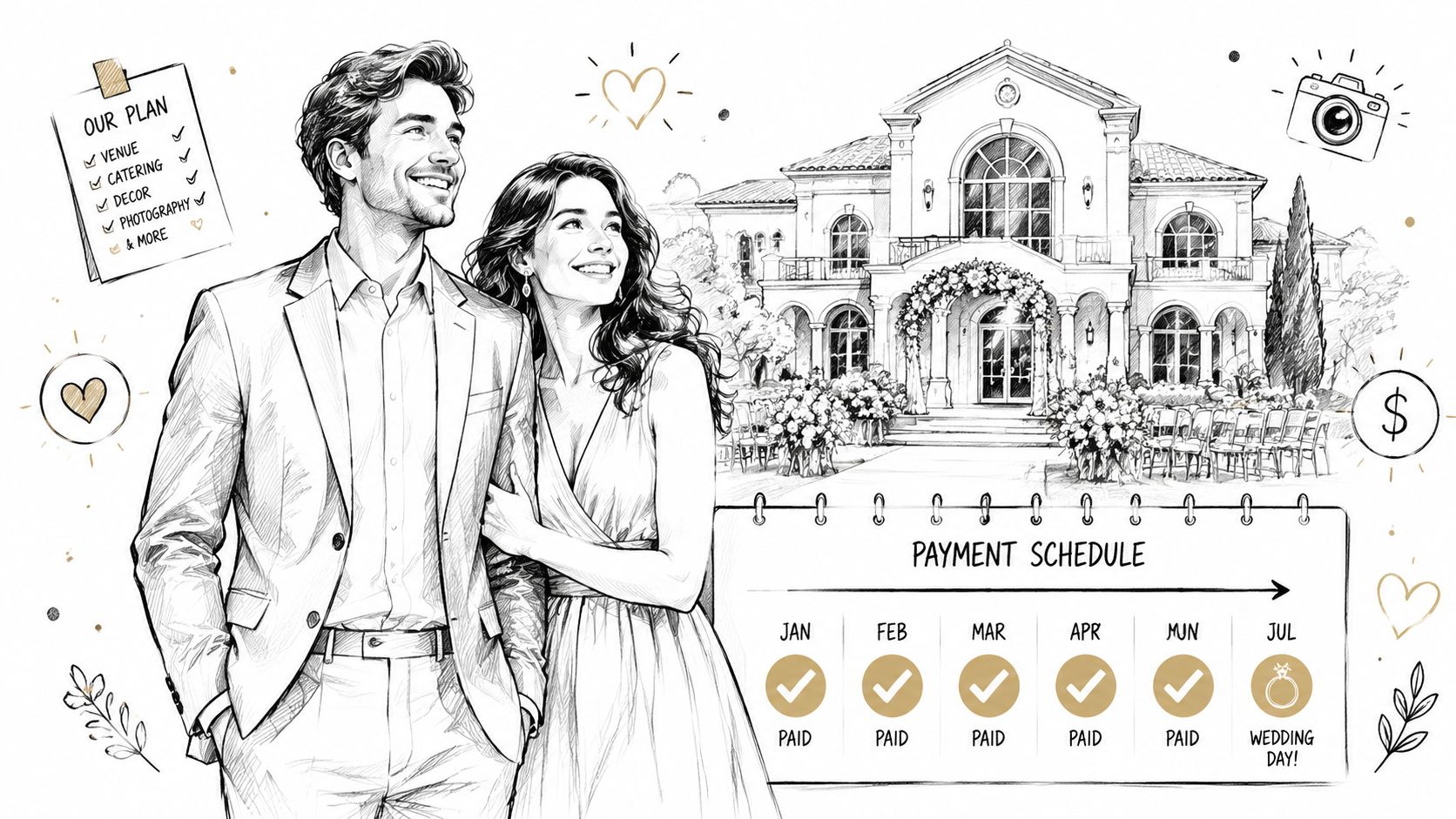
The shift I want couples to make is simple. Don't treat wedding venues with payment plans as if they're offering mini financing. Treat them as potential planning partners. A strong venue relationship is built on transparency, predictable cash flow, clear inclusions, and contract terms that don't leave you exposed.
What actually works
The most reliable setups usually share a few traits:
- Transparent pricing: The quote reflects the actual cost, not an attractive starting point that grows later.
- Bundled essentials: Standard operating items are included instead of broken into surprise add-ons.
- Reasonable flexibility: Payment timing can sometimes be adjusted to fit your planning reality.
- Clear written terms: Refund rules, overages, and payment methods are defined before you sign.
That's why transparent, all-inclusive models solve more problems than installment plans alone. The schedule helps, but the structure behind the schedule is what protects your budget.
Keep the rest of the planning practical too
Once the venue piece is stable, the rest of the wedding gets easier to manage. You can make cleaner decisions about catering, guest experience, and final details because you're not constantly re-estimating the base cost of the day.
And when you get to later planning stages, practical resources still help. If you're thinking ahead about guest welcome touches or thank-you items, Revellia's wedding gift guide can give you ideas without turning that part of the budget into another guessing game.
Choose the venue you love. But choose the contract with the same care.
If you're comparing venues in Central Texas, Texas Old Town is one option to review for couples who want clear inclusions, a long rental window, and personalized payment plans without hidden-fee confusion.