Sound equipment is the collection of technologies that capture, process, amplify, transmit, and reproduce audible sound. Events depend on that chain because the ear hears pressure from about 20 micropascals up to 200 pascals, a span so wide that a toast and a dance floor only stay clear when level, coverage, and distance are managed together.
You are three rows back at a ceremony. The couple is saying the vows, and you catch every other word. A gust rolls across the lawn, the handheld mic dips, and the sentence disappears. An hour later the best man raises a glass, the speaker howls, and half the room winces. Nobody bought the wrong playlist. The signal never made a clean trip from mouth to ear.
That trip is what planners mean when they ask what is sound equipment. It is not a single speaker on a stick. It is a relay. One device catches the voice, the next shapes it, the next adds power, and the last one turns electricity back into air the guests can hear.
Table of Contents
- What Is Sound Equipment and Why It Matters
- How Sound Equipment Evolved Over Time
- The Core Components of a Sound System
- How Sound Equipment Works Together at Events
- Choosing the Right Sound Equipment for Your Event
- How Texas Old Town Handles Sound for Events
- Putting Your Sound Plan Into Action
What Is Sound Equipment and Why It Matters
A working system is a handoff, not a pile of boxes. The microphone starts the race. The mixer decides how loud that voice sits against music. The amplifier supplies the muscle. The loudspeaker finishes by moving air toward the people who need the words. Drop any baton and the back row loses the vow, or the toast turns into a squeal.
Planners get stuck because catalogs describe gear as objects. Events need jobs. Vows need a close, steady voice. Announcements need speech that cuts through chatter. Dancing needs music that fills the floor without burying the next speech. The same room can do all three if someone changes level, mic position, and where the speakers point between moments.
A chain, not a louder box
Source gear starts the signal: a wireless mic, a phone, a laptop, or a live instrument. Control gear sets volume and tone so a quiet reader and a loud playlist do not fight. Distribution gear carries power and sound into the room through amplifiers, loudspeakers, and cables. Support gear keeps the chain alive: stands, power, spare batteries, and covers when the sky turns.
Practical rule: If guests cannot repeat the last sentence, the system failed, even when the speakers look impressive.
Aim matters as much as wattage. Speakers pointed at a hard wall bounce energy back into the mic and invite feedback. Speakers aimed at guests put the words where people sit. A venue can already own a solid PA and still sound thin if the mic is far from the speaker's mouth or the outdoor coverage was never checked.
You do not need an engineer's vocabulary to run the day. You need to know which link does which job, then match that job to vows, toasts, announcements, and dancing. The built-in PA at many halls already supplies much of the chain. The planning question shifts from "what do I buy" to "how do I use what is already here."
How Sound Equipment Evolved Over Time
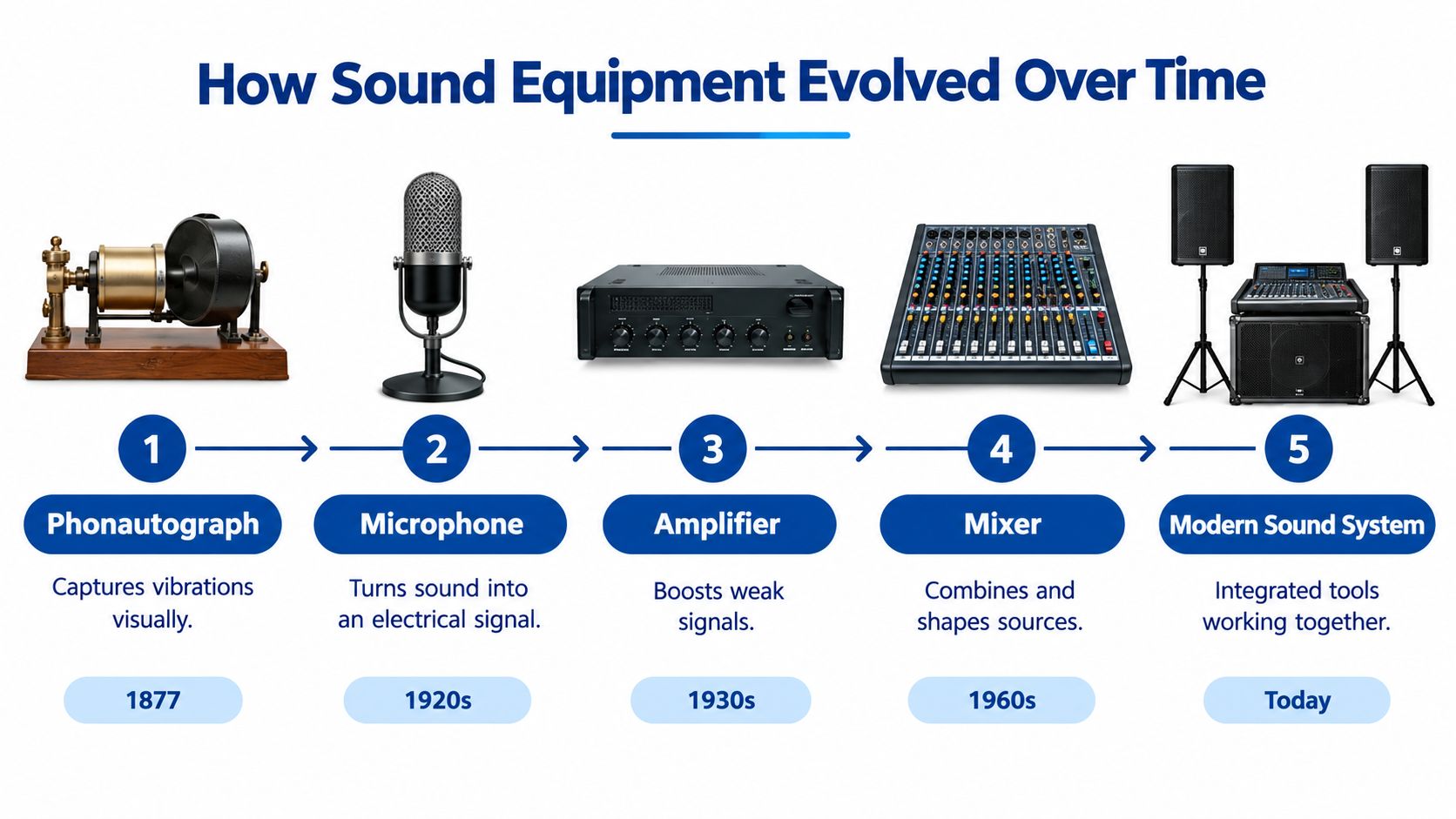
Modern event gear looks obvious until you see how recently playback even existed. In Paris in 1857, Édouard-Léon Scott de Martinville built the phonautograph, the first device to record sound vibrations, and it could not play them back. It drew the shape of sound. It did not return a voice to a room. The Museum of Communication traces that line from mechanical tracing to electrical and digital systems.
Thomas Edison's 1877 phonograph changed the bargain. For the first time a machine could both record and reproduce sound. A captured moment could be heard again. That is still the job at a reception when a recorded entrance song has to arrive on cue and a live vow has to arrive in the same seats.
From parlor sets to a full signal chain
Domestic radio grew fast in the 1920s and pulled better microphones and loudspeakers into homes, theaters, and public address. People expected speech they could follow, not a faint horn in the corner. Event systems inherit that demand every time a host introduces a family or a CEO opens a meeting.
Stereo took even longer to become normal. Experiments began in the 1880s, yet mono stayed standard for home listening until the mid-1950s. Cinemas did not commonly get stereo until Dolby Stereo in the 1970s, and live amplification adopted it later still. The lesson is not nostalgia. Clarity for a seated audience arrived in stages, and each stage added a job: capture, shape, then deliver.
Today's wireless mic, mixer, and powered speakers are that same progression in one rack. History is why a single speaker is not the whole answer. The chain exists because capturing a voice and handing it cleanly to a crowd took more than a century of separate inventions learning to work as one system.
The Core Components of a Sound System
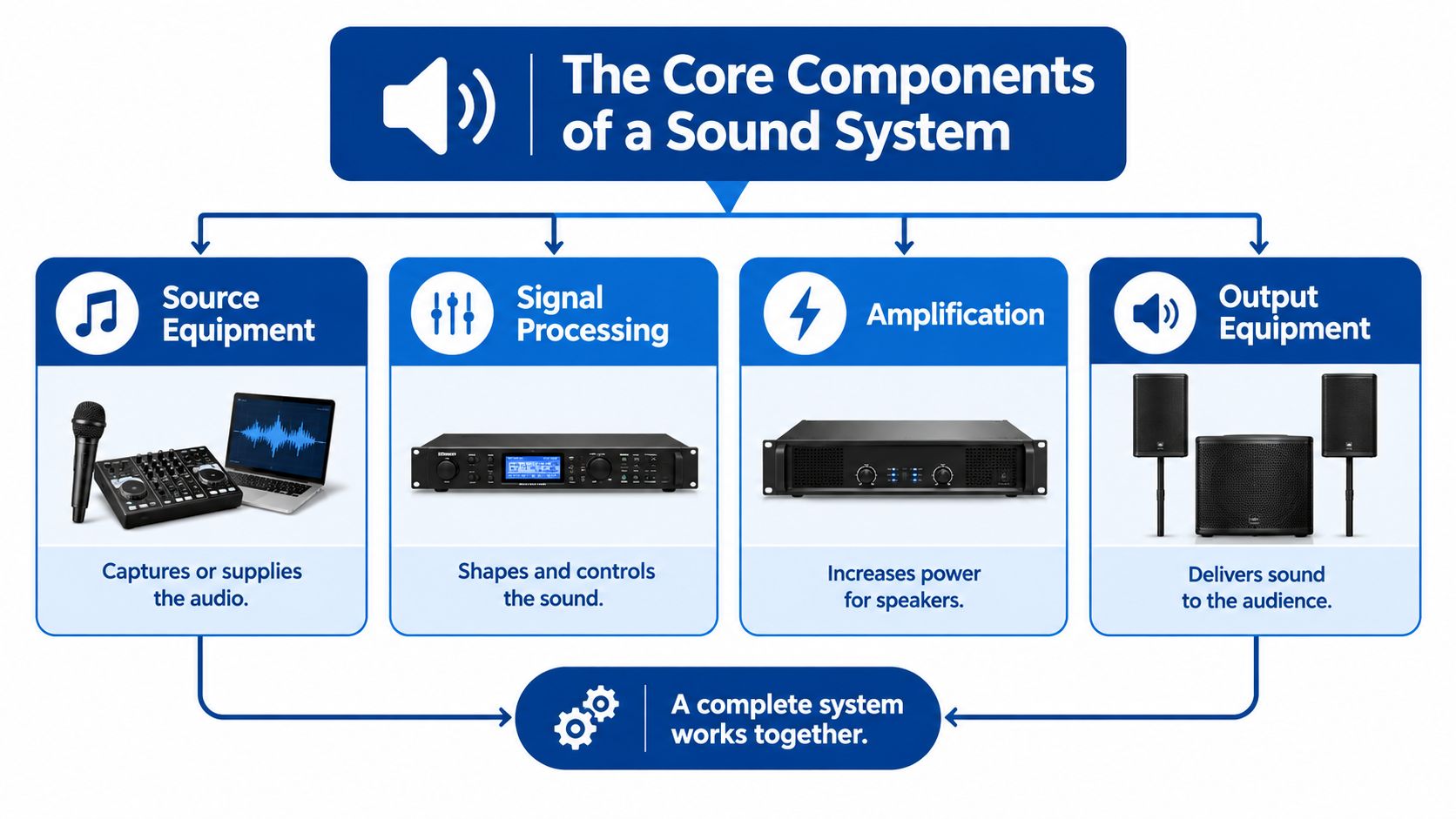
Walk the chain in the order a voice travels. Each group solves a different failure. Knowing the groups lets you ask a venue specific questions instead of "do you have sound."
Source equipment
Microphones, phones, laptops, and instruments supply the audio. A wireless handheld is the usual choice for vows because the couple can stand close and the officiant can pass it without a cable across the aisle. A lapel mic frees a presenter's hands during a corporate welcome. A phone or laptop is the source when the processional is a playlist, not a band.
Mic choice changes level before the mixer even sees it. Some capsules need an external preamp to bring a quiet voice up to a usable line. Others arrive ready. A plain guide to microphones with built-in preamps shows why that first gain stage matters when a nervous speaker barely projects.
Control, distribution, and support
Mixers and signal processors are the control room. They set the mic under the music, trim harsh highs, and keep a playlist from jumping when the next track starts. During toasts, the useful move is simple: music down, speech up, then music back once the glass is raised. Processors also include the feedback control and equalization that stop a bright room from ringing.
Amplifiers, loudspeakers, and cabling distribute the result. The amp supplies power. The speakers turn that power into air. Cables, or a reliable wireless link, have to survive the walk from the mixer to the floor. In a large hall, two mains aimed at the guests cover more seats than one cabinet cranked until the front row hurts.
Stands, power, batteries, and weather protection are the unglamorous half. A mic stand saves a reader who shakes. A spare battery saves the maid of honor's speech. Outdoor runs need covers and a power plan because a shower or a tripped breaker ends the chain faster than a bad EQ setting.
A complete system works together. Buying a bigger speaker does not fix a mic that never reaches the mouth.
Name the path out loud once during setup. Voice, mic, mixer, amp, speaker, ear. If you can point at each link, you can troubleshoot the one that dropped.
How Sound Equipment Works Together at Events
Level is not a straight line. Acoustic systems use decibels because pressure ratios are huge, and a logarithmic scale keeps those ratios readable. A-weighted decibels (dBA) tilt the measurement toward the frequencies people hear, which is why speech comfort and music punch are not the same number on a meter.
Safety limits turn that scale into a schedule. The U.S. National Institute for Occupational Safety and Health recommends 85 dBA averaged over an eight-hour shift, and it recommends cutting exposure time in half for every 3 dBA increase: about four hours at 88 dBA, two hours at 91 dBA, and one hour at 94 dBA, as summarized in WHO guidance drawing on NIOSH limits. A DJ who lives at the top of the meter all night is not only loud. They are spending the staff's safe time very fast.
What good coverage actually sounds like
Intelligibility beats peak volume. Guests should catch names and vows at the back without the front row leaning away. Even coverage means the dance floor, the ceremony chairs, and the staff aisle are in the same ballpark, not three different concerts.
Feedback is a loop, not a mystery. Sound leaves the speaker, enters the mic, gets amplified, and leaves again. The cure is geometry and gain. Put less speaker energy on the mic, and you need less amplifier gain to reach the guests. That is the practical heart of a sound system for an event: placement and level, not a bigger number on the amp.
Meters belong in more than one spot. Check the dance floor, the seated guests, and the place where coordinators stand for hours. A system can be pleasant in the center and harsh at the board.
More power is not automatically better. Past the point of clear speech, extra volume mostly buys spill, fatigue, and a higher chance the mic and the speakers start arguing.
Choosing the Right Sound Equipment for Your Event
Match the moment before you match the brand. Guest count changes how far the voice must travel. Indoor rooms bounce sound off walls and ceilings. Outdoors the energy escapes, so the same playlist feels smaller. A ceremony-to-reception move means the chain has to come up twice, often with different speaker positions. A vow-and-toast program is speech-first. A dance set is music-first. A corporate briefing is speech with occasional playback.
Needs by moment
| Event Moment | Source Equipment | Control and Distribution Needs |
|---|---|---|
| Vows and readings | Wireless handheld or lapel, close to the mouth | Speech EQ, modest level, speakers aimed at seating, not at the couple |
| Toasts and announcements | One shared handheld, a written order of speakers | Fast mic-over-music balance, spare battery, a simple handoff cue |
| Dance floor or band | Playlist device, DJ mixer, or instruments | Even coverage on the floor, limiter so speeches can still cut in |
| Corporate presentation | Lapel or podium mic plus laptop audio | Consistent speech level, playback at a lower bed, check far seats |
| Outdoor ceremony | Same mics, plus wind protection | More speaker throw, weather covers, tested power before guests arrive |
Accessibility rarely shows up on a shopping list, and it should. Offer a dedicated assisted-listening feed when the room is deep. Print a short mic procedure so a nervous reader knows where to hold the capsule and when to pause. Seat guests who need louder speech closer, or give them the feed, instead of raising the whole room until the front hurts.
What changes the list
- Room shape: Long, narrow halls need aim down the length. Square rooms need care at the side seats, where energy falls off first.
- Indoor versus outdoor: Outdoor sites lose bass and speech consonants to open air. Test at the last row, not at the mixer.
- Backup: A second mic, charged packs, and a way to play audio if the laptop fails. Weather and power deserve the same respect as the playlist.
Read one row for your quinceañera, retirement party, or briefing, then confirm the venue already covers that row. A walkthrough of how to use a wireless microphone belongs in the rehearsal, not in a scramble after the processional starts.
How Texas Old Town Handles Sound for Events
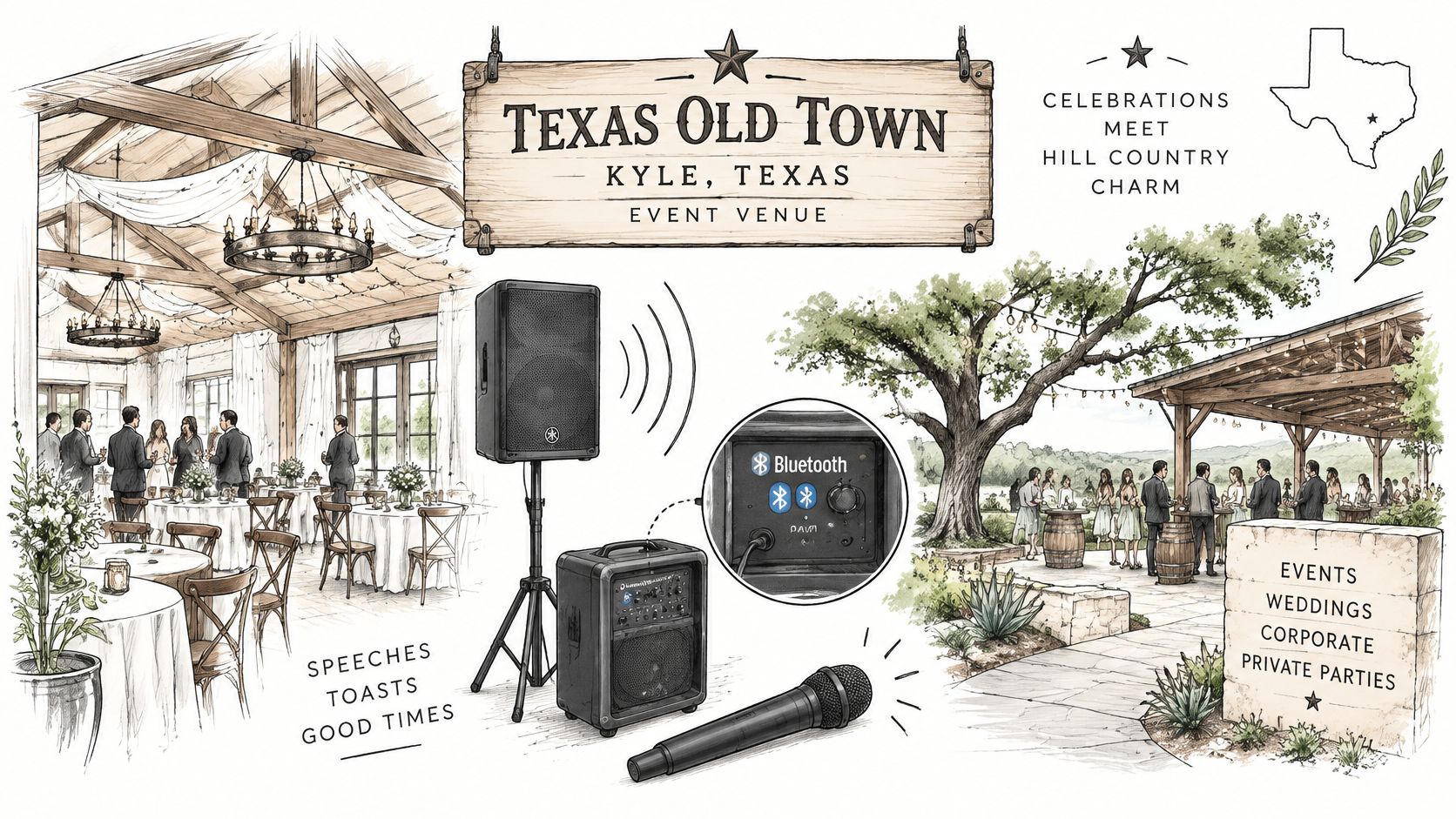
Texas Old Town in Kyle, Texas, sits on 55 acres of Hill Country between Austin and San Antonio and treats sound as a built-in amenity rather than a rental surprise. Indoor and outdoor PA systems include Bluetooth playback and a wireless microphone, so vows outside and announcements inside do not require a separate purchase for a basic program.
Rooms, time, and a person on site
Four halls cover different scales. Tejas holds up to 320 guests in a country dance hall with handcrafted pine tables. Sage and Stone each hold up to 300. Redbud is the intimate rustic hall at 150. Outdoor ceremony sites sit on the same property, with manicured grounds and an indoor, climate-controlled option if weather turns.
The rental window runs 16 hours, 8:00 a.m. to midnight, with exclusive use of the hall you book. That block is when a sound check belongs, before guests arrive and before the first song. An on-site venue manager stays through the event and can help when a battery dies or a playlist device will not pair.
A placement habit that protects the day
Speaker aim is an operating practice, not a style choice. Place the main speakers in front of the microphone pickup area and aim them toward guests rather than reflective walls. You need less amplifier gain, spill drops, and the mic is less likely to howl, while vows and announcements stay intact.
That habit also respects workplace noise rules. OSHA requires a hearing-conservation program when exposure reaches 85 dBA as an eight-hour time-weighted average, and it requires engineering or administrative controls above 90 dBA over eight hours. Under OSHA's 5 dB exchange rate, allowable time halves as level rises by 5 dB, for example 95 dBA for 4 hours and 100 dBA for 2 hours, per OSHA's noise exposure limits. A meter at the dance floor, the ceremony seats, and staff work areas tells you whether the celebration is still inside a defensible day.
On a tour, listen in the back row with the house mic, confirm Bluetooth on both indoor and outdoor systems, and note where the manager stands if something fails mid-toast.
Putting Your Sound Plan Into Action
Sound equipment is a connected chain from microphone to speaker. The event works when coverage and speech stay clear, not when the amp is at its limit. You already know the links, the moments they serve, and the levels that stop being kind to staff and guests.
Take four questions into any venue conversation.
- Included gear: Ask which PA, wireless mic, and playback connections come with the hall, indoors and outdoors.
- Coverage: Walk the last row and the dance floor. Listen for seats where speech thins out.
- Time: Put a sound check inside the rental window, with the actual mic and the actual playlist device.
- Notes: After the event, write what guests heard. A structured wrap-up such as Planstone's event evaluation report example keeps the next planner from repeating a dead spot.
Corporate groups can fold the same checks into a run of show. A practical starting point is how to plan corporate events when presentations, awards, and a short reception share one system. For Central Texas celebrations, the useful next step is a tour where you hear the house PA with a real voice, not a brochure photo of a speaker.
Texas Old Town includes indoor and outdoor PA systems, Bluetooth playback, and a wireless microphone across its Kyle halls and ceremony sites, so your vows, toasts, and dance set start from a system already in the room. Hearing that chain in the actual seats is the fastest way to judge coverage before you lock a timeline. Book a tour with Texas Old Town and walk the back row with the house microphone on.