You've got a sales kick-off confirmed eight weeks out, a leadership offsite booked six weeks ago, and both events have landed on the same team's calendar. The budget hasn't expanded, key speakers are still being confirmed, and the venue shortlist keeps changing because every decision affects the next one.
That's the practical reality behind how to plan corporate events. Corporate planning rarely follows the leisurely timeline used in wedding guides or long-lead conferences. One industry compilation reports that the average corporate event took 8 weeks to plan in 2023, while 60% of companies planned within 4 to 6 weeks (Sweap event planning statistics). A successful plan therefore starts with priorities, not decoration.
Table of Contents
- The Shape of a Corporate Event Plan
- Defining Objectives, Audience, and Budget
- Building the Timeline and Master Checklist
- Choosing the Venue, Floorplan, and AV Setup
- Catering, Bar, Transportation, and On-Site Staffing
- Contingency Planning for Weather, Tech, and Staffing Gaps
- Post-Event Follow-Up and Measuring ROI
The Shape of a Corporate Event Plan
A sales kick-off is eight weeks away, the leadership offsite is six weeks out, and both depend on the same operations team. The budget is fixed, speakers are not final, and one venue decision can force changes to catering, AV, travel, and staffing. Under that pressure, the plan must connect decisions instead of treating each workstream as a separate project.
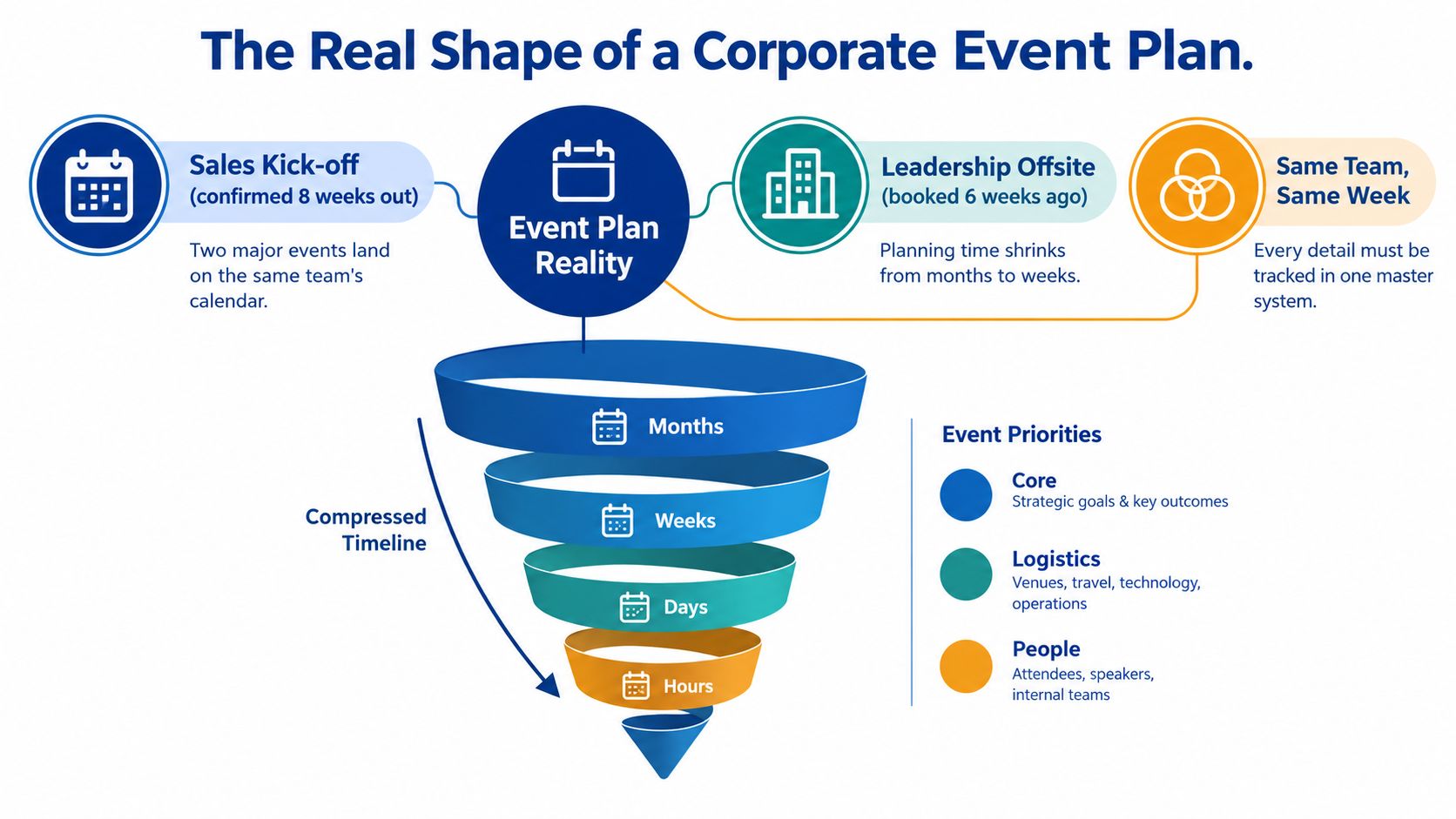
Corporate events can operate at meaningful scale. Industry reporting places average attendance at 475 people, with events of 1,000 or more attendees representing 18% of events and international attendees accounting for 18% of attendance in 2023 (Sweap event planning statistics). The figures do not dictate a large venue for every event. They do require early decisions about capacity, travel, accessibility, communication, and movement between rooms.
Work backward from the outcome
Write the business result in one sentence. A sales kick-off may need to align the team around a new strategy and increase confidence in executing it. A leadership offsite may need to resolve stalled decisions across departments. A client event may focus on stronger relationships, qualified conversations, or a commercial objective.
Then order the plan by decisions that can invalidate later work:
- Objective: What must attendees understand, decide, do, or change?
- Audience: Who needs to attend, and how does the role mix affect the format?
- Budget: Which costs are fixed, which can move, and where is the reserve?
- Timeline: What must be contracted now because delay makes it expensive or unavailable?
- Venue and AV: Does the space support the agenda, sightlines, power, sound, and movement?
- On-site operations: Who owns registration, catering, transport, speakers, vendors, and changes?
- Contingencies and measurement: What happens when something fails, and how will value be shown?
Venue and on-site logistics usually save more time than late creative refinements. A guide on maximise corporate event impact is useful when business outcomes and attendee experience compete for the same budget. The master plan should also assign responsibility for vendor coordination, schedule control, and day-of decisions. A clear outline of event manager responsibilities helps prevent ownership gaps.
Practical rule: If a decision does not affect the objective, guest movement, safety, budget, or measurement, it should not outrank those decisions on a compressed timeline.
The U.S. events market was estimated at about $302.7 billion in 2025, while the global events industry was valued at roughly $1.4 trillion (BoomPop event management statistics). The scale explains why corporate planning requires disciplined operations. Time is saved by setting priorities early. It is wasted when departments build disconnected versions of the same event.
Defining Objectives, Audience, and Budget
A budget isn't useful until it reflects the audience and the objective. Treat those three decisions as one design exercise.
Suppose a sales kick-off has 120 attendees, runs for three days, and needs to align the team around Q2 strategy while motivating the sales group. A practical outcome measure could be a confidence score collected before and after the event. The number of attendees matters because it affects room size, food service, transportation, seating, and the amount of time required for registration. The audience mix matters too. Executives may need a private working room, while individual contributors may need classroom seating, hands-on sessions, or structured networking.
Decide what the event must achieve
Write the objective so the producer can make a decision without calling another meeting. “Make the team feel motivated” is too broad to guide a venue or agenda. “Align the sales team around Q2 priorities and measure change in rep confidence before and after the event” gives the content team, facilitator, and measurement owner a shared direction.
Use three questions:
- What should attendees know? This defines content and speaker requirements.
- What should attendees do? This shapes workshops, commitments, and follow-up.
- What evidence will show progress? This determines the pre-event and post-event survey design.
A larger audience isn't automatically better. Recent industry coverage says planners are shifting toward ROI and engagement metrics rather than simple headcount, with practical attention moving toward attendance quality and post-event follow-through (Conference News corporate event trends for 2026). That supports a selective guest list when a smaller group can make better decisions or have more relevant conversations.
Build the budget around control points
Separate expenses into fixed and variable categories.
Fixed costs usually include the venue, food and beverage minimums, audiovisual scope, transportation commitments, and required staffing. These are the lines that can force a redesign if they exceed the approved budget.
Variable costs include giveaways, entertainment, decorative elements, upgraded menus, and optional activations. These are safer places to reduce spend because they can often be simplified without changing the event's core purpose.
Keep a 15% to 20% contingency line in the working budget. That planning range is a practitioner recommendation for this framework, not a sourced industry statistic. Put it in the budget from the start, label who can approve its use, and record every draw against it.
| Category | % of Budget | Notes |
|---|---|---|
| Venue and space | 25% | Confirm room access, setup time, furniture, and cleaning terms. |
| Catering and beverages | 25% | Include meal service, dietary requirements, and guaranteed counts. |
| AV and production | 20% | Scope microphones, screens, staging, operators, recording, and backups. |
| Transportation and parking | 10% | Cover shuttles, accessible routes, pickup coordination, and signage. |
| Staffing and operations | 8% | Include registration, runners, floor managers, and vendor coordination. |
| Experience elements | 7% | Use for decor, gifts, entertainment, or optional engagement features. |
| Contingency | 5% | Increase this reserve when the timeline is short or the scope is uncertain. |
This sample allocation is a planning model, not a quoted Texas Old Town price list. Inclusive venue packages can absorb line items such as tables, chairs, basic sound, venue management, cleanup, and furniture breakdown, but you still need to verify inclusions in writing. A corporate event planning budget template can help separate what the venue provides from what your team must source.
Building the Timeline and Master Checklist
Corporate timelines should be layered, so they can compress without losing the tasks that protect the event. A 12-week ideal window gives the team room to source, compare, contract, and test. A 6-week emergency cycle can work, but only if decision rights are clear and low-impact extras are cut early.
The following sequence is the working version I'd put into Asana, Monday.com, or a shared spreadsheet.
Twelve weeks or more
- Confirm objectives: Record the business outcome, audience, event format, and measurement owner.
- Hold the venue: Check capacity, access hours, backup rooms, AV infrastructure, and vendor rules.
- Secure budget approval: Approve the working budget, contingency, and purchasing authority.
- Build the decision log: Record open questions, owners, deadlines, and final decisions.
Eight to twelve weeks
- Sign contracts: Confirm venue terms, cancellation language, payment schedule, and inclusions.
- Scope AV: Map microphones, screens, presentation playback, staging, recording, lighting, and technical labor.
- Set food and beverage parameters: Choose service style, menu direction, dietary process, and guarantee deadline.
- Block travel: Reserve rooms or transport capacity where the audience requires it.
Four to eight weeks
- Draft the run of show: Add every transition, cue, speaker handoff, meal, break, and room change.
- Assign staffing: Name the registration lead, floor manager, runner, speaker contact, AV lead, and escalation owner.
- Plan movement: Draw check-in, meal, restroom, breakout, parking, and emergency routes.
- Set contingency triggers: Decide who can move the event, change the agenda, or approve substitute vendors.
One to four weeks
- Lock headcount: Send the final registration and dietary data to the venue and caterer.
- Finalize BEO details: Check room sets, service times, furniture, power, signage, and vendor arrival.
- Rehearse: Test presentations, remote connections, videos, microphones, lighting cues, and speaker entrances.
- Confirm every supplier: Collect arrival times, phone numbers, load-in instructions, and insurance documents where required.
Event week
- Load in: Verify deliveries, registration materials, signage, gifts, furniture, and technical equipment.
- Walk the site: Trace the attendee journey from parking to check-in, session rooms, meals, and departure.
- Run cue-to-cue: Test the event in sequence, not just each piece in isolation.
- Brief the team: Distribute the run sheet, vendor contact list, radio channels, emergency process, and decision authority.
The tasks that compress badly are AV scope, food and beverage guarantees, and transportation. Signage and giveaways are easier to simplify. Cut in the right order.
When the lead time shrinks, don't shorten every task equally. Freeze the venue and audience decisions first, then protect production testing and guest movement. A venue coordinator's checklist can be useful as a second set of eyes, but the event owner still needs one master checklist with one current version of the truth.
Choosing the Venue, Floorplan, and AV Setup
Venue, floorplan, and AV aren't three procurement categories. They're one operating system.
A room that can seat 300 guests banquet-style may hold far fewer in classroom format once you add tables, aisles, screens, staging, camera positions, and technical control. That difference can determine whether the general session stays together or whether the agenda has to split across rooms.
Start with the room, then test the show
Ask the venue team to draw the actual setup, not just send a capacity chart. Place the stage, screens, control position, registration desk, catering stations, sponsor areas, and accessible routes. Check sightlines from the last row, screen height, speaker distance, power drops, ceiling height, house lighting, rigging points, and load-in access.
For a multi-session event, a campus with several buildings can separate a general session from breakout rooms without requiring off-site shuttles. Texas Old Town's Austin-area property offers multiple private venues, so planners can assess whether the selected building and adjacent spaces support the intended flow. The important question isn't whether the venue looks impressive in a tour. It's whether attendees can find the next room without losing time.
| Criterion | Hotel Ballroom | Conference Center | Texas Old Town Campus |
|---|---|---|---|
| Layout flexibility | Often large, but ballroom divisions and banquet infrastructure can constrain redesigns. | Usually designed for meeting flow, with dedicated breakout and technical areas. | Multiple private venues support different capacities and event styles across one property. |
| AV infrastructure | May include preferred in-house production and hotel network access. | Often built around presentation, conferencing, and breakout requirements. | Published amenities include indoor and outdoor PA systems, Bluetooth connection, and a wireless microphone. |
| Catering model | Frequently tied to hotel menus and minimums. | May offer in-house catering or approved suppliers. | Flexible caterer policy allows planners to choose a caterer, subject to venue requirements. |
| Guest movement | Rooms, elevators, and public areas can create wayfinding and timing issues. | Usually optimized for meeting transitions. | Outdoor grounds and separate halls require a deliberate route and signage plan. |
| Key planning check | Clarify labor, power, Wi-Fi, rigging, and overtime charges. | Confirm room holds, simultaneous sessions, and equipment inclusions. | Verify the selected hall, access window, weather backup, and exact included equipment. |
Build a technical brief before requesting production quotes. Include the presenter mic count, audience microphones, playback formats, confidence monitors, presentation laptop, clickers, stage wash, recording requirements, remote speaker connection, backup projector, spare cables, and battery kit.
AV failure usually starts during planning, not during the keynote. The producer never defined who supplies the laptop, who tests the video, or who owns the backup.
If the event includes recorded content or a livestream, compare production specialists with the venue's in-house capability. A curated overview of corporate video production companies can help you understand the difference between event AV support and a dedicated video-production partner. For seating and meeting layouts, document every setup in a conference room setup guide before the final walkthrough.
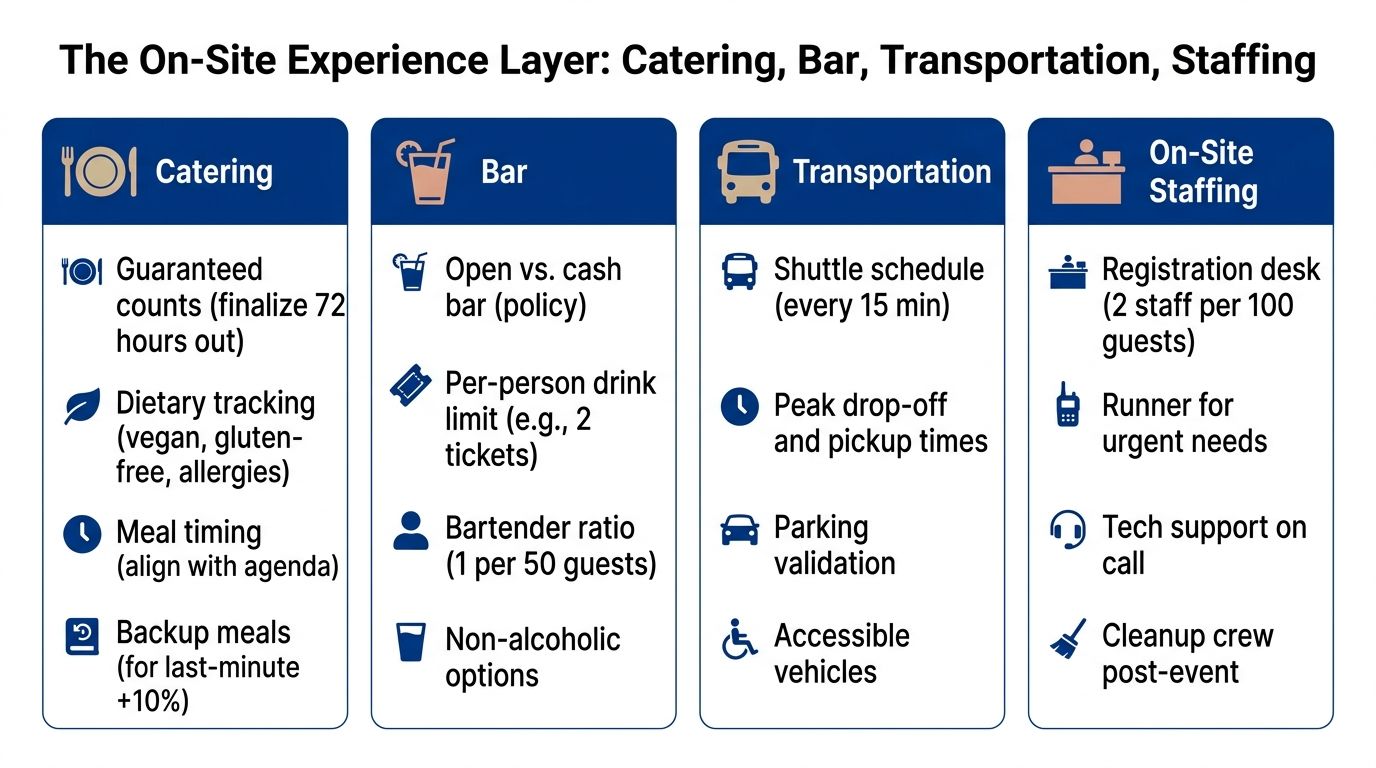
Catering, Bar, Transportation, and On-Site Staffing
Attendees judge operational quality through small frictions. They notice the registration line, the missing dietary meal, the unclear shuttle pickup, the long bar queue, and the breakout room that nobody can find.
Start catering with the guarantee process. Assign one person to maintain the dietary list, identify allergies rather than preferences, and send the final count to the caterer by the agreed deadline. Match service style to the agenda. A plated meal supports a formal program but takes more time to serve. Stations can improve movement, but they need enough space and clear labeling. A complicated menu creates more handoffs and more opportunities for an error.
For teams trying to find food vendors for your office, compare not only menu price but also delivery timing, setup requirements, staffing, dietary controls, cleanup, and the vendor's ability to handle schedule changes.
Design the attendee journey
Bar policy needs the same precision. Decide whether service is hosted, ticketed, or cash, define last call, and provide non-alcoholic choices that feel intentional rather than apologetic. Put water and alcohol-free drinks where attendees can reach them without standing in the bar queue.
Transportation planning should answer practical questions before the first guest arrives:
- Shuttle cadence: Set departure times, a visible pickup location, and a named transportation lead.
- Rideshare flow: Mark the pickup zone separately from guest drop-off and keep it clear of service vehicles.
- Parking overflow: Prepare signs, attendants, and an alternate lot plan if the primary area fills.
- Accessible arrival: Trace a step-free route from parking to check-in, meeting rooms, restrooms, and dining areas.
- Travel communication: Put maps, pickup instructions, and emergency contact details in the attendee email and on-site signage.
Accessibility also includes hearing loops or assistive listening, sign language interpreters when requested, readable signage, step-free paths, seating options, and a clear process for accommodation requests. Don't make attendees repeat those requests to several vendors. Give one operations lead ownership.
Staff for ownership, not headcount alone
For a 150-person event, build a role map before deciding staffing quantities. The venue or caterer should confirm its service requirements, but the event lead still needs named owners for registration, floor movement, speaker care, AV escalation, catering changes, and urgent errands.
Use this practical assignment model:
- Registration: Staff the desk according to arrival waves, with one person able to leave the desk for badge or access issues.
- Floor management: Keep one lead responsible for room readiness, timing, signage, and transitions.
- Runners: Assign a runner for last-minute materials, speaker needs, and internal messages.
- AV support: Keep a technical lead available throughout presentations, not only during load-in.
- Catering liaison: Give one person authority to resolve dietary, timing, and replenishment issues.
- Cleanup and reset: Confirm who clears service areas, breaks furniture down, and restores the venue.
An on-site coordination model can reduce handoffs when the venue manages its own event operations and cleanup. It doesn't remove the planner's responsibility. It gives the planner fewer disconnected parties to chase when the schedule changes.
Contingency Planning for Weather, Tech, and Staffing Gaps
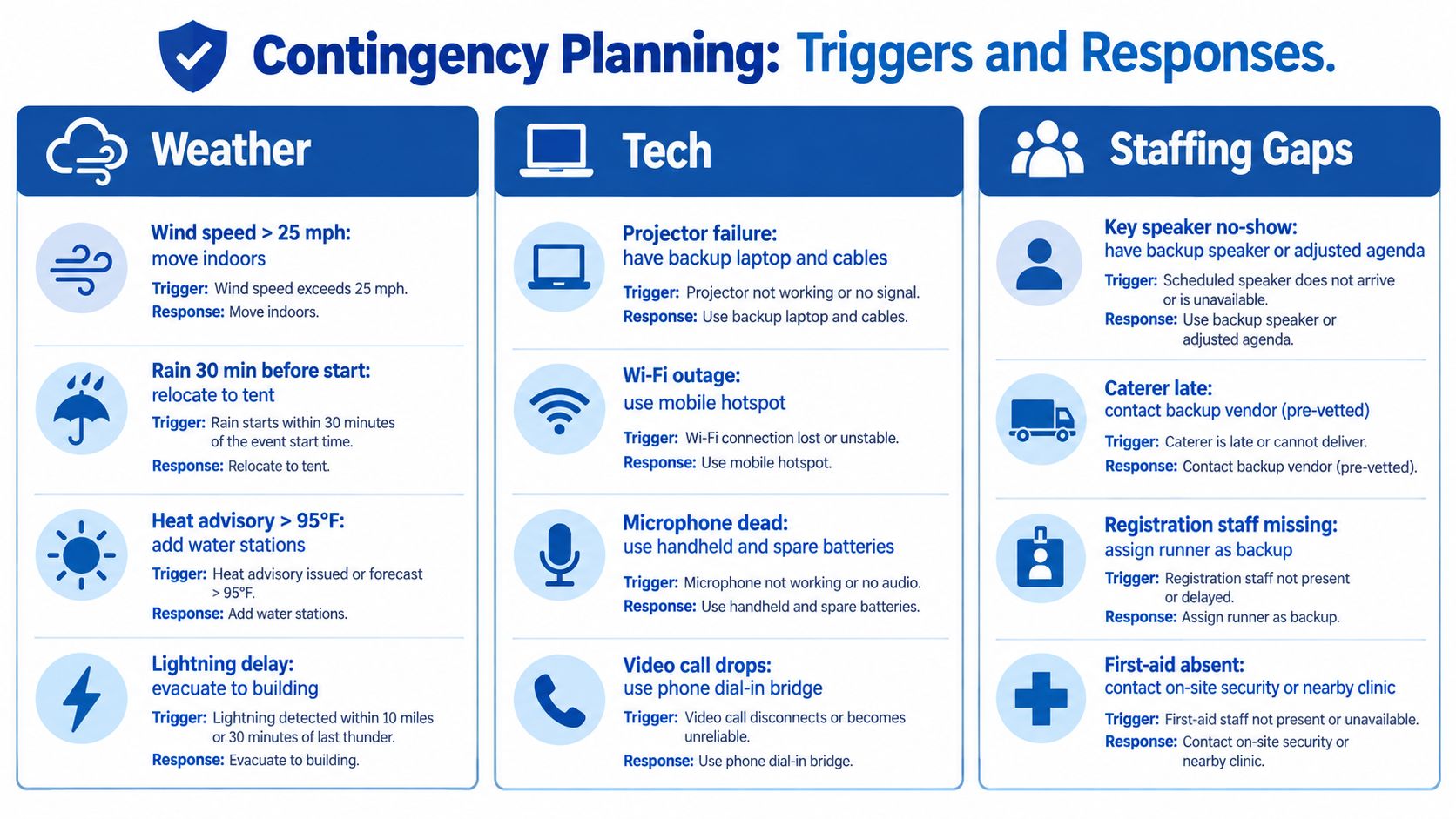
A contingency plan is useful only when it tells someone exactly when to act and what to do next. A binder full of phone numbers isn't a plan if nobody has authority to make the call.
For weather, define the trigger with the venue and safety lead. If the event uses an outdoor space, specify the wind or lightning threshold supplied by the venue's safety policy, the person who can relocate the program, the alternate room, and the time needed to reset it. On a property with multiple halls, confirm whether a backup room can be held and whether its furniture, power, sound, and signage are already understood.
Write the trigger and response together
Use a simple three-part record:
- Trigger: What condition changes the plan?
- Owner: Who makes or receives the decision?
- Response: What backup has been tested and when does it begin?
For technology, write the response before the failure:
- Projector fails: The AV lead switches to a tested backup projector or alternate display and the moderator moves to a prepared discussion prompt.
- Presenter can't connect: The speaker contact uses the presentation laptop or a preloaded local copy.
- Microphone dies: The technician provides the backup handheld and tested batteries.
- Network becomes unusable: The team switches to a local presentation, mobile hotspot, or phone dial-in process that was tested before doors open.
For staffing gaps, cross-train the runner on registration, have the floor manager understand catering escalation, and give the event lead a current vendor cell list. A missing bartender or sick runner shouldn't force the event owner to improvise every assignment from scratch.
The physical event-day kit should include:
- Printed run sheets and room layouts
- Vendor and stakeholder cell list
- Backup microphone, batteries, cables, and presentation adapter
- Weather relocation plan
- Speaker files stored locally
- Emergency contacts and venue procedures
- Accessibility accommodation notes handled confidentially
A backup isn't real until the assigned person has tested it in the room where it will be used.
Post-Event Follow-Up and Measuring ROI
The event ends when the last operational issue is closed, not when the final guest leaves. Start the follow-up while the details are still fresh.
Within 24 hours, send thank-you notes to speakers, hosts, partners, and key contributors. Within 72 hours, send the attendee survey while the agenda, service, and content remain easy to recall. The survey should connect directly to the objective. If the event was a sales kick-off, ask whether attendees understand the strategy and feel prepared to execute it. If it was a leadership offsite, ask whether the required decisions were made and whether owners are clear.
Use one post-event report
Schedule a debrief within 48 hours. Review attendance against registration, survey response quality, qualitative themes, stakeholder feedback, operational incidents, and budget status.
A useful report includes:
- Objectives recap: What the event was designed to change or accomplish.
- KPI results: Attendance quality, satisfaction, confidence, engagement, leads, decisions, or other agreed measures.
- Budget variance: Original approval, committed spend, actual spend, and contingency used.
- Attendee experience: Use NPS or a 1-to-5 satisfaction scale consistently within your program.
- Top three wins: Keep them specific enough to repeat.
- Top three fixes: Assign an owner and a deadline for each.
For revenue-attached events, connect the event to pipeline generated, opportunities influenced, and contracts signed. For internal events, track signals such as employee engagement, retention risk, leadership alignment, confidence, and completion of agreed actions. Don't claim the event caused revenue or retention unless your measurement design supports that conclusion. Report influence and evidence carefully.
Explori recommends benchmarking the same event over time, comparing events within the same portfolio, and assessing performance against similar market events. It also identifies four outcome dimensions: attitudinal impact, behavioural impact, purchase-intent shift, and portfolio contribution (Explori benchmarking guide). Use the same methodology each time. Comparing unrelated event types or changing KPIs after every event makes improvement difficult to see.
Deliver the full report within 10 business days, then complete a 30-to-60-day impact check for behavior change, follow-through, pipeline movement, or decisions implemented. Archive the master plan, vendor contacts, contracts, floorplans, BEO details, survey results, and final budget. Next year's planner should inherit a usable operating record, not a scavenger hunt.
Texas Old Town offers multiple private venues in Kyle, Texas, with indoor and outdoor settings, documented furniture counts, on-site management, cleanup, and a 16-hour access window for corporate gatherings. Visit Texas Old Town to review the spaces and discuss how the property can support your venue, logistics, and event-day planning requirements.