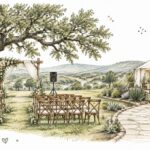
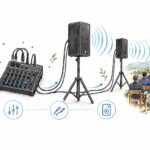
The same reception decoration can feel rustic in Tejas, intimate in Redbud, refined in Stone, or strategically placed near Sage's grand entrance. That's why the best wedding reception hall decoration ideas start with the hall, the grounds, the guest count, the ceremony location, and the time available to install, move, and remove every detail. Texas Old Town's four halls sit across a 55-acre Hill Country property, so the outdoor setting and indoor architecture should work together rather than compete. (Explore the Texas Old Town venue options)
You're probably balancing a saved inspiration board with practical questions. Will guests see across the tables? Can the arch move after the ceremony? What happens if Hill Country wind affects the welcome sign or outdoor candles? How much can your family realistically assemble during the venue's 16-hour rental window, from morning access through cleanup? (Review Texas Old Town's venue amenities)
The framework below keeps those questions visible. Choose one visual anchor, layer tables and lighting around it, and assign every ceremony-to-reception movement to a person and a time. For wall artwork and other large visual elements, Aroma Warehouse's wall art advice is also useful when you're deciding how much empty wall space to leave around a focal display.
Table of Contents
- 1. Rustic Texas Hill Country Centerpieces
- 2. String Lights and Bistro Lighting
- 3. Texas Flag and Patriotic Accents
- 4. Elegant Table Linens and Runner Arrangements
- 5. Entrance and Aisle Décor With Floral Arches or Ceremony Backdrops
- 6. Vintage or Rustic Signage and Wayfinding
- 7. Uplighting and Ambient Color Wash Effects
- 8. Candles and Luminarias for Ambient Warmth
- 9. Photo Display and Memory Wall Installations
- 10. Bar and Beverage Station Styling With Custom Glassware and Signage
- Wedding Reception Décor, 10-Item Comparison
- Turn Inspiration Into a Cutover-Ready Plan
1. Rustic Texas Hill Country Centerpieces
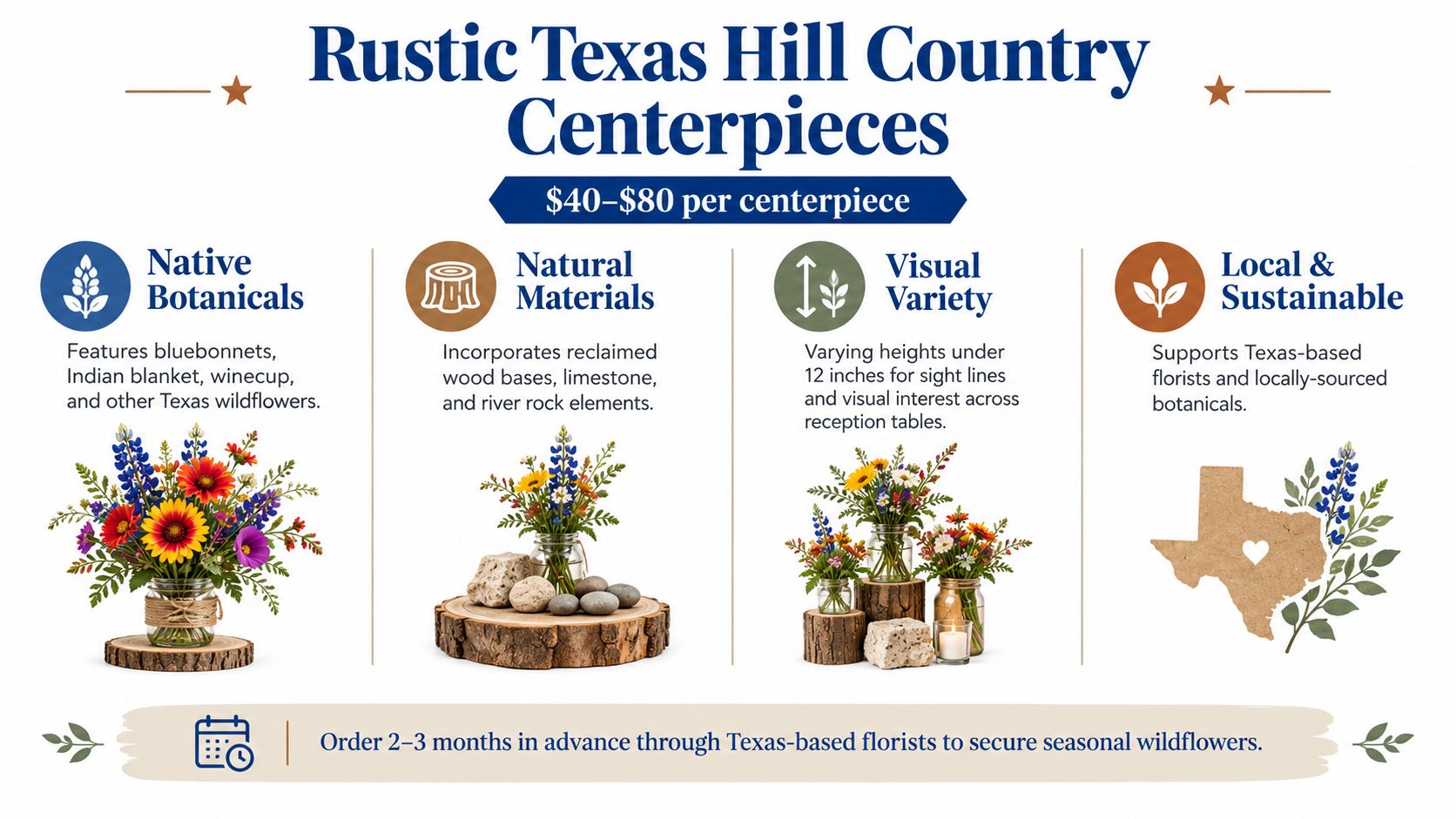
Rustic centerpieces work especially well when they look collected from the surroundings rather than copied from a generic barn wedding. Combine native Texas botanicals, seasonal wildflowers, limestone pieces, and reclaimed wood to create warmth without hiding the room's architecture. In Tejas, the handcrafted pine tables already provide texture, so the flowers can stay relaxed and low rather than competing with the furniture.
Ask a Texas-based florist from the venue's preferred vendor list to build arrangements around the property's natural colors. Sage, dusty green, warm ivory, rust, and muted yellow can echo the grounds while keeping the tables visually connected to the Hill Country setting. The native floral design options at Texas Old Town can help you compare a locally grounded look with a more formal floral direction.
Keep the centerpieces social
Low arrangements protect conversation and sightlines across the dance floor. Use a reclaimed wood base, a few limestone accents, and a loose arrangement of wildflowers, but avoid placing tall stems directly in front of guests. A florist can vary the vessels while keeping the palette consistent, which makes long banquet tables feel designed without making every place setting identical.
Reuse matters here. Ask the florist to design ceremony aisle flowers that can be moved to the sweetheart table, bar, or entrance after the ceremony. Label those pieces before setup so a helper knows exactly where they belong during the cutover.
Practical rule: Spend on flower quality and placement before adding extra objects. A thoughtful low arrangement with one strong material usually looks better than a crowded collection of rustic props.
For a DIY version, collect sealed wood boxes, neutral ceramic vessels, and flameless candles, then let the florist supply only the fresh botanicals. That split preserves the handmade character while reducing the amount of delicate work your wedding party must complete on the event morning.
2. String Lights and Bistro Lighting
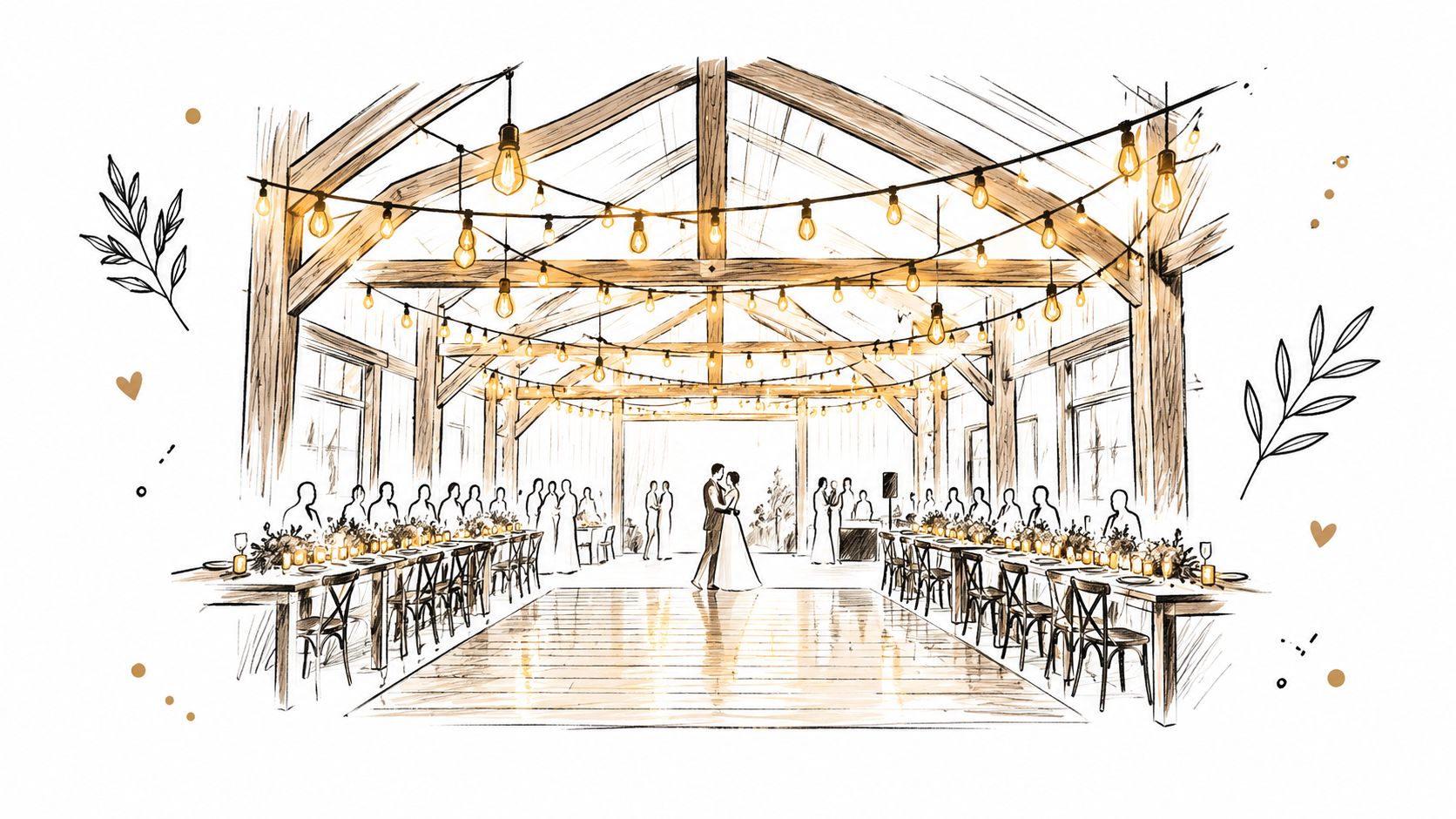
Warm string lights can connect an outdoor ceremony, cocktail area, and indoor reception without forcing every space into the same style. In Tejas, Edison-style bulbs reinforce the country dance hall character. In Stone, a restrained canopy or carefully placed strands can soften upscale finishes without making the room feel themed. In Sage, lighting near the grand entrance can draw guests naturally toward the reception, while Redbud benefits from a smaller, intimate glow.
Choose lighting locations based on guest movement, not just photographs. A strand over the dance floor creates a focal ceiling, while illumination along an exterior path helps guests move between spaces safely. Work with the venue manager and lighting vendor to identify approved power sources, attachment points, cable routes, and weather protections before signing a rental order.
Make the glow functional
Warm white bulbs generally feel more inviting than cool white fixtures for dinner and dancing. Test the setup during daylight, then check it again as the sun drops. A light level that looks subtle at noon may feel too dim once guests begin walking between the bar, dining tables, restrooms, and outdoor grounds.
For outdoor areas, use commercial-grade weather-resistant equipment and secure every run against Hill Country wind. The outdoor wedding lighting guidance from Texas Old Town is a useful starting point for discussing placement with the venue team.
Do not let decorative lighting obstruct sightlines or hang where guests can catch clothing. Keep the installation above head level, route cords away from walking paths, and assign one person to confirm that lights are operating before the doors open. Lighting earns its place in the budget because it affects the mood of the entire room, not just one table.
3. Texas Flag and Patriotic Accents
Texas flags and Lone Star details can feel elegant when they're used as punctuation rather than wallpaper. Tejas is the natural home for a prominent flag near the entrance or dance floor, especially when paired with pine furniture, neutral linens, and loose wildflowers. In Stone, use the reference more through a menu border, table card, or small metal star detail. Sage's entrance can carry a single framed vintage Texas map, while Redbud suits a personal display with restrained regional touches.
The strongest approach treats Texas imagery as part of the story of the event. A welcome sign might use a subtle Lone Star mark, menus could carry a small outline of the state, and table names could reference meaningful Texas locations. These details create cohesion without making the reception feel like a themed restaurant.
Protect the visual balance
Red, white, and blue can dominate quickly, particularly under bright lighting. Pair patriotic accents with sage green, warm gold, ivory, or natural wood to keep the palette refined. A vintage map or historical print can add character, but frame it in a way that doesn't compete with the couple's names or seating information.
Outdoor flags need weighted bases or professional anchoring. A breeze that feels pleasant to guests can topple a lightweight display, scatter paper goods, or twist fabric around a stand. Keep all freestanding pieces outside main walkways and away from the dance floor perimeter.
A bar sign such as “Drinks Y'all” can carry the personality further without adding more flags. The same treatment works for a quinceañera, milestone celebration, or corporate gathering, where subtle regional identity may matter more than a traditional wedding theme.
4. Elegant Table Linens and Runner Arrangements
Linens are one of the fastest ways to change a hall's character. A neutral base can make Tejas feel polished while preserving the warmth of its pine tables. Stone can support jewel tones, refined neutrals, or a crisp monochromatic treatment. Sage can use a runner to lead guests from the entrance toward the dining area, while Redbud often needs only a coordinated cloth, napkin, and modest centerpiece to feel complete.
Start with fabric swatches, not an online color chip. Venue lighting changes how ivory, taupe, champagne, rust, emerald, and gold appear, especially when layered with candles or uplighting. Place the swatches against the existing floors, walls, tables, and chairs during a site visit before ordering.
Build the tablescape in layers
Use a neutral cloth as the foundation, a colored runner for direction, and napkins or glassware for the smaller accent. That strategy makes it easier to reuse linens across ceremony seating, cocktail tables, and the reception. It also protects the design if a florist changes the flower varieties because of seasonal availability.
Wrinkle-resistant blends are practical for a long event day, but they still need careful delivery and storage. Confirm who receives the linen order, who places it, and who returns it. If your caterer needs access to the tables before décor is complete, build that handoff into the setup schedule rather than asking vendors to work around one another.
A beautiful linen can't fix a crowded table. Leave enough room for plates, glassware, service, and conversation before adding decorative layers.
For budget control, use the same neutral linen throughout and reserve colored runners for the sweetheart table, cake table, or entrance. You can also create a softer rustic finish with napkins and small fabric ties instead of replacing every tablecloth. For additional ideas on keeping linen choices attractive without overspending, see these suggestions for enjoying Easter without overspending.
5. Entrance and Aisle Décor With Floral Arches or Ceremony Backdrops
An entrance installation does two jobs. It gives guests a clear visual arrival point, and it creates a frame for photographs as people enter the ceremony or reception. Sage's position near the grand entrance makes it a strong candidate for a substantial welcome arch. Tejas can carry a wood arbor softened with greenery, Stone suits fabric draping or a clean floral structure, and Redbud benefits from a smaller frame that respects its intimate scale.
Design the arch with its second location in mind. A ceremony arbor can move to the reception entrance, sweetheart table, or photo area, but only if the florist knows that from the beginning. Pieces built for one position may not look balanced somewhere else, and a last-minute move can require more staff than your schedule allows.
Frame the landscape, don't block it
Outdoor ceremony décor should enhance the Hill Country view instead of covering it. Use asymmetrical flowers, ground arrangements, or fabric that opens toward the scenery. Secure every outdoor element with weather-resistant anchors, and confirm the venue's rules for attachments, candles, fabric, and electrical equipment.
The included prep kitchen can serve as a staging area for draping, labeled floral pieces, and ceremony items that will move later. Keep that area organized by destination. A box marked “reception entrance” is more useful than a box marked “flowers,” particularly when several people are working during the same morning setup.
If the ceremony and reception occupy different spaces, assign one person to supervise the cutover while another remains responsible for guest flow. Never move an arch through an active cocktail path without checking with the venue manager and caterer. The most photogenic installation is still a poor choice if it delays dinner or blocks an accessible route.
6. Vintage or Rustic Signage and Wayfinding
Guests should know where to go before they reach a decision point. At Texas Old Town, a welcome sign, seating display, and directional markers for the bar, restrooms, gifts, and dancing can keep movement clear across the property. Use rustic event planning ideas at Texas Old Town to coordinate practical signs with the reception's visual style.
Match the sign system to each hall. Tejas suits sealed wood, hand lettering, and vintage frames. Stone can take matte board, acrylic, or brushed metal for a cleaner finish. Sage benefits from a prominent entrance sign that identifies the reception route, while Redbud needs smaller framed pieces because guests stay closer to the main activity. If the ceremony and reception use different spaces, reuse ceremony signs where their wording still works, then update only the directions that change.
Design for distance and weather
Choose high-contrast lettering that remains readable from several steps away. Decorative script can look attractive yet fail on a seating chart, especially for older guests. Place directional signs at eye level and before guests must choose between paths. Keep stands outside service lanes, accessible routes, and narrow walkways.
For outdoor grounds, use sealed wood, laminated board, or another weather-resistant material. Weighted bases or approved mounting help prevent Hill Country wind from moving a sign across the lawn. Check placement against rain exposure, catering routes, and evening visibility before installation.
A controlled DIY approach limits the number of pieces. Design the welcome board, bar menu, and table cards with one typeface and accent color, then ask a local printer to produce the final pieces. For lettering styles and layout inspiration, browse these farmhouse decor finishing touches before choosing the typeface. Have the venue manager approve locations during the rehearsal or site visit.
Label every sign by destination and pack it with its stand or hardware. Assign installation and removal within the 16-hour rental window, so cutover does not interrupt guest arrival or vendor service.
7. Uplighting and Ambient Color Wash Effects
Uplighting changes how guests read the architecture. Warm white or gold along Tejas's wood features can deepen its rustic character. Redbud can use a soft wash to make the intimate room feel layered rather than small. Stone may support a restrained jewel tone that emphasizes its finishes, while Sage can use lighting to define the entrance and separate arrival from dining.
Avoid treating every wall equally. A lighting technician should identify beams, architectural details, entry points, and the dance floor perimeter that deserve emphasis. Too many fixtures can flatten the room into one color and compete with florals, string lights, or the photographer's flash.
Coordinate the lighting sequence
Use warmer light during dinner, then shift the room for dancing if the system allows it. Keep the transition subtle enough that guests can still see their tables, steps, and servers. Coordinate the lighting technician with the DJ or PA operator so the first dance, toasts, and other key moments don't trigger competing effects.
Do a daytime test with fixtures powered off as well as on. Cords, stands, and housings should disappear into the design rather than become trip hazards. Outdoor fixtures need weather protection and secure placement, particularly near grass, paths, and ceremony seating.
A practical DIY variation is to use a small number of rental uplights around one focal zone instead of trying to wash the entire hall. Pair that glow with candles or table lamps, then let the existing architecture do the rest. This approach often looks more intentional than a bright color placed on every available wall.
8. Candles and Luminarias for Ambient Warmth
Candlelight adds movement to tables and pathways in a way that static décor can't. In Tejas, clusters of votives can reinforce the warm country atmosphere. Stone can use glass cylinders or enclosed holders for a formal look. Sage's entrance can carry a line of flameless luminarias, while Redbud benefits from a few concentrated candle groupings rather than a room full of small points of light.
Start by asking the venue manager about flame policies. Indoor candles may be acceptable in protected holders, while outdoor wind and dry conditions may make flameless LED products the better choice. Never assume that a decorative candle is permitted because it's small.
Cluster light with restraint
Three or four grouped areas usually create more visual purpose than individual lights scattered randomly. On tables, use enclosed votives between arrangements, not beside napkins or directly under trailing greenery. At an entrance, place luminarias along the edge of the route and keep them away from door swings, service carts, and accessible paths.
Flameless candles also reduce the need for someone to relight or monitor them throughout the evening. Choose products with consistent color temperature and enough battery life for the full event. Store them in labeled containers and assign one person to place them during setup and collect them after the send-off.
The trade-off is authenticity. Real flames offer a natural flicker, but LED alternatives are safer and more reliable outdoors. The best choice depends on the room, the weather plan, the venue's rules, and whether your team can supervise the installation without pulling a family member away from the celebration.
The trend toward warm, lived-in lighting, including candles and table lamps, reflects a broader shift in reception design. The 2026 reception décor roundup from Paperlust identifies lighting, centerpieces, entrances, backdrops, and signage as high-impact areas, while also estimating typical U.S. reception décor costs at $3,500 to $8,000 for an 80 to 120 guest wedding. Treat that figure as contextual guidance, not a quote for your event.
9. Photo Display and Memory Wall Installations
A memory wall gives guests something to explore during arrival and cocktail hour while adding personal detail to a large room. In Tejas, mount family photographs on reclaimed wood or use vintage frames that echo the hall's country character. Stone can support a more editorial grid of black-and-white images. Sage's entrance is ideal for a timeline display, and Redbud can use a compact tabletop arrangement near the bar or guest book.
Choose the story before choosing the hardware. A chronological display can show the couple's relationship, while a family wall may include parents, grandparents, and important milestones. For a quinceañera or anniversary celebration, organize the images around life stages rather than trying to fill every available surface.
Keep the display in the guest path
Place photographs near the entrance, cocktail area, or restrooms, where guests naturally pause. Avoid putting the installation beside the dance floor or behind the dining service area, where it can be bumped or hidden. Leave enough space for guests to stop without creating a queue.
Uniform mats and frames create a polished effect, but an intentional mix can suit a rustic event. The important detail is consistency. Repeat one material, color, or mounting style so the display feels designed rather than like a collection of unrelated household frames.
Physical prints require careful transport and secure placement. Use stands, hooks, or mounting methods approved by the venue, and assign a helper to check the display after guests arrive. If the timeline is tight, a tablet slideshow or projected video can provide the same personal element without requiring dozens of frames, though it depends on reliable power, visibility, and technical support.
10. Bar and Beverage Station Styling With Custom Glassware and Signage
The built-in beverage bar can become one of the most useful focal points in the reception. Because hosts provide beverages and use an approved bartending company, bar styling needs to be discussed with both the venue manager and the bartenders. Tejas suits a wood-framed “Drinks Y'all” sign and local cocktail names. Stone can use custom menus, polished glassware, and restrained metallic accents. Sage's bar can reinforce the arrival experience, while Redbud benefits from a compact display that doesn't overwhelm the room.
Start with the service requirements, not the décor. Confirm where the bar will stand, how bartenders access power and ice, where guests queue, and which areas must remain clear for service. Decorative trays, garnish displays, and glassware should never reduce the bartender's working surface or block a guest's view of the menu.
Make the bar easy to use
A clear menu can reduce repeated questions and help guests choose quickly. Use a framed board, printed card, or small sign that matches the reception typography. Tiered garnish containers add height, but keep them behind the working zone and away from spills.
Custom napkins, coasters, stirrers, and glassware can carry the palette without requiring a large installation. For a DIY option, print a signature cocktail menu and add a small arrangement in a stable, low vessel. Avoid loose confetti, fragile props, or anything that can fall into drinks.
Ask the bartending company about replenishment, ice delivery, glassware handling, and end-of-night collection. Assign a helper to refresh the display, but don't ask that person to manage bar operations unless they're part of the approved service team. Good styling should support fast, safe service rather than make the station harder to operate.
Wedding Reception Décor, 10-Item Comparison
| Decoration | Implementation complexity | Resource requirements | Expected outcomes | Ideal use cases | Key advantages |
|---|---|---|---|---|---|
| Rustic Texas Hill Country Centerpieces | Low–Medium: simple assembly, seasonal sourcing | Local florists, reclaimed wood/stone, $40–$80 each, 2–3 months lead | Authentic Hill Country look, warm table photos | Tejas hall, barn/outdoor weddings, sustainable events | Local/sustainable, cost-effective, venue-aligned |
| String Lights and Bistro Lighting | Medium: electrical install and placement | Lighting vendor or DIY kits, $200–$2,000+, power source, pro install recommended | Ambient evening glow, extended usable hours, photogenic | Indoor/outdoor evening receptions, both Tejas and Stone | Versatile, affordable vs full lighting design, romantic |
| Texas Flag and Patriotic Accents | Low: simple placement and coordination | Flags/accents, $50–$300, minimal setup | Texas-branded atmosphere, photo focal points | Texas-centric weddings, quinceañeras, corporate events | Strong local identity, inexpensive, works across venues |
| Elegant Table Linens and Runner Arrangements | Low–Medium: ordering and on-site setup | Linen rental/purchase, $4–$100+ per table, 4–6 weeks lead | Polished cohesive foundation, protects tables | All halls, upscale receptions, events needing cohesive look | Instant transformation, adaptable, cost-effective base |
| Entrance & Aisle Décor (Floral Arches/Backdrops) | High: design, install, teardown within rental window | Florist/designer, $200–$2,000+, setup time and anchoring | Dramatic focal points, framed photos, guided flow | Ceremony focal points, grand entrances, photo-centric events | High visual impact, frames key moments, reusable modular pieces |
| Vintage or Rustic Signage & Wayfinding | Medium: design and artisan lead time | Artisan or DIY, $10–$300 per sign, 4–8 weeks lead | Clear wayfinding, personalized details, photo props | Large grounds, rustic weddings, events needing directions | Functional + decorative, cost-effective, reusable |
| Uplighting & Ambient Color Wash Effects | High: technical programming and power coordination | Lighting rental/tech, $800–$2,500+, DMX/power, site visit required | Dramatic mood shifts, highlights architecture, dynamic photos | Evening receptions, Stone hall, events needing controlled atmosphere | Transformative effect, flexible colors, syncs with music |
| Candles and Luminarias for Ambient Warmth | Low: placement and safety planning | Candles/LEDs/luminarias, $50–$300, prefer flameless LED outdoors | Intimate, romantic warmth, soft photography | Tejas hall, outdoor paths, intimate evening events | Affordable, low-tech, reusable LED options, romantic |
| Photo Display and Memory Wall Installations | Medium: curation, printing, installation | Prints/frames or digital displays, $100–$500, 4–6 weeks prep | Personalization, guest interaction, storytelling | Weddings, anniversaries, quinceañeras, family events | Emotional connection, interactive, budget-flexible |
| Bar & Beverage Station Styling (Custom Glassware/Signage) | Medium: coordination with bartenders and vendors | Custom printing/glassware, $150–$500+, approved bartending, 2–3 months planning | Functional focal point, enhanced guest experience, photogenic bar | Cocktail hours, receptions, corporate events | High visual impact for moderate cost, encourages mingling, brandable |
Turn Inspiration Into a Cutover-Ready Plan
Start by choosing one primary visual anchor. That might be a ceremony arch, a memory wall, a distinctive bar, or a lighting canopy. A single strong focal point gives guests somewhere to look and gives your photographer a clear composition. It also prevents the common mistake of spending small amounts across too many decorations without creating a memorable room.
Add one table treatment next. For Tejas, that could be low wildflower centerpieces on warm linens. Sage may need a defined entrance display and coordinated tables. Stone can use refined linens with carefully controlled uplighting, while Redbud may look best with intimate candles, compact arrangements, and a smaller photo moment. Keep the scale appropriate to the hall instead of forcing a ballroom concept into a more personal room.
Finish with one lighting layer. Choose string lights, uplighting, candles, or a combination that supports the architecture. Lighting deserves early attention because it affects how flowers, linens, signage, skin tones, and photographs look. The wider event decoration market also reflects strong demand for lighting, florals, tabletop design, and installation services. One market estimate values global event decoration services at USD 64.1 billion in 2025 and projects USD 95.3 billion by 2034, with U.S. couples spending about USD 2,800 on florists and USD 2,000 on event rentals on average in 2025. (Review the wedding décor trend source) Those figures describe broad market conditions, not a required budget for your reception.
Separate professional installations from realistic DIY work. Florists, lighting technicians, riggers, and bartending companies should handle work involving height, electricity, fresh flowers, heavy structures, or service safety. Couples and family members can often manage welcome signs, escort cards, memory displays, favors, enclosed LED candles, and small tabletop details.
Confirm outdoor weather policies and flame rules with the venue manager. Ask how wind, heat, rain, and wet ground affect signs, fabrics, florals, power cables, and ceremony seating. Coordinate caterer access with the approved bartending company so the prep kitchen, service entry, tables, and bar remain usable while décor teams work.
Create a cutover map before the event. Label each item with its ceremony location, reception location, responsible person, and return destination. For example, mark an arch “ceremony lawn to reception entrance,” aisle arrangements “ceremony to sweetheart table,” and welcome signage “entrance only.” This removes guesswork when guests are moving between spaces.
Use the 16-hour access window to schedule more than decoration. Assign time for vendor arrival, furniture placement, lighting tests, floral installation, ceremony setup, guest arrival, the cutover, final photographs, and cleanup. Texas Old Town provides on-site management and included cleanup and furniture breakdown, but your personal items still need a named person to collect them. (Review venue logistics and included services)
Digital planning also deserves a place in the process. Online planning tools now influence most wedding decisions, with 91% of planning happening online, couples spending about 7 hours per week planning, and more than 70% using at least one planning app. (Review wedding planning behavior data) Use a shared floor plan, décor inventory, vendor contact sheet, and budget tracker so your florist, caterer, lighting vendor, and venue manager work from the same information.
Before booking, compare the halls, outdoor ceremony options, vendor policy, included cleanup, parking, sound systems, furniture, access window, and weather plan at Texas Old Town. The right decoration ideas will look better when the room, guest flow, installation rules, and timeline support them.
Texas Old Town offers four distinct reception halls, outdoor ceremony settings, a Hill Country campus, venue management, flexible catering arrangements, and a 16-hour access window for coordinated setup and celebration. Visit Texas Old Town to compare Tejas, Sage, Stone, and Redbud, then start a décor plan built around the hall you'll use.