The most popular advice about choosing a banquet hall with kitchen is also the least reliable. People tell you to pick the prettiest room that lets you bring any caterer you want, then sort out the menu later. Don't do that. A beautiful hall can still stall a meal if deliveries cross the dance floor, the only sink is full of salad, or the caterer has nowhere to hold hot food during speeches.
Think in the opposite order. First prove the kitchen can receive, hold, serve, and clean up at your actual guest count. Then talk about decor, dates, and taste. A listed prep kitchen isn't automatically a production kitchen, and every permission, appliance, or shortcut you add changes both the bill and the food-safety risk until it's written into the contract.
Table of Contents
- What the Kitchen Must Be Able to Do
- How to Walk the Kitchen Before You Book
- What the Meal Operation Will Cost
- Contract Questions and Event-Day Failures
- Book a Kitchen Walk Before You Sign
What the Kitchen Must Be Able to Do
A prep kitchen and a production kitchen are different rooms, even when a listing uses the words as if they're interchangeable. A prep kitchen is built around receiving food that's mostly prepared elsewhere, holding it safely, reheating or assembling it, staging plates or buffet pans, and sending waste out. It doesn't automatically include ranges, fryers, a certified cooking hood, or a full dish pit.
A production kitchen goes further. It lets a caterer cook from raw ingredients on site, which adds exhaust, fire suppression, grease handling, more power, and more separation between raw and ready-to-eat foods. If your menu needs searing, frying, or finishing sauces to order, you need production capability. If your caterer plans to transport food hot, chill it, reheat it, and plate it, a strong prep kitchen can be enough.
Why This Room Carries So Much of the Budget
The venue isn't just a room rental. The Wedding Report's 2025 U.S. wedding statistics recorded approximately 2,011,044 U.S. weddings in 2025 and total wedding spending of $66.16 billion, or an average of $32,899 per wedding, while the median was $18,231. That gap matters because high-spending celebrations pull the average up, and the venue package is where catering, alcohol, rentals, staffing, and coordination often meet.
That doesn't mean every event costs that much. It means the hall is the operating platform for capacity, food, drinks, furniture, timing, and cleanup. In Texas, the same infrastructure has to serve weddings, quinceañeras, corporate banquets, and milestone parties, often with the same back hallway doing very different jobs in one weekend.
The Functions That Must Work Together
Start with receiving. A caterer needs a service entry and a named delivery window, not a vague promise that they can come in sometime that afternoon. If the rental van, florist, bar team, and cake baker all arrive at once through one guest door, your timeline is already fragile.
Next comes cold holding. Ask to see working refrigeration, not a plan to line coolers along a wall. Your caterer should be able to measure temperatures with a calibrated thermometer and keep raw items apart from plated salads and desserts. Coolers in a parking lot don't give you that control on a hot afternoon.
Hot holding has to match your service style. A plated dinner needs a quiet plating line where entrées stay hot while servers move in sequence. A buffet needs wells, ovens, or rented holding equipment with tested power, plus a refill path that doesn't force staff through the photo line. Chafing dishes alone aren't a plan if nobody's checked which outlets can carry them.
Handwashing, warewashing, waste, and permits are where vague answers get expensive. Hands need a dedicated sink, not the sink where lettuce is rinsed. Dishes need a three-compartment sink on site or a written agreement that the caterer brings warewashing capacity and takes dirty items out. Grease needs a procedure and a bin, never a floor drain. Food prepared at home and stored at home isn't a shortcut you should accept as normal.
Any caterer is flexible only when the contract lists what we supply, what the caterer brings, and who owns each job after service ends.
Kitchen functions to confirm before you book
| Function | Confirm this | Treat as a red flag if |
|---|---|---|
| Receiving | Separate service entry and a timed delivery window | Food must cross the guest lobby or dance floor |
| Cold holding | Working fridge or freezer plus room for a calibrated thermometer | The only cold storage is coolers in a lot or hallway |
| Hot holding | Ovens, wells, or a written plan for caterer equipment and power | Chafing dishes have no tested outlet plan |
| Handwashing | Dedicated sink at a minimum of 85°F / 29.4°C | Hands are washed in the food-prep sink |
| Warewashing | Three-compartment sink on site, or the caterer must bring it | Dishes would be washed in a restroom or left dirty on site |
| Cooking ventilation | Hood, suppression, and makeup air matched to approved appliances | A portable fryer or griddle is allowed under an unrated hood |
| Waste and grease | Bins, a grease procedure, and pest control named in writing | Grease is expected to go down a floor drain |
| Permits | Caterer's local license and any health permit named in the contract | Home kitchen prep or storage is treated as acceptable |
Don't request a date hold until you've marked every row. For each one, write venue provides, caterer brings, or not allowed. If a row stays blank, you don't have flexibility. You've inherited an unpriced problem that'll show up when the room is full and the food is cooling.
How to Walk the Kitchen Before You Book
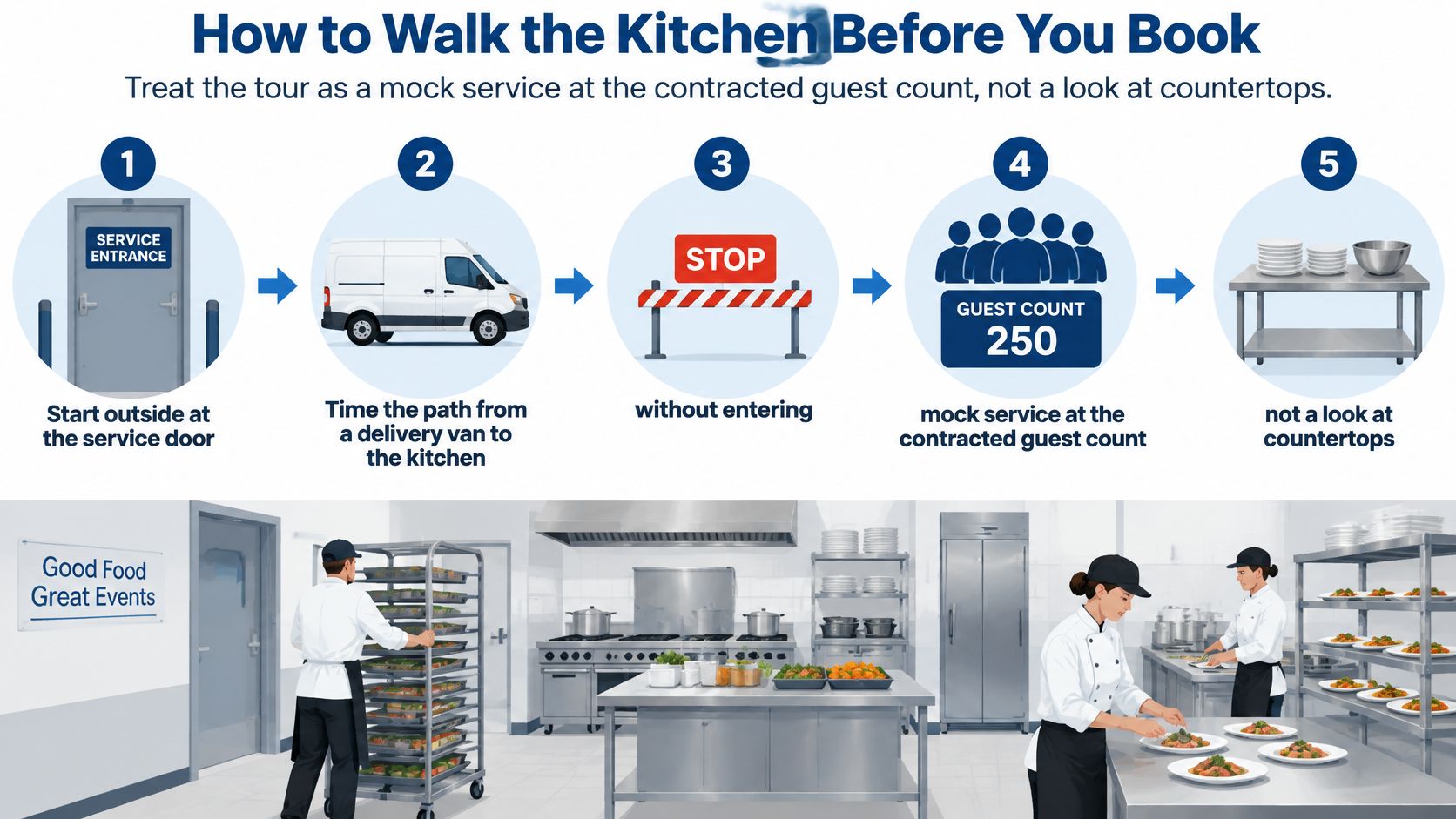
Treat the tour as a mock service, not a countertop viewing. An empty kitchen always looks adequate. It stops looking adequate when a van is unloading, the bar needs ice, a buffet pan needs refilling, and a speech starts five minutes early. Walk the room in the order food moves, and use the venue inspection checklist to keep the visit from turning into a decor conversation.
Walk It in Service Order
- Start outside at the service door. Time the path from where a delivery van parks to the kitchen door. If that path crosses the ceremony aisle, cocktail area, or guest entrance, the design is wrong for live service.
- Test the receiving window against the rental clock. Ask when the caterer may arrive, when rentals and florists unload, and when the bar team needs the same door. A generous hall rental doesn't help if food deliveries are squeezed into the busiest thirty minutes.
- Open the cold storage. Look at what's already inside and ask what else will be there on your date. Have the caterer point to where raw food stays separate from ready-to-eat plates, cakes, and garnishes.
- Find the hand sink and the hot-hold spot. The FDA Food Code requires a dedicated handwashing sink to deliver water at a minimum of 29.4°C/85°F through a mixing valve or combination faucet. Ask where thermometers and the written temperature log will sit so they're used, not buried in a crate.
- Stage one tray and carry it out. Use a sample chafing dish or covered tray and walk it to the buffet or plating point. Then walk back for a refill as if a first dance or speech is happening. If you have to squeeze past guests, the refill will be late or conspicuous.
- Name one food-safety lead. That person checks deliveries, allergen labels, holding temperatures, and the timing of refills. Ask where allergen cards will be posted and who answers a guest's ingredient question without guessing.
- End at waste and teardown. Walk to the bins, ask where grease goes, and write down who removes leftover food, who cools anything that's kept, and who cleans the prep surfaces. Don't leave this to whoever's still standing at midnight.
What You're Really Testing
You're testing sequence. Deliveries should be verified before food enters production, including allergens and cold-chain temperatures. Raw handling should stay apart from ready-to-eat assembly. Plated and buffet food should be staged by service order, and someone should record holding checks during setup and service, then document disposal, cooling, and cleanup afterward.
At our halls, for example, the practical starting point is simple. We have a prep kitchen with a separate service entry, and couples can choose their own caterer. That still doesn't answer your event by itself. Your caterer still has to confirm equipment ownership, electrical loads, gas availability, hood certification where cooking is planned, floor-drain capacity, pest-control provisions, and local licensing.
Acceptance test: Run a full mock setup at your contracted guest count, including delivery, staging, service, replenishment, and teardown. Redesign any step that crosses guest circulation before you sign.
A common confusion is assuming counters, refrigeration, and sinks equal permission to cook anything. They don't. The kitchen may not provide cooking exhaust, grease management, warewashing capacity, or enough separation for a raw-to-finished menu. For a large quinceañera or wedding, buffet refills, bar traffic, speeches, and photography already compete for attention. Temperature checks are the first task people skip when the room gets loud.
Bring your caterer to this walk if you can. A venue salesperson can describe the room, but your caterer has to work in it. If the caterer says they need a rented oven, an extra refrigerator, or a second staff member just to run food, write that down while you're standing there. That's not a reason to panic. It's the information that turns a pretty tour into a priced, workable plan.
What the Meal Operation Will Cost
The question clients ask isn't whether a caterer may enter the kitchen. It's what the whole meal operation will cost and whether it'll run on time. The Knot's average wedding catering cost guide puts catering at about $80 per guest in the latest cited Real Weddings survey, with regional averages ranging from $62 to $123. In that same survey, food and beverage were the most important wedding elements for 58% of couples.
Use that figure as a food benchmark, not a final bill. It doesn't automatically include every rental oven, extra refrigerator, delivery fee, service extension, or cleanup charge your kitchen setup creates. A lower per-person menu can finish higher than a pricier one. If the hall can't stage your service, you pay for equipment and labor to work around it.
Say two caterers quote the same chicken entrée. One can plate in the kitchen and send servers straight to tables. The other has to rent hot boxes, hire a runner for a long hallway, and keep a second staff member on refills because the buffet sits far from the holding ovens. The menu price looks identical. The operating price doesn't. Compare your hall costs the same way you'd compare any banquet hall rental cost breakdown, line by line.
Where the Extra Money Hides
- Staffing: Plated service, buffet refills, cake cutting, and late-night food each need people at different times.
- Rentals and delivery: Ovens, wells, sheet pans, plates, glassware, and extra refrigeration arrive by truck and leave the same way.
- Time: A longer service window, a second food setup, or a slow teardown can extend labor for the caterer and the bar team.
- Cleanup and leftovers: Someone packs, labels, cools, or discards food, and someone handles grease and trash.
Menus also keep stretching beyond one dinner. In the survey cited above, 27% of couples served late-night snacks, 13% used interactive food experiences, and 4% hired food trucks. Each add-on sounds small until you ask where it'll be held, what power it needs, and whether the kitchen can run dinner cleanup and a second offering at the same time.
All-in meal cost by event style
| Event style | Food benchmark | Kitchen-driven extras | What moves the total |
|---|---|---|---|
| Plated wedding dinner | About $80 per guest; regional averages $62 to $123 | Service staff, plate rentals, delivery | Guest count and special-diet plates |
| Buffet with replenishment | Same food range, often more service labor | Staging space and hot-holding gear | Speeches and photos during refill |
| Late-night or interactive food | Second offering on top of dinner | Extra window, power, and permits | A kitchen too small for two menus at once |
| Quinceañera or milestone party | Buffet plus a sweets or family table | Longer holding and dessert staging | A teen service rush and leftover plan |
| Corporate banquet | Plated or boxed, shorter program | Daytime load-in beside meetings | AV and the meal competing for the same hour |
Separate the charges by owner. Venue charges usually cover the hall, kitchen space, service entry, tables, chairs, and rental hours. Caterer charges cover food, kitchen labor, service staff, rentals they supply, delivery, extra equipment, and the staff time to replenish and clean their area. Don't let either side bury a missing item in a phrase like full service unless they've defined it.
Before you sign, send both vendors the same three-line worksheet. Line one gives your guest count and service style. Line two itemizes caterer charges for staffing, delivery, rentals, extra refrigeration, late-night replenishment, and cleanup. Line three lists what the venue already includes, such as kitchen space, the service entry, and hall hours. Anything the kitchen doesn't provide belongs on line two with a price, not in a hopeful conversation two weeks before the event.
Contract Questions and Event-Day Failures
Once the kitchen scores well on the walk, the contract has to protect what you just verified. Most event-day failures aren't dramatic. They're small ownership gaps that nobody wrote down. A cooler gets blocked by gifts, a caterer discovers another vendor in the prep room, or an unlisted appliance trips a breaker during the first course.
Questions That Prevent Specific Problems
Who else holds keys during the rental, and does the caterer get exclusive use of the prep room? Shared access sounds harmless until a decorator stores boxes on the plating counter or a family member opens the refrigerator hunting for cake. Food areas need controlled traffic.
What's the earliest delivery time and the latest trash-out? Ask whether a rehearsal dinner the night before changes cooler space, and whether the bar, florist, and rental company share your load-in window. If you're comparing a wedding venue that allows outside catering, flexibility only counts when those hours are usable by the caterer you hire.
Which bartending companies are allowed if you supply beverages? Find out whether ice, glassware, garnishes, and food share one hallway or one sink. Bar traffic can steal the caterer's hand sink, ice, and counter space during cocktail hour.
Who insures dropped rentals, and who pays if an unapproved appliance trips a breaker? Put the caterer's equipment schedule in writing and ban unlisted gear. Name one food-safety lead and one venue contact who can make a decision during speeches without hunting for approval.
How does an indoor ceremony backup change the dining set? Moving chairs and tables over food that's already holding is a common delay. Ask where guests wait during the flip, where hot food stays, and whether service staff can still reach the kitchen while furniture moves.
For a 200-guest buffet, a good answer is concrete. It names a 30- to 45-minute receiving window in your plan, a replenishment path that avoids the photo line, and a person who owns the temperature log. Those aren't universal rules. They're the level of specificity you should hear before you trust the timeline.
Ventilation Is a System, Not a Hood Shape
Don't assume a hood works because you can see one. ASHRAE's kitchen ventilation handbook chapter identifies demand-controlled kitchen ventilation requirements when total hood exhaust exceeds 2.4 m³/s, approximately 5,080 cfm. At that level, at least 75% of hood exhaust must be controlled by a system capable of reducing exhaust and replacement-air flow by at least 50% while maintaining capture and containment of smoke, effluent, and combustion products.
In plain language, the system has to turn down without losing smoke, and it has to return to full flow if modulation fails. Commissioning means measured hood airflow, makeup-air verification, smoke-capture testing under representative appliance loads, alarm and interlock checks, and a full-flow fail-safe test. Those results should be recorded and repeated after major equipment changes.
A portable fryer added the week of the event is the usual miss. If it isn't on the approved equipment schedule, it doesn't belong under the hood.
Start by inventorying every appliance the caterer may use, including ranges, ovens, fryers, griddles, combi ovens, and portable equipment. The venue, mechanical engineer, or authority having jurisdiction should confirm that the hood, suppression system, electrical service, and makeup-air balance can support that load. Negative pressure can pull odors or combustion products into the hall. Too much makeup air can create drafts that disturb flames and cool buffet food before it reaches a guest.
Traffic failures are quieter but just as damaging. A refill crosses the dance floor during the first dance, so the pan sits empty. A cooler door is blocked by gifts, so salads warm while someone moves boxes. Toasts run long, nobody checks holding temperatures, and the lead can't say how long a pan has been out. These aren't catering talent problems. They're path, access, and ownership problems you can fix on paper.
Write the fixes into the contract. Require the equipment schedule in advance, prohibit unapproved appliances, coordinate service and guest doors with the ventilation design, and repeat the smoke and path test after any equipment change. If the venue can't tell you who can authorize a change on event day, you don't have a contingency plan. You have a hope.
Book a Kitchen Walk Before You Sign
Book your next tour as a working kitchen visit, not a decor appointment. Bring your caterer, your marked kitchen scorecard, and your three-line cost worksheet. You're not trying to re-tour the whole property. You're repeating only the rows that failed or stayed blank, at the headcount you expect to feed.
Start at the service door and move in service order. Confirm cold holding with the refrigerator open, hot holding with the actual equipment in place, and the dedicated handwashing sink with the water running. Carry one tray from the kitchen to the farthest guest table and back. If the route only works when the room is empty, it won't work when the room is full.
What to Ask Us to Show You
When you tour with us, ask us to show the service entry, the prep kitchen, the cold storage your caterer would use, and any ventilation documentation tied to cooking your caterer plans to do. We have a prep kitchen with a separate service entry, and couples can choose their own caterer. Each rental includes an on-site venue manager, which gives your caterer a named venue contact during service instead of a general phone number.
Ask for the hours in writing for the hall you're considering. Wedding clients at Redbud Hall have had venue access from 8 AM until midnight, but you should still confirm your receiving window, your caterer's load-in time, and your trash-out deadline for your date. Rental hours and kitchen access hours aren't always the same thing, and that distinction changes staffing.
- Bring the menu draft. A plated filet, a taco buffet, and a late-night snack station ask different things of the same room.
- Bring the equipment list. Mark every oven, hot box, and portable appliance as venue supplied, caterer supplied, or not allowed.
- Bring the timeline. Put delivery, cocktail hour, speeches, refills, cake, and teardown on one page so conflicts show up early.
- Leave with names. You need one food-safety lead from the caterer and one venue manager who can solve an access or power problem.
Don't place a deposit because a kitchen looked clean on a weekday morning. Place it because your caterer walked the door, opened the cold storage, tested the sink, carried the tray, and priced every missing item. If a venue can't show you the door, the sink, the holding plan, and a named contact, keep looking. The room may be lovely, but your guests will remember whether dinner was hot, on time, and easy to reach.
Bring your caterer, your guest count, and your unanswered kitchen rows to a working tour at Texas Old Town, where our prep kitchen has a separate service entry and you can choose your own caterer. We'll walk the service door, cold storage, hand sink, and tray path with you, and confirm hours and on-site staffing in writing before you sign.