You're probably already in the middle of it, comparing a Hill Country ranch, a hotel ballroom, and a venue brochure while leadership keeps asking the same question, “Will this feel like a real retreat, or just a nicer meeting?” That's the right question. The wrong move is treating a company offsite in Texas like a scenic day trip and hoping the strategy part will happen by accident.

A productive company retreats Texas project starts with a hard truth. A key challenge is that many Texas retreat guides focus on scenic settings but fail to address the practical needs of a productive offsite in 2026, such as reliable Wi-Fi, ample breakout space, and formats that support hybrid teams. That gap matters because corporate offsites have to deliver focused work and collaboration, not just a change of scenery, as noted in Texas corporate retreat planning guidance.
If the event also has to feel memorable, useful, and easy to defend internally, it helps to think like an operator, not a guest. I've found that planners move faster when they borrow a few principles from organizing memorable team events and apply them before they ever book a venue. The result is a retreat that has a clear purpose, a workable schedule, and fewer surprises for everyone involved.
Table of Contents
- Beyond the Barbecue: Planning a Texas Retreat That Works
- Aligning Your Retreat Goals with Business Objectives
- Choosing the Right Venue for Your Company Retreat
- Building an Agenda That Balances Work and Connection
- Navigating the Logistics of Your Texas Retreat
- Measuring Your Retreat's ROI and Post-Event Follow-Up
Beyond the Barbecue: Planning a Texas Retreat That Works
The first version of a Texas retreat usually sounds simple. Get the team out of the office, put them somewhere pretty, feed them well, and hope the energy improves. That's how people end up with a fun trip that doesn't move the business forward. The better version starts when someone asks what the retreat needs to change once everyone gets back.
A corporate planner I'd trust will usually spot the tension right away. The CEO wants morale. The department lead wants alignment. Finance wants the spend justified. Hybrid teams want a format that doesn't punish the people who can't sit in the room all day. Those aren't conflicting goals if you design the retreat around them from the start.
The strongest company retreats Texas programs use the state's range of venue types to match the format to the objective. Texas venues support intimate leadership offsites for 15–30 guests, mid-size gatherings for 15–80, and large company events for 150–200+ attendees, which matters because the room count, meeting space, and activity style should fit the outcome you're after, not the other way around, according to Texas retreat venue roundups.
Practical rule: if the agenda is serious, the venue has to be serious about the basics, Wi-Fi, breakout rooms, acoustics, and a layout that doesn't force the team to improvise between sessions.
That's where a lot of scenic venues fall short. They sell the feeling of being away, but they don't always support the work that happens once the novelty wears off. For a leadership session, that means the room must support focus. For a mixed in-person and remote meeting, that means the venue has to function like a meeting space, not just a backdrop.
Texas Old Town is a useful example of the right mindset. It's one option among several for planners who need a venue with flexible rooms, a 16-hour rental window, and practical logistics between Austin and San Antonio. That combination is what keeps the event from collapsing into schedule compression, especially when the goal is both connection and output.
Aligning Your Retreat Goals with Business Objectives
A Texas retreat works only when the business goal comes first. If you skip that step, the rest of the plan gets vague fast, from the agenda to the meal format to whether breakout rooms even belong in the design. A leadership alignment retreat should not look like a culture outing, and a culture outing should not be built like a sales kickoff.
Start with one primary objective and keep it narrow. If the retreat is about leadership alignment, the sessions need to produce decisions, not just open discussion. If it is about cross-functional collaboration, the agenda should build shared context and give teams one real problem to work on together. If it is a milestone celebration, the structure still needs room for recognition without turning the whole event into a social-only trip.
The useful test is what changes after everyone goes home. Did managers leave with the same priorities? Did two departments agree on a handoff process? Did the team spend enough time together to replace email back-and-forth with direct conversation? Those are stronger indicators than whether the group had a good time, because a pleasant event and a productive one are not the same thing.
Budget also shapes how the objective gets framed. A separate industry report estimates that in 2025, the average corporate retreat cost in North America ranges from $1,800 to $4,500 per employee, with premium leadership retreats exceeding $6,000 per person, which is why planners need a sharper business case for every line item, as outlined in corporate retreat cost data. Once the spend reaches that level, the retreat stops looking like a perk and starts looking like a strategic investment.
That shift changes the planning conversation. The goal is no longer to put people in a nice setting and hope the result is useful. The goal is to take them out of the usual workflow so they can solve something that gets blurred in daily operations, then check every choice against that outcome.
Write the objective in one sentence and do not widen it. “Align the leadership team on next quarter's priorities” gives you something to build around. “Create a memorable experience for everyone” does not. The first can be tested against the agenda, the venue, and the follow-up. The second only sounds complete until the retreat is over.
For planners who need a venue that supports both focus and logistics, Texas Old Town's corporate event venue near Austin is a practical example of how the setting can support the work instead of competing with it.
For smaller offsites that need house-style lodging, top apps for finding homes can help narrow options without losing sight of the retreat objective.
Choosing the Right Venue for Your Company Retreat
A Texas retreat venue can either support the work or get in its way. The state gives planners a wide spread of choices, from Hill Country ranches and urban hotels to coastal properties and rustic lodges, so the primary task is matching the setting to the objective, arrival pattern, and amount of quiet time the group needs. That range is a strength, but it also means the selection process takes more discipline than picking the first attractive block of rooms. For a broader look at how the market is spread across Texas, Texas venue market coverage is a useful reference.
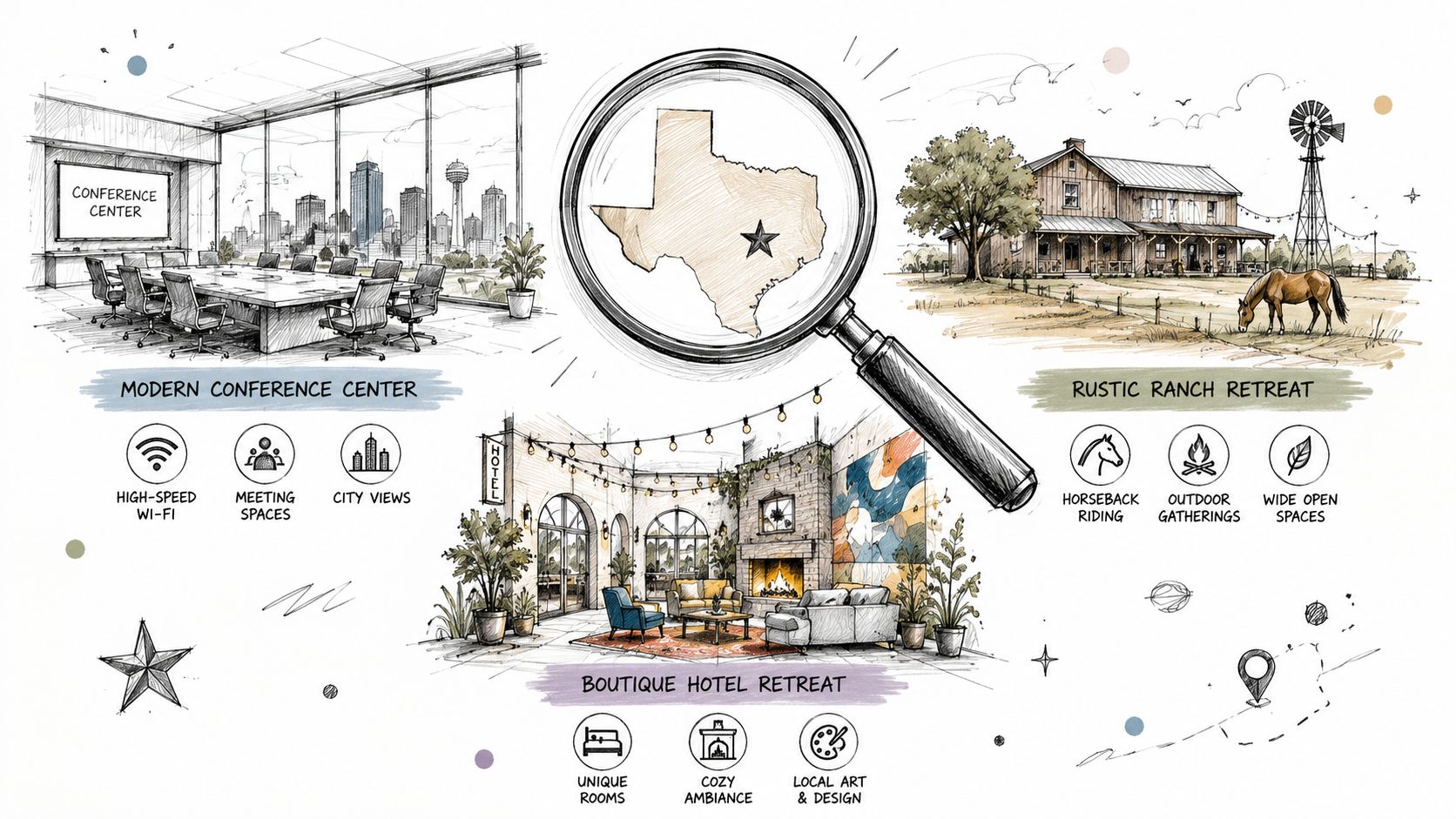
Trade-offs show up fast once you start comparing properties. Urban hotels make arrival easier, especially if part of the team is flying in for a short program, but they can feel too close to the regular office rhythm. Rural properties create cleaner separation and usually help people stay focused, yet they ask more of your transportation plan and your timing. Coastal venues bring a lighter mood, but weather and routing can complicate the schedule if you do not build in margin.
The right venue is not the one with the prettiest photo. It is the one that fits the group, the timing, and the work you need done.
For smaller offsites that rely on private homes or house-style lodging, top apps for finding homes can help narrow the search, especially if you are checking sleeping space, access, and distance to the meeting site. That research is useful, but a retreat venue still has to do more than provide beds. You need dependable Wi-Fi, real breakout space, workable parking, catering rules that do not create friction, and enough room to move between sessions without losing time.
Texas Old Town is a good example of how venue design can support the agenda instead of fighting it. Its four distinct halls, 16-hour rental window, outdoor ceremony space, and indoor climate-controlled reception areas give planners room to separate working sessions, meals, and team time without cramming everything into one shared area. The venue details are outlined in Texas Old Town's corporate event venue overview, and that kind of layout matters when the retreat has to stay productive as well as pleasant.
When you review any Texas venue, start with the basics that affect execution. Capacity should match the actual group size, whether you are hosting a leadership session or a larger company gathering. The technology needs to support business use without constant troubleshooting. Vendor policies should leave you enough control over budget and schedule that you are not rebuilding the plan around the venue's limitations. If a property cannot answer those questions clearly, it is not ready for a working offsite.
Building an Agenda That Balances Work and Connection
Most retreat agendas fail in one of two ways. They're packed from morning until night, which leaves no room for real conversation. Or they're so loose that no one knows what the event was for. The right agenda uses structure to create freedom, not pressure.
For Texas corporate retreats, the most successful format uses a 50/30/20 split, with 50% unstructured connection, 30% coordinated activities, and 20% structured work, according to best-practice retreat planning guidance. That ratio works because people need enough open time to build trust, enough guided activity to keep energy moving, and enough focused work to make the retreat feel intentional.
Useful pattern: put the hardest business conversation when people are fresh, not after lunch, and don't stack every “fun” item into the same block.
A sample 3-day agenda helps leaders visualize the balance. Day one should absorb arrival, orientation, and one meaningful working session. Day two can carry the deepest content, then leave the evening open for low-pressure team time. Day three should be shorter, with decisions, takeaways, and a clean departure. That structure keeps the retreat from feeling like a conference with nicer landscaping.
| Day | Morning (9 AM – 12 PM) | Afternoon (1 PM – 5 PM) | Evening (6 PM onwards) |
|---|---|---|---|
| Day 1 | Arrival, check-in, and opening remarks | Strategic session and small-group discussion | Welcome dinner and informal connection |
| Day 2 | Working session and planning workshop | Team activity and open breakout time | Group meal or optional Texas-themed outing |
| Day 3 | Recap, commitments, and next-step planning | Departure and travel buffer | N/A |
The agenda should also respect Texas weather. Outdoor sessions can work beautifully, but only when they're placed with the season in mind. Midday heat can flatten attention fast, so use shaded spaces, air-conditioned breakouts, or early and late outdoor windows instead of assuming a lawn or patio is usable all afternoon.
If you need a practical template for making the schedule feel orderly, Texas Old Town's reception schedule template is a useful reference point for pacing transitions and handling room flow. The point isn't to copy a wedding run-of-show. It's to borrow the discipline of a clear sequence so the retreat doesn't waste momentum every time the group changes rooms or activity types.
Navigating the Logistics of Your Texas Retreat
A retreat budget gets tight fast when every category pulls in a different direction. Venue rental, travel, catering, activities, and technology all compete for the same pool, and in Texas, ground transportation can become the sleeper issue when the venue sits outside a major city. Strong plans treat logistics as part of the agenda itself, because the way people move and arrive shapes the event before the first session starts.
Texas travel costs also need to be framed in practical terms. Retreat spending per employee can run high enough that leadership will ask where the money is going, so the budget needs to show how each line supports the event's purpose. If the retreat is meant to improve alignment, strengthen cross-functional work, or give leaders time to make decisions together, the logistics should reflect that goal rather than just listing expenses.
The map matters as much as the spreadsheet. Getting people from the airport to the venue is usually manageable, but it gets messy when attendees are coming from different cities or the site is deep in the Hill Country. A clearer transportation plan reduces late arrivals, keeps remote attendees from feeling like an afterthought, and prevents the opening session from starting with missing people and rushed check-ins.
For teams coordinating shuttles, luggage, or guest movement to a resort-style property, Solana EV insights on resort fleets show how transportation planning can be tied to the retreat experience itself. That same attention to movement is useful when you are comparing larger properties, including planning guidance for large event venues at Texas Old Town. Transportation is not just a line item. It sets the tone the moment people step off the vehicle.
Weather is the other Texas-specific variable, and it deserves a real backup plan. Rural venues can be excellent for focus and connection, but they also require a plan for heat, storms, and schedule slips. Flexible vendor policies and BYO beverage options can help planners control where the money goes instead of locking into a rigid package. Texas Old Town's flexible vendor setup is a useful case study because it gives planners room to choose catering and bar structure while keeping operational support in place.
Travel time should also be treated as a human factor, not just a routing problem. If people have to drive between cities, or from the airport to a Hill Country property, that transit time belongs in the event design. Do not stack a high-energy session immediately after arrival. Do not schedule dinner so late that guests face a tired drive back to their hotel. Good logistics feel calm because someone did the math early and built the retreat around how Texas works.
Measuring Your Retreat's ROI and Post-Event Follow-Up
If the retreat ends when everyone drives home, you've left most of the value on the table. The true test is whether people use what happened there once they're back in the office. That means the measurement plan has to be built before the event, not retrofitted after someone asks for a summary.
A solid approach starts with baseline data before the event, then a post-retreat survey within 48 hours, followed by 30-, 60-, and 90-day reviews of action items and collaboration patterns, according to retreat ROI measurement guidance. That sequence helps separate the feel-good moment from durable change, which is exactly what leadership needs if it wants a real answer on return.
Track a mix of behavioral and business signals. If the retreat was about alignment, look at whether teams are making decisions faster or escalating fewer issues. If it was about cross-functional work, watch for cleaner handoffs and more consistent follow-through. If morale was the goal, monitor whether people are participating more fully in meetings or showing up with more confidence after the retreat.
A good follow-up process is simple enough that managers will use it. Send the immediate survey quickly. Assign owners to each action item before people leave the venue. Review progress at 30 days while the retreat is still fresh enough to matter. Then check again at 60 and 90 days so you can tell whether the event changed habits or just created a temporary lift.
One practical way to strengthen the ROI story is to tie the retreat's outputs to the business language leadership already uses. If the team committed to fewer blockers, more consistent communication, or clearer ownership, those are measurable patterns even when they're not easy to assign a dollar value to. That's the level of reporting that turns a retreat from a “nice idea” into a decision leadership wants to repeat.
If you're planning company retreats Texas leadership can defend, start with a venue that gives you room to work, enough flexibility to adjust, and the kind of logistics that don't unravel on event day. Texas Old Town is worth a direct conversation if you want indoor and outdoor options, practical vendor flexibility, and a Hill Country location that works for Central Texas teams. Reach out to Texas Old Town now, compare your dates and headcount, and build a retreat plan that's designed for business results, not just a good weekend.