wedding planning

Wedding Venue Amenities: The Complete Planning Guide

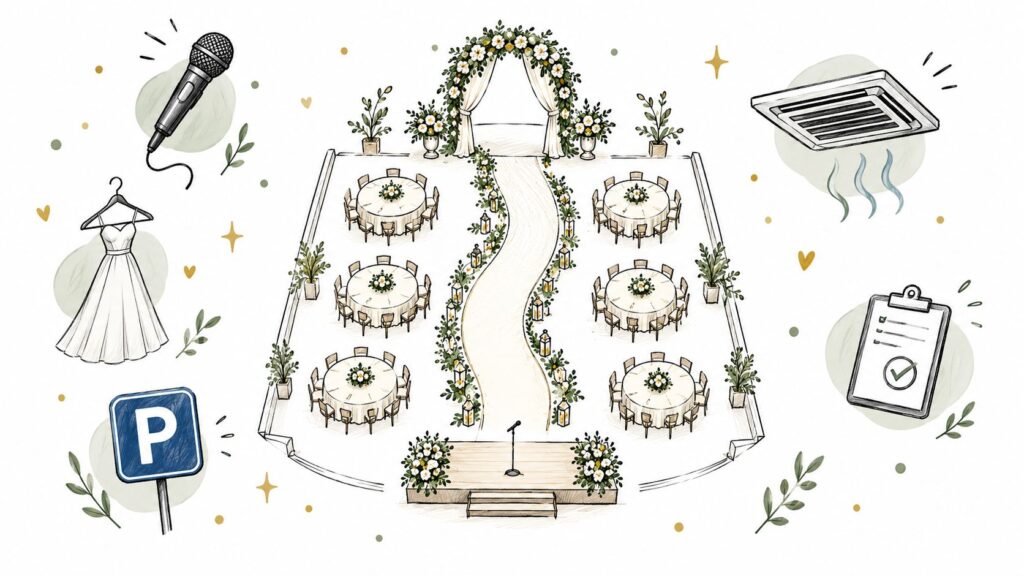
You arrive for a venue tour ready to fall in love with the grounds. The ceremony lawn looks beautiful, the reception hall photographs well, and then the practical questions start: Where will the wedding party get ready? Can guests hear the vows from the back row? What happens if rain moves the ceremony indoors? Those aren't small details to sort out later. Wedding venue amenities are the operating system for the day, shaping your timeline, vendor needs, guest comfort, and final cost. A useful tour doesn't just show you what looks good. It reveals what the venue can handle, what you'll need to arrange, and what could derail the plan if nobody asks. Table of Contents Why Wedding Venue Amenities Shape the Whole Day Amenities are part of the schedule The right setup gives you breathing room What Amenities Actually Do for Cost and Planning Turn features into planning inputs Ceremony, Reception, and Climate Control Check the room at full occupancy Test the sound where guests will sit Dressing Suites, Catering, and Bar Logistics Look beyond the dressing room label Make responsibilities explicit Accessibility as a Guest Journey Walk the whole route Check how the details connect Matching Amenities to Your Venue Style Choose the format that removes the right work Your Venue Tour Checklist Walk the spaces and test the systems Verify guest access and the written price Why Wedding Venue Amenities Shape the Whole Day A venue is usually the first major vendor a couple books, and it affects how nearly every other vendor works. The caterer needs a workable kitchen and a clear service route. The DJ needs reliable power and sound coverage. The photographer needs time and space for portraits. Your guests need comfortable places to gather, eat, and move between parts of the celebration. That's why a beautiful property can still be a difficult choice. During a tour, a couple might focus on the ceremony backdrop and forget to ask how long the walk is from the parking area, where the wedding party can change, or who's responsible for moving chairs if the ceremony plan changes. Each unanswered question becomes a task for someone to solve later, often while several other vendors are waiting for a decision. Amenities are part of the schedule Think through the day in order. The wedding party arrives, vendors unload, the couple gets ready, guests find their seats, the ceremony begins, and the room transitions into dinner and dancing. An amenity matters when it makes one of those moments easier or more reliable. A private dressing suite can give the wedding party a place to prepare without competing for a public restroom. An indoor ceremony option can preserve the schedule when outdoor conditions aren't suitable. On-site management can help vendors follow the same timeline instead of asking the couple or family to direct setup. Touring rule: For every feature that looks attractive, ask what job it performs on the wedding day and who is responsible for it. The right setup gives you breathing room The Knot's 2025 Venue Report analyzed responses from 16,956 U.S. couples married in 2024 and found that 70% favored open-air venues and natural settings. The same report noted that indoor ceremonies and ballroom receptions remained popular in some regional markets, reinforcing the value of having both outdoor atmosphere and a credible indoor alternative (The Knot's 2025 Venue Report). The practical takeaway isn't that every couple needs every amenity. It's that the venue should support the kind of day you want without asking you to improvise the basics. When spaces, sound, preparation areas, and staff responsibilities are clear, you can spend less time solving operational problems and more time enjoying the event. What Amenities Actually Do for Cost and Planning A venue's amenities can reduce more than the rental list. They can remove separate vendor searches, added delivery windows, setup decisions, and last-minute labor charges. Compare the work and cost an amenity replaces, not just whether the venue lists it. That distinction matters in a market where budgets are often uncertain. The Knot's 2026 Real Weddings Study surveyed 10,474 U.S. couples married in 2025; industry coverage reports that 41% went over budget and 21% had no formal budget. In that same coverage, 73% of venues included rentals such as tables, chairs, or linens, while only 16% offered space-only rentals (wedding industry statistics and study coverage). Those figures make the right comparison clear. A venue fee that includes furniture, setup, cleanup, and an on-site manager may be easier to budget than a lower base rental that leaves those jobs to you. But don't assume an included item covers every related task. Ask whether setup, room changes, breakdown, and disposal are included, and get the answer in writing. Turn features into planning inputs Check the venue's proposal for documented furniture counts and the exact services included. Then identify what you'd otherwise have to rent, hire, or coordinate. Tables and chairs can save a rental order; included cleanup can spare you from arranging post-event labor; an on-site manager can keep vendors aligned without making a family member the event dispatcher. Flexible vendor policies matter, too. A venue that lets you choose a caterer may give you options, but ask about kitchen access, insurance requirements, bar rules, and service charges. Freedom is useful only when the conditions are clear. If you're comparing package details, review Texas Old Town's wedding package pricing alongside the written inclusions from other venues. Ask each property for a quote based on the same guest count, event duration, and service needs. Use the chart as a reminder to compare the full plan, not as a promise that one pricing model will always cost less. The useful number is the written total for your actual event, including required vendors and any additional services you'll need. Ceremony, Reception, and Climate Control Outdoor ceremony space and indoor reception space work best as a coordinated plan. One gives you the setting you want; the other can protect the event from


Wedding Venue Tours: Your Walkthrough Checklist

Most advice about wedding venue tours starts with the wrong question: Do you love the look of this place? The better question is whether the venue can carry your guest count, budget, vendors, weather plan, and timeline without forcing expensive compromises later. A venue tour is a physical audit of decisions you've already started making online. The photographs can show gardens, ceilings, tables, and ceremony backdrops. They can't show whether guests will queue for restrooms, whether a caterer can reach the prep kitchen, whether the backup ceremony room has enough chairs, or whether the quoted price excludes services you assumed were included. Table of Contents How Couples Actually Choose Venues Today Replace the mood test with a verification test Auditing the Quote Before You Walk the Property Read the quote as an operating document Ask questions that expose the true total Inspecting Usable Space and Guest Flow Follow the guest route Inspect the spaces vendors use Evaluating Weather Backups and Outdoor Logistics Rehearse the rain plan during the tour Test the plan against Texas conditions Comparing Rental Windows and Day-Of Flexibility Compare the two operating models Ask who owns the clock Finalizing Your Venue Decision How Couples Actually Choose Venues Today A venue tour should test operations and costs, not merely confirm that a property photographs well. The The Knot Real Weddings 2025 Vendor Report analyzed 16,956 U.S. couples married during 2024 and found that 90% of wedding planning happened online. Couples spent an average of 6 hours per week researching vendors, and 64% used wedding-planning websites or apps such as The Knot and WeddingWire. By the time you arrive, you may already know the property's advertised capacity, style, ceremony options, and headline pricing. Use the appointment to test what online research cannot show: guest circulation, sound, access, supplier routes, setup conditions, and the distance between ceremony and reception spaces. A gallery cannot reveal a queue outside the restrooms or a narrow service entrance that slows catering. The venue often becomes the first major commitment. The same report found that 82% of couples hired their venue first. A separate study surveyed 781 U.S. couples at the venue-consideration stage and reported that nearly 80% began researching venues within two months of engagement. That early decision makes a disciplined tour more valuable than a quick viewing. Replace the mood test with a verification test Walk the property as a guest, then repeat the route as a vendor. Check where people arrive, wait, sit, eat, dance, use the restroom, and leave. Ask what changes if the ceremony moves indoors, the guest count shifts, or a supplier unloads while guests are arriving. Bring a written checklist and record answers on site. If a coordinator says something is included, request the detail in the proposal or contract. Spoken reassurance may help you understand the offer, but written terms determine what you can schedule and budget. Practical rule: Don't let a venue answer an operational question with a photograph. Ask to see the room, route, equipment, or document that proves the answer. Timing affects your choices. A wedding venue tour timing analysis cites research on 15,700 couples and reports that 89% book a venue. It also notes that peak-season Saturday dates in major markets can be unavailable 12 to 14 months ahead. Compare properties early enough to assess genuine alternatives, rather than choosing between the few configurations still open. For an outdoor celebration, use an outdoor ceremony venue checklist alongside the walk-through. Check the backup space, guest movement, supplier access, and weather-related changes before signing. Emotion can guide the shortlist, but operational and financial evidence should decide the venue. Auditing the Quote Before You Walk the Property A beautiful tour can make you emotionally commit before you understand the invoice. Request an itemized estimate before visiting, then label every line included, optional, required, or unknown. This lets you compare a low rental fee with a fuller package that already covers services you would otherwise need to arrange separately. Budget pressure makes this audit practical, not administrative. Industry reporting has found that many engaged couples are reconsidering their budgets because of inflation, while Zola's 2025 report found that 48% struggled to reconcile realistic budgets with social-media-driven expectations. The lesson is straightforward: assess the venue against the cost of operating your event, not the attractive figure in the first email. Read the quote as an operating document Check whether the price includes sales tax, gratuity, furniture, setup, cleanup, furniture breakdown, management, ceremony seating, ceremony sound, reception sound, parking, and vendor access. Ask how the quote changes when the guest count, event duration, bar arrangement, or catering plan changes. Vendor restrictions can alter the economics just as sharply. A required caterer, exclusive bar provider, mandatory security team, or limited rental list may add costs after the base fee has made the venue look affordable. Request the approved-vendor requirements in writing, then share them with your planner or caterer before comparing proposals. Pricing Element Red Flag, Hidden Cost Green Flag, Transparent Value Rental fee The headline figure excludes essential event services The proposal identifies what the rental covers Furniture Tables and chairs are billed separately or quantities are unclear Furniture counts and included pieces are documented Cleanup The couple or caterer must arrange post-event cleaning Cleanup and furniture breakdown are assigned in writing Access A short window creates extra setup or overtime charges The access period is long enough for vendors to work without rushing Catering An exclusive provider or outside-catering fee appears late Catering choices and kitchen access are explained before booking Bar service Beverage rules, staffing, or service fees remain vague Host-provided beverage policies and required bartending terms are clear Overtime The end time and extension rate aren't stated The contracted end time and overtime procedure are explicit The contract should resolve the questions raised by the estimate. Review Texas Old Town's venue rental contract information alongside each proposal, while applying the same audit to every property. Compare the total required commitment, the decisions you control, and

What Vendors Do You Need for a Wedding

You've opened a wedding checklist and found a wall of vendor names: venue, caterer, photographer, florist, rentals, transportation, beauty, cake, entertainment, coordinator, and more. The list makes every hire look equally urgent, but they aren't. The right question isn't what vendors do you need for a wedding. It's which professionals your venue, guest count, format, and priorities require. A typical couple works with an average of 14 vendors, according to The Knot's wedding vendor resources. That number sounds intimidating until you separate the team into layers. A venue and a few high-impact specialists establish the structure, while other vendors add comfort, style, convenience, and personality. Table of Contents Building Your Core Wedding Vendor Ecosystem Think in layers, not obligations Essential Vendors You Must Book First Start with the venue Add the people who control the day Secure ceremony and reception leadership Secondary and Optional Vendors to Elevate the Day Compare necessity with enhancement Spend on the experience guests notice How Your Venue Choice Changes Your Vendor List Ask what the contract eliminates Budgeting and Contract Tips for Your Vendor Team Protect the money before you sign Timeline for Hiring Your Wedding Vendors Begin with the fixed conditions Work backward from the wedding day Finalizing Your Vendor Roster and Next Steps Build one operational plan Building Your Core Wedding Vendor Ecosystem Your vendor list should function as a system, not a shopping spree. Each provider either creates a hard logistical condition, fulfills a legal or operational requirement, or improves the atmosphere and guest experience. Once you classify vendors that way, the planning process becomes much easier to control. Start with the venue, because it determines the shape of everything else. Guest capacity, ceremony and reception locations, catering rules, furniture, sound equipment, parking, access hours, cleanup, and preferred-vendor policies all influence who you'll need to hire independently. A venue that includes tables and chairs removes one decision. A venue with in-house catering changes another. A venue without day-of management may make coordination a priority. The core ecosystem usually includes: Venue: Provides the physical setting and establishes the event's operational boundaries. Planner or coordinator: Manages decisions before the wedding or directs the day itself. Photographer: Preserves the visual record and affects portrait timing, family-photo organization, and lighting needs. Caterer and bar team: Handles food, beverage service, staffing, equipment, and service flow. DJ or band: Provides music, announcements, sound reinforcement, and reception pacing. Officiant: Leads the ceremony and handles the required formalities for your wedding format. Florist and décor team: Shapes the visual environment, though these services may be scaled or replaced with venue décor. Attire and beauty professionals: Prepare the couple and wedding party for the ceremony and photographs. The most recent vendor data from The Knot says couples hire the dress-purchase category at 91%, venues at 90%, and photographers at 87%, with an average vendor team of 14 providers. Those figures show a useful pattern: the venue, attire, and photography sit near the center of the planning workflow, while the rest of the team depends more heavily on the wedding's design and format. Preferred-vendor lists such as this one from Texas Old Town can also reduce research time by giving couples a starting point for local providers. Think in layers, not obligations The first layer keeps the event possible. The second makes it run smoothly. The third makes it feel like your wedding. That distinction protects your budget. You may need a caterer if the venue doesn't provide food, but you might not need a separate rental company if the venue supplies furniture. You may need a DJ for announcements and sound, but you might skip a separate emcee. You may want a florist, but a ceremony in a naturally green setting may require less décor than a blank ballroom. Practical rule: Don't add a vendor until you can name the specific problem they'll solve or the experience they'll improve. Write your first draft in three columns: required by the venue or law, needed for smooth operations, and chosen for style or convenience. That simple filter prevents a generic checklist from dictating your wedding. Essential Vendors You Must Book First Some vendors control the conditions under which every other provider works. Book those first, because a late decision can force changes to guest count, menus, load-in plans, power requirements, photography timing, or the ceremony schedule. Start with the venue The venue is your first serious contract. Confirm the date, capacity, ceremony options, access window, rain plan, catering rules, beverage policy, furniture, sound equipment, dressing rooms, parking, cleanup, and required insurance before you compare other vendors. Venue policies create downstream decisions. A caterer needs to know whether there's a prep kitchen and service entrance. A band needs to know about electrical access, sound limits, stage dimensions, and load-in routes. Your photographer needs to understand where portraits can happen and how much time the venue allows before guests arrive. Industry planning guidance places the venue and planner first, followed by photography or videography, catering, and entertainment, because sought-after providers may be reserved 9 to 18 months ahead in major markets. The booking sequence and lead-time guidance are summarized in The Knot's wedding vendor checklist. Add the people who control the day A planner or coordinator is the next decision if you don't have strong venue management or family members who can handle logistics without becoming guests responsible for the event. A full-service planner helps with design, sourcing, contracts, and scheduling. A day-of coordinator takes over the operational load closer to the wedding. Your photographer deserves early attention because the photographer's availability and working style influence the timeline. Ask how they handle family portraits, dark interiors, difficult weather, large wedding parties, and coordination with videography. Don't choose on portfolio style alone. You'll spend much of the day near this person, so communication matters. Catering is a major operational hire, not just a menu choice. Review staffing, service format, rentals, dietary accommodations, kitchen requirements, bar responsibilities, setup, cleanup, and overtime. Use this practical guide to

Wedding Venue Manager: Duties, Costs, and Tips

You arrive at the venue expecting romance, photographs, and a room full of people you love. Instead, the caterer is asking where to unload, the florist needs access to the ceremony site, the bar team is waiting for approval, and someone has discovered that the reception layout doesn't match the floor plan. Without a capable wedding venue manager, those small questions land on the couple, parents, or an overwhelmed friend. A venue manager works behind the scenes to keep the property, staff, vendors, and physical schedule aligned. The role protects more than convenience. It protects the timeline, the condition of the venue, and the money you've committed to one of the largest parts of your wedding budget. Table of Contents The Reality of Day-Of Event Execution Where the responsibilities meet Core Responsibilities and Operational Scale The information system behind the event How On-Site Management Protects Your Timeline Before the ceremony During the ceremony and reception After the final song Evaluating Costs and Hidden Venue Fees Ask what the package really includes Modern Booking Trends and Communication Standards What mature communication looks like Critical Questions to Ask During Your Venue Tour Confirm the manager's actual role Test the venue's flexibility Securing a Seamless Event Experience Choose support that matches your event The Reality of Day-Of Event Execution At the moment guests begin arriving, a successful wedding can look effortless. The ceremony chairs are aligned, the indoor reception room is ready, the sound system works, and the catering team knows which entrance to use. That calm appearance usually reflects hours of decisions made before the first guest steps onto the property. A wedding venue manager is the operational anchor for the physical venue. They oversee the building, grounds, venue-provided furniture, utilities, access rules, cleaning standards, and venue staff. They also coordinate the parts of outside vendor activity that affect the property, such as arrival times, load-in routes, setup locations, and breakdown procedures. That role isn't automatically the same as a wedding planner or day-of coordinator. A planner works for the couple and may manage the broader wedding design, personal details, off-site events, transportation, family photographs, and communication with every vendor. The venue manager works for the property and focuses on making sure the property performs as promised. Where the responsibilities meet The distinction matters because couples often hear “coordination” and assume it includes every wedding-day task. A venue manager may prepare tables and chairs, supervise venue staff, manage the bar arrangement, check climate control, and protect the approved floor plan. A personal coordinator may cue the processional, gather family members for photographs, manage personal décor, and keep the couple's full timeline moving. Strong teams define those boundaries before the wedding. The venue manager shouldn't be expected to leave a catering setup problem to find a missing attendant, and your independent coordinator shouldn't have to troubleshoot the venue's power, bathrooms, or furniture inventory. Practical rule: Ask for the venue manager's responsibilities in writing, then compare them with the duties assigned to your planner or day-of coordinator. The best venue manager prevents disruption without becoming the visible focus of the celebration. When a delivery arrives early, weather changes the ceremony plan, or a vendor needs a property decision, that professional should know who can approve the change and what the venue can support. Core Responsibilities and Operational Scale The workload becomes clearer when you stop thinking of the venue manager as the person who opens the doors. The job is a continuous control system for bookings, documents, vendors, staff, facilities, and guest movement. The wedding-venue segment accounted for 35% of total event-venue revenue, or about $42 billion in 2022, according to an industry estimate of event-venue revenue. That scale helps explain why venue operations affect the couple directly. A mistake involving capacity, timing, service packages, or vendor access can disrupt both the event and the venue's ability to serve future bookings. A separate 2026 industry summary estimates that the average U.S. wedding venue hosts 52 weddings per year, while top venues host more than 100 events annually. The same wedding venue industry analysis estimates a $70 billion U.S. wedding industry, 2.1 million weddings, and $35,000 in average spending per wedding, with venues averaging $11,200 per wedding. These figures show why repeatable systems matter. Managers can't rely on memory and informal handoffs when the property hosts a high volume of events. The information system behind the event A capable manager maintains one reliable source of truth for: Bookings and holds: Dates, spaces, rental windows, and approved event uses must remain synchronized. Client documents: Contracts, floor plans, policies, payment records, and special requests need accessible version control. Vendor schedules: Caterers, florists, entertainment teams, rental companies, and bartenders require clear arrival and departure instructions. Operational deadlines: Final guest counts, layout approvals, insurance documents, menu details, and access requests should never depend on a verbal reminder. Industry guidance recommends a centralized information system, a detailed event timeline covering setup through pack-down, and a shared calendar for holds and critical dates. Those controls reduce the risk of double-bookings, missed deadlines, and inconsistent vendor execution by giving the team the same operational reference point. The wedding venue management guide describes these controls as core operating practices, not optional administration. The manager also handles practical details guests never see. They may coordinate a caterer's service entrance, confirm that the PA system and wireless microphone are ready, check room temperature, inspect restrooms, verify accessible routes, and direct furniture movement between ceremony and reception spaces. If you manage a venue or agency, consistent post-event feedback can reveal where handoffs fail. A structured resource such as review collection for agencies can help teams collect client feedback and identify recurring service issues without relying on scattered messages. For a broader description of the operational role, compare the event manager responsibilities that cover venue readiness, vendor coordination, and event execution. How On-Site Management Protects Your Timeline A venue rental window only helps if the manager uses it deliberately. Extended access gives the team room to

How Far in Advance to Book Wedding Venue: A Guide 2026

You've chosen a wedding season, started a guest list, and probably saved more venue photos than you'd like to admit. Then the practical question arrives: how far in advance should you book a wedding venue? The answer isn't one universal deadline. A Saturday in peak season at a sought-after property demands a very different strategy from a weekday celebration with a flexible guest list. Your venue determines the date, ceremony layout, guest capacity, rental schedule, and much of your vendor search. Book too late, and you may still find a beautiful space, but you'll likely trade away date choice, vendor availability, or planning breathing room. Book with a clear framework, and you can decide whether you need to move quickly or can confidently plan closer to the wedding. Table of Contents Planning Your Venue Booking Timeline Determining Your Ideal Booking Window Match the timeline to your date Decide what you're willing to trade Tailoring Timeline to Guest Count and Venue Type Apply the capacity check Coordinating Vendor Availability Within Your Schedule Protect the vendors that matter most Strategies for Near-Term Bookings at Texas Old Town Use flexibility as a planning tool Follow a short, disciplined process Common Mistakes and Practical Tips Mistakes that reduce your choices Conclusion and Action Plan Planning Your Venue Booking Timeline Maya and Daniel had a date in mind, a rough guest count, and family members traveling from different cities. They also wanted a spring Saturday, which meant their preferred dates were competing with other couples looking for the same limited inventory. Their first instinct was to book a photographer, but that would have been premature. Until the venue confirmed the date, every major vendor conversation remained provisional. The practical order is simple. Establish your date flexibility, estimate your guest count, tour suitable venues, and secure the venue before finalizing the rest of the wedding team. Couples who want a particular season, Saturday, property, or room capacity need to start earlier than couples willing to consider weekdays, winter dates, or different venue styles. Practical rule: Treat the venue as the anchor of the wedding plan. Don't build the rest of the schedule around an unconfirmed date. Your working timeline should account for more than the ceremony itself. Include tours, contract review, deposit decisions, vendor research, guest travel, and any rehearsal or setup needs. A detailed event planning timeline for Texas Old Town can help you place those decisions in the right order, while downloadable event checklist templates can keep conversations, deadlines, and follow-ups visible. Start by answering four questions: How fixed is your date? A single Saturday requires an earlier search than a range of possible dates. Which season matters? Spring and fall dates generally face stronger competition than less popular periods. How many guests are you inviting? Capacity can eliminate otherwise attractive venues. What type of space do you want? A popular barn, estate, hotel, or specialty property may fill faster than a less date-sensitive option. Determining Your Ideal Booking Window A couple planning a spring Saturday at a popular venue should begin serious research 12 to 18 months before the wedding. That window gives you time to compare spaces, review contracts, and act before preferred dates disappear. For an off-peak date or weekday, 6 to 9 months ahead can be enough, particularly when you can adjust the exact date or venue style, according to a 2026 wedding venue market analysis. Highly competitive dates require an earlier start. A sought-after property, a specific spring or fall Saturday, and a narrow guest-capacity range can push the search to 18 to 24 months. Contact venues before your preferred date enters the standard planning window, tour promptly, and be ready to decide when the right space becomes available. Match the timeline to your date Use the date, season, and guest logistics to set your target: Peak-season Saturday: Start venue research 12 to 18 months out. For a highly requested property or unusually competitive date, begin 18 to 24 months ahead. Spring or fall Friday or Sunday: Start around 9 to 12 months out. Move sooner if your venue list is short or your guest count fits only one hall. Winter or another off-peak date: A 6 to 9 month search can work, especially when the day of week remains flexible. Weekday wedding: Aim for 6 to 9 months, while contacting venues earlier if guests must travel or your vendor needs are specialized. Booking behavior supports a two-stage process. Couples who booked their venue committed a median of 248 days before the wedding, about 8 months, while their first inquiry arrived a median of 359 days ahead, about 12 months in the reported wedding venue data. Start researching and sending inquiries roughly a year out, then allow several months to compare availability, pricing, layouts, and contract terms before signing. Decide what you're willing to trade A shorter booking window works when you keep a major choice flexible. If you want a peak Saturday at one specific venue, with a tightly defined capacity and fixed vendors, begin early. If the wedding is closer, adjust the day, exact date, or venue type. Texas Old Town couples should use that same approach, checking which available space fits the guest count before sacrificing the date. Tailoring Timeline to Guest Count and Venue Type Your guest count should shape the venue search before you schedule tours. It determines whether the room can accommodate the celebration comfortably and whether the layout leaves space for dining, dancing, bars, buffet lines, and guest movement. A 150-person wedding and a 300-person reception need different rooms, even when both couples want an indoor hall with an outdoor ceremony. Texas Old Town makes that comparison concrete. Redbud accommodates up to 150 guests, while Tejas accommodates up to 320 guests. Sage and Stone each accommodate up to 300 guests, giving couples several capacity and atmosphere options within the same broader setting. Venue size affects timing, but capacity is not the only demand factor. A smaller room can book quickly if

Wedding Venue for 300 Guests in Texas

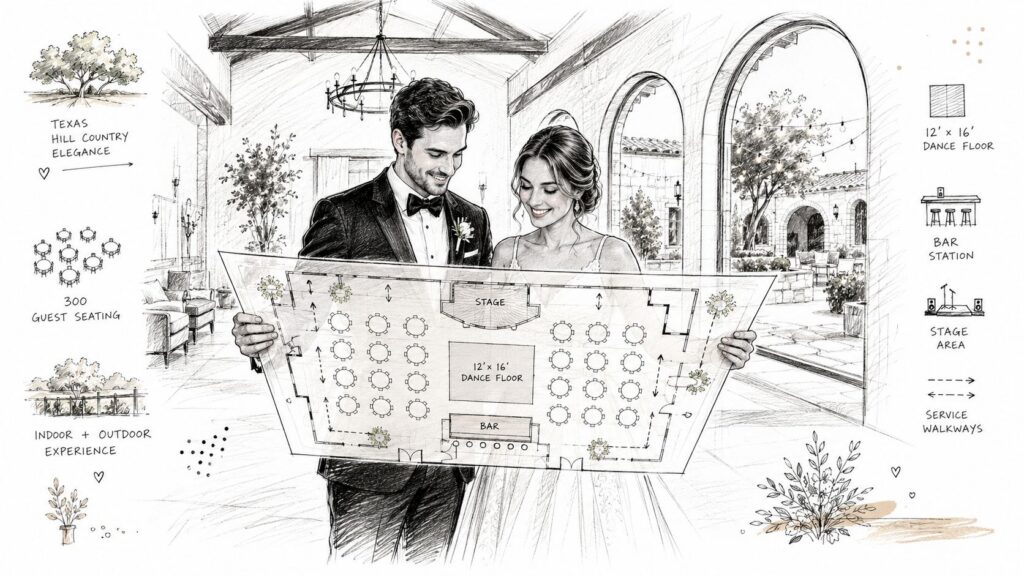
You're standing in a Texas venue that advertises room for 300 guests. The hall looks wide, the grounds look expansive, and the sales representative points out an outdoor ceremony lawn as if the entire day will unfold effortlessly. Then you start placing real people and real equipment into the picture. The band needs a stage, the caterer needs a service route, the bar needs a sensible location, and 300 guests need more than chairs. They need space to walk, talk, eat, dance, find the restroom, and leave safely. A wedding venue for 300 guests should be evaluated as an operating system, not a pretty room. The right question isn't whether 300 people can technically stand inside. It's whether the venue can support dinner, entertainment, weather changes, vendor traffic, photography, accessibility, and a realistic event timeline without making guests feel crowded or forcing the staff into constant workarounds. Table of Contents Start With the Real Event Scenario What the empty room hides Test Capacity and Floorplans Measure the room guests will actually use Plan Indoors, Outdoors, and Weather Fully indoor Fully outdoor Hybrid settings Build the Event Timeline Pressure-test the clock at the service entrance Coordinate Catering and Production Keep production visible to the team, not the guests Review Access, Budgets, and Contracts Compare the complete price Read the contract like an operations manager Use the Final Venue Checklist Capacity and layout Weather and access Catering, production, and timing Start With the Real Event Scenario A couple touring a large hall often sees the room in its most flattering state. The floor is empty, the lights are bright, and no rental truck is parked at the service entrance. A courtyard appears to offer a natural cocktail-hour setting, while the main room seems large enough for dinner and dancing. On paper, the venue looks ready for 300 people. The pressure test starts when the couple stops looking at décor and starts plotting the event. A seated dinner needs tables with clearance for chairs and servers. A band or DJ needs a dedicated footprint, power, and a sightline that doesn't turn the dance floor into a corridor. The bar can't sit where every guest must cross the photographer's family portrait area, and the caterer shouldn't have to move plated meals through the same doorway used by arriving guests. Practical rule: A venue tour should answer how people and equipment move, not just where the tables look attractive. Walk the actual sequence. Ask where the wedding party gets ready, where guests enter, where ceremony seating ends, and how guests reach cocktail hour. Then trace the path to dinner, the bar, the restrooms, and the dance floor. If that route crosses a service entrance, narrow passage, steep grade, or photo location, note it before you fall in love with the room. What the empty room hides The most common mistake is treating every visible area as usable reception space. A courtyard may be beautiful but unusable during heat or rain. A wide foyer may need to hold registration, gifts, cocktail furniture, a guest book, and a queue for the bar. A corner that looks ideal for a DJ may block an emergency route or leave one side of the room without clear audio. Ask the venue representative to show you: Catering movement: Where do meals arrive, where are they staged, and how do servers reach tables? Production storage: Where do cases, spare chairs, décor boxes, and leftover rentals go during the reception? Guest transitions: Can guests move from ceremony to cocktails without entering a working service path? Photography access: Can the photographer capture family groups and portraits without stopping traffic? Weather fallback: Can the indoor plan absorb the guests if an outdoor ceremony or cocktail hour changes? For Central Texas venues, compare the property's stated layout with the practical details shown in large event venue planning options. You're looking for a room that still works after every operational function is added. If the representative can't produce a convincing answer on tour, don't assume the planner will solve it later. Test Capacity and Floorplans A room advertised for 300 guests can feel cramped once the reception is fully built. Tables, chair clearance, catering routes, bars, staging, speakers, and dancing all compete for the same footprint. Use the venue's occupancy figure as a starting point, then test the actual program. The Perfect Wedding's venue capacity guide recommends discounting stated maximum capacity by 20% to 30% for a comfortable seated dinner with a dance floor and standard event elements. By that measure, a venue marketed for 300 may function more realistically at about 210 to 240 guests. A cocktail reception, tightly packed banquet dinner, and reception with generous dining and dancing space are different products. Ask which configuration produced the advertised number before you compare venues. Measure the room guests will actually use Planning benchmarks place banquet dining at 10 to 12 square feet per guest. A safer working range, including chair clearance, circulation, and service access, is 12 to 15 square feet per guest, according to Superior Seating's table-plan guidance. For 300 guests, dining alone therefore requires about 3,600 to 4,500 square feet. That figure excludes the dance floor, bars, stage, buffet lines, and support areas. Request a measured floorplan rather than relying on a styled rendering. Mark every column, door, bar, kitchen entrance, restroom, fixed furnishing, ceiling drop, and emergency exit. Then place the reception on that drawing. Leave enough room for guests to pull out chairs without blocking service staff or neighboring tables. Remove these areas from the usable count before deciding whether the room fits: Dance floor: Reserve the planned dance area first, based on the reception format and expected participation. Entertainment: Include the DJ or band, stage, speakers, instruments, microphones, cables, and production access. Dining: Test round and rectangular tables, the head table or sweetheart table, chair pull-out space, and sightlines. Guest services: Place bars, buffet or service stations, cake, gifts, lounge furniture, and coat storage. Operations: Protect catering corridors, production storage,

DIY Wedding Planning at Texas Old Town

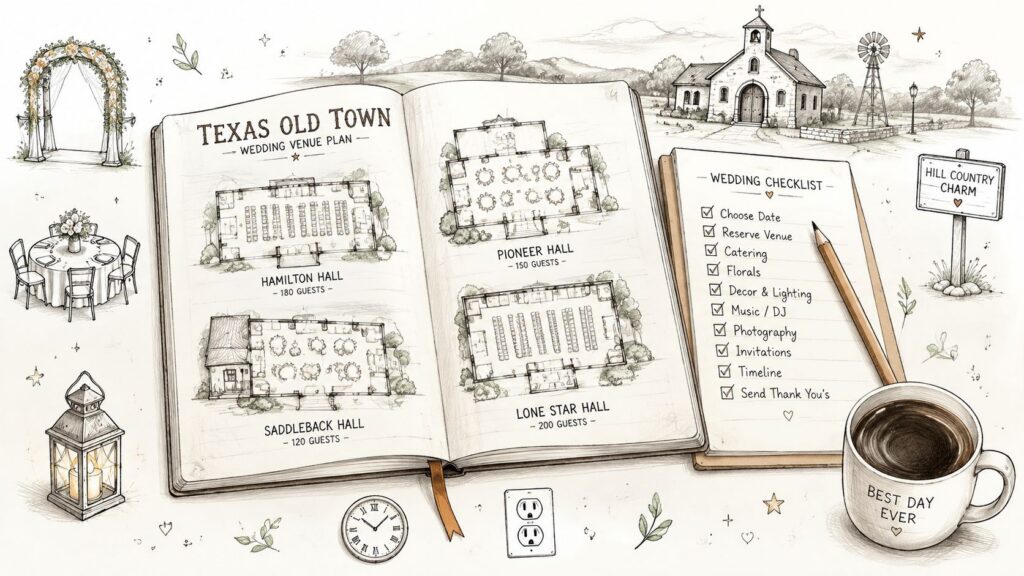
You booked a Hill Country venue because you wanted creative control, flexible vendors, and a celebration that felt like yours. Then, three months before the wedding, you opened a generic Pinterest timeline and noticed it says nothing about moving guests across a large property, coordinating several load-in points, or finishing cleanup before midnight. That's the moment many couples discover that a DIY wedding isn't only a design project. It's an operations plan. Texas Old Town's 55-acre campus in Kyle, Texas, gives couples four distinct venues, indoor and outdoor ceremony options, a prep kitchen, dressing suites, sound equipment, parking, and an on-site venue manager. Its 16-hour rental window, from 8 a.m. to midnight, creates valuable breathing room, but it also creates a fixed operating boundary. Every vendor arrival, décor decision, guest movement, meal service, and breakdown task has to fit inside it. The practical approach is a hybrid one. Keep control of the details that carry your personality, such as signage, welcome tables, favors, and selected décor, while assigning high-risk logistics to people who can manage them without pulling you into problem-solving on your wedding day. Table of Contents Why a Venue-Specific Plan Changes Everything The plan must answer operational questions Pre-Event Planning and Venue Specifications Compare the room before you design the room Lock the rules before contracts Building Your Event Day Timeline A working sequence for the day Vendor Coordination and Contract Control Put the scope in writing Treat vague proposals as a warning On-Site Management and Guest Logistics Control movement, sound, and power Make the weather call early Sample Schedules for Different Event Types Wedding schedule Quinceañera schedule Corporate schedule Where DIY Effort Pays Off and Where It Does Not Why a Venue-Specific Plan Changes Everything A couple can make sensible choices and still end up with a fragile wedding-day plan. They may choose Texas Old Town for its flexible vendor policy and expansive Hill Country setting, collect décor from family members, and design a ceremony and reception that look perfect on paper. The trouble starts when the plan assumes one simple room, one entrance, one setup route, and unlimited time. The property's structure changes the work. Access runs from 8 a.m. to midnight, the campus includes four distinct halls, and the selected venue may have different furniture, service-entry, and ceremony-flow considerations. If the ceremony happens outdoors and the reception takes place indoors, someone must direct guests, protect reserved seating, move personal items, and make sure the transition doesn't depend on the couple's attention. Practical rule: A DIY plan should be written around the venue's actual access rules and floor plan, not around a generic wedding template. The venue manager is an important part of that operating picture. Texas Old Town provides on-site management during the event, along with venue infrastructure such as furniture, dressing suites, indoor and outdoor PA systems, a prep kitchen, and parking. That support doesn't eliminate the need for a coordinator or responsible family lead. It gives your team a knowledgeable point of contact for venue-related decisions, while your own designated lead still needs to manage personal décor, vendor questions, timeline changes, and family requests. The plan must answer operational questions A useful venue-specific plan answers questions that inspiration boards never address: Which vendors arrive first, and where do they unload? Which items stay in the ceremony area, and which move to the reception? Who controls the master décor inventory? Who makes the call if weather affects the ceremony? Who stays behind for personal-item collection and vendor check-out? Which tasks belong to the venue manager, and which belong to your coordinator? DIY can help control costs as wedding spending rises. The typical U.S. wedding budget reached about $36,000 in 2025, and nearly three-quarters of couples married in 2024 reported spending more than they originally budgeted, according to Fidelity's wedding cost overview. Shifting selected tasks into personal labor can make sense, but only when the labor is scheduled, staffed, and priced accurately. The sections that follow turn that broad idea into a working playbook. Start with venue specifications, build the day around the 16-hour window, lock vendor scopes in writing, and assign guest and breakdown responsibilities before the rehearsal. Pre-Event Planning and Venue Specifications Your first planning decision is the hall, not the centerpiece style. Texas Old Town's published venue information identifies four private spaces, including Tejas, Sage, Stone, and Redbud, with capacities ranging from 150 to 320 guests. The supplied venue brief also references Willow, Elm, Oak, and the Chapel in its planning notes, so couples should confirm the current hall names, capacities, included furnishings, and selected-space specifications directly during the site visit. That confirmation matters because a room's capacity doesn't tell you how easily a DIY team can install décor, stage a ceremony, serve dinner, or flip the space. A hall with a larger maximum may require more careful zoning for the dance floor, buffet, DJ, guestbook, bar, and accessible routes. An intimate room may simplify guest movement but leave less space for storage and staging. Compare the room before you design the room Use the venue's current written specifications to complete this comparison before signing décor and rental contracts. Hall Max Capacity Included Furniture DIY Setup Notes Tejas Up to 320 guests Published tables and chairs, with handcrafted pine tables noted in the venue brief Confirm dance-floor placement, service access, décor attachment rules, and ceremony-to-reception flow Sage Up to 300 guests Published tables and chairs Map the entrance, guest circulation, catering access, and any outdoor ceremony transition Stone Up to 300 guests Published tables and chairs Confirm upscale finishes, approved décor methods, power locations, and protective requirements Redbud Up to 150 guests Published tables and chairs Plan compact storage, narrow traffic routes, bar placement, and guestbook positioning Chapel Confirm with venue Confirm with venue Verify whether it's used for ceremony, reception, or both, then document every setup constraint The venue brief lists tables, chairs, arbors, beverage-bar infrastructure, dressing suites, a prep kitchen, PA systems, and accessible parking among the available amenities.

10-Point Venue Inspection Checklist for Events

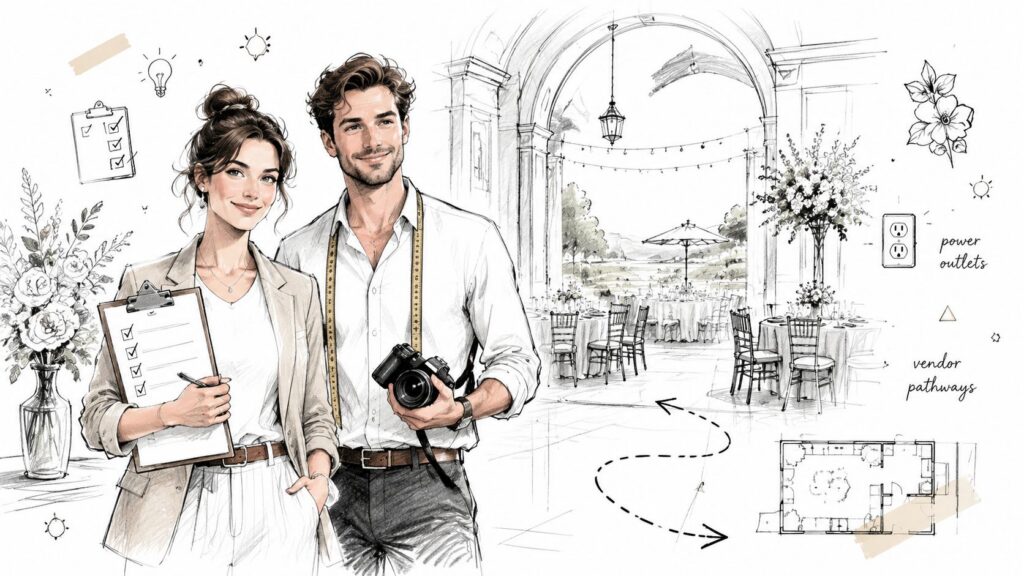
You're touring a venue that looks perfect in photographs. The hall is attractive, the grounds are memorable, and the sample floor plan seems to fit. Then the practical questions surface. Can vendors reach the kitchen without crossing the guest area? Is there enough power for the DJ, catering equipment, and lighting? Does the rental window leave enough time for setup and breakdown? Are weather contingencies, beverage rules, overtime charges, and cleanup responsibilities documented? A venue inspection checklist turns a pleasant tour into a decision-ready audit. Bring a tape measure or laser measurer, compare dimensions with floor plans, photograph conditions, test key systems, request written policies, and record unresolved risks beside each venue's strengths. A serious site survey may take about 60–90 minutes per venue, according to this event venue site-visit checklist, because marketing photographs can't verify logistics. Texas Old Town in Kyle, Texas, provides a useful working example. Its property includes four halls, indoor and outdoor ceremony options, a 55-acre Hill Country setting, documented furniture and venue specifications, flexible catering, and a 16-hour exclusive rental window. Use those published features as claims to verify on-site, not as reasons to skip the inspection. Table of Contents 1. Venue Capacity, Layout, and Furniture Inventory Measure the layout you will use 2. Climate Control and HVAC System Functionality Test the system under realistic conditions 3. Audio/Visual and Sound System Integrity 4. Restroom Facilities, Plumbing, and Sanitation 5. Kitchen Facilities and Food Service Compliance Match the kitchen to the event plan 6. Electrical Systems, Power Distribution, and Backup Power Test emergency systems and document responsibility 7. Structural Integrity, Safety, and Fire Code Compliance Request evidence, not reassurance 8. Parking Facilities and Vehicle Access Match the inspection to arrival conditions 9. Exterior Grounds, Landscaping, and Outdoor Ceremony Site Condition Test the outdoor plan against the event timeline 10. On-Site Management and Event Day Operations Readiness 10-Point Venue Inspection Comparison Turn Your Tour Notes Into a Booking Decision 1. Venue Capacity, Layout, and Furniture Inventory A room can meet its advertised capacity and still fail your event plan. Check the floor area left after guest tables, chairs, dance floor, bar, buffet stations, staging, photography equipment, ceremony seating, and accessible routes are in place. A ceremony-to-reception changeover may require more space than either arrangement alone. Inspect each Texas Old Town hall separately. Tejas lists capacity for up to 320 guests, Sage and Stone for up to 300, and Redbud for up to 150. Compare those specifications with room dimensions, door widths, columns, service routes, and the furniture supplied. In Tejas, count the handcrafted pine tables and chairs, inspect representative pieces for damage or instability, and confirm which items will be available on your event date. Measure the layout you will use Photograph the room in more than an empty configuration. Ask the venue to set up a ceremony-to-reception transition, dinner service, and dance-floor arrangement. Mark table spacing, aisle widths, bar and buffet positions, vendor access, and routes that become blocked once furniture is installed. Review the Texas Old Town floor-plan information before the tour, then test whether the documented layouts match the room on-site. Furniture selection affects both comfort and appearance. Use this guide to compare criteria for choosing hospitality furniture NZ, including durability, condition, and suitability for repeated event use. Confirm usable capacity: Ask which layouts support the stated guest count and which require reduced aisles, seating, or service space. Record inventory evidence: Photograph tables and chairs, count available quantities, and note repairs or replacements promised. Test access: Walk routes from guest arrival through ceremony, reception, restrooms, exits, and vendor service areas. Document flexibility: Save sketches or photographs of each workable setup and record changeover time, storage limits, and related charges. Approve capacity only when the furniture plan works for your actual event. Test the large-band, buffet, and cocktail-transition scenarios before signing. 2. Climate Control and HVAC System Functionality Inspecting climate control means verifying that the system can handle a full room, not merely checking whether the thermostat turns on. During the tour, identify supply vents, return vents, thermostats, and areas likely to heat or cool unevenly. Ask whether doors, windows, and service entries may stay open during setup, and observe how that affects the reception space. Texas weather makes the answer part of the event plan. A 16-hour rental window may include morning vendor access, a warm afternoon ceremony, and a crowded evening reception. Ask for recent maintenance documentation, the response protocol for a failed unit, and the location of backup equipment. If the venue mentions a generator or portable cooling, request written confirmation of what it supports and, where possible, a demonstration. Test the system under realistic conditions A quiet daytime tour cannot show how the room behaves with guests, stage lighting, kitchen activity, and doors opening repeatedly. Stand in several guest areas, including corners and locations near entrances, and listen for unusual mechanical noise. Ask the manager to explain thermostat controls and identify who can adjust them during setup and the reception. Run this check before comparing venues: Seasonal performance: When was the last HVAC service, and can the venue provide maintenance documentation? Event heat load: How will the room handle a full dance floor, stage lighting, and catering traffic? Backup response: What happens if a unit fails or power is interrupted, and how quickly will staff respond? Client control: Can the on-site manager adjust settings, and who approves changes? Record the tested conditions, the staff member responsible, and any promised follow-up in your tour notes. A visually attractive hall with unclear climate-control responsibility carries more operational risk than a less dramatic space with a documented response plan. For Texas Old Town, verify how the listed 16-hour access window affects climate control during vendor arrival, ceremony, and reception. The practical question is whether the venue's stated support works across those phases, not whether the room feels comfortable during a short visit. 3. Audio/Visual and Sound System Integrity A venue can advertise a PA system and still leave gaps in coverage, setup, or

How to Plan Wedding Budget: A Practical Guide

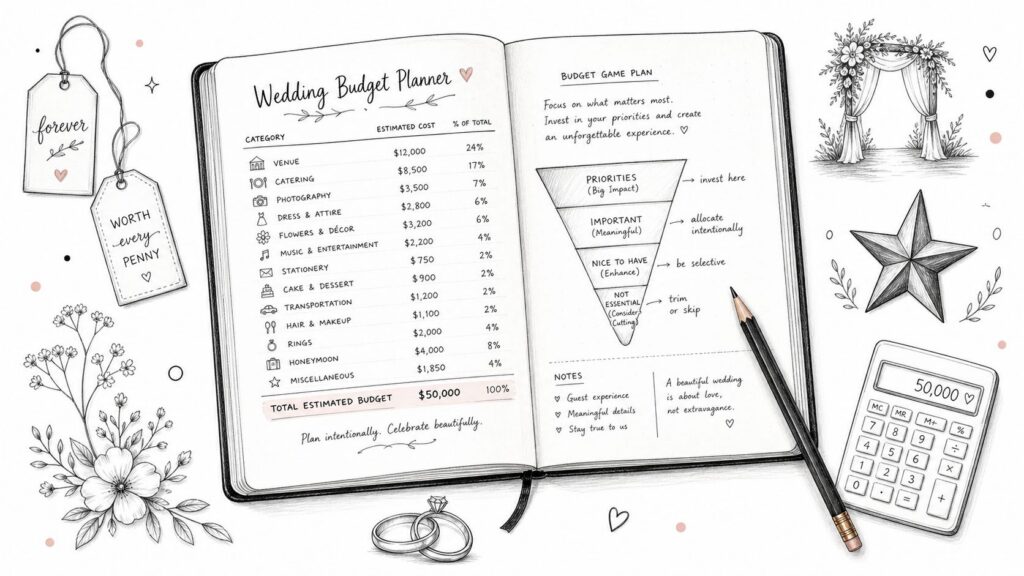
You're engaged, the venue tour is on the calendar, and the budget is still a moving target. That's the moment couples usually get into trouble. They start with a number that feels reasonable, then let guest count, upgrades, and contract fine print drag them into a wedding they didn't plan to buy. If you want a clean answer to how to plan wedding budget, stop treating the budget like a wish list. Build it from cash, not vibes, then let the venue and guest list tell you what kind of wedding you can afford. That's the only way to avoid falling in love with a date, a room, and a menu before you know what the math can support. How I Picked These Wedding Budget Strategies I've spent years watching couples build budgets around Hill Country venues, and the methods described here survived a simple filter. A budgeting approach earned a place here only if it passed three tests: it had to account for what the venue already includes, it had to scale cleanly when the guest count changed, and it had to respect a realistic payment timeline instead of assuming all the money shows up at once. What disqualified a method was just as important. Flat-percentage formulas got cut when they ignored contingency reserves or assumed every venue costs the same to outfit. Any advice that told couples to "set a number" without auditing the venue quote first got cut too, because that's exactly how couples end up short on service charges they never saw coming. The guidance below has been refined through repeated booking seasons, and I've adjusted it after watching the same overruns happen in the same categories, florals and staffing most often. If a rule didn't hold up when real contracts and real deposits were on the table, it didn't make this article. Setting a Realistic Total Before You Book Anything The first mistake couples make is calling a number a budget when it's really just a hope. You don't need a prettier guess. You need a hard ceiling built from what's available, then a working budget underneath it. Start with three buckets. Add up liquid savings, confirmed family contributions, and the monthly amount you can set aside before the wedding date. That total is your ceiling, not your spending target. Keep a separate working budget below it, because you should reserve contingency money before you assign a dollar to flowers, linens, or signature drinks. Practical rule: Don't touch a vendor spreadsheet until you've carved out your cushion. If you spend the contingency on upgrades, you're not "staying flexible," you're just removing the only protection you have. Couples usually need a reality check from someone who sees contracts all day. Budget planning guides from EasyRegistry's budget wedding advice make the same basic point, keep the total honest and cut waste early. That's right, but it's still too vague on its own. The better move is to decide, in writing, what the wedding can cost before you tour a venue with gorgeous landscaping and a seductive cocktail hour. One tool that has helped couples in my experience is putting the three-bucket math into a dedicated system rather than a notes app. Superchat's guide to AI personal finance assistants walks through how these tools can track savings progress and flag spending drift, which is useful when your wedding savings window is only 10 or 12 months long. Use the venue hunt as a filter, not a fantasy builder. If you're still narrowing where to marry, this wedding venue selection guide helps you compare spaces without pretending every site costs the same. Book nothing until your ceiling, cushion, and first-priority categories are set. What a Wedding Budget Actually Looks Like in Central Texas National headlines are only useful if you know how to read them. The Knot's Real Weddings data reported an average U.S. wedding cost of about $34,000 in 2025 (The Knot). Guest count moves the total fast, too: weddings with 50–75 guests average around $21,500, while 150–200 guests average $45,000 (Zola). Is $10,000 or $30,000 realistic in Texas? In my general observation of Hill Country weddings, $10,000 can absolutely work in Central Texas if the guest list stays under about 60 people and the venue absorbs rentals and logistics. Tables, chairs, cleanup, and on-site management included in one package change that math more than any other single decision. At 150 guests, $10,000 stops being workable because food and service alone become the dominant expense at seated-meal prices. A larger budget, meanwhile, performs more comfortably for a mid-size Central Texas wedding at a full-service venue. Historical data reminds us that even modest shifts in the national average can move your personal line items through inflation, overtime, delivery charges, and staffing (The Knot). The 50/20/30 split is a draft heuristic I use as a starting frame for couples who begin with a hard ceiling: roughly 50% of the budget to the venue-and-catering core, 20% to photography and attire priorities, and 30% spread across everything else. In my general observation, it works well for couples who set a ceiling first, though many still underestimate site fees and service charges, so treat the split as a draft, not a contract. Where the money goes first The smartest budget planners don't start with decor. They start with the categories that swallow the biggest share. The Knot's 2026 Real Weddings Study found venue and rentals at 29%, catering, cake, and drinks at 24%, and photographer and videographer at 10% (The Knot). Those are the lines that set the tone, eat the fastest, and punish underestimates. Now add a Hill Country venue into the equation. A property with tables, chairs, cleanup, on-site management, and a long rental window absorbs expenses many generic budget guides assume you'll pay separately. That doesn't make the venue cheap. It makes the math more honest. You're not just buying a room, you're removing several outside rentals and a chunk of day-of coordination from your budget. Category Share of

Unique Texas Wedding Venues: Top Picks for 2026

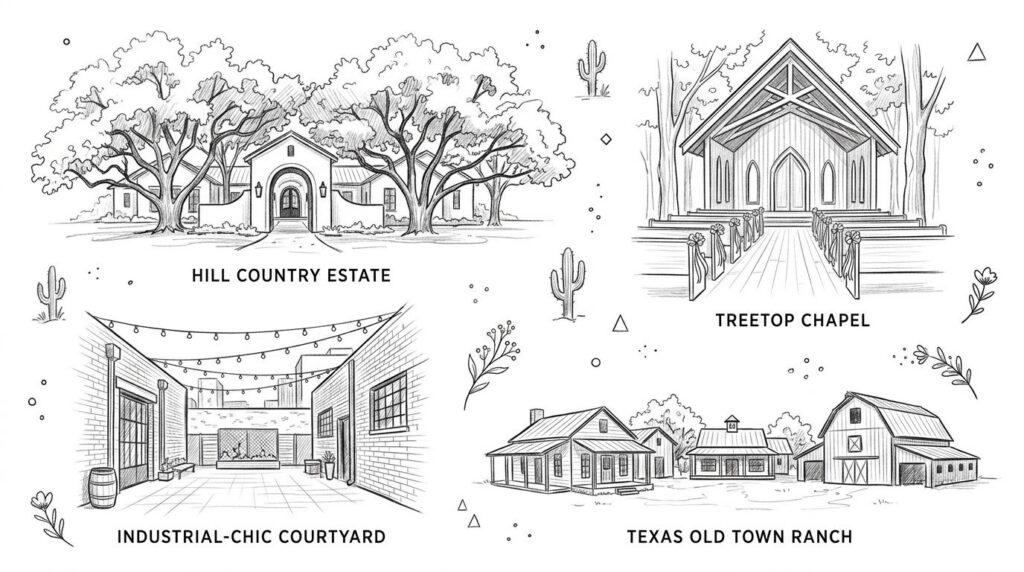
Beyond the ballroom, finding a Texas venue with true character usually starts the same way. You open a dozen tabs, scroll past chandeliers, beige carpet, generic draping, and hotel ballrooms that could be anywhere. After a while, every venue starts to look polished but interchangeable, and that's when couples begin asking the better question. Not “What's available?” but “What actually feels like us?” That's where unique Texas wedding venues earn their keep. The right one doesn't just look good in photos. It solves planning problems, supports your timeline, fits your guest list, and gives your wedding a sense of place. In the Hill Country and along the Austin to San Antonio corridor, that often means balancing scenery with weather backup, vendor freedom with venue rules, and style with practical access. This guide gets to the point. These are seven standout venues with real personality, from a treetop ceremony setting to museum gardens and resort-style estates. If you're also building a wedding design around native textures and regional plants, this read on insights for Texas plant enthusiasts can help you think beyond standard floral formulas. Table of Contents 1. Texas Old Town Why it works so well in practice Best fit and real trade-offs 2. Cypress Valley Who should book it 3. The Greenhouse at Driftwood What it solves for couples 4. Gruene Estate Where it shines and where to be careful 5. The Contemporary Austin Laguna Gloria The planning reality 6. Camp Lucy Sacred Oaks and sister venues Ideal couple and likely friction points 7. UMLAUF Sculpture Garden + Museum Best use of the space Unique Texas Wedding Venues, 7-Point Comparison How to Choose the Right Unique Venue for You 1. Texas Old Town A common planning problem shows up early. One partner wants Hill Country scenery, the other wants a reception space that feels more polished than rustic, and nobody wants to rebuild the guest experience from scratch just to get a different look. Texas Old Town solves that better than most properties because it operates as one wedding campus with four distinct halls in Kyle. The setting spans 55 acres at Texas Old Town, but its true benefit lies in how that space functions on a wedding day. Guests are not funneled into a tight parking situation. Photos do not feel repetitive after the ceremony. Events also maintain more privacy because the halls are spread out enough to avoid the crowded, back-to-back feel that can happen at multi-event properties. Why it works so well in practice The strongest planning advantage is time. Texas Old Town gives couples exclusive 16-hour access from morning through midnight, which changes the pace of the day in a practical way. Hair and makeup teams can start without compressing the whole timeline. Floral crews have more setup room. Family portraits are easier to schedule without cutting deep into cocktail hour. If you have ever watched a short rental window create stress for vendors, parents, and the couple all at once, you know how useful that extra margin is. The four halls also make this venue unusually flexible. Tejas suits couples who want a true Texas dance hall character. Redbud fits smaller celebrations that still need warmth and personality. Sage and Stone work better for couples who want Hill Country views paired with interiors that read cleaner and more refined. That is the reason this property deserves a closer look than a standard venue roundup usually gives it. The question is not only whether it is pretty. The question is which hall matches your guest count, design direction, and service style without forcing expensive workarounds. Planners also notice the operational details right away. Dressing suites with private restrooms help the morning stay organized. Indoor and outdoor PA systems, Bluetooth hookup, and a wireless mic reduce rental gaps for ceremony and reception audio. A prep kitchen with separate service access keeps catering traffic out of guest areas. On-site management, furniture counts, cleanup, and furniture breakdown remove several end-of-night problems that often fall back on family or vendors. For outdoor ceremony planning, their guide to outdoor wedding ceremony tips in Texas weather is worth reviewing before you lock a timeline. Couples who are still comparing options can also use Texas Old Town's guide on how to choose the perfect wedding venue in Texas. Best fit and real trade-offs Texas Old Town is a strong fit for couples who want flexibility without giving up structure. You can choose your own caterer, which matters if your menu is tied to family expectations, cultural traditions, or a very specific food standard. The bar setup is more controlled. Couples provide the beverages, and service must go through an approved bartending company. That is a reasonable system for liability and service consistency, but it adds a coordination step and should be priced early. Pricing is handled in a way many couples appreciate once they start comparing proposals. Quotes include sales tax and gratuity, which makes side-by-side budgeting more honest. The trade-off is that there is no one-size-fits-all public rate sheet that tells you everything upfront. You need a custom quote based on your date and plan. Best for: Couples who want one venue brand with multiple style options, a long rental window, and freedom to choose key vendors. Less ideal for: Couples who want a fully all-inclusive package with very few planning decisions. What problem it solves: It gives you venue personality choices without changing location, guest logistics, or the underlying operating system. 2. Cypress Valley Some venues are memorable because they're beautiful. Cypress Valley is memorable because guests talk about it afterward like they visited a hidden retreat. Located in Spicewood, it's built around old-growth cypress, a spring-fed ravine, and a treetop ceremony setting that feels unlike anything in a standard venue rotation. This is the kind of place that works best when a couple wants the environment to do most of the aesthetic work. You don't need to over-style it. The site already gives you atmosphere, and that's part

Scroll to Top