You booked a Hill Country venue because you wanted creative control, flexible vendors, and a celebration that felt like yours. Then, three months before the wedding, you opened a generic Pinterest timeline and noticed it says nothing about moving guests across a large property, coordinating several load-in points, or finishing cleanup before midnight. That's the moment many couples discover that a DIY wedding isn't only a design project. It's an operations plan.
Texas Old Town's 55-acre campus in Kyle, Texas, gives couples four distinct venues, indoor and outdoor ceremony options, a prep kitchen, dressing suites, sound equipment, parking, and an on-site venue manager. Its 16-hour rental window, from 8 a.m. to midnight, creates valuable breathing room, but it also creates a fixed operating boundary. Every vendor arrival, décor decision, guest movement, meal service, and breakdown task has to fit inside it.
The practical approach is a hybrid one. Keep control of the details that carry your personality, such as signage, welcome tables, favors, and selected décor, while assigning high-risk logistics to people who can manage them without pulling you into problem-solving on your wedding day.
Table of Contents
- Why a Venue-Specific Plan Changes Everything
- Pre-Event Planning and Venue Specifications
- Building Your Event Day Timeline
- Vendor Coordination and Contract Control
- On-Site Management and Guest Logistics
- Sample Schedules for Different Event Types
- Where DIY Effort Pays Off and Where It Does Not
Why a Venue-Specific Plan Changes Everything
A couple can make sensible choices and still end up with a fragile wedding-day plan. They may choose Texas Old Town for its flexible vendor policy and expansive Hill Country setting, collect décor from family members, and design a ceremony and reception that look perfect on paper. The trouble starts when the plan assumes one simple room, one entrance, one setup route, and unlimited time.
The property's structure changes the work. Access runs from 8 a.m. to midnight, the campus includes four distinct halls, and the selected venue may have different furniture, service-entry, and ceremony-flow considerations. If the ceremony happens outdoors and the reception takes place indoors, someone must direct guests, protect reserved seating, move personal items, and make sure the transition doesn't depend on the couple's attention.
Practical rule: A DIY plan should be written around the venue's actual access rules and floor plan, not around a generic wedding template.
The venue manager is an important part of that operating picture. Texas Old Town provides on-site management during the event, along with venue infrastructure such as furniture, dressing suites, indoor and outdoor PA systems, a prep kitchen, and parking. That support doesn't eliminate the need for a coordinator or responsible family lead. It gives your team a knowledgeable point of contact for venue-related decisions, while your own designated lead still needs to manage personal décor, vendor questions, timeline changes, and family requests.
The plan must answer operational questions
A useful venue-specific plan answers questions that inspiration boards never address:
- Which vendors arrive first, and where do they unload?
- Which items stay in the ceremony area, and which move to the reception?
- Who controls the master décor inventory?
- Who makes the call if weather affects the ceremony?
- Who stays behind for personal-item collection and vendor check-out?
- Which tasks belong to the venue manager, and which belong to your coordinator?
DIY can help control costs as wedding spending rises. The typical U.S. wedding budget reached about $36,000 in 2025, and nearly three-quarters of couples married in 2024 reported spending more than they originally budgeted, according to Fidelity's wedding cost overview. Shifting selected tasks into personal labor can make sense, but only when the labor is scheduled, staffed, and priced accurately.
The sections that follow turn that broad idea into a working playbook. Start with venue specifications, build the day around the 16-hour window, lock vendor scopes in writing, and assign guest and breakdown responsibilities before the rehearsal.
Pre-Event Planning and Venue Specifications
Your first planning decision is the hall, not the centerpiece style. Texas Old Town's published venue information identifies four private spaces, including Tejas, Sage, Stone, and Redbud, with capacities ranging from 150 to 320 guests. The supplied venue brief also references Willow, Elm, Oak, and the Chapel in its planning notes, so couples should confirm the current hall names, capacities, included furnishings, and selected-space specifications directly during the site visit.
That confirmation matters because a room's capacity doesn't tell you how easily a DIY team can install décor, stage a ceremony, serve dinner, or flip the space. A hall with a larger maximum may require more careful zoning for the dance floor, buffet, DJ, guestbook, bar, and accessible routes. An intimate room may simplify guest movement but leave less space for storage and staging.
Compare the room before you design the room
Use the venue's current written specifications to complete this comparison before signing décor and rental contracts.
| Hall | Max Capacity | Included Furniture | DIY Setup Notes |
|---|---|---|---|
| Tejas | Up to 320 guests | Published tables and chairs, with handcrafted pine tables noted in the venue brief | Confirm dance-floor placement, service access, décor attachment rules, and ceremony-to-reception flow |
| Sage | Up to 300 guests | Published tables and chairs | Map the entrance, guest circulation, catering access, and any outdoor ceremony transition |
| Stone | Up to 300 guests | Published tables and chairs | Confirm upscale finishes, approved décor methods, power locations, and protective requirements |
| Redbud | Up to 150 guests | Published tables and chairs | Plan compact storage, narrow traffic routes, bar placement, and guestbook positioning |
| Chapel | Confirm with venue | Confirm with venue | Verify whether it's used for ceremony, reception, or both, then document every setup constraint |
The venue brief lists tables, chairs, arbors, beverage-bar infrastructure, dressing suites, a prep kitchen, PA systems, and accessible parking among the available amenities. Don't assume every item you see in a photograph is included in your rental. Ask for a written inventory that identifies quantities, finishes, placement rules, and whether the venue team or your vendors handle setup.
For a detailed inspection process, use this venue inspection checklist while walking the property.
Lock the rules before contracts
Ask the venue to document its requirements for vendor insurance, load-in routes, service entrances, alcohol service, approved bartending companies, outside catering, permits, and noise restrictions. The venue brief states that couples can choose their caterer, while host-provided beverages require an approved bartending company. That flexibility is useful, but the contract must still identify who supplies ice, glassware, mixers, linens, trash removal, and food-service equipment.
Confirm the 11 p.m. music cutoff and build the final song, guest departure, and teardown around it. During the site visit, measure the ceremony and reception areas, photograph every power outlet, trace ADA-accessible paths, inspect parking flow, and identify a secure location for personal décor. Then send the measurements to your florist, rental company, caterer, DJ, and coordinator before they finalize proposals.
Building Your Event Day Timeline
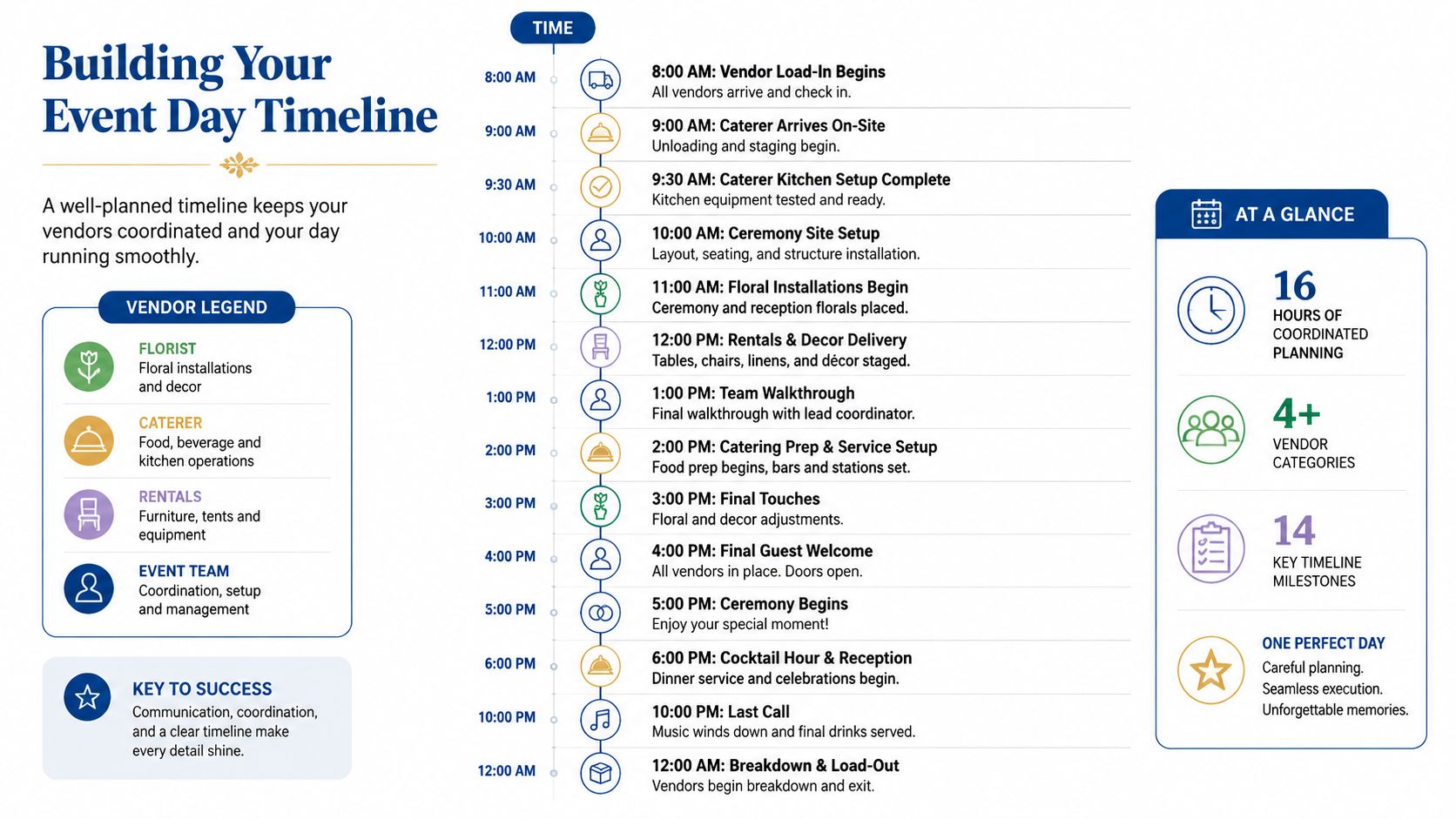
A 16-hour rental window sounds generous until several vendors need the same entrance, the same service route, or the same room. The timeline should treat access as a sequence of controlled handoffs. Rentals and large décor arrive first, florals follow once surfaces are ready, and the caterer sets up when the kitchen and service area are clear.
A practical wedding day can begin with vendor access at 8 a.m., but that doesn't mean every vendor should arrive then. Give each team a defined arrival slot, a named contact, a parking instruction, and a specific destination. Staggering arrivals prevents a florist's van, rental truck, band trailer, and catering vehicles from competing for the same space.
A working sequence for the day
Use the following as a planning model, then replace each block with the times agreed upon by your venue manager and vendors.
- 8:00 a.m. Vendor load-in begins. The venue lead checks arrival routes, opens approved access points, and records any damage or missing rental pieces.
- 9:00 a.m. Rental placement and major furniture setup continue. Your décor lead inventories boxes instead of asking the couple to answer questions.
- 9:30 a.m. Caterer kitchen setup should be complete, with refrigeration, prep surfaces, service ware, and staffing confirmed.
- 10:00 a.m. Ceremony-site installation begins. Florals, arbor décor, programs, reserved signs, and sound equipment should be placed in a defined order.
- 11:30 a.m. Reception room styling starts. Centerpieces, table numbers, menus, favors, and place settings go out only after the floor plan is confirmed.
- 1:00 p.m. Wedding party and family portraits can begin if the schedule allows. Keep one person available for vendor decisions.
- 2:30 p.m. Final ceremony check. Test microphones, music cues, aisle access, shade or weather adjustments, and accessible seating.
- 4:00 p.m. Final guest welcome and ceremony readiness. This is not the time to assemble favors or search for missing signage.
- Ceremony and cocktail period. The coordinator directs guest movement, protects personal belongings, and manages the ceremony-to-reception transition.
- Reception. Build buffers between dinner, speeches, dances, and open dancing. Meal service delays should not force the final formalities into the music cutoff.
- 11:00 p.m. Music ends. Guest departure begins while the breakdown crew collects personal décor and separates rentals from keepsakes.
- Midnight. All personal items and vendor materials must be cleared according to the venue agreement.
For additional guidance on sequencing formalities, vendor arrivals, and buffer periods, Fiore's wedding timeline guide is a useful planning reference. Couples can also adapt this reception schedule template to the selected hall and meal format.
Three mistakes appear repeatedly in DIY timelines. Couples underestimate setup by 90 minutes, schedule no dedicated rehearsal slot, or assume someone will handle breakdown without naming that person. The last mistake is especially costly because the couple and close family are usually exhausted once guests leave. Assign a teardown captain, a labeled vehicle, and a written inventory before the wedding week.
Vendor Coordination and Contract Control
Flexible vendor access gives couples choice, but choice creates administrative work. A DIY wedding needs one master roster that every vendor can read, not scattered text messages and separate family spreadsheets.
Create the roster in Google Sheets, Airtable, or a printed binder. Include the vendor's company, lead contact, mobile number, arrival time, departure time, load-in route, parking instruction, power needs, kitchen needs, insurance certificate status, contract scope, balance status, and emergency contact. Add the venue manager's direct contact and identify the person authorized to approve changes.
Put the scope in writing
Each contract should state what the vendor supplies, what the couple supplies, and what happens when the plan changes. Include setup and breakdown windows inside the 8 a.m. to midnight rental period, overtime rates, delivery charges, staffing assumptions, cancellation terms, meal requirements, and responsibility for damaged or missing items.
The budget context makes this discipline important. One survey cited by Kai Plan found that 61% of recently married couples exceeded their set wedding budget, and among those who went over, almost two-thirds overspent by at least 20%; the same source reports that 41% used savings and 11% took out a loan. These figures appear in Kai Plan's wedding budget analysis, and they reinforce a practical rule: an unpriced detail is not a free detail.
Use concise communication templates rather than long emotional emails:
- Initial outreach: “Please confirm availability, total scope, arrival and departure times, required access, power needs, insurance requirements, and every fee before we place a deposit.”
- 60-day check-in: “Please confirm the current guest count assumption, menu or design scope, load-in plan, payment status, and any requested changes.”
- 14-day check-in: “Please reply with your final arrival time, vehicle description, staffing count, equipment list, and day-of contact.”
- One-week packet: Send the floor plan, parking instructions, venue rules, emergency contacts, timeline, vendor roster, and load-out procedure in one PDF.
Treat vague proposals as a warning
Independent reporting cited by FinCalcs describes 74% of couples exceeding budget and 20% overspending by more than $10,000, while emphasizing itemized scopes, multiple quotes, and written fees in its wedding budget planning guide. The point isn't to chase a particular benchmark. It's to prevent small changes from cascading through catering, staffing, rentals, and venue labor.
Before selecting vendors, review Texas Old Town's preferred vendor lists alongside outside options. A preferred vendor may already understand access procedures, but any vendor still needs a written scope and a confirmed arrival plan.
On-Site Management and Guest Logistics
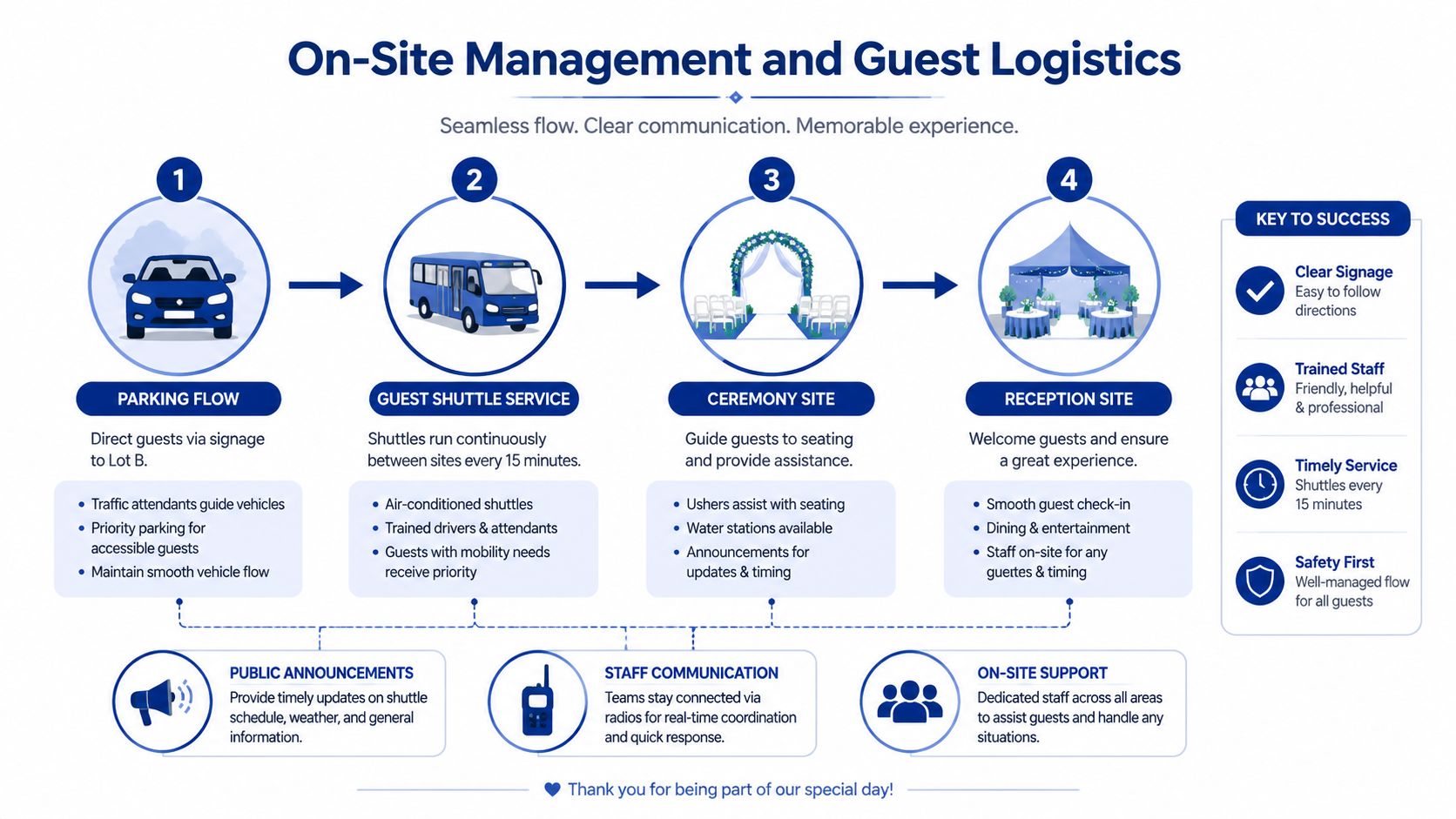
A 55-acre Hill Country campus requires a guest plan that works beyond the reception room. Put parking signs where drivers can see them, give the parking lead a printed map, and keep accessible routes clear from the lot to the ceremony and reception areas. Don't rely on guests discovering the correct building through landscaping or informal directions.
Your venue manager should receive the final floor plan, vendor roster, timeline, weather plan, and decision-maker list before event day. Ask the manager to handle venue-rule questions, access decisions, facility issues, and building-related adjustments. Your coordinator or DIY lead should handle personal décor, family communication, vendor sequencing, guest questions, and timeline calls.
Control movement, sound, and power
If guests move from an outdoor ceremony to an indoor reception, use signs, greeters, and a clear verbal announcement. For larger groups, ask the venue about shuttle routing, staging areas, vehicle access, and the time required to move guests safely. Never block an accessible route with welcome décor, shuttle queues, speaker cables, or rental carts.
Power planning needs the same attention. Confirm which circuits are available for catering equipment, DJ or band equipment, lighting, and outdoor ceremony sound. Don't plug every high-draw device into one convenient outlet. Have the AV lead test microphones, speakers, music playback, extension cables, and backup batteries before guests arrive, and ask the venue manager whether supplemental power is permitted or required for outdoor equipment.
Make the weather call early
Choose the indoor backup location before the forecast becomes urgent. Document who makes the pivot decision, which vendors receive the call, how guests will be redirected, and which décor can move without damage. A decision point no later than 48 hours before the event gives the caterer, rental company, florist, transportation team, and venue enough time to adjust.
Keep one weather kit with towels, protective coverings, garment bags, cable covers, signage stands, and a printed contact sheet. The kit won't solve every condition, but it prevents a minor weather issue from becoming a communication failure.
Sample Schedules for Different Event Types
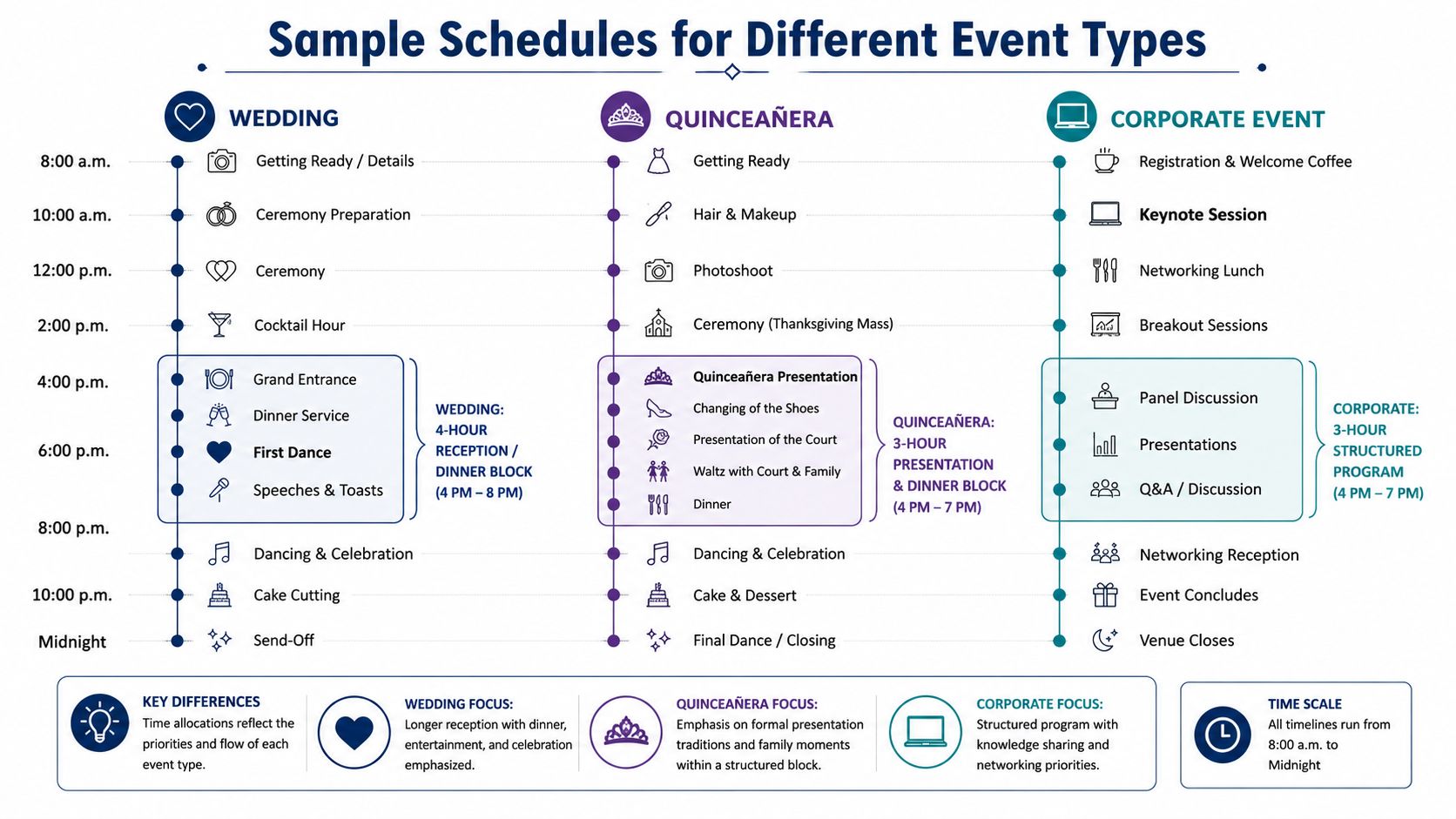
The same 16-hour access window supports different operating rhythms. A wedding needs a controlled ceremony transition, a quinceañera needs uninterrupted preparation and formal presentation staging, and a corporate event needs fast AV changes between program areas.
Wedding schedule
- 8:00 a.m. to 11:30 a.m. Rentals, catering, florals, ceremony décor, and reception styling.
- 11:30 a.m. to 2:30 p.m. Portraits, final room checks, rehearsal cues, and vendor meal preparation.
- 2:30 p.m. to 4:00 p.m. Ceremony readiness, guest direction, and sound check.
- 4:00 p.m. to 5:00 p.m. Guest welcome and ceremony.
- 5:00 p.m. to 6:00 p.m. Cocktail transition and reception-room completion.
- 6:00 p.m. to 10:45 p.m. Dinner, speeches, dances, and celebration.
- 10:45 p.m. to midnight Guest departure, personal-item collection, and vendor load-out.
Quinceañera schedule
- 8:00 a.m. to noon. Dance-floor staging, reception décor, catering setup, sound checks, and court positioning.
- Noon to 3:00 p.m. Quinceañera preparation, damas and escort arrival, portraits, and final choreography review.
- 3:00 p.m. to 4:00 p.m. Guest arrival and seating.
- 4:00 p.m. onward. Formal presentation, dinner, dances, cake or dessert service, and open celebration.
- Late evening to midnight. Guest departure, costume and personal-item collection, then vendor breakdown.
Corporate schedule
- 8:00 a.m. to 9:30 a.m. AV load-in, registration setup, catering staging, and room checks.
- 9:30 a.m. to 10:00 a.m. Speaker testing and attendee arrival.
- 10:00 a.m. to noon. Keynote program.
- Noon to 1:00 p.m. Meal service and room reset.
- 1:00 p.m. to 3:00 p.m. Breakout sessions across the selected halls.
- 3:00 p.m. to 4:00 p.m. AV changeover and refreshment service.
- 4:00 p.m. to 6:00 p.m. Closing program or networking.
- 6:00 p.m. to midnight. Catering removal, equipment load-out, signage collection, and final inspection.
For each schedule, assign one person to verify setup, one to check vendor arrivals, one to monitor guest entry, and one to lead breakdown. The roles can be held by different relatives or staff, but they shouldn't remain unnamed.
Where DIY Effort Pays Off and Where It Does Not
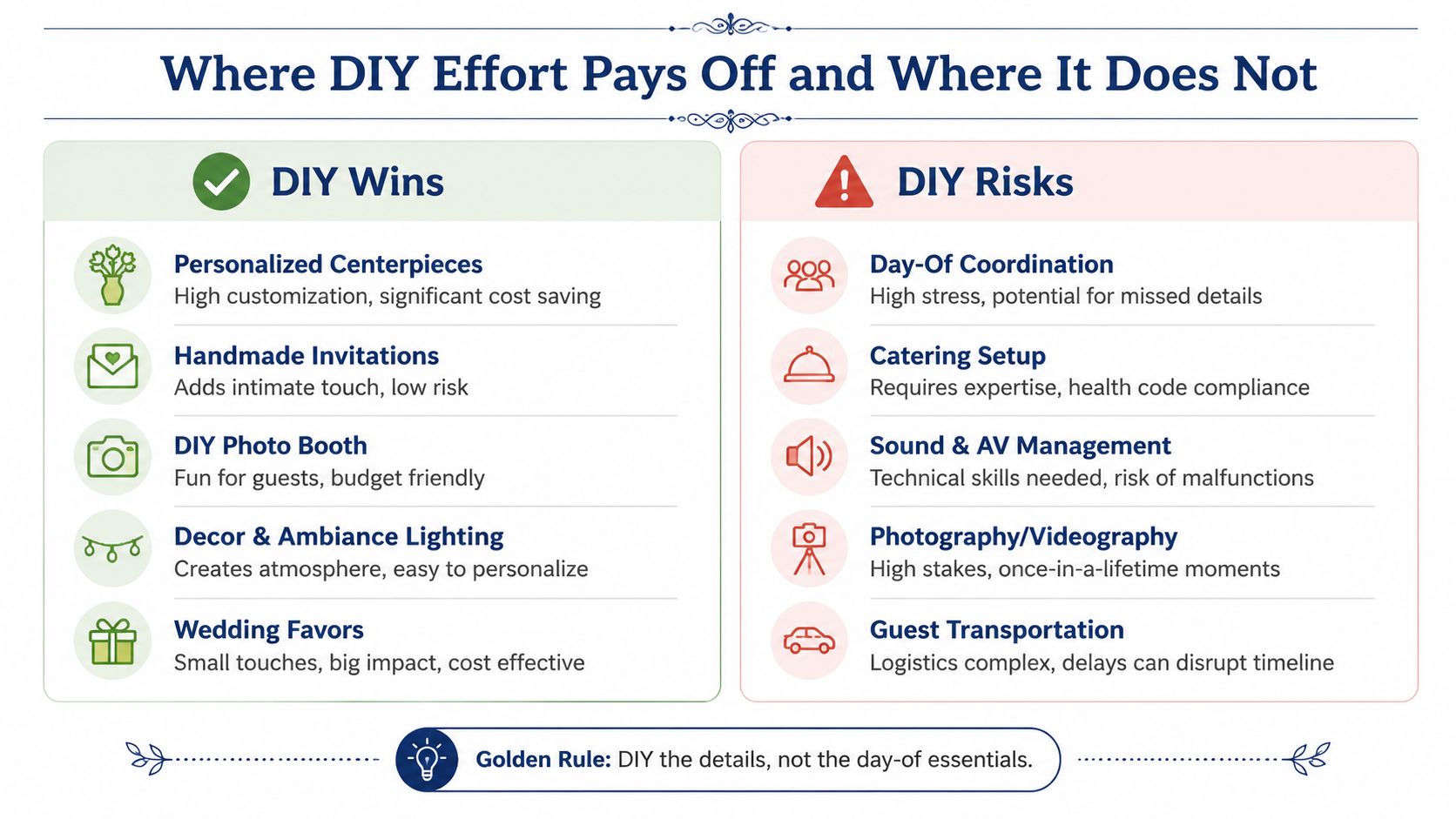
DIY effort pays off when the task is visible, repeatable, and easy to pause. Custom signage, welcome-table styling, favors, selected centerpieces, and décor installation can give a Texas Old Town celebration a personal feel while using the venue's rustic architecture as part of the design. These tasks also fit more comfortably into the extended access window than high-pressure services do.
The risk rises when a task affects guest safety, sound, food service, timing, or the midnight exit. Day-of coordination during the ceremony-to-reception transition, AV management across the campus, catering setup, and final breakdown all require someone who can stay calm while the couple remains present for the celebration.
Use this decision test:
- Keep it DIY if the task has a clear owner, a written checklist, low guest impact, and a realistic setup window.
- Delegate it if it requires repeated vendor communication or access to several areas.
- Hire support if failure would delay the ceremony, interrupt sound, compromise food service, or leave personal property behind.
The strongest DIY weddings aren't fully self-managed. They're strategically hybrid, with couples retaining creative control and professionals or experienced leads protecting the high-stakes logistics.
Visit Texas Old Town to tour the available halls, verify current furniture and access specifications, and build your DIY wedding plan around the actual property. Bring your draft guest flow, vendor list, and décor questions to the visit so the venue team can help you turn creative ideas into a workable event-day schedule.