A team building retreat shouldn't begin with a list of games, a resort shortlist, or the question, “What would everyone enjoy?” That popular approach produces pleasant days that rarely change how people work together afterward. A useful retreat starts with a business problem, protects participation equity, and builds an agenda that moves deliberately from connection to trust, collaboration, strategy, and follow-through.
That shift matters because corporate offsites are becoming shorter, more purposeful, wellness-infused, and measured for ROI, rather than functioning only as annual getaways, according to recent retreat industry coverage. Independent offsite research also reports that 85% of companies identify team building as the primary objective, while the average offsite includes 2.6 events annually and dedicates 44% of time to social programming and team building. Those figures change the planning question. You're no longer choosing between “work” and “fun.” You're deciding how much time bonding deserves, which business outcomes need attention, and how every employee can participate without unreasonable cost, travel, or physical demands.
Table of Contents
- Why Most Team Building Retreats Fall Short
- Defining Goals and Designing a Sequenced Agenda
- Choosing Activities That Match Your Objectives
- Building a Transparent Retreat Budget
- Managing Venue Logistics and Day-Of Operations
- Measuring Retreat Impact and Proving ROI
- Retreat Planning Checklists and Templates
Why Most Team Building Retreats Fall Short
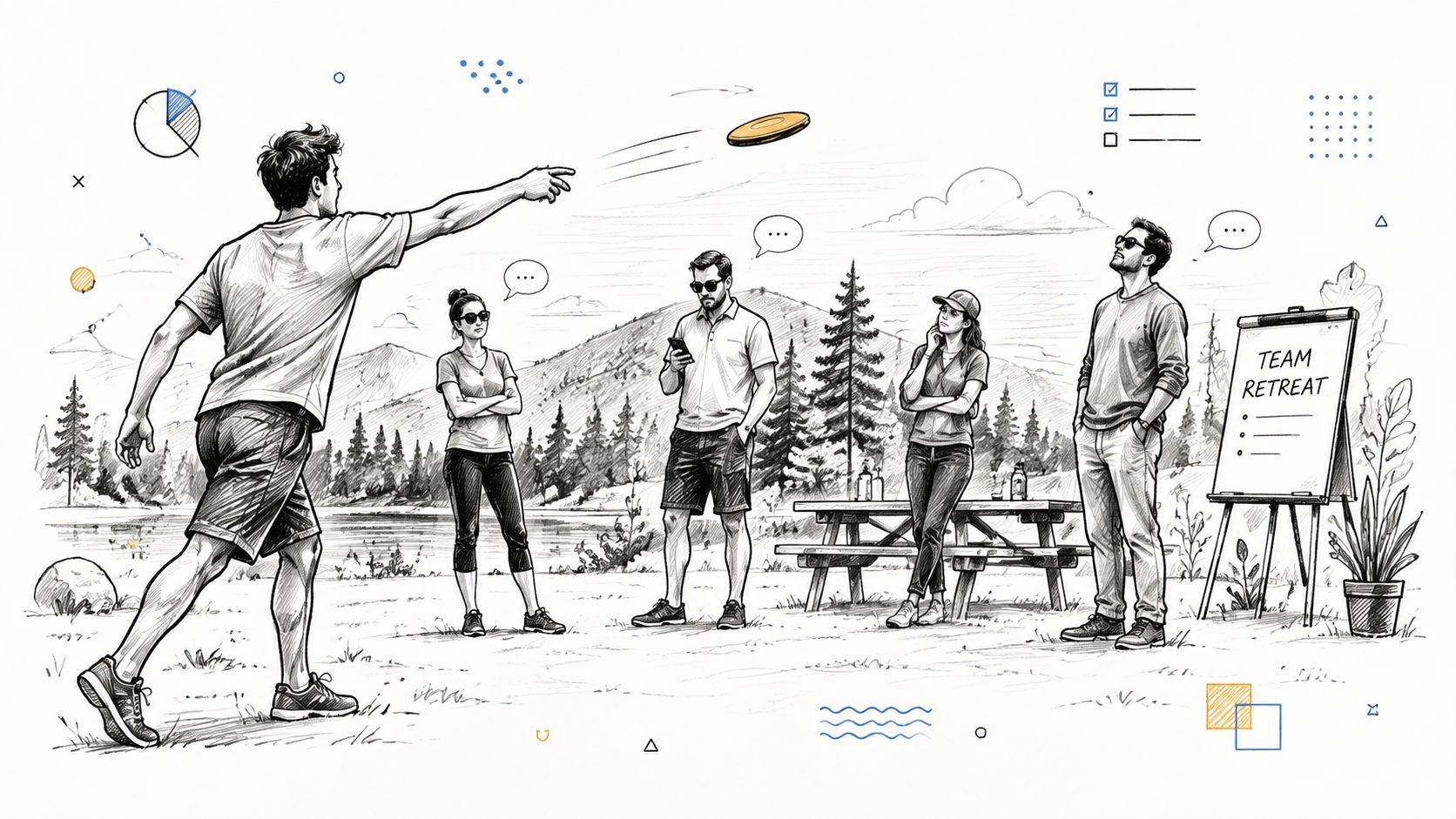
The most common retreat mistake is treating shared enjoyment as proof of team development. A group may laugh over a field game, enjoy dinner, and leave with photos that look successful. Unless the experience changes a working relationship, clarifies a decision, or creates a repeatable collaboration habit, the organization has hosted entertainment, not a business intervention.
Start with the outcome. A leadership team might need to clarify decision rights, a growing department might need better handoffs with sales, or a remote group might need stronger working agreements. Those needs call for different agendas, different facilitators, and different measures. A high-energy outdoor challenge may help a newly formed group build trust, but it won't resolve unclear ownership in a product launch.
The annual getaway model is losing relevance
Organizations increasingly use shorter, more frequent, purpose-driven offsites instead of one large annual retreat. Hybrid work remains a major driver of in-person gatherings, while destination and nature-based settings are gaining interest because teams want fewer digital distractions and more meaningful cohesion, as described in industry reporting on corporate retreat trends.
That model creates a practical trade-off. A shorter retreat has less room for unfocused programming, so planners must choose a small number of outcomes and design each activity around them. A more frequent cadence can reinforce behavior, but only if leaders assign owners and revisit commitments after the group returns.
Planning test: If you can't explain what should look different at work after the retreat, you aren't ready to choose the activity.
Participation equity belongs in the brief
Inclusion isn't a courtesy added after the venue is booked. It affects attendance, energy, trust, and the credibility of the event. Research cited by Surfoffice's company offsites report says 57% of fully remote companies consider offsites essential, 62% have hosted an offsite outside their team's primary country, and 65% of employees report some personal financial impact from attending.
Those pressures affect employees differently. Caregivers may struggle with overnight schedules, lower-paid employees may hesitate to absorb incidental costs, and team members with disabilities may be excluded by high-intensity activities. Planners should offer accessible alternatives, communicate what the company covers, avoid compulsory participation in physically demanding experiences, and make social time welcoming without making alcohol or late nights central to belonging.
Resources on modern team activities for distributed groups can help planners move beyond one-size-fits-all programming. The strongest retreat is not the most elaborate one. It's the one that gives people a fair opportunity to contribute while producing a result leaders can recognize in the work.
Defining Goals and Designing a Sequenced Agenda
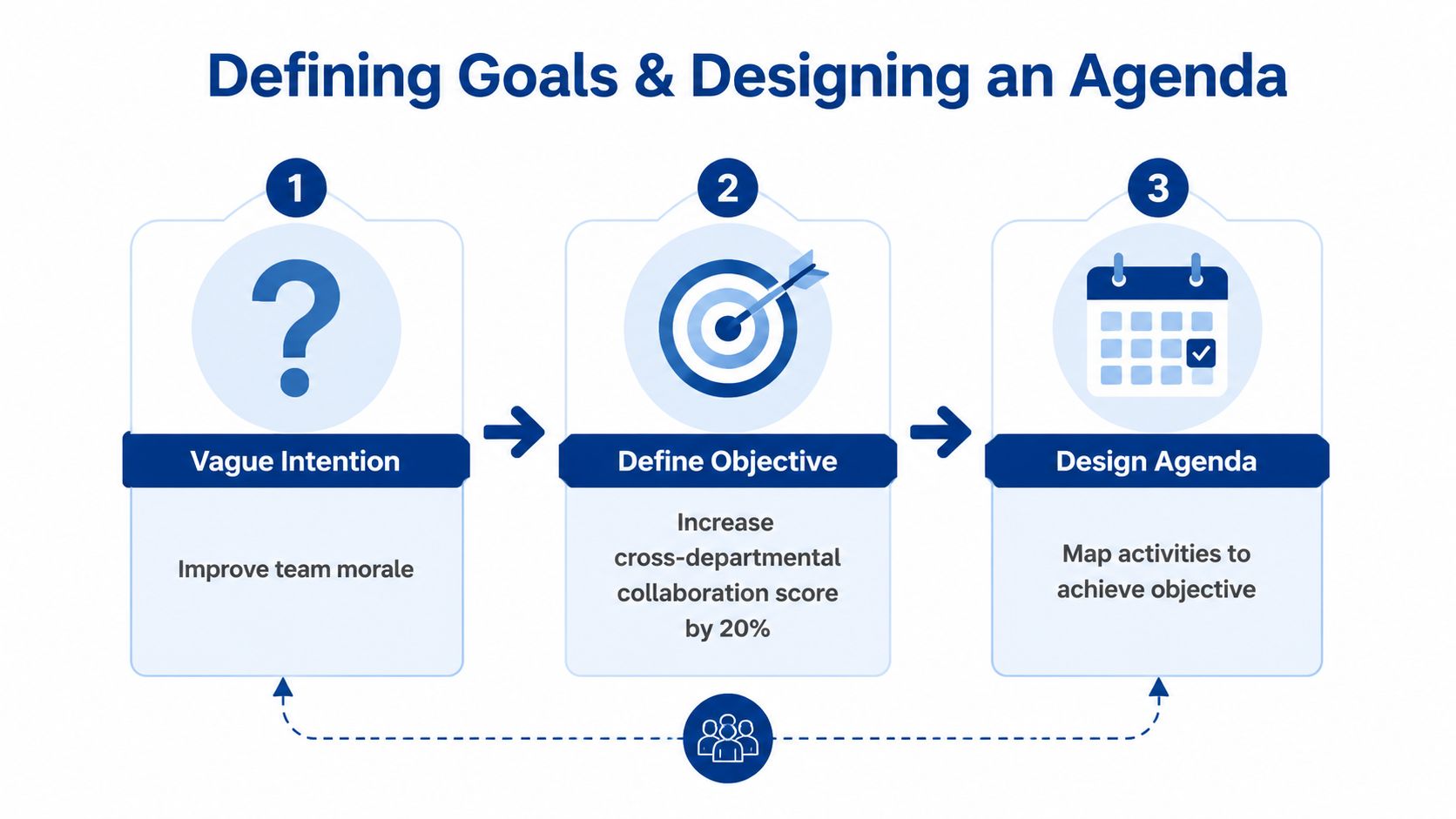
“Improve morale” is a useful concern, but it's not a usable retreat objective. Convert it into an observable workplace change, such as clearer cross-functional handoffs, faster escalation of delivery risks, or agreed decision-making norms. Then identify how you'll know whether the change occurred through a survey item, a documented operating agreement, or a follow-up behavior measure.
A practical design sequence is:
- Connection: Open with a low-stakes activity that helps people speak, listen, and learn something relevant about one another.
- Trust: Introduce structured vulnerability or shared reflection once participants have settled into the room.
- Collaborative challenge: Give the group a problem that requires information-sharing and coordinated decisions.
- Strategy: Move into priorities, planning, or role clarity after trust has formed.
- Integration: Translate insights into commitments, owners, deadlines, and follow-up rituals.
Expert guidance recommends placing a low-stakes opener in the first 30 to 60 minutes, delaying strategic work until trust has developed, and debriefing after every major activity. Even 10 minutes of guided reflection after each exercise can improve retention and transfer back to work, according to guidance on sequenced corporate retreat design.
Match the agenda to the available time
A half-day team building retreat needs one central outcome. Use a short connection opener, one collaborative exercise, a focused working session, and a closing commitment round. Don't attempt leadership development, strategic planning, conflict repair, and culture work in the same compressed schedule.
A full-day format allows more breathing room. Place connection and trust before lunch, use the afternoon for a real business challenge, and protect time for reflection rather than filling every transition with content. A multi-day retreat can add deeper planning or a facilitated workshop, but the extra time shouldn't become permission to add activities without purpose.
Use the event planning timeline to assign decision dates for objectives, venue contracting, participant communications, catering, transport, and final facilitator checks. The timeline matters because retreat quality often deteriorates through late additions. Leaders remember the headline objective, while planners absorb the operational consequences of every extra session.
Make debriefs part of the activity
A debrief isn't a casual “How was that?” Ask questions that connect the experience to work:
- What behavior helped the group make progress?
- Where did information get trapped?
- Who took space, and who held back?
- What should we repeat in our next project?
- Which commitment needs an owner today?
A retreat can surface insight, but it can't permanently repair a pattern without reinforcement. Set expectations with leadership before the event. The retreat may establish agreements and create momentum. Managers must then use those agreements in meetings, project reviews, and one-to-one conversations.
For broader context on building strong company culture, consider how the retreat fits into everyday leadership practices. Culture isn't created by one offsite. The event should make desired behaviors easier to name, practice, and revisit.
Choosing Activities That Match Your Objectives
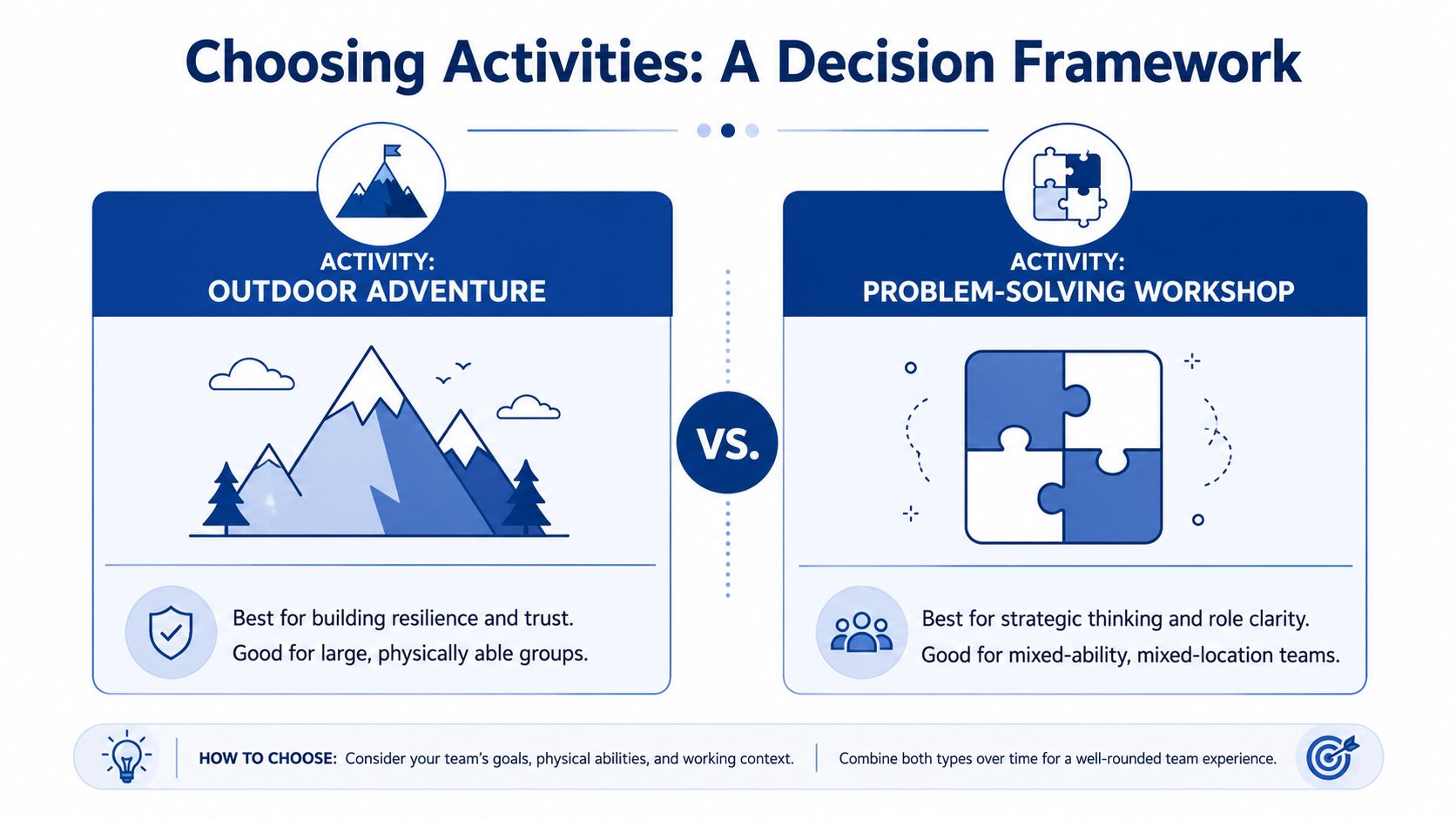
Activity selection should follow a decision filter, not a trend list. Begin by asking what the group needs to practice. If the answer is basic familiarity, choose a low-pressure connection exercise. If the problem is siloed decision-making, select a challenge that requires cross-functional information exchange. If the issue is strategic ambiguity, use a facilitated workshop with visible outputs.
| Activity type | Best fit | Main trade-off |
|---|---|---|
| Low-stakes icebreaker | New teams, distributed groups, cautious participants | Builds familiarity but won't solve complex operating problems alone |
| Outdoor adventure | Trust, resilience, informal connection | Can exclude people with mobility, health, or comfort constraints |
| Problem-solving challenge | Collaboration, role clarity, shared decision-making | Requires skilled facilitation and a well-designed brief |
| Strategic workshop | Alignment, priorities, planning | Feels premature when the group hasn't built enough trust |
| Social meal or company picnic | Relationship-building and informal conversation | Offers limited business learning unless paired with intentional prompts |
Design for mixed comfort levels
A good retreat gives people multiple ways to participate. Pair verbal discussion with written reflection. Offer roles such as timekeeper, observer, analyst, or spokesperson. Let participants opt out of strenuous elements without having to explain a personal medical or family circumstance in front of colleagues.
High-intensity activities can create memorable moments for some employees and anxiety for others. That doesn't make adventure activities wrong. It means the planner should provide an equivalent route to the same objective. A trust exercise might involve navigating a physical course, solving a visual puzzle, or coordinating a time-limited planning task. The learning target stays consistent while the access route changes.
Group size also affects the choice. Large teams need parallel stations, clear instructions, and facilitators who can observe smaller interactions. Small teams can handle deeper discussion, but they may need careful prompts so one dominant voice doesn't define the entire experience.
Use the venue as a flexible operating system
A venue with indoor and outdoor options gives planners room to adjust for weather, energy, and accessibility. Texas Old Town, for example, offers four distinct halls across a 55-acre Hill Country property, with capacities ranging from 150 to 320 guests, along with indoor and outdoor settings, a prep kitchen, and indoor and outdoor PA systems. That flexibility can support a morning workshop indoors, a lower-pressure outdoor breakout, and a return to a climate-controlled room when conditions or participant energy change.
Don't confuse physical variety with program quality. More spaces won't compensate for weak objectives or poor facilitation. Choose the activity that produces the behavior or decision you need, then use the venue to make participation smooth.
Building a Transparent Retreat Budget
A venue quote is only one line in the budget. Finance teams need the full participant experience, including catering, audiovisual support, transportation, facilitation, materials, accessibility requirements, insurance, and contingency planning. Employees also need clarity about which expenses the company covers and which it doesn't.
A transparent budget separates fixed costs from variable costs. Venue rental and facilitator fees may remain stable as attendance changes, while meals, transport, materials, and accommodation often move with the participant count. Build scenarios for the expected group, a smaller group, and a larger group before requesting approval.
The following planning table is a template, not a set of market prices. Replace each range with written quotes from your selected suppliers.
| Category | Low Estimate | High Estimate | Notes |
|---|---|---|---|
| Venue rental | Quote required | Quote required | Confirm access window, rooms, furniture, staffing, and cleanup |
| Catering | Quote required | Quote required | Price meals, breaks, dietary accommodations, service, and gratuity |
| AV and technology | Quote required | Quote required | Include microphones, screens, speakers, power, and technical support |
| Transportation | Quote required | Quote required | Account for pickup points, parking, accessibility, and late changes |
| Facilitation | Quote required | Quote required | Match facilitator expertise to the business outcome |
| Activities and materials | Quote required | Quote required | Include equipment, printing, supplies, and accessible alternatives |
| Contingency reserve | Set internally | Set internally | Protect against weather, schedule changes, and attendance shifts |
Make employee cost exposure visible
The offsite report cited earlier indicates that 65% of employees experience some personal financial impact from attending. That makes reimbursement and participation policy part of the retreat design, not a private finance detail. State whether travel, meals, parking, childcare support, accommodation, and optional activities are covered. If the company can't cover every cost, avoid designing the event around expensive participation.
Texas Old Town publishes a pricing approach in which sales tax and gratuity are included in the quoted price, with no hidden fees. That kind of structure can make stakeholder review easier because planners can compare a more complete venue figure instead of reconstructing the total from exclusions.
For a broader budgeting workflow, use these event planning budget templates to document assumptions, approvals, payment dates, and supplier responsibilities. A payment plan can also distribute costs across fiscal periods where the venue offers that option, but confirm the schedule and cancellation terms in writing.
Connect spend to a decision
Finance approval improves when the business case is specific. Tie the retreat to a defined issue, record a baseline, and identify the evidence you'll collect afterward. Possible measures include engagement responses, role-clarity scores, cross-team project activity, decision-cycle feedback, or completion of agreed strategic actions.
Don't promise that a retreat alone will produce a financial return. Present it as one intervention within a broader operating plan, with clear owners for follow-through. That is more credible than attaching an unsupported productivity figure to a social event.
Managing Venue Logistics and Day-Of Operations
Retreat logistics fail in the margins. A venue can look ideal during a tour and still create trouble if the rental window excludes setup, the parking arrangement is vague, or the facilitator has to manage microphones while leading a sensitive discussion.
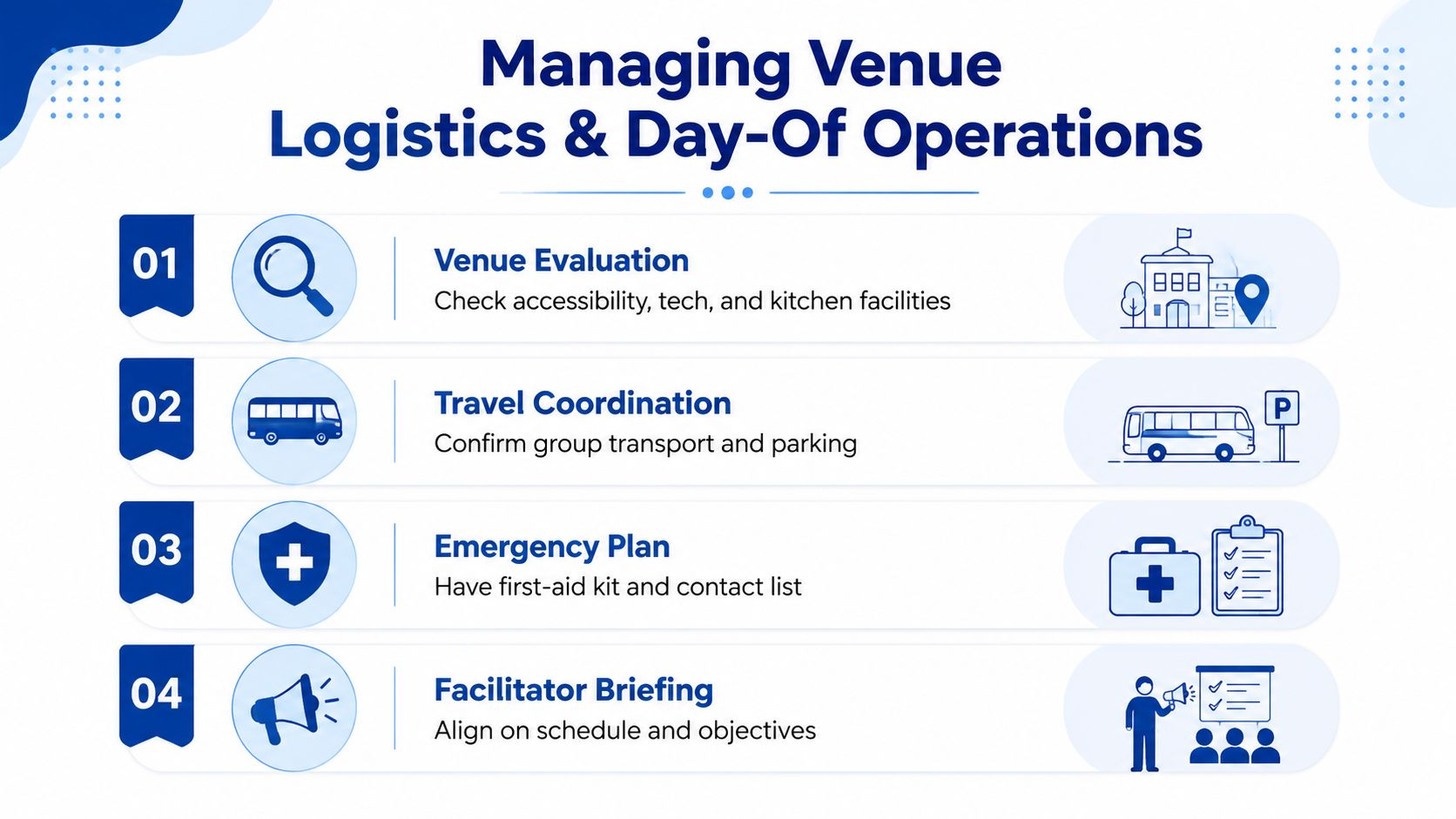
Evaluate the venue against the actual run of show. Confirm when suppliers can arrive, when the room is available, where materials can be stored, how catering enters the building, and who handles breakdown. Ask for a floor plan, furniture inventory, electrical information, accessibility details, emergency contacts, and the name of the person responsible during the event.
Build a realistic venue scorecard
Score each option against the conditions that affect participant experience:
- Access window: Can the team set up calmly, run the program, and clear the space without rushing?
- Room flow: Can participants move between plenary, breakout, meal, and outdoor areas without confusion?
- Technical support: Are microphones, speakers, screens, power, and connectivity suitable for the agenda?
- Catering control: Can the venue accommodate your preferred caterer, dietary needs, service timing, and kitchen requirements?
- Weather resilience: Is there an indoor substitute for every essential outdoor activity?
- On-site ownership: Will a venue manager handle operational issues while the planning team facilitates?
Texas Old Town provides an exclusive 16-hour access window from 8:00 a.m. to midnight, indoor and outdoor PA systems with Bluetooth connectivity, a wireless microphone, a prep kitchen with a separate service entry, private parking, accessible layouts, on-site management, and included cleanup and furniture breakdown. Those features address common pressure points, but planners should still confirm the exact layout and supplier responsibilities for their date.
Protect transitions and technical reliability
Schedule more transition time than the agenda looks like it needs. Groups take time to move, collect belongings, use restrooms, reset emotionally after a difficult conversation, and understand the next instruction. If every session runs directly into the next, the facilitator will either cut reflection or run late.
Use a single production contact for microphones, music, slides, room temperature, and lighting. Test the presentation from the actual laptop and confirm whether outdoor audio, indoor audio, or both are needed. For room layouts and seating options, review the venue's conference room setups before finalizing the agenda.
Prepare for weather and travel disruption
For an Austin to San Antonio corridor event, send a clear arrival plan with parking instructions, rideshare guidance, accessibility contacts, and a late-arrival protocol. Assign one person to monitor transportation while another manages the venue schedule. If outdoor work matters, prepare an indoor equivalent that preserves the objective, not merely a less interesting substitute.
The day-of brief should include the run of show, supplier phone numbers, first-aid location, dietary notes, emergency procedures, room assignments, and escalation authority. Participants should know where to go. Facilitators should know who can make an operational decision without interrupting the group.
Measuring Retreat Impact and Proving ROI
Measurement starts before the retreat, not during the closing toast. Select a small set of indicators that reflect the stated objective, then capture a baseline while the issue is still visible. If the retreat is about role clarity, ask participants to rate their understanding of ownership and decision rights. If it's about collaboration, measure how easily people identify the right partner, share information, or resolve a cross-functional obstacle.
Use three layers of evidence
Participant feedback shows whether people experienced greater clarity, connection, trust, or alignment. Keep pre- and post-retreat questions consistent so the comparison means something. Add open-text prompts that ask which behavior the participant will change and what support they need.
Observed outputs show whether the group produced something useful. Examples include a decision-rights agreement, a cross-functional workflow, a prioritized initiative list, or named owners with deadlines. A retreat that ends with no artifact leaves leadership with feelings but little evidence.
Workplace follow-through tests durability. Schedule check-ins at 30, 60, and 90 days as part of the original plan, not as an optional follow-up. Review the agreed actions, repeat selected survey questions, and compare collaboration patterns or project progress with the baseline.
Measurement rule: Track the behavior the retreat was designed to change, not the number of activities completed.
Industry guidance increasingly points planners toward pre- and post-retreat surveys, engagement measures, retention data, and ROI tracking, alongside sustainability and wellness considerations, as described in corporate offsite planning research. Those measures won't prove that the retreat caused every business result. They can show whether participants changed their understanding, whether leaders delivered the promised follow-through, and whether the selected intervention addressed the original problem.
Present the result honestly
A leadership report should contain the objective, baseline, agenda choices, participant feedback, tangible outputs, follow-up status, and unresolved risks. Separate direct evidence from interpretation. If alignment improved in the survey but project execution didn't change, say so. That finding may indicate a need for manager reinforcement, process changes, or a different intervention.
ROI isn't always a single financial calculation. For some retreats, the defensible result is a completed strategic decision that had stalled. For others, it's clearer ownership, stronger cross-team access, or a documented operating agreement. Define that evidence before spending the budget, then report what happened.
Retreat Planning Checklists and Templates
A workable planning cycle assigns one owner to each decision and puts every commitment in writing. Use this compact checklist as a starting point:
- 12 weeks out: Define the business outcome, participant list, accessibility needs, preferred dates, and approval path.
- 10 weeks out: Compare venues, request complete quotes, review access windows, and select the facilitator.
- 8 weeks out: Confirm the agenda architecture, catering approach, transportation, room layouts, and measurement baseline.
- 6 weeks out: Send a participant brief covering schedule, dress expectations, physical requirements, dietary collection, travel, and reimbursement.
- 4 weeks out: Finalize activity materials, facilitator notes, technology, emergency contacts, and the indoor weather plan.
- 2 weeks out: Reconfirm attendance, suppliers, dietary details, transport, room setup, and payment status.
- Event day: Run a facilitator briefing, test AV, protect transitions, debrief major activities, and record decisions.
- After the retreat: Send the follow-up summary, assign owners, repeat the agreed survey questions, and schedule the 30-, 60-, and 90-day reviews.
For venue comparison, score each option on access time, room flexibility, accessibility, technology, catering policy, parking, weather backup, on-site management, cleanup, transparent pricing, and payment terms. For participant communication, explain what is mandatory, what is optional, what the company pays, and how someone can request an adjustment privately.
A detailed event planning checklist from Creventa can supplement this workflow. For a Central Texas option, Texas Old Town's four halls accommodate 150 to 320 guests, with published furniture counts and prep-kitchen access that can support early layout and catering decisions. Use those details during the comparison stage, then verify availability and specifications directly before contracting.
Texas Old Town offers corporate groups four private halls, indoor and outdoor settings across a 55-acre Hill Country property, a 16-hour exclusive access window, flexible catering, on-site management, and included cleanup and furniture breakdown. Visit Texas Old Town to review the venue options and discuss a team building retreat built around your objectives, accessibility requirements, agenda, and budget.