You've been handed the offsite brief, and the ask sounds simple until the true constraints show up. The team wants something more memorable than another hotel ballroom. Finance wants cost control. Leadership wants strategy time that doesn't feel stiff. Attendees want an experience that feels worth leaving their desks for.
That tension is exactly why venue choice matters so much. The global team building service market is projected to grow from USD 6.99 billion in 2026 to USD 40.35 billion by 2035, according to Business Research Insights on the team building service market. Teams aren't treating offsites like a nice-to-have anymore. They're using them to reset culture, align priorities, and build working relationships that are harder to create in routine office settings.
If you're comparing team building venues in the Austin to San Antonio corridor, the details decide whether your day runs smoothly or turns into a coordination problem. This guide gets into those details fast, with a planner-first lens on layout, catering flexibility, A/V practicality, parking, and the kind of activities each property supports. If you need context for understanding corporate event ROI, start there, then come back and shortlist your venue.
Table of Contents
- 1. Texas Old Town
- 2. Hyatt Regency Lost Pines Resort & Spa
- 3. Camp Lucy
- 4. Kalahari Resorts & Conventions Round Rock
- 5. The Retreat at Balcones Springs
- 6. JW Marriott San Antonio Hill Country Resort & Spa
- 7. iFLY Austin
- 8. Your Team-Building Event Planning Checklist
- 8-Point Team-Building Venue Comparison
- Why Texas Old Town Offers Unmatched Flexibility and Value
1. Texas Old Town
You're building an agenda with real pressure points. Leadership wants a strategy session that feels polished. HR wants time for connection that does not feel forced. Finance wants a venue that does not pile on hidden fees. Texas Old Town is one of the few team building venues near Austin that gives planners room to solve all three.
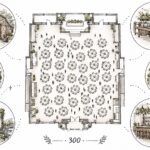
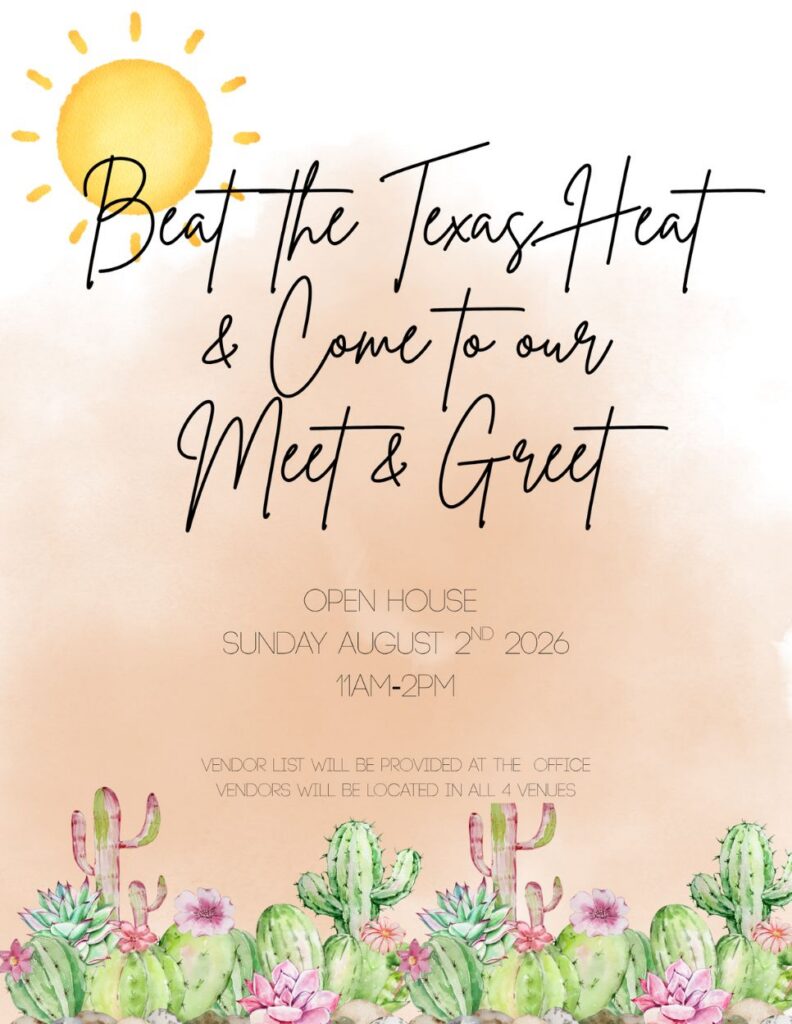
Set on 55 acres in Kyle, the property has four separate halls, Tejas, Sage, Stone, and Redbud, with capacities from 150 to 320 guests. That range gives planners options for right-sizing the room, controlling flow, and separating business programming from social time. The grounds also give you usable outdoor space, not just scenery.
The operations side is what makes it easy to shortlist. Bookings include exclusive 16-hour access from 8:00 a.m. to midnight, on-site management, clean-up, furniture breakdown, indoor and outdoor PA systems with Bluetooth hookup and a wireless microphone, dressing suites, a prep kitchen, and a large private parking lot with accessible access. For event planners, that removes several common friction points before load-in even starts.
Why planners keep shortlisting it
Texas Old Town fits groups that need flexibility without moving into a resort budget or a rigid package model. You can bring in your own caterer, use the prep kitchen and service entry, and follow a bring-your-own-beverage setup with an approved bartending company. That matters if you're balancing dietary requirements, different service styles, or a budget that needs more control than in-house catering usually allows.
I look closely at access windows for team-building events because setup time affects the whole day. A venue can have a strong look and still create problems if vendors are rushed, registration has to be built in a narrow window, or the room needs a fast reset between workshops and dinner. The 16-hour booking window helps planners stage the day properly instead of compressing everything into back-to-back transitions.
Budget clarity is another plus. Texas Old Town states that quotes include sales tax and gratuity, which makes early cost planning cleaner than venues where those charges show up later. You can review more about its corporate event fit in Texas Old Town's guide to planning a corporate retreat or team building event near Austin.
Best-fit team building formats
This venue works well when you need the day to do two jobs at once. A focused meeting block needs dependable A/V and a room that holds attention. The team-building portion needs space to relax the tone and let people interact more naturally. Research summarized in this article on team cohesion outcomes in team-building activities found that team-building efforts can improve task cohesion and social cohesion in different ways, which is a useful planning lens here.
Formats that fit the property well include:
- Leadership offsite with dinner service: Use the hall for a morning strategy session, move into breakouts or planning pods later, then shift outdoors for a reception.
- Department summit: Run the all-hands meeting indoors, then use the lawn and open areas for networking, games, awards, or sponsor-style stations.
- Culture reset event: Start with a workshop or facilitated discussion, then move into a shared meal and unstructured social time.
- Multi-team rotation day: Assign one activity track indoors, another outside, and use the grounds to keep groups moving without crowding one another.
The trade-offs are clear.
- Best strengths: Four venue styles on one property, long exclusive access, flexible catering structure, practical built-in A/V, and straightforward operating support.
- Main limitations: You'll need to request a quote, alcohol service requires an approved bartender, and events need to wrap by midnight.
For planners weighing atmosphere against operational control, Texas Old Town is a practical option with more flexibility than many Hill Country venues in the same category. Explore the property and venue details at Texas Old Town.
2. Hyatt Regency Lost Pines Resort & Spa
If your team wants a classic retreat format with lodging, meeting space, recreation, and dining in one place, Hyatt Regency Lost Pines is a strong contender. It's built for corporate groups that need a smoother handoff between general sessions and activity blocks, especially when you're coordinating attendees coming in from multiple offices.
The advantage here is convenience. You're not stitching together hotel rooms, a nearby activity vendor, and a separate banquet venue. The resort format keeps transitions tighter, which helps when leadership wants the schedule to feel polished.
Where it works best
Lost Pines is most useful for multi-part agendas. You can run a formal morning session, break into outdoor programming later, and still keep everyone on property for dinner or evening networking. That's a good fit for companies that need both business infrastructure and a less corporate atmosphere once presentations are over.
Countryside retreat settings saw a 308% increase in popularity between 2023 and 2024, and 54% of companies preferred beachside or nature-based settings over urban or standard indoor conference locations, according to Party Houses corporate retreat statistics. Lost Pines fits that preference well because it gives you a resort environment without losing the operational backbone planners usually need.
What works well here:
- Business-plus-recreation agendas: Keynotes, breakouts, and team activities on the same property.
- Overnight retreats: Fewer transportation handoffs and easier guest management.
- Executive groups with mixed expectations: Some attendees want structured sessions, others want spa, golf, or low-key downtime.
What doesn't work as well is strict budget shopping. Team-building options and meeting packages are quote-based, and popular dates can tighten your choices. If your planner brief depends on public pricing transparency, this one may require more upfront sales conversations than you'd like. Venue and meetings details are available at Hyatt Regency Lost Pines Resort & Spa meetings.
3. Camp Lucy
Camp Lucy is for planners who want the event to feel curated rather than purely scheduled. The property combines multiple indoor and outdoor venues, on-site lodging and dining, and a menu of instructor-led activities that can make a retreat feel less like a meeting with entertainment bolted on afterward.
That matters because some teams resist traditional team-building language. They'll engage more naturally in an archery session, yoga block, tasting, or stargazing program than in a forced icebreaker in a conference room.
Why the activity mix matters
Camp Lucy's biggest strength is that the space supports varied energy levels across the day. You can plan a retreat where one block is high interaction and the next is reflective or wellness-oriented. That range helps when your audience includes both extroverted sales leaders and quieter technical or operational staff.
The best team building venues don't just offer activities. They make it easy to alternate intensity so people don't burn out by lunch.
This is also where social outcomes become more intentional. In-person outdoor venues can drive stronger participant satisfaction and stronger long-term relationship bonding than purely virtual formats, according to Market Intelo's team-building activities market report. Camp Lucy's mix of polished indoor space and experiential outdoor programming aligns well with that kind of design.
Useful formats here include:
- Wellness-forward retreats: Morning business session, midday yoga, evening social tasting.
- Client-facing internal events: High-end setting with built-in hospitality appeal.
- Creative team offsites: Less rigid environment for brainstorming and informal interaction.
The main trade-off is customization complexity. Pricing is generally quote-based, and some activities come with participation limits or age restrictions. That's manageable, but it means planners need to lock the agenda earlier than they would at a simpler banquet property. Browse meetings and retreat options at Camp Lucy.
4. Kalahari Resorts & Conventions Round Rock
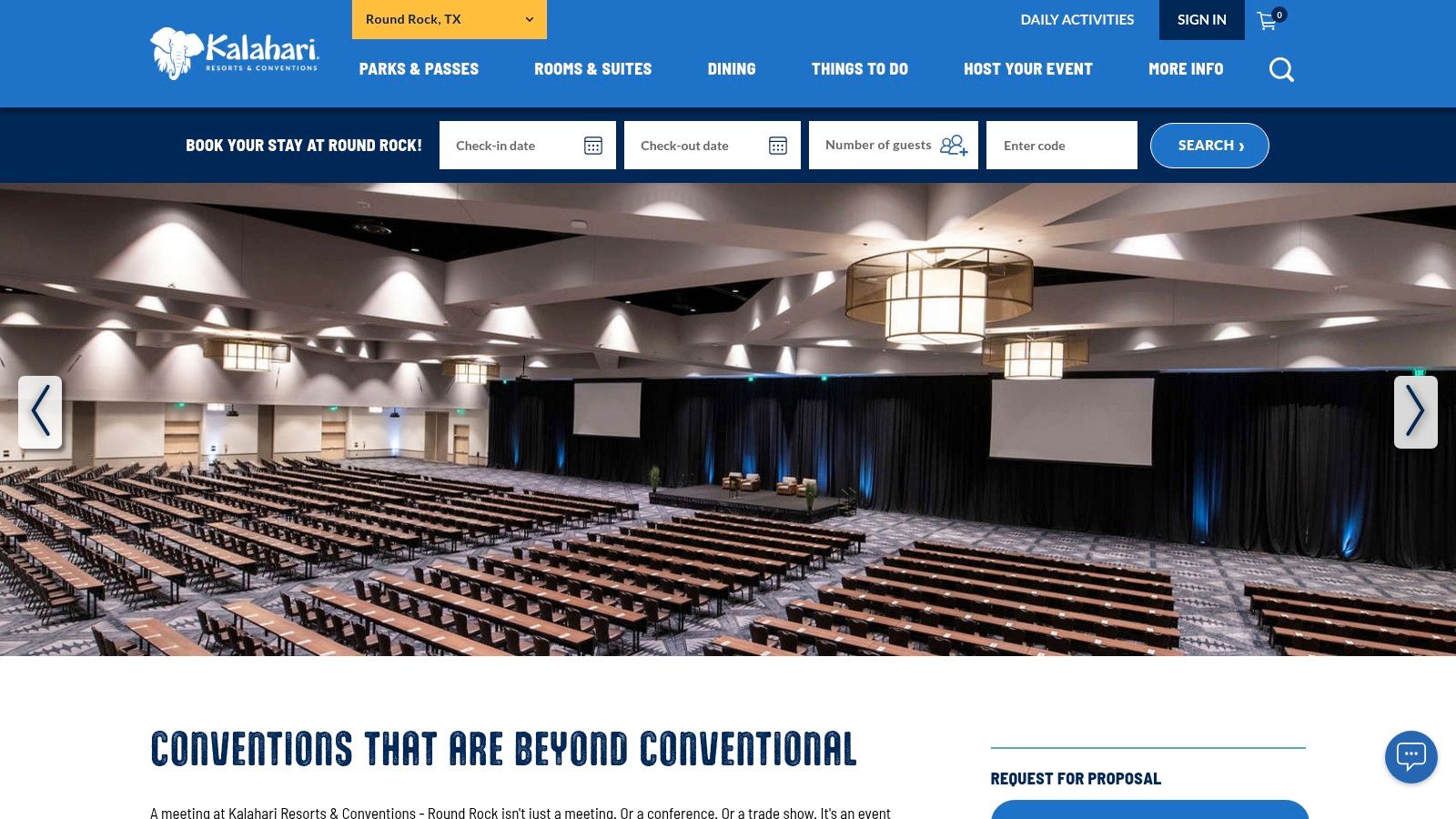
Kalahari is the high-capacity answer on this list. When the event is large, cross-functional, and operationally complex, having major meeting inventory, on-site catering, and production support under one roof can save a planning team a lot of moving pieces.
This isn't the venue for a quiet reset. It's the venue for scale, convenience, and built-in activity options that don't require buses or outside entertainment coordination.
Best use case
Kalahari works best for all-hands meetings, sales kickoffs, broad departmental gatherings, and organizations that need extensive breakout capacity. If your attendee list is large enough that room turnover, signage, registration flow, and F&B timing become major concerns, a property built for conventions starts to look much more attractive.
U.S. organizations report an average return of USD 4.00 for every USD 1.00 invested in meetings and team-building, while face-to-face events globally deliver a 4.52x ROI, according to High5's team building statistics. Venues like Kalahari make the strongest case when your event's success depends on smooth execution across many attendees rather than a boutique atmosphere.
Here's the practical read:
- Best for: Large groups, dense agendas, multiple breakouts, centralized vendor management.
- Less ideal for: Reflection-heavy retreats, intimate leadership sessions, or groups that want the setting itself to feel calm and secluded.
- Watch item: The entertainment-forward environment can feel busy, so planners should reserve quieter spaces for executive discussions.
The convenience is real, but so is the trade-off in ambience. If your brief says “keep everything in one place,” Kalahari deserves a close look. See the meetings offering at Kalahari Resorts & Conventions Round Rock.
5. The Retreat at Balcones Springs

Some team building venues are designed for comfort first. Balcones Springs is designed for immersion. The property leans into the camp-meets-resort model, with cabins, waterfront areas, ropes elements, sports courts, trails, bonfire spaces, and in-house meal coordination.
For planners, that means less fragmentation. Lodging, food, and activity scheduling can stay close together, which helps if your goal is to keep the team engaged rather than letting people scatter after each session.
What to plan for
This venue is strongest when you want participants to unplug and spend meaningful time together over more than a few hours. The property supports facilitated activities that are more active and collaborative than what most banquet venues can offer, especially if you want shared challenge elements instead of conversation-only networking.
There's also a strategic upside to secluded venues. A growing share of retreat planners are choosing exclusive-use formats over generic hotel conference setups, and retreat groups often expect meeting rooms and multiple on-site meals as part of the package, according to the retreat preferences noted earlier. Balcones Springs fits that expectation well because it's built around staying on property rather than popping in for a short meeting block.
Field note: If the agenda includes ropes, waterfront, or bonfire programming, build in buffer time for clothing changes, hydration, and a slower transition back into structured sessions.
Good fits include:
- Company retreats with overnight stays
- Team reset programs after reorgs or rapid growth
- Groups that benefit from facilitated challenge activities
Less ideal uses include half-day meetings or polished client entertainment. This property shines when the event is intentionally immersive. Review event options at The Retreat at Balcones Springs.
6. JW Marriott San Antonio Hill Country Resort & Spa
JW Marriott San Antonio Hill Country Resort & Spa sits at the more formal end of the spectrum. It's a meetings-driven resort with the infrastructure to support larger corporate programs, but it also gives planners access to outdoor venues and curated group experiences that soften the feel of a conventional conference.
That balance is useful when leadership wants strong production values without making the event feel cold. The venue can handle polished business sessions, but it's still able to support wellness and social programming that helps attendees connect.
Planner trade-offs
This property is a good choice when you need confidence in service systems. Large resorts tend to have stronger staffing depth, more established banquet operations, and dedicated meetings support. For planners managing executives, sponsors, or sensitive agendas, that predictability can matter as much as the venue aesthetic.
There's also a broader planning lesson here. A lot of corporate teams default to hotels because they feel safe, but not every hotel layout supports the kind of interpersonal interaction an offsite is supposed to create. If you're evaluating whether a nontraditional venue might work better, Texas Old Town's perspective on whether wedding venues are good for corporate events is a useful reminder to compare function, not just category.
A few direct trade-offs:
- Strength: Strong meetings infrastructure and support for large programs.
- Strength: Good option for planners who want formal daytime sessions and a resort setting after hours.
- Watch item: Pricing is custom, and ancillary charges can stack up quickly if you add specialty production or multiple hosted functions.
This is a venue for planners who want professional systems first and atmosphere second, though it still delivers both. Start with the property's events information at JW Marriott San Antonio Hill Country Resort & Spa.
7. iFLY Austin
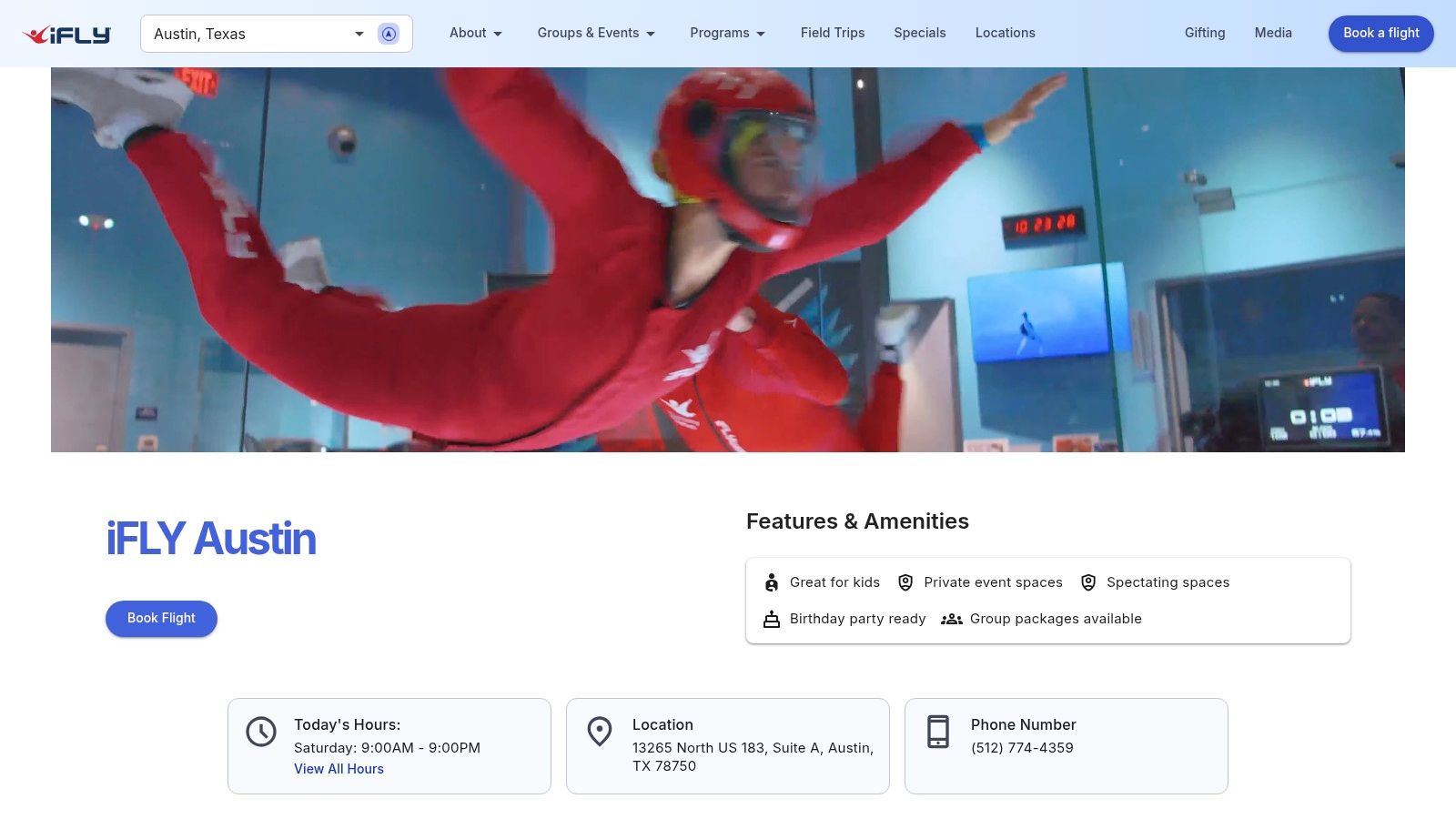
Not every offsite needs a full-day ranch or resort. iFLY Austin works when you need a short, high-energy experience that gets people talking fast. It's especially effective as a half-day event, a breakout reward, or an add-on to a broader Austin meeting schedule.
This kind of venue solves a different planning problem. Instead of asking people to bond over another meal, it gives them a shared experience with a little adrenaline and a lot more story value.
How to use it well
iFLY is best when the agenda is tight and the team is mixed in familiarity. New hires, cross-functional groups, and remote colleagues meeting in person often warm up faster when the activity gives them something immediate to react to together. That's different from the slower social build you get at a dinner reception.
There's also an inclusion angle planners should think about more often. Practical accessibility planning matters, especially for underserved or neurodiverse participants. The guidance collected by Oxford Health BRC on involving underserved communities highlights accessible venues and practical support as important factors for successful participation. For a venue like iFLY, that means planners should confirm comfort levels, mobility considerations, timing, and opt-in expectations rather than assuming every attendee wants the same experience.
Use it well by doing three things:
- Pair it with meeting space: Start with a brief business session, then move into flights.
- Offer choice: Let attendees spectate or join alternate social time if needed.
- Keep group size realistic: Throughput can limit very large programs unless you buy out the venue.
For shorter team building venues in Austin, this one is memorable and operationally simple. Check corporate event options at iFLY Austin.
8. Your Team-Building Event Planning Checklist
Even the best venue can't rescue a weak event plan. The biggest mistakes usually aren't dramatic. They're small gaps that compound: unclear objectives, loose vendor communication, underbuilt transitions, or no contingency for weather, dietary requests, and timing drift.
A good checklist keeps those problems from reaching event day. It also helps you compare team building venues on the criteria that directly affect execution.
Checklist
Use this planning checklist before you sign and again two weeks before the event.
- Define the outcome first: Decide whether the event is meant to build trust, solve a strategic problem, celebrate a milestone, or onboard a changing team. The venue should support that goal, not fight it.
- Map the agenda to the space: Confirm where presentations, breakouts, meals, and social time will happen. Don't assume one room can do every job well.
- Confirm catering rules early: Ask whether the venue requires in-house catering, allows outside caterers, or provides prep space only.
- Audit A/V and Wi-Fi needs: Check microphones, speakers, screens, Bluetooth compatibility, bandwidth expectations, and who troubleshoots on site.
- Review load-in and parking: Ask where vendors unload, how early setup can begin, and whether attendee parking is close, private, and accessible.
- Plan inclusion details: Consider transport, sensory load, dietary needs, childcare constraints, flexible timing, and spaces for quieter breaks.
- Pressure-test the timeline: Add transition buffers, meal service windows, and reset time between programming blocks.
- Document the day-of flow: A simple schedule document helps every vendor and stakeholder work from the same sequence. If you need a starting point, adapt this event reception schedule template from Texas Old Town.
Good planners don't just book a venue. They remove uncertainty before attendees ever arrive.
8-Point Team-Building Venue Comparison
| Venue / Item | Implementation complexity | Resource requirements | Expected outcomes | Ideal use cases | Key advantages |
|---|---|---|---|---|---|
| Texas Old Town | Low–moderate, planner-friendly with on-site day-of management | Moderate, vendor selection possible, BYOB (approved bartender), prep kitchen, parking | Predictable, scenic Hill Country events with flexible capacity | Weddings, quinceañeras, milestone events, mid-size corporate gatherings (150–320) | Multiple venue styles on 55 acres; 16-hour access; transparent pricing; award recognition |
| Hyatt Regency Lost Pines Resort & Spa | Moderate, resort coordinates meetings and activities | High, resort fees, accommodations, facilitated team-building options | Integrated retreat blending business sessions and outdoor bonding | Corporate offsites, multi-day meetings needing lodging and recreation | Self-contained resort, varied spaces, curated team-building programs |
| Camp Lucy | Moderate–high, tailored itineraries and instructor-led activities | High, custom quotes, lodging, instructors, curated programming | High-touch wellness or creative retreats with strong interpersonal engagement | Luxury retreats, wellness-focused offsites, strategy sessions | Multiple venue options, instructor-led activities, dedicated event team |
| Kalahari Resorts & Conventions – Round Rock | Moderate, large-scale logistics but centralized services | Very high, extensive production, catering, minimums for groups | Large conferences or all-hands with integrated entertainment and meetings | Large departmental meetings, conventions, groups needing scale | 200,000+ sq ft of flexible meeting space; on-site entertainment; full production support |
| The Retreat at Balcones Springs | Moderate, immersive programming often coordinated onsite | High, overnight lodging, facilitated ropes/waterfront activities, bundled meals | Deeply immersive team bonding and skills-building in a secluded setting | Multi-day retreats, leadership development, experiential team-building | Private camp-style setting, end-to-end logistics, classic ropes and waterfront programming |
| JW Marriott San Antonio Hill Country Resort & Spa | Moderate–high, professional meetings infrastructure with custom programs | High, resort pricing, activity fees, broad capacity | Professional, large-scale meetings with curated wellness and team programs | Conferences, incentive trips, large-scale corporate meetings | On-staff meetings support, recognized venue, varied seasonal group activities |
| iFLY Austin | Low, turnkey short-session planning with onsite coordination | Low–moderate, corporate packages, buyout option for larger groups | High-energy, memorable short team-building that builds rapport quickly | Half-day team-building, add-on experiential activity, small–medium teams | Unique adrenaline activity, turnkey event coordination, central Austin location |
| Your Team-Building Event Planning Checklist | Low, simple to implement as a planning tool | Minimal, staff time to follow checklist and coordinate tasks | More organized execution, reduced oversights and smoother timelines | Any team-building or corporate event planning process | Comprehensive, practical, improves planning consistency and follow-up |
Why Texas Old Town Offers Unmatched Flexibility and Value
A planner finalizing a shortlist usually ends up weighing three things at once. How much production support the venue can handle, how many outside vendors it will accommodate, and how much schedule pressure the team will be under once load-in starts.
That is the lens that separates these venues. Lost Pines and Camp Lucy work well when overnight rooms and resort programming are part of the brief. Kalahari and JW Marriott fit large agendas with heavier meeting infrastructure. Balcones Springs makes sense for retreat-style programs that benefit from privacy and facilitated activities. iFLY serves a different need. It gives planners a fast, high-energy add-on for shorter events.
Texas Old Town earns attention for a more operational reason. It gives planners room to shape the event instead of forcing the event into a preset package. The four private halls support different capacities and aesthetics on one campus, which helps when stakeholder preferences shift during sourcing. The long exclusive rental window also changes the day-of schedule in practical ways. Teams get more time for vendor load-in, room flips, catering setup, rehearsal, and strike without compressing the guest experience.
Vendor policy is a real differentiator here. Planners can choose catering based on budget, dietary needs, service style, and brand fit instead of defaulting to an in-house menu. The prep kitchen and separate service entry help that process run cleanly on event day. Beverage planning is similarly flexible. You control the bar strategy while still working within the venue's approved bartending requirements.
The value case is mostly in the details planners care about after the contract is signed. Clear pricing. Documented furniture inventory. Built-in A/V support. Included cleanup. On-site management. Those details reduce revision rounds, vendor confusion, and day-of surprises.
For teams meeting between Austin and San Antonio, Texas Old Town fills a useful gap in the market. It offers a Hill Country setting that feels more distinct than a standard hotel ballroom, while still giving planners the control points that matter most. If the brief calls for atmosphere, flexible vendor execution, and a schedule that can absorb real event logistics, it belongs near the top of the shortlist.
If you are comparing team building venues and want a property with flexible setup options and fewer planning constraints, Texas Old Town is worth touring early in the process. Its four private halls, extended access window, flexible catering structure, built-in A/V, and Hill Country setting fit corporate offsites, milestone events, and team programs that need polish without a rigid operating model.