You arrive at the venue expecting romance, photographs, and a room full of people you love. Instead, the caterer is asking where to unload, the florist needs access to the ceremony site, the bar team is waiting for approval, and someone has discovered that the reception layout doesn't match the floor plan. Without a capable wedding venue manager, those small questions land on the couple, parents, or an overwhelmed friend.
A venue manager works behind the scenes to keep the property, staff, vendors, and physical schedule aligned. The role protects more than convenience. It protects the timeline, the condition of the venue, and the money you've committed to one of the largest parts of your wedding budget.
Table of Contents
- The Reality of Day-Of Event Execution
- Core Responsibilities and Operational Scale
- How On-Site Management Protects Your Timeline
- Evaluating Costs and Hidden Venue Fees
- Modern Booking Trends and Communication Standards
- Critical Questions to Ask During Your Venue Tour
- Securing a Seamless Event Experience
The Reality of Day-Of Event Execution
At the moment guests begin arriving, a successful wedding can look effortless. The ceremony chairs are aligned, the indoor reception room is ready, the sound system works, and the catering team knows which entrance to use. That calm appearance usually reflects hours of decisions made before the first guest steps onto the property.
A wedding venue manager is the operational anchor for the physical venue. They oversee the building, grounds, venue-provided furniture, utilities, access rules, cleaning standards, and venue staff. They also coordinate the parts of outside vendor activity that affect the property, such as arrival times, load-in routes, setup locations, and breakdown procedures.

That role isn't automatically the same as a wedding planner or day-of coordinator. A planner works for the couple and may manage the broader wedding design, personal details, off-site events, transportation, family photographs, and communication with every vendor. The venue manager works for the property and focuses on making sure the property performs as promised.
Where the responsibilities meet
The distinction matters because couples often hear “coordination” and assume it includes every wedding-day task. A venue manager may prepare tables and chairs, supervise venue staff, manage the bar arrangement, check climate control, and protect the approved floor plan. A personal coordinator may cue the processional, gather family members for photographs, manage personal décor, and keep the couple's full timeline moving.
Strong teams define those boundaries before the wedding. The venue manager shouldn't be expected to leave a catering setup problem to find a missing attendant, and your independent coordinator shouldn't have to troubleshoot the venue's power, bathrooms, or furniture inventory.
Practical rule: Ask for the venue manager's responsibilities in writing, then compare them with the duties assigned to your planner or day-of coordinator.
The best venue manager prevents disruption without becoming the visible focus of the celebration. When a delivery arrives early, weather changes the ceremony plan, or a vendor needs a property decision, that professional should know who can approve the change and what the venue can support.
Core Responsibilities and Operational Scale
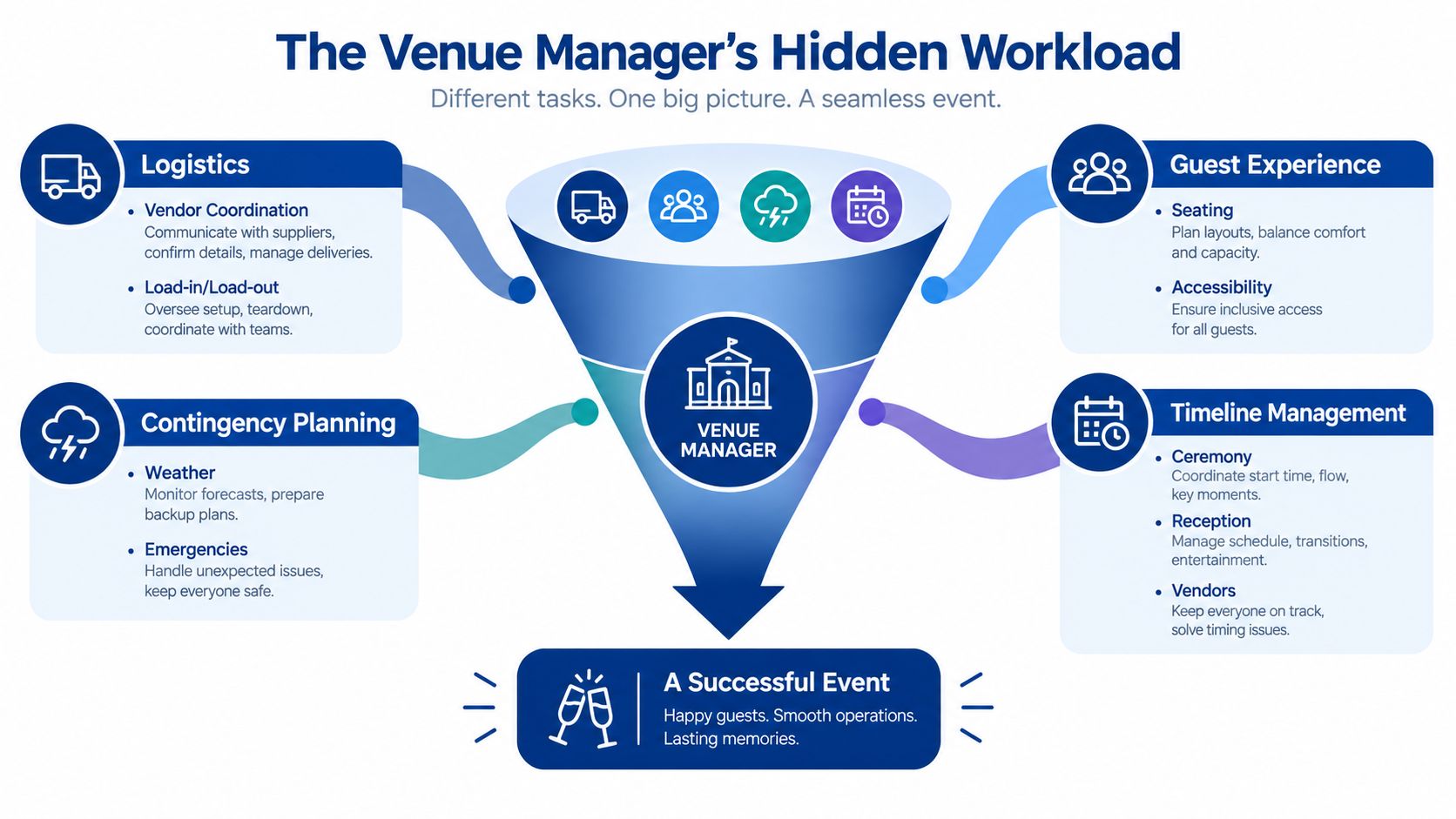
The workload becomes clearer when you stop thinking of the venue manager as the person who opens the doors. The job is a continuous control system for bookings, documents, vendors, staff, facilities, and guest movement.
The wedding-venue segment accounted for 35% of total event-venue revenue, or about $42 billion in 2022, according to an industry estimate of event-venue revenue. That scale helps explain why venue operations affect the couple directly. A mistake involving capacity, timing, service packages, or vendor access can disrupt both the event and the venue's ability to serve future bookings.
A separate 2026 industry summary estimates that the average U.S. wedding venue hosts 52 weddings per year, while top venues host more than 100 events annually. The same wedding venue industry analysis estimates a $70 billion U.S. wedding industry, 2.1 million weddings, and $35,000 in average spending per wedding, with venues averaging $11,200 per wedding. These figures show why repeatable systems matter. Managers can't rely on memory and informal handoffs when the property hosts a high volume of events.
The information system behind the event
A capable manager maintains one reliable source of truth for:
- Bookings and holds: Dates, spaces, rental windows, and approved event uses must remain synchronized.
- Client documents: Contracts, floor plans, policies, payment records, and special requests need accessible version control.
- Vendor schedules: Caterers, florists, entertainment teams, rental companies, and bartenders require clear arrival and departure instructions.
- Operational deadlines: Final guest counts, layout approvals, insurance documents, menu details, and access requests should never depend on a verbal reminder.
Industry guidance recommends a centralized information system, a detailed event timeline covering setup through pack-down, and a shared calendar for holds and critical dates. Those controls reduce the risk of double-bookings, missed deadlines, and inconsistent vendor execution by giving the team the same operational reference point. The wedding venue management guide describes these controls as core operating practices, not optional administration.
The manager also handles practical details guests never see. They may coordinate a caterer's service entrance, confirm that the PA system and wireless microphone are ready, check room temperature, inspect restrooms, verify accessible routes, and direct furniture movement between ceremony and reception spaces.
If you manage a venue or agency, consistent post-event feedback can reveal where handoffs fail. A structured resource such as review collection for agencies can help teams collect client feedback and identify recurring service issues without relying on scattered messages.
For a broader description of the operational role, compare the event manager responsibilities that cover venue readiness, vendor coordination, and event execution.
How On-Site Management Protects Your Timeline
A venue rental window only helps if the manager uses it deliberately. Extended access gives the team room to absorb deliveries, inspect setup, correct layout issues, and complete breakdown without pushing every task into a narrow period.
Before the ceremony
The manager begins by confirming that the property matches the approved plan. That includes checking furniture placement, ceremony seating, lighting, temperature, restrooms, signage, sound equipment, and vendor access points.
Caterers may need a separate service entrance and prep area. Florists need a clear path to the ceremony site. Entertainment teams need time to test microphones, speakers, and power. The manager coordinates those movements so vendors aren't blocking guest entrances or competing for the same work area.
An extended rental such as a 16-hour access window can cover setup, the celebration, and breakdown in one controlled period. Texas Old Town, for example, publishes an 8:00 a.m. to midnight exclusive-use window as part of its venue offering. That structure gives a manager more time to solve problems before guests see them.
During the ceremony and reception
The venue manager protects the facility while coordinating venue-controlled transitions. If the ceremony takes place outdoors, the manager confirms that the indoor space is ready as a backup and that the relevant sound equipment can support either location. If guests move indoors for cocktails, staff can redirect traffic while the manager supervises the room turnover.
The planner or personal coordinator may cue the processional, manage the wedding party, and coordinate the reception program. The venue manager focuses on the building, venue staff, furniture, food-service access, bar requirements, and physical safety of the space.
A calm timeline depends on someone watching the spaces that the couple can't watch while they're getting married.
After the final song
Breakdown is part of the event, not an afterthought. The manager confirms that vendors remove their equipment, staff return furniture correctly, trash follows the venue's requirements, and personal items leave with the right person. Included clean-up and furniture breakdown can keep family members from spending the final hours of the evening sweeping, lifting tables, and searching for misplaced décor.
The point of on-site management isn't to make every wedding identical. It's to give each event a responsible operational lead who can act quickly while the couple stays present with guests.
Evaluating Costs and Hidden Venue Fees
The cheapest venue quote isn't necessarily the lowest-cost choice. Compare what the venue performs directly with what it leaves for you to source, staff, and supervise.
A transparent proposal should identify management, cleaning, furniture, access hours, taxes, gratuity, utilities, trash handling, and vendor requirements. Industry guidance warns that true event cost modeling must account for cleaning, utilities, consumables, trash haul, staffing, wear-and-tear, and administrative time. Those categories can sit outside the headline rental fee if you don't ask.
| Service Element | Included in Venue Package | Sourced Externally A La Carte |
|---|---|---|
| On-site venue management | Venue employee oversees property operations and venue staff | Couple hires separate operational support or assigns duties to family |
| Setup and furniture | Venue team places listed tables and chairs according to the approved plan | Rental company may deliver, place, collect, and charge for labor |
| Clean-up and breakdown | Venue team handles defined post-event cleaning and furniture return | Couple pays a cleaning crew or assigns cleanup to guests |
| Vendor access | Venue supplies approved arrival instructions and service routes | Couple or planner coordinates access across separate vendors |
| Facilities and equipment | Published amenities such as restrooms, sound equipment, bars, or prep areas | Separate rentals, delivery charges, setup fees, or staffing may apply |
| Staffing contingencies | Venue plans labor for its own operating requirements | External team may bill added labor when call-offs or delays occur |
Ask what the package really includes
The phrase “clean-up included” needs a definition. Does it cover venue floors, bathrooms, tables, chairs, trash, décor removal, and catering debris? Or does it only mean a basic sweep after the couple's team has cleared everything?
Labor planning deserves the same scrutiny. Event-staffing guidance recommends a 10% to 15% labor buffer above calculated headcount, and recommends giving schedules at least 2 weeks in advance for large events over 150 guests, according to venue operations and staffing guidance. If a venue doesn't explain who absorbs late changes, call-offs, or extended labor, ask whether those costs appear on the final invoice.
Review the venue rental contract guidance before signing. A clear contract should state the rental window, staffing scope, cleaning boundaries, vendor rules, damage responsibility, payment schedule, and every required add-on.
Modern Booking Trends and Communication Standards
The venue manager's systems are visible before the wedding day. Slow replies, incomplete answers, and inconsistent follow-up usually indicate a sales and service process that hasn't been built for how couples research now.
A 2025 industry survey reports that most couples take 1 to 4 weeks to decide, while wedding professionals report conversion rates often ranging from 21% to 60%. Those figures appear in the 2025 wedding professional survey, which also describes lower conversion as a common current challenge. Couples are comparing carefully, and the venue that communicates clearly has a practical advantage.
A separate 2026 industry analysis estimates that 68% to 72% of venue enquiries arrive outside office hours, while 43% of couples expect a reply within 24 hours and couples typically contact 4 to 10 venues before booking. Those figures come from the same data-driven market analysis cited in the survey source above. Treat them as operational guidance: a venue needs an after-hours intake process, not just a voicemail box.
What mature communication looks like
A strong venue pipeline should answer common questions immediately through a clear FAQ. Couples should be able to find access hours, capacity, indoor and outdoor options, vendor policies, bar requirements, furniture, parking, accessibility, payment terms, cleaning, and weather procedures without sending several messages.
AI-friendly FAQs aren't about replacing a human manager. They organize accurate information so a prospective couple receives a consistent answer before a manager follows up personally.
Follow-up should also be deliberate. After an enquiry, the venue should record the couple's date, guest count, preferred space, concerns, and next decision point. A useful nurture process answers the actual hesitation, such as pricing clarity, vendor flexibility, ceremony backup space, or the difference between a venue coordinator and an independent planner.
Communication standard: You shouldn't have to chase a venue to learn what its package includes.
The booking experience reveals whether the venue can manage details at scale. Ask who responds after the tour, who updates the contract, who owns your questions, and what happens if the original contact leaves. Professional communication creates continuity long before the wedding day.
Critical Questions to Ask During Your Venue Tour
Don't leave a venue tour with only photographs and a capacity figure. Ask questions that expose who will make decisions when the florist is late, the ceremony moves indoors, or the reception needs a faster transition.
Confirm the manager's actual role
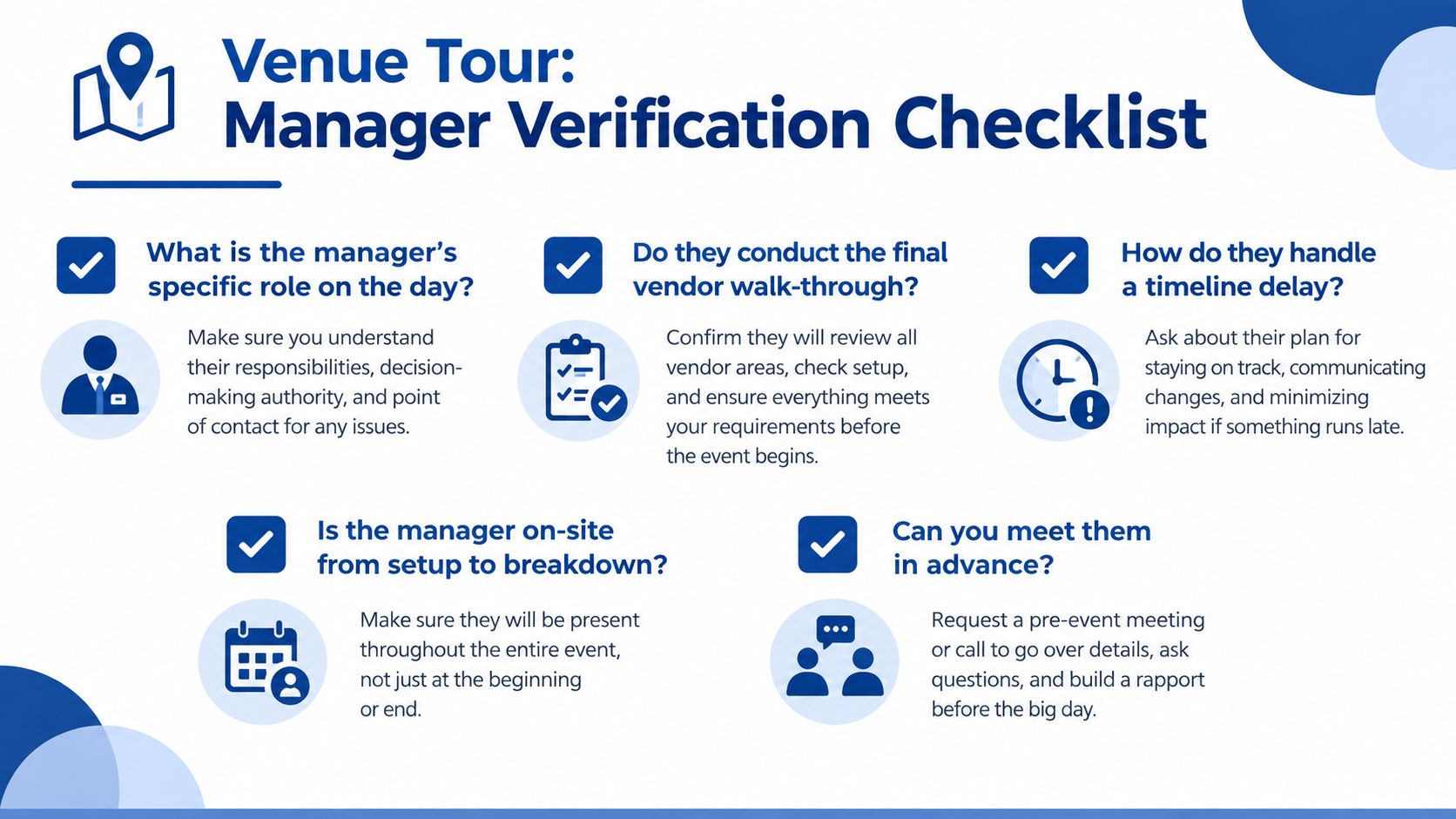
Start with these questions:
- Who is the venue manager assigned to our event? Ask whether that person will be on-site or whether the role changes between the booking process and the wedding day.
- What does the manager handle personally? Request a written list covering setup, furniture, vendor access, sound, climate control, bar operations, guest flow, cleaning, and breakdown.
- Does the manager conduct a final vendor walk-through? A walk-through should confirm arrival routes, floor plans, service entrances, equipment, and timing.
- How does the team handle a timeline delay? Listen for a defined escalation process, not a vague promise to “make it work.”
- Is the manager present from setup through breakdown? Ask for arrival and departure times, including who remains after guests leave.
- Can we meet the manager before signing? The conversation should make clear whether the person understands your layout and priorities.
Test the venue's flexibility
Ask whether the property supports multi-day celebrations, overnight accommodations, rehearsal dinners, outside caterers, outside entertainment, and extended access. A 2025 trend report identifies estate venues with overnight accommodations and weekend-long celebrations as growing preferences, with nearly a third of couples planning multi-day weddings. The 2025 wedding stay trend report also describes interest in micro weddings, eco-friendly choices, and clearer budget management.
Those preferences change the manager's workload. A multi-day event requires room turnover, vendor storage, staffing across separate activities, and clear rules for access between events. Ask who cleans between uses, who secures personal items, and whether additional labor or facility charges apply.
For virtual or remote venue research, a practical buying guide for virtual tours can help you assess how a property's online walkthrough presents entrances, transitions, accessibility, and service areas. Then verify every important detail in person or in the contract.
Use a written venue inspection checklist during the tour. A professional answer is specific, documented, and consistent with the proposal.
Securing a Seamless Event Experience
Your venue choice is also an operations choice. You aren't only selecting a backdrop for photographs. You're selecting the people, access rules, systems, labor model, and cleanup process that will carry the wedding from the first delivery to the final departure.
Prioritize a venue that provides a named on-site manager, a centralized planning process, and a clearly documented rental window. Extended access reduces pressure on setup and breakdown, but only when the venue manager actively controls the schedule and assigns responsibilities.
Cost transparency matters just as much. Compare the full package, not only the room fee. Include management, tables and chairs, sound equipment, dressing spaces, service entrances, utilities, taxes, gratuity, cleaning, furniture breakdown, trash, vendor rules, and contingency labor.
Choose support that matches your event
A smaller celebration may need straightforward property oversight. A larger or multi-day celebration needs stronger coordination between vendors, spaces, staff, and guest movement. If your venue manager doesn't cover personal wedding logistics, hire an independent planner or day-of coordinator rather than assigning those duties to a relative.
Texas Old Town offers four private halls, outdoor ceremony sites, exclusive 16-hour access, on-site venue management, standard venue amenities, flexible caterer selection, and included clean-up and furniture breakdown on a 55-acre Hill Country property. Those features illustrate the kind of operational details couples should compare across venues, not a reason to skip the questions above.
The right manager doesn't take attention away from your wedding. They keep preventable problems away from you.
Schedule tours with a written question list, request an itemized proposal, and read the contract before you compare prices. A venue that answers operational questions directly gives you a much stronger foundation for enjoying the day you planned.
Visit Texas Old Town to tour its four Central Texas wedding venues, review the 16-hour access model, and discuss on-site management, flexible catering, and included cleanup. Ask the team to walk you through the actual setup, ceremony, reception, and breakdown process before you choose your date.