You're comparing two wedding venue quotes, and the cheaper one appears to win by several thousand dollars. Then you notice that it includes neither chairs nor cleanup, the rental ends before the final dance, and every outside vendor carries another charge. The more expensive package looks worse on the first page, but it may already cover the furniture, staffing, setup, breakdown, and time your wedding requires.
That's why wedding venues with packages shouldn't be compared by rental price alone. Compare the total landed cost for the same guest count, schedule, catering assumptions, and level of service, then divide that total by the number of guests. The right question isn't “Which package is cheapest?” It's “Which package gives us a predictable wedding day without paying for services we don't need?”
The stakes are substantial. The Knot's 2025 Real Weddings Study found that the average reception-venue expenditure was approximately $12,900 among couples married in the United States in 2024, and 89% hired a reception venue. The Wedding Report estimates 2,011,044 U.S. weddings and approximately $66.16 billion in wedding spending for 2025 in its U.S. wedding market statistics. A venue package is therefore not a decorative label. It's a budgeting system for a large, complicated purchase.
Table of Contents
- The Real Decision Behind Every Wedding Venue Package
- What a Wedding Venue Package Usually Includes
- Packaged Venues vs A La Carte Rentals
- How to Read a Venue Package Price Transparently
- Sizing the Right Package for Your Guest Count
- Accessibility and Weather Contingency Hidden Inside Packages
- Questions to Ask Before You Sign Any Venue Package
- How Texas Old Town's Package Model Fits This Framework
The Real Decision Behind Every Wedding Venue Package
A couple I'd expect to meet on a venue tour has two proposals open on a laptop. Venue A offers a low room-rental price, but the quote stops at the walls. Venue B costs more upfront and includes tables, chairs, management, cleanup, a ceremony setup, and a longer access window. Both venues can host the guest list. Neither quote makes the better choice obvious.
The couple's mistake would be comparing the first number on each proposal. They need to add the furniture rental, labor, security, ceremony setup, overtime risk, taxes, gratuity, and every required vendor charge to Venue A before judging it. If Venue B already includes those items, its higher headline price may represent a lower cost per guest and far less coordination.
Treat the package as a budget framework
Couples frequently exceed their initial wedding budgets. The Knot's study reports that 53% of couples went over their original budgets, which makes transparent inclusions commercially important, not merely convenient. Bundling space with tables, chairs, staffing, setup, cleanup, and ceremony infrastructure can reduce the uncertainty created by a long list of separate suppliers.
That bundled structure matters especially when the guest count changes. A package that works for an intimate reception may be poor value for a large event if it excludes the labor and infrastructure required to serve more people. Conversely, a highly serviced package can waste money if you're paying for capacity, furniture, or staffing you won't use.
Planner's rule: Compare the complete wedding operation, not the room rental.
Your comparison should answer three questions
- What will we pay in total? Include mandatory charges, vendor costs, overtime exposure, and contingency.
- What work remains ours? Identify who handles load-in, setup, ceremony conversion, cleanup, furniture breakdown, and vendor coordination.
- What happens when the plan changes? Ask how the price changes if the guest count, caterer, beverage plan, weather decision, or schedule changes after signing.
A package is a good fit only when it matches your guest count, timeline, vendor preferences, and tolerance for logistical work. The best-looking brochure can still hide a difficult wedding day.
What a Wedding Venue Package Usually Includes
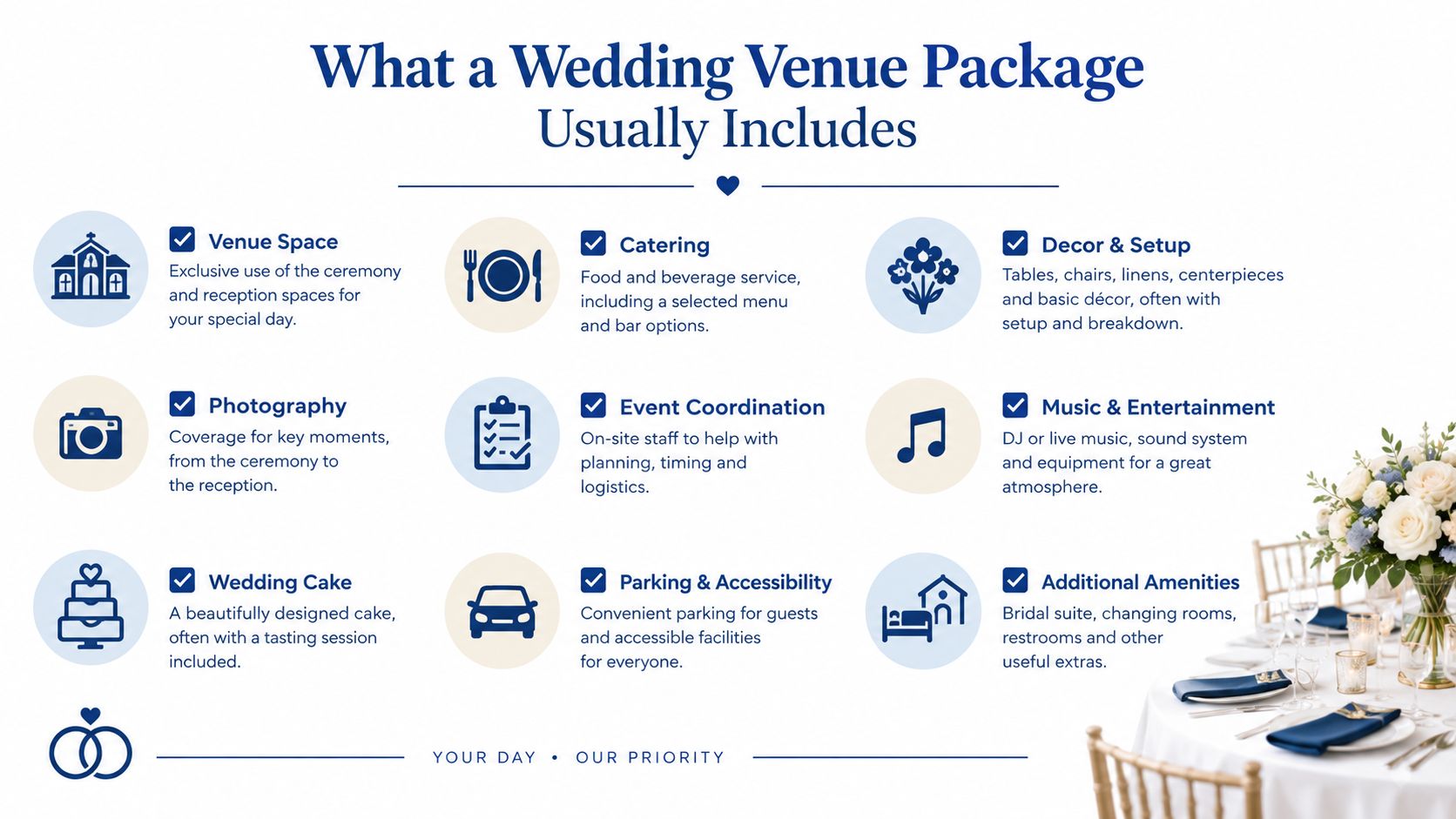
A venue package typically bundles the physical setting with the operational pieces needed to run an event. Read the inclusion list as a production plan, not a list of amenities.
Start with the exclusive-use area and rental window. Confirm which rooms, ceremony spaces, grounds, parking areas, and dressing spaces are private to your event. Then identify when vendors can load in, when your wedding party can arrive, when guests may enter, and when breakdown must finish. A long access window has practical value because setup, ceremony, reception, and cleanup don't have to compete for the same compressed period.
Furniture should be listed by type and count. “Tables and chairs included” isn't enough. Request the actual inventory, including dinner tables, cocktail tables, ceremony seating, sweetheart or head tables, and any furniture that requires a separate setup charge.
The core package checklist
- Space: Reception hall, ceremony area, cocktail-hour zones, and rain-plan location.
- Time: Exclusive access, vendor load-in, guest entry, event end, and breakdown deadline.
- Infrastructure: Climate control, lighting, power access, kitchen or catering-prep area, and service entrances.
- Furniture: Tables, chairs, ceremony seating, bars, and any included specialty pieces.
- Sound: Indoor and outdoor PA coverage, microphones, speakers, and connection requirements.
- Getting ready: Dressing suites, private restrooms, mirrors, vanities, and access hours.
- Operations: On-site manager, setup, cleanup, furniture breakdown, parking, and security responsibilities.
Know where the package ends
A venue package doesn't automatically mean all-inclusive. Catering, alcohol, bartending, floral design, photography, entertainment, cake, decor, transportation, and officiating may remain separate. Some venues include catering but require an approved caterer. Others let you choose any caterer but require licensed bartenders or event insurance.
Ask the venue to label every line as included, optional, required, or not available. That simple classification prevents you from treating a preferred vendor list or a sample event design as part of the contracted package.
Packaged Venues vs A La Carte Rentals
A packaged venue and an a la carte rental solve different problems. The package usually trades some flexibility for clearer responsibility and fewer separate arrangements. The raw rental gives you more control, but it also transfers more decisions, labor, and financial exposure to you.
| Factor | Packaged Venue | A La Carte Rental |
|---|---|---|
| Cost predictability | More services may sit inside one quote, but exclusions still need review. | Base rent can look lower, while furniture, labor, utilities, and cleanup are added separately. |
| Coordination | One venue team may manage access, setup rules, and event operations. | You or your planner coordinate more suppliers and timing details. |
| Vendor choice | May include a preferred list or restrictions. | Often offers broader choice, subject to venue rules and logistics. |
| Setup and breakdown | Frequently included or clearly assigned to the venue team. | Commonly falls to hired labor, vendors, or the couple's planner. |
| Overtime exposure | A defined access window can make the cutoff easier to understand. | Every additional rental, labor, or equipment period may create another charge. |
| Customization | Inclusions can limit choices if the package is rigid. | You select more items, but each selection requires another quote and contract. |
| Accountability | Fewer parties may be responsible for the venue operation. | Responsibility is distributed across several vendors. |
When a package is the smarter choice
Choose a package when you value predictable logistics over maximum customization. It fits couples who don't want to source furniture, organize cleanup labor, manage venue access, or solve a last-minute setup problem between the ceremony and reception.
A package also makes sense when your wedding has a demanding timeline. Separate vendors may each arrive on time, but someone still has to coordinate their access, staging, delivery routes, and departure. A venue manager who already knows the building can resolve operational questions faster than a couple trying to direct vendors while getting ready.
When a la carte gives you an advantage
An a la carte rental can work well when you already have a trusted planner, caterer, rental company, and production team. It may also suit a couple with a strong design brief that doesn't fit the venue's standard furniture, bar, or vendor arrangements.
The danger is assuming flexibility equals savings. A lower rental price is only useful if the required additions remain reasonable. Ask whether the venue permits outside vendors, who handles setup and breakdown, and whether your caterer can work efficiently with the kitchen, service entrance, power, and cleanup rules.
The middle ground is often strongest: flexible vendor access with a curated preferred list. You keep meaningful choice while retaining a reliable starting point for caterers, bartenders, rentals, and entertainment.
How to Read a Venue Package Price Transparently
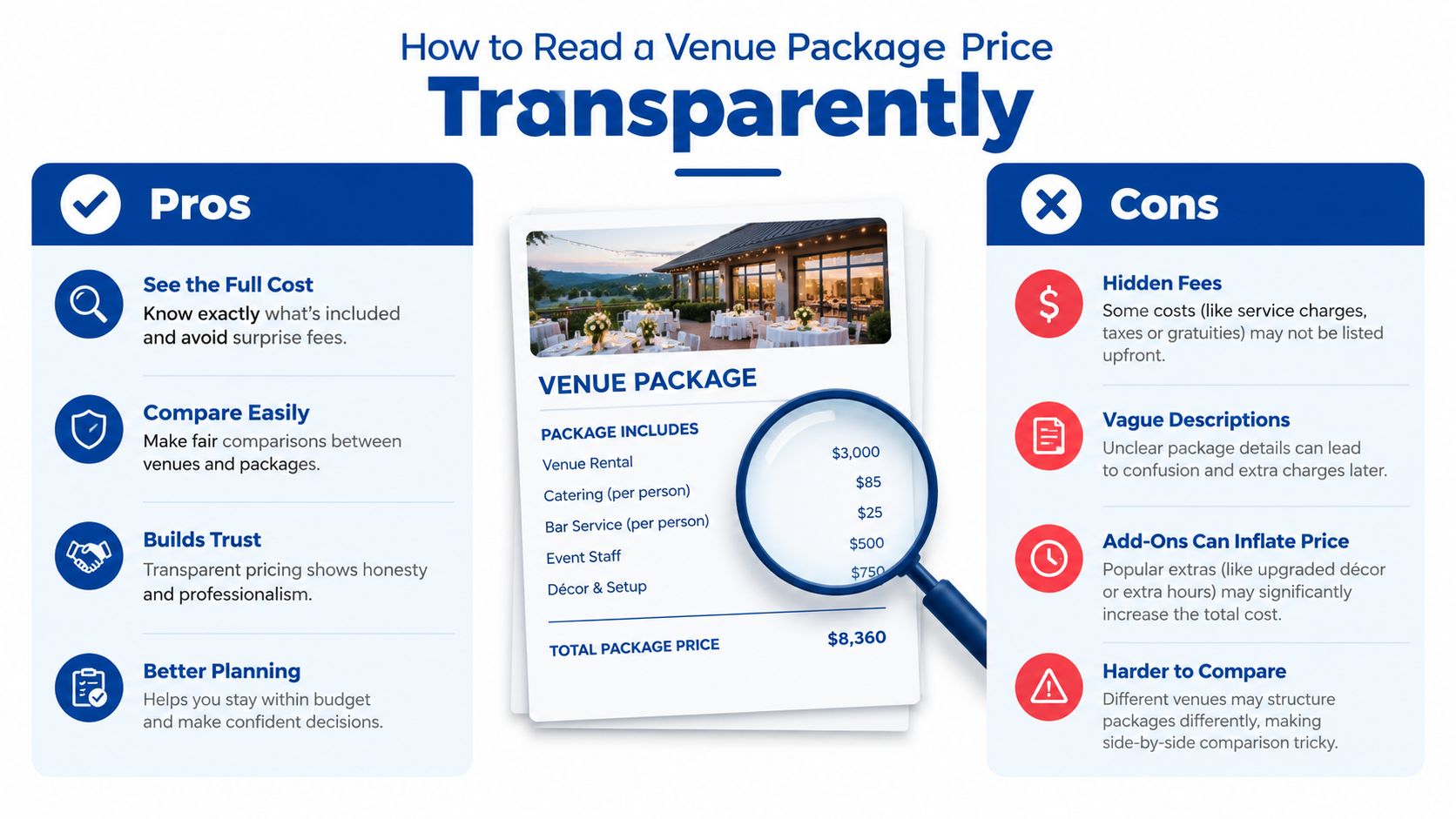
Start with five fields. Don't accept a quote comparison until both venues have been translated into the same model.
- Base rental: The room, property, or exclusive-use fee.
- Mandatory venue charges: Service charges, security, required staffing, cleanup, management, furniture labor, and administrative fees.
- Vendor and catering charges: Catering, bar service, alcohol, rentals, cake, sound, lighting, and outside-vendor fees.
- Overtime exposure: Additional access, late finish, delayed breakdown, extra labor, and vendor waiting time.
- Contingency: A realistic reserve for schedule changes, weather relocation, added guests, or revised service needs.
Then calculate:
All-in cost = base rental + mandatory venue charges + vendor and catering charges + expected overtime + contingency
Cost per guest = all-in cost ÷ confirmed guest count
Use the same guest count and event assumptions for every venue. If one quote assumes a shorter rental, limited furniture, or a different beverage model, it isn't an apples-to-apples comparison.
Find the charges hiding below the headline
Consumer guidance on negotiating wedding vendor contracts identifies food-and-beverage service charges commonly ranging from 15–25%. The same guidance highlights the need to document scope changes and examine overtime, setup, breakdown, taxes, corkage, cake cutting, and outside-vendor penalties.
Put those items in separate spreadsheet columns. Don't bury them in a notes field, because conditional charges are exactly what couples forget when they compare a clean room-rental figure with a bundled proposal.
Here's the practical test. Model the planned schedule, then model a late-finish or weather scenario. A venue with a 16-hour exclusive-use window can give vendors separate time blocks for access, setup, ceremony, reception, and breakdown, but the contract must still state the exact load-in and guest-entry rules.
For a real example of how inclusions and payment details should be examined, review Texas Old Town's wedding package pricing. Its quoted prices include sales tax and gratuity, so couples can place those costs in the included column rather than estimating them separately. That doesn't eliminate every wedding expense, but it changes the comparison from an advertised rental figure to a clearer landed-cost calculation.
Sizing the Right Package for Your Guest Count
A venue can advertise space for 300 guests and still feel cramped at 220. The published maximum may assume a ceremony-only layout, minimal service space, or no dance floor. Ask what the capacity includes before comparing packages.
Use usable event capacity, not the headline maximum. Count dinner tables, aisles, bars, catering stations, entertainment, service access, and any indoor ceremony arrangement.
Build in room to move
Reserve a 10–15% buffer above the expected guest count for circulation, seating comfort, service access, and accessibility needs, as outlined in wedding venue capacity planning guidance. For a seated dinner with round tables, approximately 25 square feet per guest is a useful planning benchmark. Table size, dance-floor dimensions, buffet placement, aisle width, and accessible routes can change the final requirement.
For a 300-guest package, that benchmark produces roughly 7,500 square feet for the dining footprint before adding production and service zones. Use the calculation as a screening tool, not as a replacement for a scaled floor plan.
Request a layout that shows:
- Dinner: Maximum seated count with the selected tables and aisles.
- Entertainment: DJ or band footprint, dance floor, staging, and power access.
- Food service: Buffet or plated-service paths, catering staging, and bar location.
- Ceremony: Indoor rain-plan seating and the time needed to reset the room.
- Access: Step-free routes, accessible seating, restrooms, and vendor pathways.
A room can lose substantial reception capacity when an outdoor ceremony moves indoors. If dinner and the ceremony use the same hall, confirm whether the venue flips the room, whether guests remain seated, and which furniture must move.
Match the hall to the actual event
Texas Old Town lists four private venues across a 55-acre Hill Country property in Kyle, Texas, with capacities from 150 to 320 guests and an exclusive 16-hour rental window from 8:00 a.m. to midnight, according to its published venue information. Redbud is designed for up to 150 guests, Tejas accommodates up to 320, and Sage and Stone each accommodate up to 300.
Use the same test for any venue. A smaller room may suit an intimate wedding and keep guests connected. A large celebration needs enough usable space for dining, dancing, ceremony contingencies, and service zones.
Then convert the quote into a true comparison. Add the package fee, required upgrades, guest-based charges, taxes, service fees, and any extra hours. Divide that all-in total by the expected guest count. A $5,000 rental and an $8,000 package are only comparable after both are converted to the same per-guest, all-in cost.
Accessibility and Weather Contingency Hidden Inside Packages
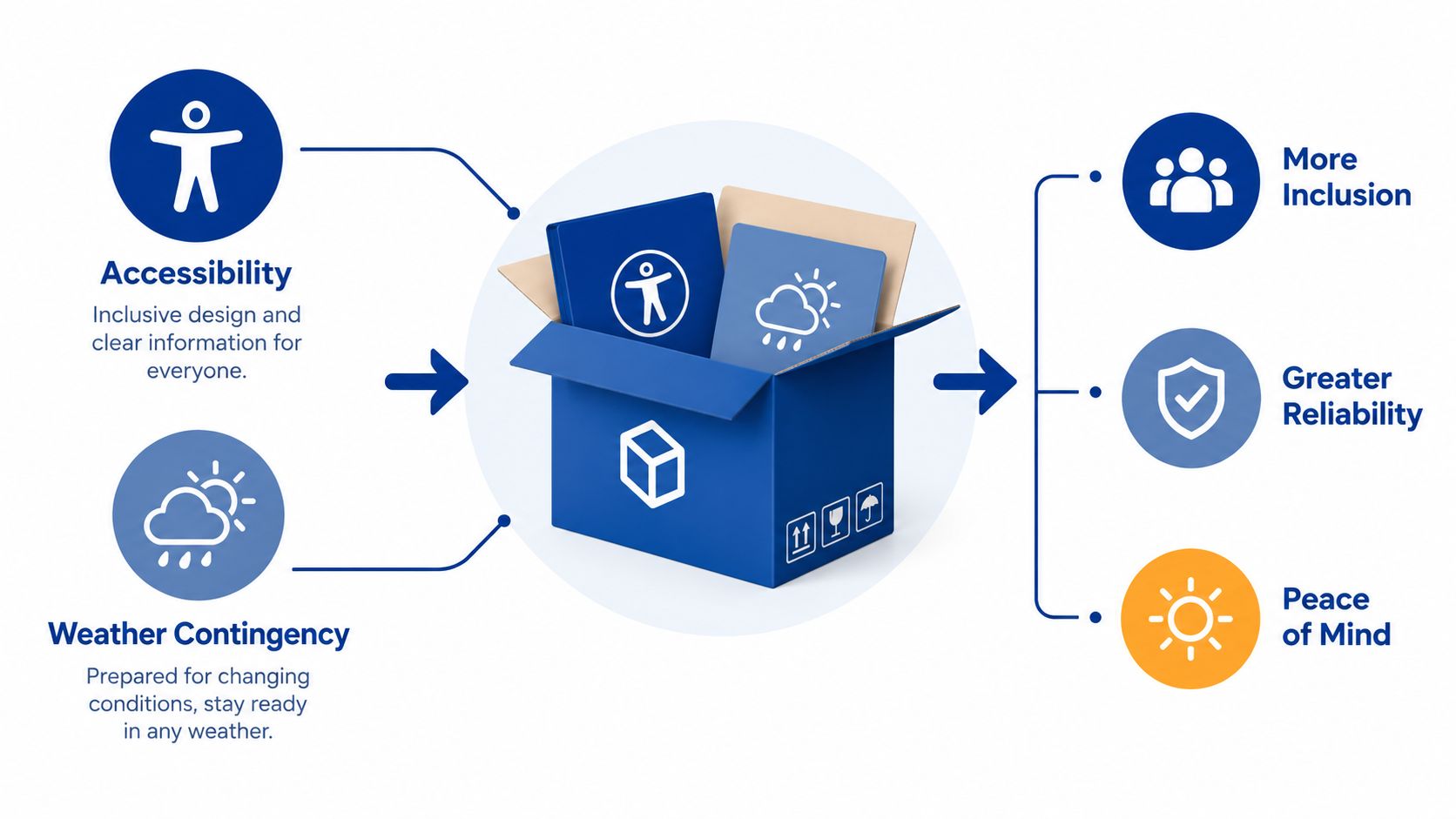
Accessibility and weather planning belong in the same conversation because both ask whether every guest can move safely and comfortably through the event. A venue that looks easy to get around on a sunny tour may become difficult when guests must travel between outdoor areas, indoor rooms, restrooms, dressing spaces, and parking during heat or storms.
Ask for a route map, not a verbal assurance. Trace the path from accessible parking to the ceremony, reception, restrooms, dressing areas, bars, and photo locations. Check whether each route is step-free, whether the surface is stable, and whether guests can avoid long exposure to rain or extreme heat.
Put the backup plan in writing
An outdoor ceremony is not automatically a simpler ceremony. It becomes a reliable option only when the package defines the decision deadline, backup room, guest capacity, sound coverage, furniture movement, vendor load-in, climate control, and communication responsibilities.
The contract or event plan should answer:
- Who makes the weather call?
- When must that decision be made?
- How much time is available for the room flip?
- Where do guests wait during the transition?
- Will the indoor space fit the ceremony and reception requirements?
- How will musicians, microphones, photography, and catering adapt?
- Who tells the wedding party, guests, vendors, and transportation providers?
For practical planning around a disrupted outdoor event, review what to do if it rains on your wedding day. The point is broader than rain. Heat, smoke, mud, wind, and sudden storms can all turn an attractive outdoor plan into a transportation and accessibility problem.
Operational test: If the venue can't explain the weather flip as a sequence of people, rooms, equipment, and decisions, the backup plan isn't finished.
A Hill Country property may include tended grounds, streams, and uneven natural surfaces. That setting can be beautiful, but the package should also document accessible routes, indoor alternatives, sound coverage, and the manager's role in executing the change.
Questions to Ask Before You Sign Any Venue Package
Bring these questions to the tour and write the answers into the proposal or contract. A verbal promise is difficult to price and even harder to enforce after the wedding date is reserved.
Rental terms
- What exactly is exclusive? Clarify the rooms, grounds, parking, ceremony site, and vendor areas included.
- What are the access boundaries? Confirm load-in, guest entry, event end, cleanup, and final exit times.
- What does overtime cost? Ask whether the charge applies to guests, vendors, cleanup labor, or all of them.
Inclusions and staffing
- Which furniture counts are guaranteed? Request tables, chairs, bars, ceremony seating, and setup responsibilities in writing.
- Who manages the event operation? Confirm whether an on-site manager is present and what decisions they can make.
- Is cleanup and furniture breakdown included? Identify whether that means venue trash removal, vendor cleanup, room reset, or all three.
Vendors and money
- Can we choose our caterer and beverage team? Confirm approved bartenders, alcohol rules, insurance, kitchen access, and corkage.
- Which charges are included in the quoted price? Separate taxes, gratuity, service charges, security, cake cutting, and outside-vendor fees.
- What happens if our plan changes? Ask for the financial effect of a guest-count change, schedule change, caterer change, cancellation, or postponement.
For payment timing and budgeting structure, review venue payment plans alongside the actual contract. A payment plan can make installments easier to manage, but it doesn't replace a clear total price, cancellation policy, or written list of what remains outside the package.
How Texas Old Town's Package Model Fits This Framework
Texas Old Town offers four private venues on a 55-acre Hill Country property in Kyle, Texas. Tejas accommodates up to 320 guests, Sage and Stone up to 300, and Redbud up to 150, according to the Texas Old Town venue overview. Choose the hall by usable floor plan and guest experience, not by the package headline alone.
The operating terms deserve close review. The package includes an 16-hour rental window from 8:00 a.m. to midnight, indoor and outdoor ceremony options, climate-controlled reception halls, indoor and outdoor PA systems, dressing suites, private parking, tables and chairs based on published counts, on-site management, cleanup, and furniture breakdown. Couples may choose their caterer. Beverages can be host-provided through an approved bartending company.
What the pricing model answers
Quoted prices include sales tax and gratuity, removing two common gaps from the initial comparison. Texas Old Town also offers personalized payment plans, a curated preferred-vendor list, and a flexible vendor policy. Place each item in your worksheet under included, optional, or required before comparing proposals.
Then convert the quote into a true all-in cost per guest. Add the venue fee, required services, catering, beverages, decor, photography, entertainment, transportation, and any other event costs. Subtract nothing unless the contract confirms the item is included. Divide that total by your expected guest count. A $5,000 rental and an $8,000 package cannot be compared fairly until both figures include the same costs and are divided by the same guest count.
Confirm the furniture layout, catering scope, beverage quantities, decor, photography, entertainment, guest transportation, and final timeline in writing. The package saves coordination only when responsibilities are assigned clearly between the venue team and your vendors.
The final test is practical: does the package support your guest count, ceremony plan, access needs, weather backup, vendor choices, and total budget? If the contract answers those points, you are comparing a defined wedding operation rather than a room with attractive marketing copy.