You're standing on a Hill Country property with a glass of iced tea in one hand and a venue brochure in the other, trying to decide whether the place feels ready for your event or just dressed up for the tour. The tables look right. The ceremony lawn looks great in photos. Then you start asking key questions, and that's where the difference between rustic and run-down becomes obvious.
Western themed venues are selling more than a look. They're selling a setting that has to hold up under heat, crowds, vendors, grandparents, kids, music, food service, and the kind of timeline that gets messy fast if the property isn't built for it. If you're booking a wedding, quinceañera, corporate offsite, or milestone party, the details that matter most are the ones nobody puts on a mood board.
Table of Contents
- Why Western Themed Venues Need a Second Look
- The Market Context Buyers Should Understand
- What Climate Control Actually Means in a Western Venue
- Why Climate Control Matters for Weddings and Special Events
- The Buyer Checklist for Climate, Layout, and Logistics
- Matching Ceremony Format to Venue Layout
- How Western Venues Scale Across Event Types
- The Real Signal of a Serious Western Venue
Why Western Themed Venues Need a Second Look
A couple tours a Hill Country property and falls for the pine tables, the lanterns, and the ceremony lawn. That reaction is normal. The mistake is stopping there, because the prettiest room in the brochure is not always the room that can handle your guest count, your weather, your timeline, or your vendor team without drama.

Western themed venues work when the theme supports the event, not when the theme becomes a liability. Couples, quinceañera families, corporate planners, and milestone hosts all run into the same question in different ways: can the property deliver the event, or does it only photograph well?
Rustic is not the same as unfinished
People use “rustic” as if it automatically means charming. Sometimes it does. Sometimes it means poor circulation, awkward load-in, no backup ceremony space, and a staff that hopes the weather cooperates.
A serious western venue solves problems before guests see them. The reception hall stays comfortable, the ceremony plan has a backup, the vendor path is clear, and cleanup doesn't hijack the next morning. That's not a luxury list. It's the difference between a smooth event and a room full of people asking why the music cut out or why they're sweating through dinner.
Who should care most
Everyone should care, but the pain points differ. A wedding couple worries about comfort, photos, and the ceremony backup. A quinceañera family worries about grandparents, court entrances, dancing, and vendor coordination. Corporate planners care about presentation, audio, branding, and a schedule that doesn't unravel when one session runs long. Milestone-event hosts just want the room to feel easy, not chaotic.
Practical rule: If a venue keeps talking about “vibe” but avoids questions about loading, temperature, and contingency plans, keep walking.
The right lens is simple. Theme gets people interested. Operations decide whether they stay happy. That's the standard you should use on every tour.
The Market Context Buyers Should Understand
Western themed venues are not competing in a cute little niche. They sit inside a crowded event market where operators win bookings by being flexible, not just photogenic. Industry compilations show a large global venue market with North America holding a major share, and that matters because buyers can choose from properties that do much more than one type of celebration Zipdo's event venue industry statistics.
That same compilation points to roughly 100,000 event venues in the U.S., with weddings leading bookings, followed by corporate meetings and conferences, then social gatherings Zipdo's event venue industry statistics. The booking mix tells you what strong western properties already know. They need multiple halls, indoor and outdoor options, and vendor rules that let a planner build the event around the guest list instead of forcing every group into one rigid format.
Outdoor space is not a bonus anymore
Outdoor demand changed after the pandemic, and buyers should treat that as a permanent shift in expectations. Venue compilations reported a sharp increase in interest for outdoor spaces, which is why so many Hill Country properties pair ceremony lawns with climate-controlled reception halls Zipdo's event venue industry statistics. Guests want the open-air look, but they do not want dinner service, speeches, or dancing left at the mercy of the weather.
Western themed venues also ride a broader experiential trend. A 2025 industry roundup reported a jump in interest for ranch vacations and cowboy-core activities, along with stronger demand for ranch stays, cowboy-core experiences, and horseback-riding getaways Cincinnati.com press release. That does not mean every venue should turn itself into a tourist attraction. It does mean guests are paying for settings that feel immersive and deliberate, not just a decorated room with a western sign on the wall.
Buyers should expect serious western venues to compete like mainstream event real estate, because that is what they are.
What Climate Control Actually Means in a Western Venue
Climate control is not a wall thermostat and a polite promise. In a western venue, it is the system that keeps guests comfortable while the property still looks like a ranch, a barn, or a Hill Country retreat. That matters because these venues often mix open-air character with enclosed reception space. A tent gives atmosphere. A house gives control. A good venue takes the look of the first and the reliability of the second.
The four layers that matter
Start with HVAC, the part that heats and cools the room. If the reception hall cannot reach a comfortable temperature quickly, arrivals feel it first, then dinner service, then the dance floor.
Then check humidity control. Proper humidification and dehumidification protect comfort, flowers, paper goods, wood finishes, and anything else that reacts badly to sticky air or overly dry air. Ask about ventilation too, because stale air and cooking odors can make a polished room feel tired fast. Finally, ask about zoning, which lets different spaces run at different setpoints instead of forcing the whole property to share one weak compromise.
A venue that handles all four layers well feels calm from the first guest arrival through cleanup. A venue that misses even one layer can make a beautiful room feel strained.
For a closer look at how system design affects event space performance, a good commercial AC installation guide is a useful reference. If you have ever wondered why some Hill Country properties stay usable in peak heat while others feel like they are losing the battle, the answer usually sits in the mechanical layer, not the decor.
The question to ask on tour
Ask, does the reception hall have its own thermostat, or does it share a unit with the ceremony space? That one question tells you more than a polished brochure ever will.
Then ask how the venue handles guest comfort during Texas heat. The Texas Old Town heat guide is a useful example of how seriously timing, airflow, and room planning have to be taken in this weather.
Why Climate Control Matters for Weddings and Special Events
Book the wrong room on a hot day, and you spend the whole event managing complaints instead of hosts and timelines. Jackets come off, guests head outdoors to cool down, and the room loses energy before dinner even ends. Book a room that runs too cold, and you get stiff shoulders at the table, food cooling faster than it should, and a crowd that stops relaxing.
Comfort affects the whole timeline
A serious reception hall should hold a 68 to 72°F setpoint without bouncing around every time the doors open or the dance floor fills up. That range works for formal wear, movement, speeches, and a crowded floor. Relative humidity should stay around 40 to 55%, because that keeps the room comfortable and helps protect décor and materials from air that feels sticky or overly dry.
That control matters for flowers and cake too. Humid rooms shorten the useful life of delicate arrangements, and warm air makes frosting and texture harder to manage. Poor ventilation creates stale pockets around buffet lines and serving stations, which makes plated dinners and self-serve setups feel rushed and messy.
AV and flooring are easy to forget until they fail
Sound and video gear need steady airflow. Projectors, speakers, mixers, and wireless systems behave better in a room that stays cool and does not trap heat. Wooden dance floors also react badly to moisture swings, and a venue that cannot hold humidity steady can turn a polished floor into a problem before guests notice anything is wrong.
Attire planning matters here too. Coordinated outfits look and feel different once the room turns hot, cold, or damp. If you are sourcing wedding apparel for groups, the venue still has to support the clothing. Good clothing helps. A bad room still ruins comfort.
A climate-controlled hall protects the meal, the music, the photos, and the guests who are most likely to leave early if they feel miserable.
The Buyer Checklist for Climate, Layout, and Logistics
The worst tours are the ones where the seller keeps talking while you forget to ask about the stuff that can wreck the day. Use the tour to pressure-test the venue, not to admire it. If the answers are vague, that's the answer.
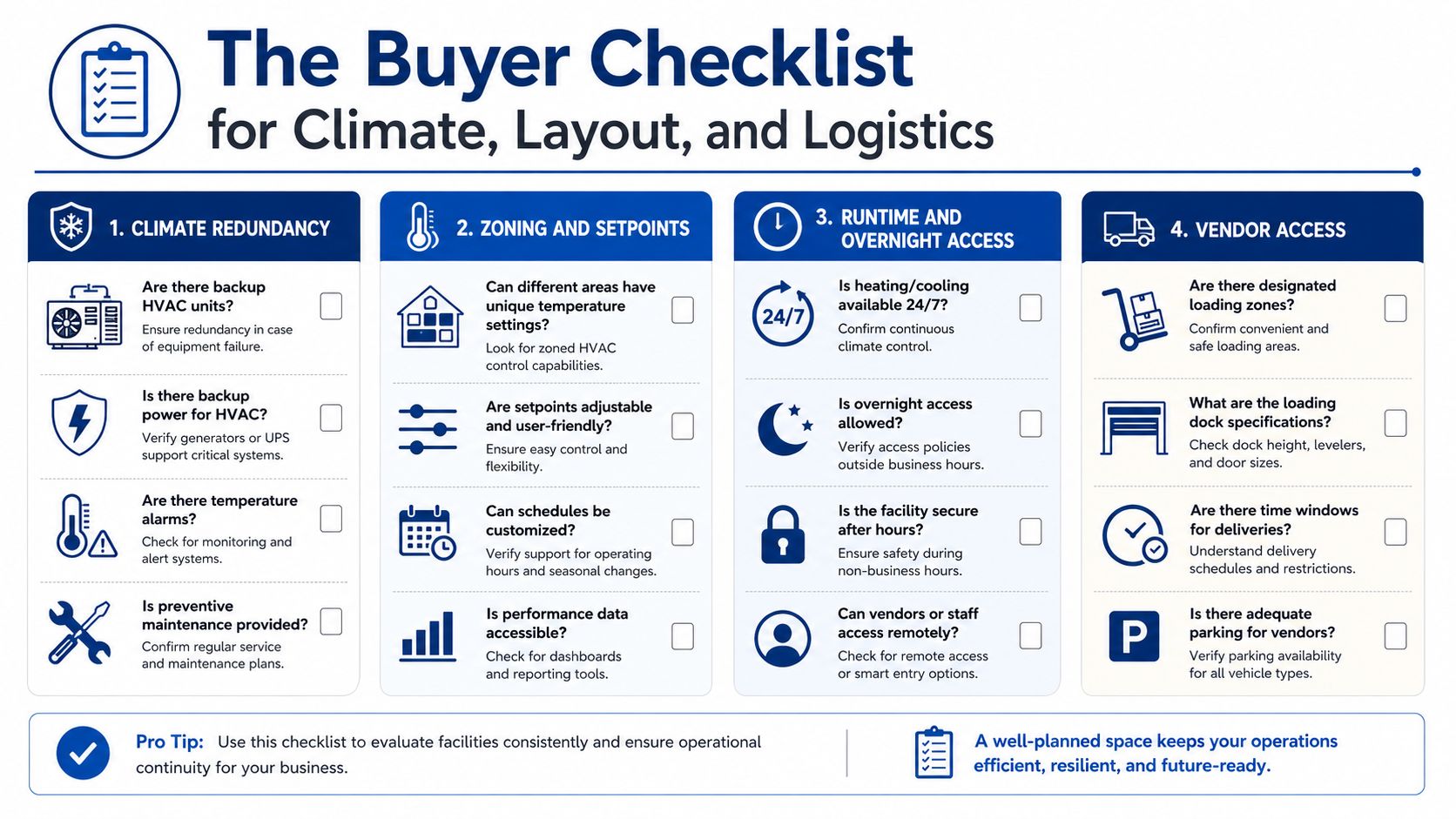
Climate redundancy and setpoints
Ask, What happens if the power flickers? That reveals whether the property has backup planning or just confidence. Ask whether the reception hall and ceremony space can be controlled separately, and whether staff can adjust the room quickly if the guest count is bigger or the weather shifts.
If a venue dodges the question, they probably don't have a clean answer. That's a red flag, especially for summer events.
Runtime, access, and vendor freedom
Ask whether heating and cooling are available for the entire rental window, not just during the ceremony or dinner. Ask about early vendor load-in, late-night breakdown, and overnight access for décor removal or secure storage. Then ask the blunt question, Can we choose our own caterer, and what vendors are restricted?
That last one matters because hidden vendor rules often create more friction than the room itself.
Accessibility and cleanup
Ask how far grandparents or guests with mobility concerns have to walk from parking to the ceremony site. Ask whether the restrooms are easy to find, whether the route is covered if weather turns, and whether the floor plan allows smooth movement between dining, dancing, and exits.
The Texas Old Town indoor outdoor event space page is a solid example of why buyers compare more than just décor. A venue can look authentic and still fail if the layout, access points, and transition spaces don't work for real people.
Bring this to every tour:
- Backup climate plan. Ask what happens if a unit fails during guest arrival.
- Separate room control. Ask whether one thermostat runs the whole property.
- Vendor policy. Ask which vendors are required, preferred, or restricted.
- Parking and access. Ask how guests, caterers, and rentals move in and out.
- Cleanup timing. Ask who breaks down tables, chairs, and décor, and when.
Matching Ceremony Format to Venue Layout
The prettiest ceremony setup is useless if it doesn't fit your guest profile. Indoor, covered outdoor, and open-air lawn ceremonies each create a different event-day experience, and the right choice depends on age mix, weather tolerance, audio needs, and how formal the celebration is supposed to feel.
Indoor ceremonies work when certainty matters
Indoor ceremonies are the safest choice for older guests, children, and events with tighter timelines. They're also the easiest setting for microphones, sound checks, and consistent lighting. If you want clean audio for vows, entrances, and announcements, indoor space usually gives you the fewest surprises.
A property with a layout like Texas Old Town's four-hall campus and outdoor ceremony sites shows why flexibility matters. When one campus can shift between rooms and settings, the planner isn't forced into a single answer on weather day.
Covered outdoor spaces split the difference
Covered spaces are the practical middle ground. You still get the western look, the natural light, and some breeze, but you're not betting the entire ceremony on perfect weather. This format works well for family-heavy guest lists, especially when you know some people want the outdoors but not the full exposure.
You still need to ask about sound coverage and power access for microphones. If guests can't hear the ceremony or the officiant has to fight ambient noise, the photo looks better than the experience feels.
Open-air lawns are for specific guest profiles
Open-air lawns are beautiful, but they demand a tolerant crowd and a venue with a real backup plan. They work best when the weather is stable, the guest list is mobile, and the couple wants the surroundings to drive the visual tone. They are not the default choice for a formal event just because the view is strong.
A serious venue will tell you exactly how the move works if weather changes. “We'll move inside if it rains” is not a plan. It's a promise that still needs details.
How Western Venues Scale Across Event Types
Western themed venues succeed when they act like adaptable event campuses, not single-purpose backdrops. A room that works for a wedding reception should also be able to handle a quinceañera entrance, a corporate dinner, or a retirement party without forcing the host to rebuild the whole event around the building.
Different events need different room behavior
A wedding needs clean transition space, bridal party prep, and a dance floor that doesn't feel cramped once dinner ends. A quinceañera needs room for the court, family seating, and a grand entrance that feels ceremonial rather than improvised. Corporate planners need AV that behaves, breakout-friendly space, and a layout that doesn't sabotage presentations.
Milestone birthdays and retirement parties are less formal on paper, but they often have the hardest guest mix. You can have teenagers, grandparents, and coworkers all in the same room, which means accessibility, circulation, and temperature all matter more than a themed backdrop.
Adaptability beats rigid styling
The strongest western venues are the ones that give you options without making the property feel generic. Multiple halls, dressing suites, flexible vendors, and on-site management let the event adapt to the guest list instead of forcing the guest list to adapt to the room. That's the difference between western as a design language and western as a one-note wedding niche.
If you're comparing properties, ask whether they can host the same family in three different event formats without changing the operational playbook. That's the ultimate test.
A venue that serves weddings, quinceañeras, corporate offsites, and milestone events well is telling you something important, it's built for people, not just photos.
The Real Signal of a Serious Western Venue
A serious western venue shows its value before the first guest arrives. The parking is clear, the entrance flow makes sense, the room stays comfortable, and staff already know where vendors load in and where the family should wait. A property that gets those basics right is usually safer, calmer, and easier to run than one that only photographs well.
The strongest test is operational. If a venue can handle a wedding, quinceañera, corporate meeting, or milestone party without forcing the planner to improvise, that venue has real depth. If you are comparing options in Central Texas, start with Texas Old Town western venue options and judge how the property functions once guests, vendors, and timing all hit at once.
Climate control is the first thing I look at. I want to know whether the system holds the room evenly, whether doors and corridors create hot spots, and whether the venue has a backup plan if the weather shifts or the crowd gets larger than expected. A place can have the right western look and still fail the day if people are sweating through dinner or shivering during the ceremony.
Layout comes next. A good western venue gives you room for ceremony flow, dinner seating, dancing, and guest movement without making one part of the event steal space from another. Ask how the space handles grandparents, children, wheelchair users, and vendors carrying equipment at the same time. If the answer is vague, the room will create friction later.
Logistics matter just as much as décor. You want vendor access that does not cut across guest areas, clear rules for setup and teardown, and staff who can explain how the timeline functions. If the venue expects the family to solve those problems on event day, keep looking.
One more practical check, ask how the property supports photos and video without getting in the way of the event itself. Strong venue images only help if the space works under real conditions, and the digital pro photography guide is a useful reminder that lighting, angles, and timing all depend on how the venue functions during the day. The right western venue gives photographers room to work and still keeps the event moving.
That is the actual signal. A serious western venue is not the one with the most rustic props, it is the one that competently handles temperature, layout, vendors, and guest comfort without making those details visible to everyone else.